

This policy brief is based on IMF Working Paper No. 2026/053. The views expressed are those of the authors and do not necessarily represent the views of the IMF, its Executive Board, or IMF management.
Abstract
Europe’s defense spending is undergoing a historic shift. With NATO members expected to reach 2% of GDP and discussions underway to increase targets to 5% by 2035, this paper examines the possible macroeconomic consequences of such rearmament using two complementary approaches. First, using an annual panel dataset covering 27 EU countries over the period 1989–2023, we show that past national defense spending has stimulated economic activity in the short term, and entailed sizable cross-border spillovers. Importantly, we find that spending multipliers varied considerably across countries and over time: they tended to be larger when import intensity is low, fiscal space (captured by sovereign yields spread) is ample, and public investment efficiency is high. Second, a novel high-frequency dataset of monthly defense procurement contracts from Opentender, covering EU-27 countries from 2009 to 2023, allows for improved causal identification using fiscal news and instrumental variables based on European aggregate defense procurement and each country’s geographic proximity to major adversaries. The estimates corroborate the positive effects of defense spending on output and show that equipment procurement has the strongest relative impact. Given the larger and more synchronized nature of the current European defense buildup relative to past national episodes in our sample, multipliers might fall below historical estimates, especially if monetary policy is not accommodative.
After a decades-long decrease in average military spending, Europe is rearming. Defense outlays among European Union (EU) member countries increased by about 30 percent between 2021 and 2024, with further increases expected to meet NATO targets. Given the size and persistence of this spending, it is likely to carry significant macroeconomic consequences for the region. Drawing on a recent working paper by Furceri et al (2026), this brief explores: (a) what are the expected impacts on GDP of defense spending from a historical perspective? (b) is the impact heterogeneous across countries? (c) are there spillovers into other countries from higher military spending? (d) and does the composition of spending matter for the overall impact?
Our dataset combines macro-level data from national accounts and detailed micro-data from all procurement contracts in the EU-27 countries. To strengthen the analysis, we exploit the fact that countries closer to potential military threats tend to spend more on defense, using this geographic variation as a natural experiment.
Following the approach in Ramey and Zubairy (2018), we estimate how much each euro of defense spending has boosted GDP over time (the so-called defense multiplier), controlling for other fiscal variables, past economic performance, and the presence of armed conflicts.
We find a positive and persistent impact of defense spending on output, starting with a multiplier of about 1.3 on impact, and reaching 1.9 two years after the defense spending shock. These numbers are consistent in our both macro- and micro-level data (using the instrumental variable approach in the latter case). Our estimates of the multiplier are the literature on local multipliers (Chodorow-Reich, 2019; Nakamura and Steinsson, 2014; and Gabriel et al., 2023) as well as recent findings on defense spending in European countries (García-Serrador et al., 2025; Ben Zeev et al., 2025).
Figure 1. Output cumulative multiplier
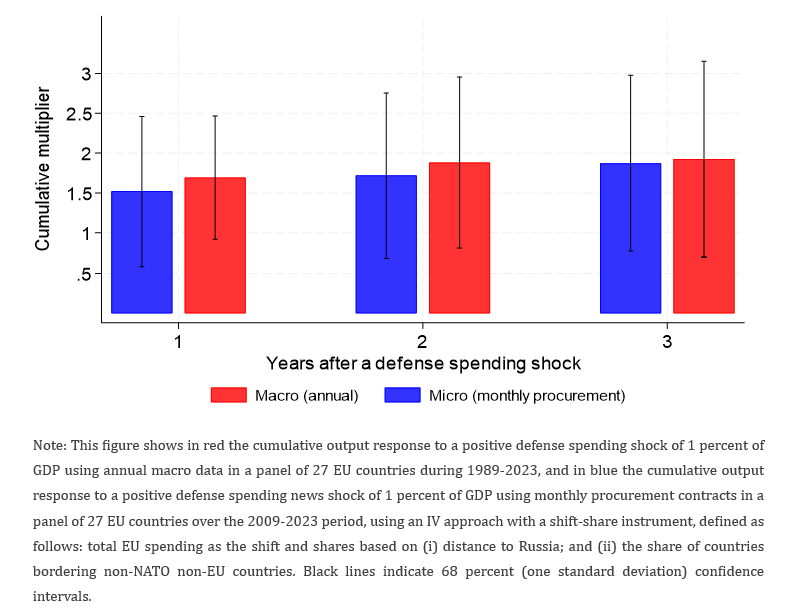
Several factors may explain why these multipliers exceed one, notably that most countries in our sample operate within a currency union or a de facto fixed exchange rate regime. This can amplify fiscal multipliers by limiting exchange rate adjustments and monetary policy offsets. In fact, we find that prices went up, but short-term interest rates tended to fall and the real exchange rate to depreciate as countries increased defense spending, indicating there was no tightening of monetary policy as a response to higher spending. This implies that given the larger and more synchronized nature of the current European defense buildup relative to past national episodes in our sample, multipliers might fall below historical estimates, especially if monetary policy is not accommodative.
The estimates abovementioned mask significant heterogeneity across countries. We find that:
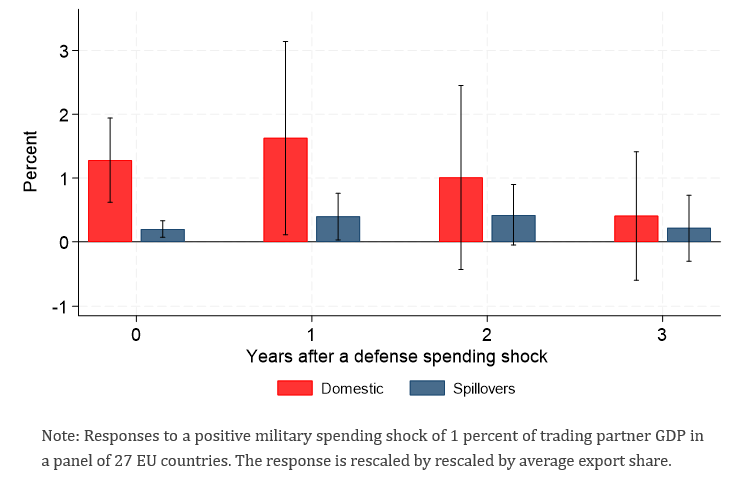
Given the high degree of economic integration and trade within the European Union, a natural question is whether defense spending generates cross-country spillovers. We find that a defense spending shock of 1 percent of trend-GDP increases total imports of goods and services by about 2 percent of trend-GDP, with intra-EU and extra-EU imports each increasing by roughly 1 percent of trend-GDP. Imports of arms also increased by about 50 percent, highlighting military spending as an important channel through which defense spending spills across EU countries. In addition, when a country’s trading partners ramp up defense spending, the benefits ripple outward: a 1 percent of trend-GDP increase in defense spending in trading partners leads to a 0.2 percent boost in GDP on impact, increasing to 0.4 percent two years later.
Figure 2. Domestic vs. Spillover Effects
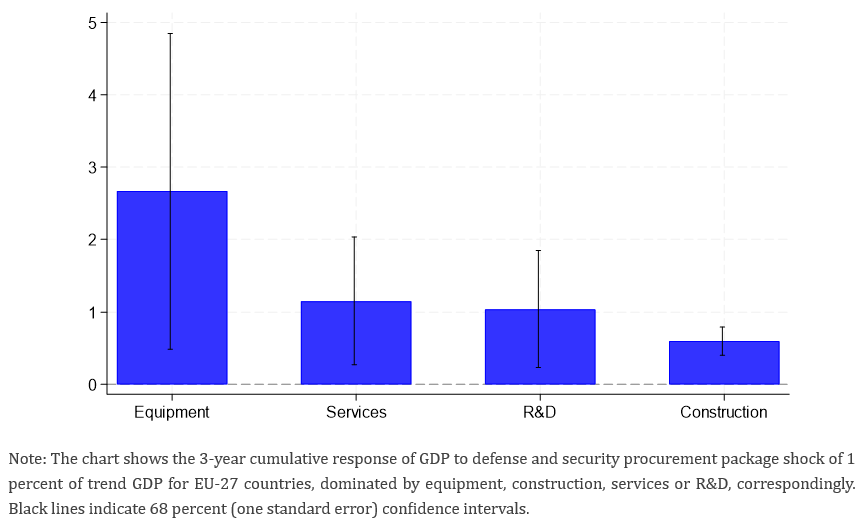
Finally, we test whether expense composition affects output using a novel high-frequency dataset of monthly procurement contracts across Europe, disaggregated by nation and 8-digit sector. Using the European Commission’s definition of defense and security sectors, we classify defense procurement expenditure into four categories:
Examining different spending categories, we find that packages dominated by equipment have the largest impact on output, peaking above 2. This supports Ramey and Shapiro (1998), who show that defense buildups strongly stimulate equipment-intensive industries, durables, and capital goods, generating broad sectoral spillovers. These effects likely arise from forward supply chain linkages and increased capital accumulation, which boost productivity. In contrast, services- and R&D-based packages produce more modest effects during the analyzed period, while construction-based packages have the smallest impact.
Figure 3. Heterogeneity by Defense and Security Procurement Subcomponent
Europe’s defense buildup is likely to support output in the short-term, not only domestically but also across borders through trade linkages. Yet the payoff varies widely: it is larger where fiscal space is ample, import leakages are low, public investment is efficient, and procurement is tilted toward equipment. These findings suggest that policymakers should complement higher defense outlays with measures that strengthen domestic and intra-EU production capacity, improve procurement and investment efficiency, while preserving credible medium-term fiscal frameworks.
Auerbach, A. J., & Gorodnichenko, Y. (2013). Output spillovers from fiscal policy. American Economic Review, 103(3), 141–146.
Ramey, V. A., & Shapiro, M. D. (1998). Costly capital reallocation and the effects of government spending. Carnegie-Rochester Conference Series on Public Policy, 48, 145–194.
Ramey, V. A., & Zubairy, S. (2018). Government spending multipliers in good times and in bad: Evidence from US historical data. Journal of Political Economy, 126(2), 850–901.
Ben Zeev, N., Pappa, E., & Scola Gagliardi, E. (2025). The offensive power of defense news in Europe. CEPR Discussion Paper No. 20637.
Garcia-Serrador, A., Sarasa-Flores, D., & Ulloa, C. (2025). Buy guns or buy roses?: EU defence spending fiscal multipliers. BBVA Research Working Paper 25-06.
Furceri, D., Juarros, P., Mishra, S., Nguyen, A. D., Pessoa, A. S., & Sollaci, A. (2026). Macroeconomic Impacts of EU Defense Spending. IMF Working Papers 2026, 053 (2026), accessed 4/8/2026.