

This policy brief is based on Swiss Finance Institute Research Paper No. 24-80. The views expressed are those of the authors and not necessarily those of the institutions the authors are affiliated with.
Abstract
Why do banks lend some loans bilaterally and syndicate others? By combining the ECB’s credit registry (AnaCredit) and syndicated loan data (DealScan), we show that loan size alone does not adequately explain syndication. Banks with weaker capital buffers and less industry expertise are significantly more likely to syndicate a loan. Loans to riskier borrowers are also more likely to be syndicated. These determinants are stronger the larger the loan, and they compound each other. Syndicated loans carry spreads that are 57 basis points higher than comparable bilateral loans, and their pricing is much more sensitive to borrower risk. Crucially, firms with syndicated loans are no more likely to subsequently issue bonds than firms with large bilateral loans, contradicting the popular view that the syndicated loan market serves as a stepping stone to public debt markets.
When extending a loan, banks can act as the sole lender or share the loan with other lenders. Syndicated lending, where a lead bank arranges a loan and sells portions to participating lenders, is a large and growing market, estimated at over $1 trillion globally in 2021 according to Allied Market Research (2022). Despite its size, little is known about why some loans are syndicated while others are granted bilaterally.
Syndicated loans are a hybrid instrument: like bilateral loans, a lead arranger negotiates terms and screens and monitors the borrower; like bonds, the risk is spread across multiple lenders. This hybrid nature gives rise to two competing hypotheses about what drives syndication.
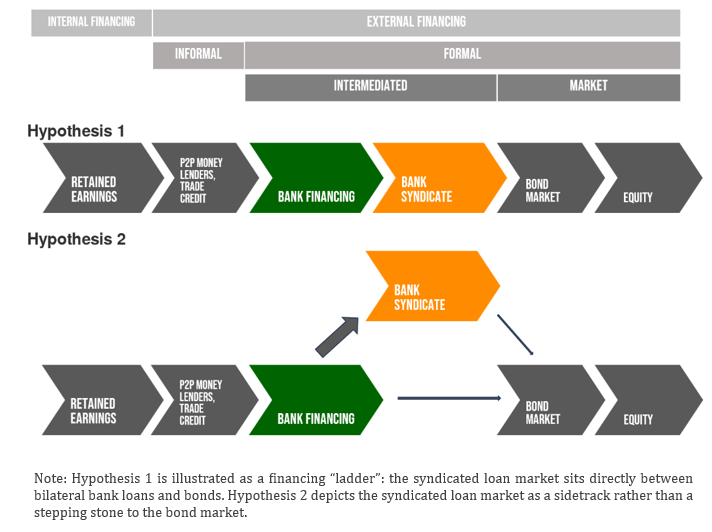
A large literature in corporate finance shows that firms with strong reputations and lower credit risk borrow in public bond markets, while riskier firms rely on monitored bank loans. Since syndicated loans sit between bilateral loans and bonds, a natural hypothesis is that syndicated loans serve as an intermediary step along a financing ladder: firms start with bilateral bank borrowing, graduate to the syndicated loan market as their riskiness decreases and their reputation grows, and eventually access the bond market.
Under this view, syndicated loan borrowers should be safer and more reputable than borrowers of bilateral loans. The syndicated loan market occupies a position between bilateral bank financing and the bond market in the financing hierarchy, as shown under “Hypothesis 1” of Figure 1.
A very different hypothesis views syndication not as a stepping stone for the safest borrowers, but as a tool for managing credit risk that a single bank cannot or does not want to bear alone. When a borrower is particularly risky, or when a bank lacks the capital or sector expertise to hold the loan confidently, forming a syndicate spreads the risk across multiple lenders. Under this view, syndicated loans should be associated with riskier borrowers, less capitalised and less specialised banks.
Under this view, the syndicated loan market is not a stepping stone to the bond market. Rather, it is a parallel route where banks place the riskiest exposures they cannot accommodate bilaterally (illustrated under “Hypothesis 2” of Figure 1).
By combining the ECB’s credit registry (AnaCredit) with syndicated loan data (DealScan) we observe both bilateral and syndicated lending by the same banks as well as the entire credit structure of firms, which allows us to put both hypotheses to the test. We find strong evidence for the second hypothesis, that is, syndication is a risk-management tool rather than a stepping stone to the bond market.
Figure 1. Two views of the syndicated loan market in the financing hierarchy
Our analysis identifies three key factors that drive a bank’s decision to syndicate.
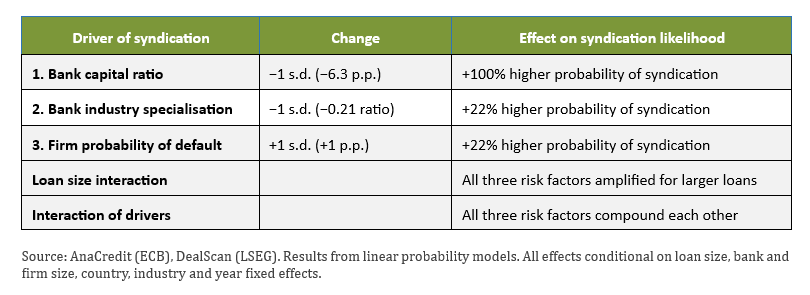
We find that less well-capitalised banks are much more likely to syndicate a given loan. A one standard deviation decrease in a bank’s capital ratio (about 6.3 percentage points) is associated with a doubling of the probability that the loan gets syndicated. The effect is stronger for larger loans: big loans demand large capital buffers, so undercapitalised banks are quickly pushed to seek partners.
A second driver is a bank’s expertise in the borrower’s industry. Banks that specialise in lending to a particular sector develop superior knowledge of the firms in that sector. We proxy this through the share of a bank’s loan portfolio directed to the borrower’s industry. We show that a one standard deviation decrease in banks’ industry specialisation for a given firm is associated with a 22% higher likelihood to syndicate the corresponding loan. Industry specialisation is a more important driver of syndication the larger the loan. In addition, we find that bank capital and industry specialisation are substitutes: a well-capitalised but less specialised bank may still grant a loan bilaterally, whereas a poorly capitalised bank needs industry expertise to do so.
The third driver is the risk of the borrower. Using banks’ own internal probability-of-default (PD) estimates, which are reported to AnaCredit, we show that a one standard deviation increase in a firm’s PD (around 1 percentage point) raises the probability of syndication by 22%. The COVID-19 pandemic provides a natural experiment: banks were 20% more likely to syndicate loans to firms in industries directly hit by the pandemic (hospitality, food service, real estate, and travel) during 2020–22, consistent with an increase in the perceived credit risk in those sectors.
The three drivers compound each other. A large loan to a risky borrower, made by an undercapitalised bank without sector expertise, is very likely to be syndicated. The same loan made by a well-capitalised, specialised bank will typically be kept bilateral.
Table 1. Drivers of Loan Syndication
The risk-management logic of Hypothesis 2 does not only explain whether a bank syndicates a loan (the “extensive margin”), but also how much of the loan it retains (the “intensive margin”). Less well-capitalised lead banks, banks with lower sector specialisation, and riskier borrowers are all associated with the lead bank holding a smaller portion. A one standard deviation increase in these risk factors is associated with a decrease in the lead share by 2-8%. This result holds after accounting for secondary market loan sales (using AnaCredit’s panel structure to observe what the lead arranger holds six months after syndication).
Thus, through both the extensive margin and the intensive margin, banks systematically match their total exposure to their capacity to bear risk.
Next, we compare the loan pricing of syndicated loans and bilateral loans. Conditional on a comprehensive set of controls, including loan seniority, callability, and firm risk, syndicated loans carry interest spreads that are 57 basis points higher than comparable bilateral loans made by the same bank. This premium is not explained by non-bank participation in syndicates, nor by reporting differences across data sources.
We also find a different sensitivity of the spread to borrower risk. A one standard deviation increase in borrower PD raises spreads by 21 basis points for bilateral loans, but by 39 basis points for syndicated loans. Thus, the syndicate is willing to accommodate riskier borrowers but prices this risk more sensitively.
We introduced two hypotheses at the outset: Hypothesis 1, in which safe and reputable firms use the syndicated loan market as a stepping stone to the bond market, and Hypothesis 2, in which syndication is a risk-sharing tool for banks unable to accommodate risky borrowers bilaterally. Having established that the drivers of syndication are in line with Hypothesis 2, we now directly test the bond market graduation prediction of Hypothesis 1.
We match our sample to first-time bond issuers (using data from Darmouni and Papoutsi, 2022) and find that the probability of graduating to the bond market is statistically identical for firms with syndicated loans and firms with large bilateral loans (0.2% in each case). Moreover, syndicated loan borrowers have systematically higher probabilities of default than bilateral borrowers and bond issuers — across all loan size categories.
These findings bring us back to Figure 1. The bottom row of that figure illustrates the two possible financing paths: the top path (Hypothesis 1) has Bank Syndicate sitting squarely in the ladder between Bank Financing and the Bond Market; the bottom path (Hypothesis 2) has firms moving directly from Bank Financing to the Bond Market, with the Bank Syndicate as a detour rather than a stepping stone. The data support the second path.
Ongena, S., Osberghaus, A. and Schepens, G. (2025), ‘Joining Forces: Why Banks Syndicate Credit’, Swiss Finance Institute Research Paper No. 24-80. Available at SSRN: ssrn.com/abstract=4943344
Darmouni, O. and Papoutsi, M. (2022), ‘The Rise of Bond Financing in Europe’, ECB Working Paper No. 2663.