

This policy brief is based on ECB, Working Paper Series No 3156. The views expressed are those of the author and do not necessarily reflect those of the European Central Bank.
Abstract
This paper studies how households adjust the quality of their purchases following adverse economic shocks and its consequences for inflation inequality. While shocks induce an overall shift toward lower-quality varieties, responses vary sharply by income: higher-income households systematically trade down in quality, whereas lower-income households exhibit little adjustment, consistent with being closer to a lower bound in their quality choice. This sudden and aggregate demand shift toward lower quality varieties has consequences for inflation: the price of low-quality varieties increases relatively more than those of higher quality. Therefore, when hit by adverse shocks, lower-income households not only have limited scope to substitute toward cheaper varieties but also experience higher relative prices for the varieties they consume.
Using detailed supermarket scanner data on purchases by German households between 2005 and 2018, this paper studies how households adjust the quality of the varieties they buy, and the implications this has for inflation risk over the business cycle. The key idea is that households can respond to income or economic shocks by switching to lower-quality (typically cheaper) varieties of the same products, thereby reducing their spending. However, this option may not be equally available to all households. In particular, households that already consume low-quality varieties before a downturn may have little room to adjust further, as they are already close to the bottom of the quality distribution.
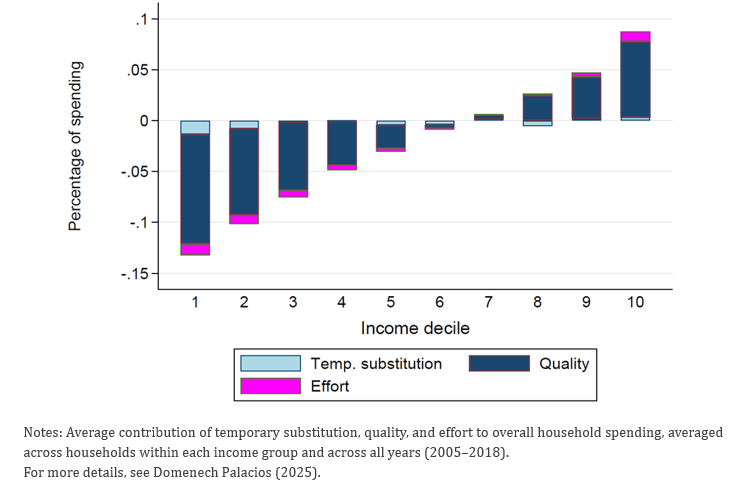
To this end, I first decompose household expenditures to understand households’ shopping patterns, with a focus on their quality choice. To do so, I follow Nord (2022), who decomposes household expenditures into three different components: the direct effect of shopping behaviour (the effort households put in their shopping by finding identical product varieties at lower prices, also referred to as within varieties variation); the differences in substitution among similar varieties of the same product category, or between varieties variation; and a counterfactual expenditure that measures the expenditure we would observe if all households purchased the same average quality variety of goods and at the average price. I further decompose the second term into temporary differences in the price of products, that is, temporary discounts (temporary substitution) and permanent differences in the price of different varieties, which I assume they summarise quality differences between varieties of a given product. I perform the decomposition at the household level, group households according to their income levels, and investigate the average contribution of each term in either increasing or decreasing the overall spending levels.
Figure 1 shows the magnitude of each term, relative to overall spending levels, for each income group. Search effort, temporary substitution, and quality choice help lower the overall level of spending of lower-income households. These contributions monotonically decrease with income, such that for income deciles 7 and above, these choices increase overall spending. For the lowest income group, the three components together decrease overall expenditures by around 13% on average, while for the highest income decile they increase overall expenditures by around 8% for a given consumption basket. The variation is mainly driven by quality choice, which plays a significantly larger role in determining overall household expenditures than the other two components.
Figure 1. Contribution to expenditure by income group
When the economy deteriorates, households respond by substituting toward cheaper or lower-quality varieties of the same goods. I investigate how this behaviour varies across income levels and whether it could shape the inflation experienced by different household groups. To do so, I study how the contribution of quality choice to lowering total household expenditures reacts to adverse shocks, either aggregate (during a recession) or idiosyncratic (for example, if a household member becomes unemployed). The more negative the response, the more households lower the quality of the varieties they purchase in order to reduce overall expenditures.
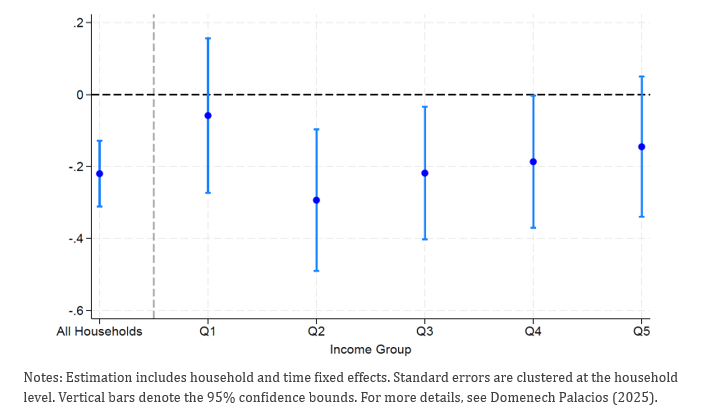
I document two main findings. First, on average, households respond to adverse shocks by reducing the quality of the goods they purchase. This is shown in the first column of Figure 2, which indicates that households reduce expenditures through quality downgrading by an additional 0.2 percentage points on average when hit by a recession. These results are aligned with existing evidence (see Jaimovich et al., 2019 and Cavallo et al., 2024), who also document expenditure switching towards cheaper varieties in bad times.
Second, this average response masks substantial heterogeneity across the income distribution. Higher-income households actively trade down in quality following income losses or recessions, whereas lower-income households exhibit little or no further adjustment along the quality margin. The remaining columns in Figure 2 present the results by income group. Notably, a subset of lower-income households (those at the lowest income group) does not appear to trade down in the quality of the varieties they purchase during economic downturns. Since these households already tend to consume lower-quality goods on average, they may lack access to this margin of adjustment when confronted with a negative shock. In contrast, middle- and higher-income households do adjust their purchasing behaviour under such conditions. In some instances, this trading down behaviour is not strongly observed for the highest-income households. One possible explanation is that these households may prioritize maintaining consumption quality for reasons related to habit formation, perceived status, or a relatively lower sensitivity to income shocks. These patterns also emerge when examining responses to idiosyncratic shocks (such as job loss) and are amplified when focusing on the period of the Great Financial Crisis.
These results suggest that a non-negligible share of households operate close to a lower bound in quality even in normal times, rendering this margin of adjustment largely unavailable during downturns. In contrast, higher-income households tend to reduce the quality of their purchases during bad times, effectively protecting their real consumption quantities by trading down to cheaper varieties.
Figure 2. Heterogeneous trading down
When a large share of consumers shifts demand toward low-quality goods, their increased popularity can push up the prices of these varieties relative to higher-quality alternatives. Consequently, the households least able to substitute (those with lower incomes) end up also facing higher relative prices for the products they already consume. This dynamic amplifies inflation inequality and contributes to the persistence of cost-of-living pressures at the bottom of the income distribution.
To study this, I investigate the causal effect of an aggregate demand shift toward lower quality varieties at the onset of the great financial crisis. To identify an exogenous demand shift, I implement a shift-share research design that exploits pre-crisis consumption patterns across sociodemographic groups and differential population growth during the Great Financial Crisis, an identification strategy that is based on that of Jaravel (2019). The results suggest that a 1% increase in aggregate demand for low-quality varieties due to trading down raises their relative prices by about 0.45% on average and by as much as 1.9% compared with high-quality varieties. These price responses imply that quality adjustment, while providing insurance for some households, can amplify inflation risk for others.
Argente, D. & Lee, M. (2021), ‘Cost of living inequality during the great recession’, Journal of the European Economic Association 19(2), 913–952
Cavallo, A. & Kryvtsov, O. (2024), ‘Price discounts and cheapflation during the post-pandemic inflation surge’, Journal of Monetary Economics 148, 103644.
Domenech Palacios, M. (2025), ‘Inflation Risk and Heterogeneous Trading Down’, ECB Working Paper No. 2025/3156, Available at SSRN 5807881
Jaimovich, N., Rebelo, S. & Wong, A. (2019), ‘Trading down and the business cycle’, Journal of Monetary Economics 102, 96–121
Jaravel, X. (2019), ‘The unequal gains from product innovations: Evidence from the US retail sector’, The Quarterly Journal of Economics 134(2), 715–783
Kaplan, G. & Schulhofer-Wohl, S. (2017), ‘Inflation at the household level’, Journal of Monetary Economics 91, 19–38
Nord, L. (2022), ‘Shopping, demand composition, and equilibrium prices’, Available at SSRN 4178271
Orchard, J. (2022), ‘Cyclical demand shifts and cost of living inequality’, Available at SSRN 4033572