

This policy brief is based on OeNB Working Paper No. 275. The views expressed are those of the authors and not necessarily those of the institutions the authors are affiliated with.
Abstract
This policy brief explores how international migration shapes trade by distinguishing between the extensive and intensive margins of trade. Using data on migration to OECD countries and bilateral trade with around 180 partner countries over the period 1995–2023, the analysis shows that migration is robustly associated with trade creation. This effect operates primarily through the extensive margin of trade: migrant communities are linked to the formation of new trade relationships and the introduction of new products, rather than to higher trade volumes within existing flows. The trade‑creating role of migration is strongest for smaller migrant communities and for trade involving lower‑income origin or destination countries. The findings are robust across alternative specifications and migration measures, highlighting migration as an important factor facilitating the exchange of new products and international trade integration.
International trade patterns reflect far more than prices, distance, and formal barriers to trade. They are also shaped by information, trust, and familiarity — factors that determine whether firms are willing and able to establish commercial relationships across borders in the first place. One of the most powerful carriers of such information are individuals. Migrants bring with them knowledge of foreign markets, institutions, business practices, and consumer preferences, creating links that connect economies beyond what conventional measures of trade costs such as distance or tariffs would predict.
The positive link between migration and trade is well established in economic literature. Countries tend to trade more with countries from which they receive migrants, and migrant networks are known to facilitate cross‑border exchanges. What remains less widely understood, however, is how migration shapes trade. Does migration mainly increase the volume of goods that countries already exchange, or does it help firms overcome the fixed costs of entering new markets and trading new products? This distinction matters. Expanding trade volumes along existing relationships is very different from creating new ones. Establishing a new trade link and trading new products requires firms to acquire information about foreign demand, navigate unfamiliar regulatory environments, and build trust with new partners. Understanding whether migration primarily affects this extensive margin of trade, rather than the intensive margin, therefore provides deeper insight into the channels through which migration contributes to economic integration.
This policy brief draws on new empirical evidence covering migration to OECD countries and bilateral trade with its trading’s partners over the last three decades. The analysis confirms that migration has a clear, positive effect on trade, but shows that it operates primarily through the extensive margin of trade — by enabling countries to start trading new products or establishing new bilateral trade links. Beyond this main result, the brief highlights important nuances: The trade creating role of migration is strongest for initial migrant communities and diminishes as diasporas grow larger. Effects are also more pronounced when origin or destination countries are less economically developed, a pattern consistent with the idea that migrant networks are particularly valuable where formal market supporting institutions might be less developed. Importantly, these findings are robust across alternative data sources and estimation strategies.
To examine how migration shapes trade, we combine comprehensive data on bilateral migration and trade flows over an extended period. The analysis focuses on migration to OECD countries and their trade with around 180 partner countries between 1995 and 2023.
Bilateral trade data are taken from the BACI database compiled by CEPII, which harmonizes detailed customs records reported by exporting and importing countries. The data are available at a highly disaggregated product level, making it possible to distinguish between different components of trade. Following the framework proposed by Hummels and Klenow (2005), that has also been used by Baier et al. (2014), among others, we decompose total trade flows into two margins: The extensive margin, which captures the scope of trade — that is, the range of products traded between two countries — and the intensive margin, which reflects the volume of trade within products that are already exchanged. This decomposition has become standard in the trade literature for studying how different factors affect market entry versus deepening of existing trade relationships. Migration data are sourced from the OECD International Migration Database (OECD.stat) and measure bilateral stocks of migrants residing in OECD destination countries.1 In the main analysis, migrants are identified based on citizenship, which offers the broadest and most consistent coverage over time. Alternative measures based on the country of birth are used to assess the robustness of the results.
Empirically, we rely on a theory-based gravity framework, which is the standard workhorse model for analyzing bilateral trade patterns. In this framework, trade between two countries is explained by the economic size of the trading partners and on trade costs, such as geographical distance or participation in trade agreements. Our approach extends the gravity model by incorporating migration stocks and by explicitly distinguishing between the extensive and intensive margins of trade, measured at the product-level.
A key challenge in this setting is that migration and trade may influence each other. To address this concern, we mainly exploit variation in migration regularization policies across OECD countries over time, using a novel dataset on regularization programs and eligibility requirements compiled by Elguezabal et al. (2025). These policies affect migration stocks by changing migrants’ legal status but are plausibly unrelated to short term trade developments. This source of variation strengthens the empirical identification of the relationship between migration and trade outcomes.
Our analysis shows that migration has a clear and robust trade creating effect. It is important to note, however, that this effect operates primarily through the extensive margin of trade — that is, by enabling countries to start trading new products or to establish new bilateral trade links. By contrast, once persistent bilateral relationships are considered, migration does not have a statistically significant effect on the intensive margin, i.e. on the volume of goods traded within existing product categories.
Chart 1. Migration increases trade. It affects the range of traded products (extensive margin) rather than the volumes of already traded products (intensive margin; insignificant coefficient estimate)
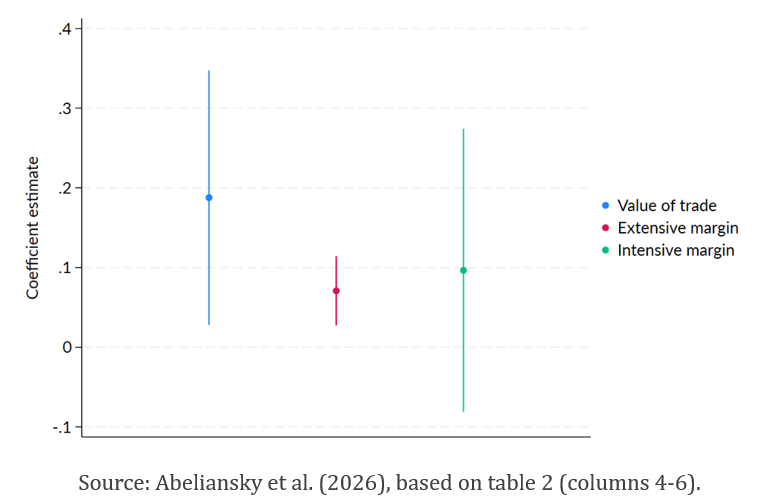
Quantitatively, a 10 percent increase in the stock of migrants residing in an OECD country is associated with a 0.7 percent expansion in the range of products imported from migrants’ countries of origin. When potential endogeneity is accounted for by using migration regularization policies, the estimated effect on the extensive margin becomes even stronger, while the effect on the intensive margin remains insignificant (see chart 1). This suggests that ignoring the two way relationship between migration and trade leads to an understatement of migration’s role in opening markets.
The statistical significance at the extensive margin is economically intuitive: Entering a foreign market with new products involves fixed costs related to information, trust, and regulatory familiarity. Migrant communities can help firms overcome these barriers by providing market‑specific knowledge and informal networks. Once these barriers are overcome and trade links are established, migration appears to play a more limited role in determining how much is traded.
Taken together, the results point to a clear conclusion: migration contributes to international trade mainly by broadening the scope of economic exchange and by diversifying the basket of traded goods, not by scaling up trade within already established relationships.
While migration has a clear average effect on trade creation, this effect is not necessarily uniform across contexts. For this reason, we are interested in exploring dimensions of heterogeneity, in particular non‑linearities in migrant stocks and differences by the income level of origin and destination countries.
Chart 2. Non-linear effect of migration on the value of trade: higher if bilateral migration is low
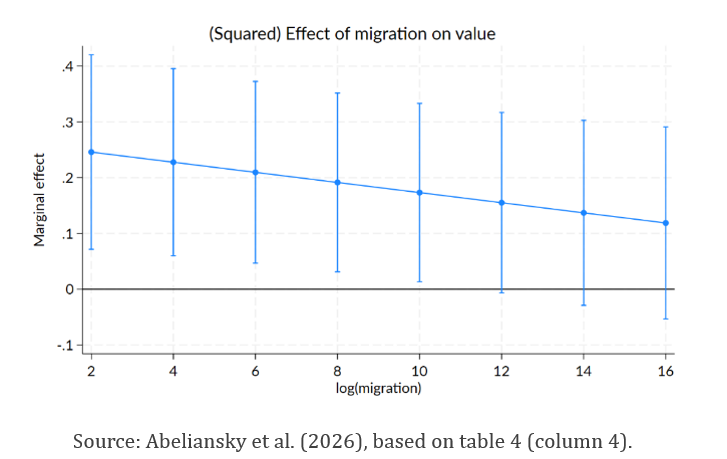
Chart 3. Non-linear effect of migration on the extensive margin of trade: higher if migration is low
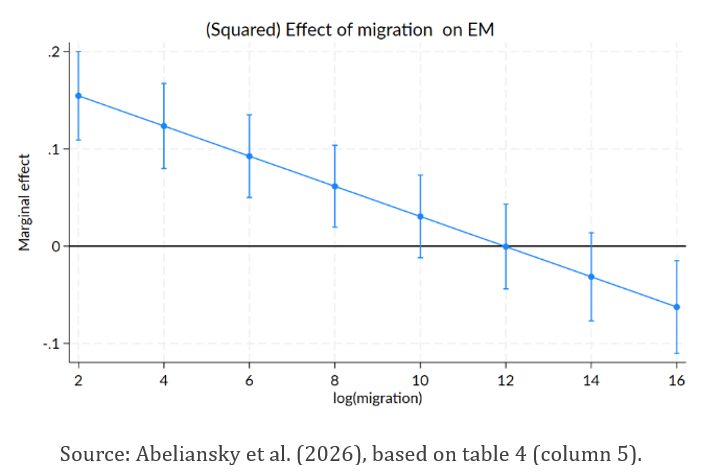
Charts 2 and 3 show the marginal effect of migration on the value of trade and on the extensive margin across different levels of migrant stocks when adding squared migration to the estimations.2 In both cases, the relationship shows to be non linear. At relatively low levels of migration, additional migrants are associated with large increases in trade. As migrant communities grow, however, the marginal effect declines. Most observations in the sample lie well below the estimated turning point, implying that migration remains trade enhancing for most country pairs, though with diminishing returns.
Our results further show that the trade creating effect of migration varies systematically with the level of economic development in both origin and destination countries. Migration is more strongly associated with trade along the extensive margin when either the country of origin or the destination country (or both) has a lower GDP per capita. As income levels rise, the marginal effect of migration on trade creation declines.
This pattern indicates that migration plays a particularly important role in trade relationships involving less economically developed countries. Such relationships are often characterized by higher informational barriers and greater uncertainty, conditions under which migrant networks are likely to be especially valuable in facilitating new trade links. Importantly, this heterogeneity persists even after accounting for long standing bilateral ties, suggesting that migration contributes to trade creation beyond enduring historical, cultural, or geographic connections.
The main results of this analysis are robust across alternative specifications, data sources, and identification strategies. In particular, the finding that migration is associated with trade creation primarily through the extensive margin remains stable when using different measures of migration, accounting for potential endogeneity, and controlling for persistent bilateral trade relationships. These conclusions are unaffected by alternative modeling choices, including specifications that allow for non‑linear effects and interactions with country characteristics. The robustness of the results also extends to the heterogeneity patterns discussed above. Although effect sizes vary across contexts, the qualitative conclusions remain unchanged.
This policy brief revisits the relationship between migration and international trade using new evidence that distinguishes between the extensive and intensive margins of trade. While the positive association between migration and trade is well documented in the literature, our analysis shows that how migration shapes trade deserves greater attention.
The central finding is that migration is associated with trade creation primarily through the extensive margin. Migrant communities are linked to the establishment of new trade relationships and the introduction of new products into bilateral trade, whereas effects on the volume of already traded goods are limited once long standing bilateral ties are considered. This pattern is robust across alternative specifications, migration measures, and identification strategies. Furthermore, the results indicate that the trade‑creating role of migration is not uniform: It is strongest for relatively small migrant communities, declines as diasporas grow larger, and is more pronounced when origin or destination countries are less economically developed. Across all these dimensions the extensive margin emerges as the dominant channel.
Taken together, these findings highlight the importance of viewing migration not only as a demographic or labor‑market phenomenon, but also as a factor shaping countries’ integration into global trade networks. By facilitating new market entry and increasing the variety of traded products rather than merely expanding existing trade flows, migration contributes to a broader and more diversified pattern of international trade.
Abeliansky, A., I. Martínez Zarzoso and A. Raggl (2026). Immigration and Trade Creation: Evidence from the Extensive and Intensive Margins. OeNB Working Paper, no. 275, Oesterreichische Nationalbank.
Baier, S. L., Bergstrand, J. H., and Feng, M. (2014). Economic integration agreements and the margins of international trade. Journal of International Economics, 93(2):339–350.
Elguezabal, P., Martínez-Zarzoso, I., and Nowak-Lehmann, F. (2025). Immigration as a trade facilitator: A review and new insights. Cuadernos Económicos de ICE, 109.
Hummels, D. and Klenow, P. J. (2005). The variety and quality of a nation’s exports. American economic review, 95(3):704–723.
Further control variables are included in the empirical analysis. See Abeliansky et al. (2026) for a description.
For the intensive margin, the results are insignificant.