

This Policy Note is partly based on ECB Working Paper No 3132. Thes note represents the authors’ own views and does not necessarily represent the views of either the ECB, De Nederlandsche Bank, or the Eurosystem. The authors would like to thank John Hutchinson and Daniela Arlia, Julika Herzberg, Aidan Meyler, Maarten Dossche and Romana Peronaci for helpful comments. Any errors or omissions are the authors sole responsibility.
Abstract
In this Policy Note we draw on recent data from the ECB’s Consumer Expectations Survey to analyse how consumers’ experiences of extreme weather events relate to their perceptions and expectations. Consumers’ personal experiences are associated with a deterioration in measures of their current and expected financial situation. Consumers also extrapolate from past experiences to future risks of being affected by extreme weather events. Such risks are in turn correlated with a deterioration in macroeconomic expectations (higher inflation and lower growth) and with a higher perceived need to put aside savings. We also find that, while consumers increasingly recognize the economic costs of climate change and its risks, support for specific policies underlying a green transition, such as higher taxes or public debt, remains mixed and varies substantially across demographic groups.
Climate change is accelerating, and climate-related losses have been increasing worldwide over the past decade.1
The summer of 2025 saw wildfires spreading across unprecedentedly large areas in Spain and Portugal thereby setting new records for the worst wildfire season in the EU.2 Academics and central banks increasingly work on assessing the implications of climate change and its mitigation for economic growth and inflation, monitor financial stability risks arising through extreme weather events, or study the interactions between climate change, and loss of biodiversity.3 These discussions naturally raise the question of what climate change means for households who make decisions on consumption and savings that can in turn impact the environment and the speed of transition to a green economy. The ECB’s Consumer Expectations Survey (CES) can help us to gain new insights on how climate change affects euro area households and their beliefs about the future.
In this policy note we draw on recent data to document consumers’ experience of extreme weather events that have impacted them financially and their expectations about the future likelihood of natural disasters. We also shed light on consumers’ preferences for policies that aim to tackle climate change.
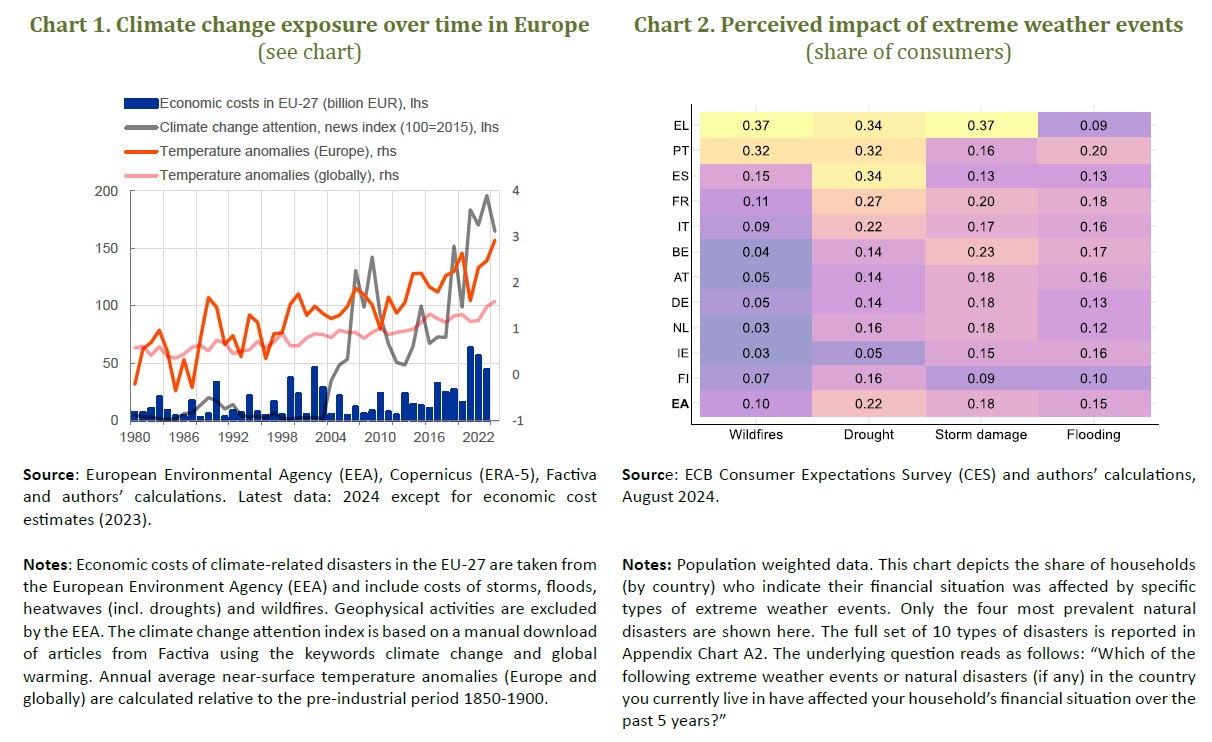
Climate change has gained increasing attention in the news over the past years as its consequences increasingly materialise. Europe is the fastest-warming continent in the world. Chart 1 illustrates this trend by showing a widening gap between the speed of global warming in Europe which outpaces the rest of the world.4 At the same time, economic damages from extreme weather events in the EU have been increasing over recent years.5
In recent research based on CES data, Georgarakos et al. (2025) show that many consumers are indeed well informed about the basic mechanisms of climate change answering, on average, 5 out of 7 climate-related knowledge questions correctly. They also show that three-quarters of consumers pay attention to climate change related news and many are quite concerned about its economic consequences (48 percent). In line with this, according to a recent Eurobarometer survey, the majority of consumers view climate change as a serious issue and, in the CES, consumers consistently rate the environment and climate change among the top policy priorities in their country with 24 percent rating it among their top three policy priorities.6
Climate change affects the severity and frequency of extreme weather events (IPCC 2023). CES data from 2024 provide additional evidence on the effect of such events on the financial situation of euro area households. In particular, a considerable fraction of consumers report to have been affected by extreme weather events such as wildfires (10%), droughts (22%), storms (18%) or floods (15%) over the past 5 years (Chart 2). Notably, not all countries are affected equally. Consumers in southern countries like Greece, Spain, Italy and Portugal are most hit among the surveyed countries.7
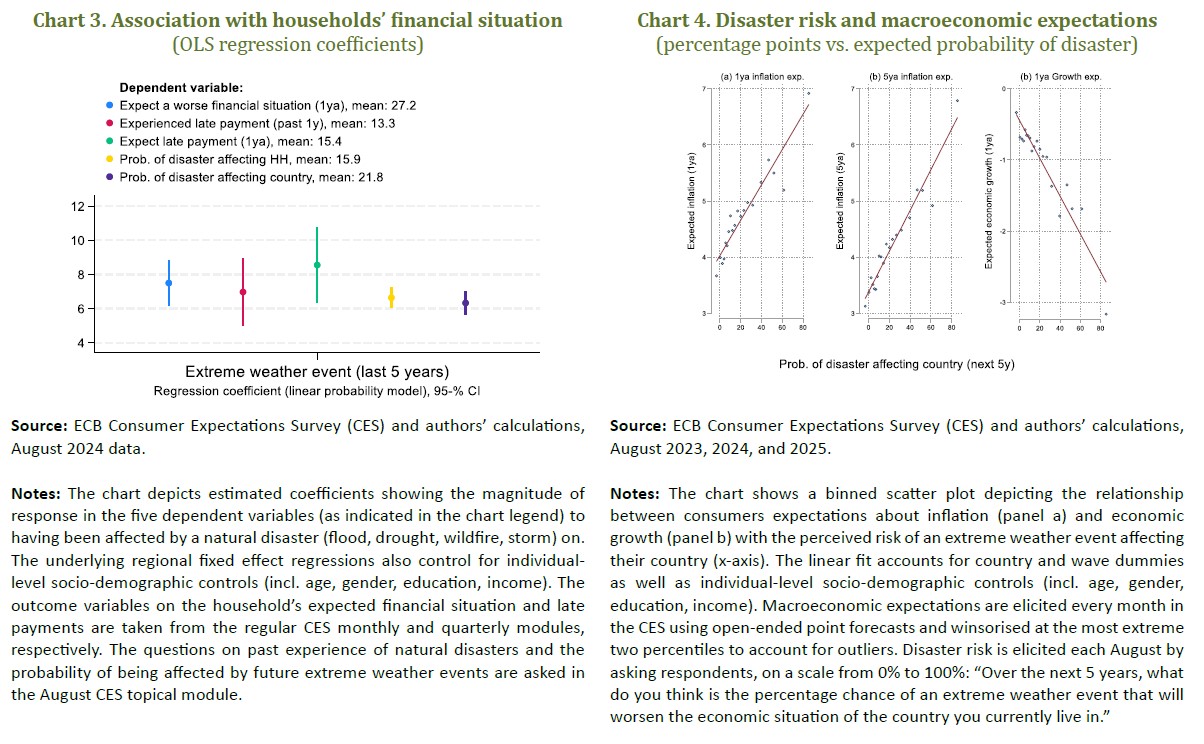
Further empirical modelling results confirm that these experiences can affect consumers’ broader financial outlook (Chart 3). The impact of past experiences is particularly reflected in worsening expectations for households’ own future financial situation and, consistent with this, a significantly higher current and expected share of delayed regular debt repayments.
Consumers who have already been affected by extreme weather events in the past also report significantly higher probabilities that they will be affected by such events in the future (see again Chart 3). This association is of similar size whether we look at the perceived probability of a future disaster affecting one’s country or one’s household, with effects of around 6 percentage points on both probabilities. The magnitude of these effects can be interpreted as relatively large since, on average, consumers assign a considerable likelihood of extreme weather events to affect their country (16.1%, median: 10%) and their household’s financial situation (22.1%, median: 15%) over the next five years.8
As shown in Chart 4, higher perceived risks of extreme weather over the next five years are further associated with higher inflation expectations and lower expected economic growth over the next 12 months. The positive correlation between the perceived probability that extreme weather events will affect the country and inflation expectations (net of country fixed effects and individual socio-demographic characteristics) is also observed at longer horizons of consumers’ inflation expectations (Chart 4, panel b). These findings highlight that households do not view climate risks as distant or transitory, but as relevant factors influencing their economic outlook already today.9 Consumers might thus anticipate disruptions in supply chains, agricultural production, and energy costs resulting from extreme weather.10 At the same time, households seem to expect weaker economic growth, consistent with the idea that more frequent natural disasters could weigh on investment, labour productivity, and overall economic performance.
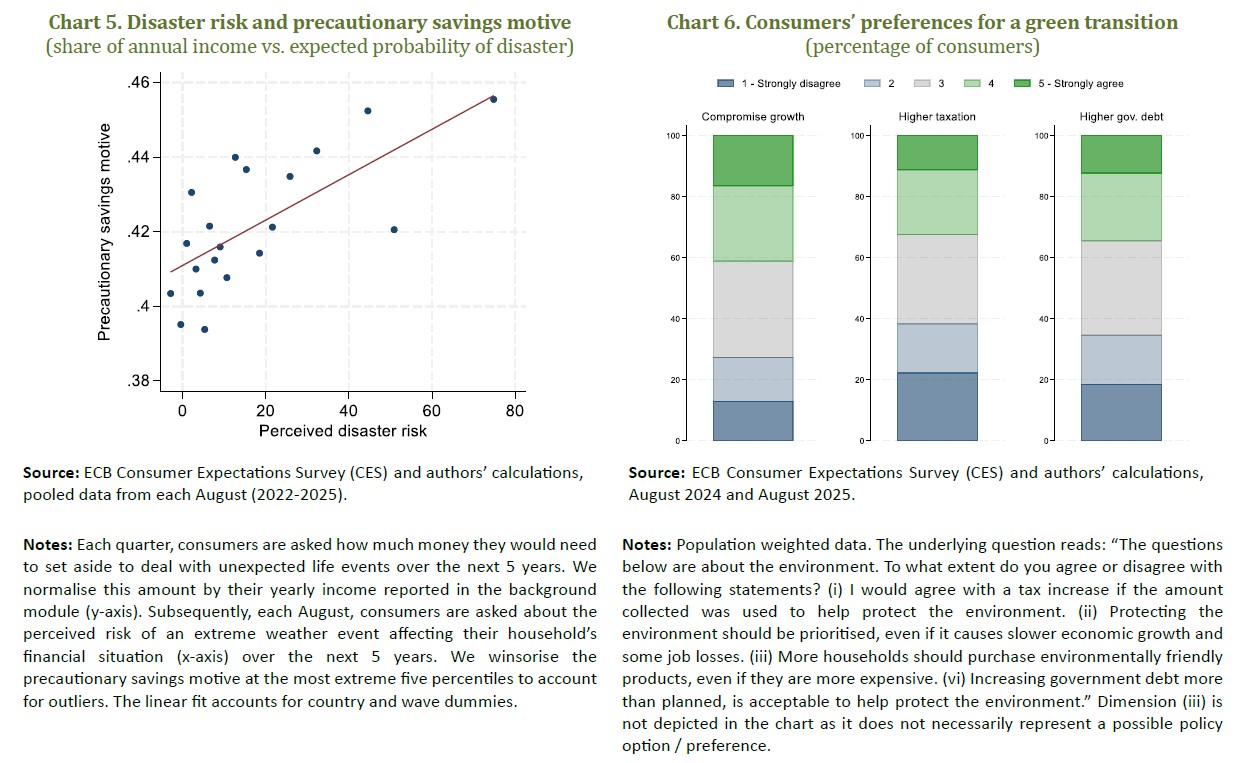
CES data also indicate that households who perceive higher climate disaster risks revise their precautionary savings motives upward (Chart 5). This correlation suggests that climate concerns might not only shape expectations about the economy but also translate potentially into changes in household financial behaviour.11 A heightened desire to put aside resources for unexpected shocks can dampen consumption and induce more precautionary savings, thereby contributing to weaker aggregate demand. Apart from consumption and savings decisions, however, consumers’ preferences and support for political measures are equally important to enable a smooth transition to a greener economy.
Ultimately, a wide support for policies that tackle climate change will be crucial to facilitate the transition to a green economy. Government policies aimed at fostering the green transition typically require significant investment that in turn may be financed by higher taxes. Yet, many households may be reluctant to carry the associated higher tax burden, which could slow down the green transition.
Each August, the CES elicits household preferences related to policies and the green transition. Respondents are asked about whether they agree or disagree with measures that aim to tackle climate change along a range of four dimensions. The elicited dimensions include (i) a preference of climate action as a priority over economic growth, (ii) a switch of household consumption towards more expensive green products (iii) higher taxation to finance the costs of climate change, as well as (iv) increasing government debt to finance climate-change-related expenditures (included since August 2024). Responses were classified on a scale ranging from “1 – strongly disagree” to “5 – strongly agree”.
In the CES, support for climate policies shows clear patterns among euro area consumers (Chart 6).12 Around 40% of respondents agree that protecting the environment should be prioritised even at the cost of slower growth and job losses, while about 25% say they disagree with prioritising environmental protection. When it comes to more specific policy preferences and their associated trade-offs, approximately one-third of consumers are willing to accept higher taxation or higher public debt respectively to protect the environment. These CES results confirm that, while climate policies involving direct fiscal costs (tax increases, higher debt) meet resistance (35%-40% disagreement respectively), a sizeable share of households still expresses willingness to support them.13 Recent research drawing on CES data also shows consumers expect the government to increase debt and taxes in response to increasing temperatures.14
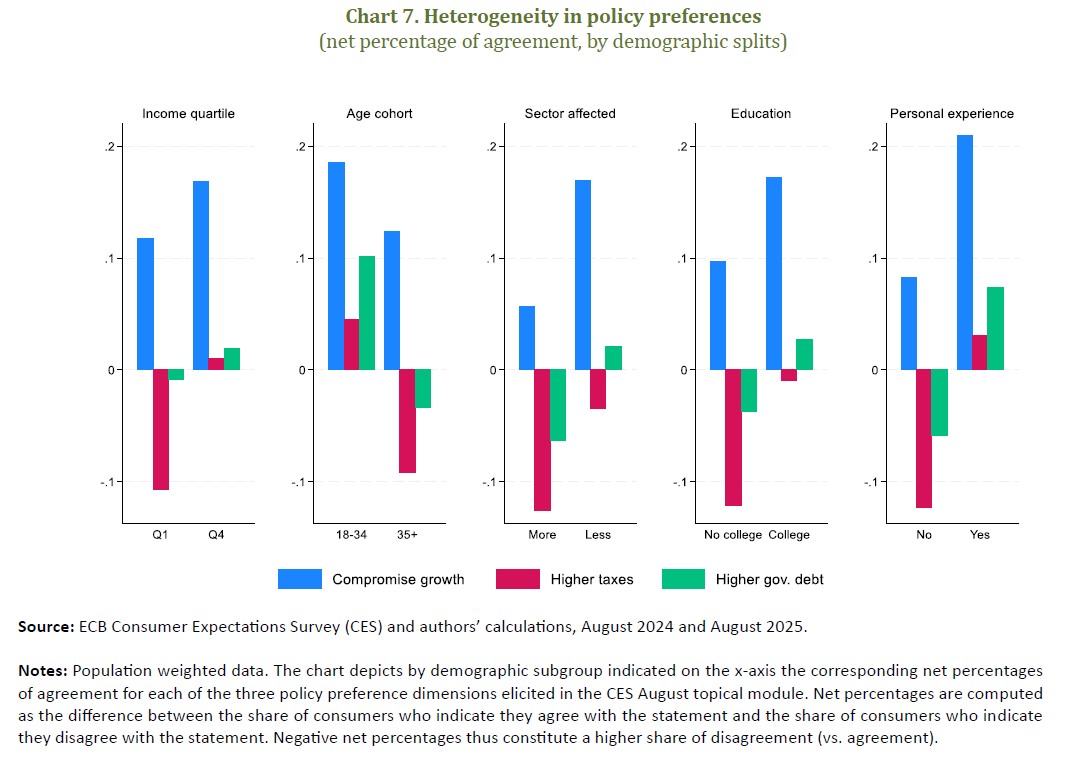
Still, support for climate action varies substantially by demographic subgroups (see Chart 7). For example, we observe that younger consumers (18–34 years) are much more supportive of green policies reflected by a positive net share of agreement across all three policy dimensions, while households from the lowest income quartile are less supportive of higher taxes compared to households from the highest quartile. In a related vein, consumers who work in sectors that are more likely to be affected by the green transition (e.g., agriculture, manufacturing) are less supportive of higher taxes or higher debt that may be needed to help tackle climate change. This higher share of disagreement might be driven by fears of being impacted by the policies directly. Recent international findings by Dechezleprêtre et al. (2025) also highlight widespread but heterogeneous support for climate action that can be increased by targeted communication, particularly when the mechanisms behind policies are explained to groups who would otherwise oppose those policies. When comparing demographic groups with different levels of education, we observe patterns of consumers without higher education being more strongly opposed to the ideas of increased taxation or higher government debt than consumers with a college degree.
Finally, personal past experiences of extreme weather events substantially increase willingness to accept growth sacrifices, but also the support of higher taxes and debt. This observation is consistent with recent evidence from Italy by Guiso and Jappelli (2024) who show that support for public funding of disaster-mitigation projects (flood protection) is higher when people are informed about the risks that natural disasters may entail. Similarly, in a global cross-country survey, Andre et al. (2024) document that the support for climate action is higher among countries that are more exposed to climate change.15 This pattern is also reflected in the CES. We observe a higher net share of support for prioritising climate action over growth in countries with either a greater share of exposure to extreme weather events in the past or greater risk perceptions of being affected by future events.16 These cross-country patterns are not as strong, however, when looking at preferences for increased taxation or higher government debt, suggesting that in addition to past exposure, climate policy preferences are also shaped by the afore-mentioned socio-demographic characteristics, economic conditions and other individual concerns.
In this Policy Note we document that climate change is not a distant concern for euro area consumers but already influences their economic outlook and their perceived financial situation. Moreover, this is particularly the case for those consumers who have experienced direct effects of extreme weather events in the past. We observe substantial regional heterogeneity of consumers’ experience of extreme weather events in the CES. Consumers personal experiences are associated with a deterioration in measures of their current and expected financial situation. According to the CES, consumers also extrapolate from experiences to future risks of being affected by extreme weather events. Such risks are in turn correlated with a deterioration in macroeconomic expectations (higher inflation and lower growth) and with a higher perceived need to put aside enough savings.
While consumers increasingly recognize the economic costs of climate change and its risks, we find that support for specific policies underlying a green transition, such as higher taxes or public debt, remains mixed and varies substantially across demographic groups. For policymakers, these results underscore the importance of integrating climate considerations into the analysis of household expectations and behaviour, as perceptions of climate risk can ultimately also play a role for the transmission of economic policy. Concrete policies that aim to accelerate the green transition might also require communication that fosters support from large parts of society. Going forward, CES data can help to monitor the ongoing effects of climate change on consumer expectations and their behavioural adaptation to climate change realities.
The full appendix material is available in the PDF version of this publication.
Andre, P., Boneva, T., Chopra, F. and Falk, A., 2024. Globally representative evidence on the actual and perceived support for climate action. Nature Climate Change, 14(3), pp.253-259.
Addoum, J.M., Ng, D.T. and Ortiz-Bobea, A., 2023. Temperature shocks and industry earnings news. Journal of Financial Economics, 150(1), pp.1-45.
Bilal, Adrien, and James H. Stock. “Macroeconomics and climate change.” (2025).
Brand, C., Coenen, G., Hutchinson, J. and Saint Guilhem, A., 2023. The macroeconomic implications of the transition to a low-carbon economy. Economic Bulletin Articles, 5.
Campiglio, E, J Deyris, D Romelli and G Scalisi (2025), “Warning words in a warming world: Central bank communication and climate change”, European Economic Review 178, 105101
Ceglar, A., Boldrini, S., Lelli, C., Parisi, L. and Heemskerk, I., 2023. The impact of the euro area economy and banks on biodiversity (No. 335). ECB Occasional Paper.
Costa, H. and Hooley, J., 2025. The macroeconomic implications of extreme weather events. OECD Economics Department Working Papers.
Dechezleprêtre, A., Fabre, A., Kruse, T., Planterose, B., Sanchez Chico, A. and Stantcheva, S., 2025. Fighting climate change: International attitudes toward climate policies. American Economic Review, 115(4), pp.1258-1300.
Dell, M., Jones, B.F. and Olken, B.A., 2012. Temperature shocks and economic growth: Evidence from the last half century. American Economic Journal: Macroeconomics, 4(3), pp.66-95.
Dietrich, A.M., Müller, G.J. and Schoenle, R.S., 2024. Big news: Climate-disaster expectations and the business cycle. Journal of economic behavior & organization, 227, p.106719, for a New Keynesian model implementing such survey-based disaster beliefs.
Ehlers, T., Frost, J., Madeira, C. and Shim, I., 2025. Macroeconomic impact of extreme weather events (No. 98). Bank for International Settlements.
European Central Bank, 2024. Climate change-related statistical indicators. ECB Statistics Paper Series, No. 48. Frankfurt am Main.
European Environmental Agency, 2025. Briefing 10/2025: Economic losses and fatalities from weather- and climate-related extremes, doi: 10.2800/8982821
Forster, P.M., Smith, C., Walsh, T., Lamb, W.F., Lamboll, R., Cassou, C., Hauser, M., Hausfather, Z., Lee, J.Y., Palmer, M.D. and von Schuckmann, K., 2025. Indicators of Global Climate Change 2024: annual update of key indicators of the state of the climate system and human influence. Earth System Science Data Discussions, 2025, pp.1-72.
Georgarakos, D., Kenny, G., Meyer, J. & van Rooij, M., 2025. How do rising temperatures affect inflation expectations? ECB Working Paper Series, No. 3132, European Central Bank.
Guiso, L. and Jappelli, T., 2024. Are People Willing to Pay to Prevent Natural Disasters?. CSEF, Centre for Studies in Economics and Finance, Department of Economics, University of Naples.
Hansen, J.E., Kharecha, P., Sato, M., Tselioudis, G., Kelly, J., Bauer, S.E., Ruedy, R., Jeong, E., Jin, Q., Rignot, E. and Velicogna, I., 2025. Global warming has accelerated: are the united nations and the public well-informed?. Environment: Science and Policy for Sustainable Development, 67(1), pp.6-44.
IPCC, 2023. Climate Change 2023: Synthesis Report. Contribution of Working Groups I, II and III to the Sixth Assessment Report of the Intergovernmental Panel on Climate Change [Core Writing Team, H. Lee and J. Romero (eds.)]. IPCC, Geneva, Switzerland, pp. 35-115,
Usman, S., Parker, M. and Vallat, M., 2025. Dry-roasted NUTS: early estimates of the regional impact of 2025 extreme weather. Available at SSRN.
See, for example: Forster et al. (2025). Recent studies also suggest an acceleration in the change of global climate, see: Hansen et al. (2025).
See official numbers from the European Forest Fires Information System and recent newspaper articles such as: https://www.bbc.com/news/articles/cd6n8qqlj8go.
See, for example, Campiglio et al. (2025), Brand et al. (2023), ECB (2024), Usman et al. (2025) and Ceglar et al. (2023).
See European Environmental Agency (EEA) (2025). For a long time, the impact of climate change was considered to mostly affect developing economies (e.g. Dell et al. 2012). Most recent studies, however, show that in advanced economies many industries can be affected by a changing climate (Addoum et al. 2025) and related economic losses (Usman et al. 2025). Economic losses from weather- and climate-related extremes are also increasing in Europe (see Chart 1 for economic losses). More than 50% of the 790 billion in economic losses incurred between 1980 and 2023 were not covered by insurance. These numbers come on top of tragic loss of life and refer to member states of the European Environmental Agency and six additional Balkan countries, see EEA (2025).
Importantly, climate change related costs of extreme weather events have also increased globally (see Ehlers et al. 2025) as well as insurance premia for such events.
See Eurobarometer Special Report Climate Change (2025) and Chart A1 in the Appendix for CES numbers.
As we elicit consumer perceptions these statistics might contain significant measurement error compared with officially recorded statistics. Nevertheless, we find supportive evidence of meaningful self-reported exposure to extreme weather events when comparing CES data with regional data for ECB physical risk indicators and EU Copernicus Satellite activations, see Appendix Charts A3 and A4.
See Chart A5 for the full distribution of the perceived likelihood of future extreme weather events over the next 5 years.
Academic evidence, on the persistence of extreme weather events on actual inflation by Ehlers et al. (2025), however, show a transitory impact on inflation (for droughts and flooding). Work by Costa and Hooley (2025) shows negative demand effects might outweigh supply-side factors.
Georgarakos et al. (2025) find supportive evidence for this interpretation by asking consumers about the underlying channels of their expectation formation depending on different scenarios of global warming.
See Dietrich et al. (2024).
We omit from this analysis preferences on household consumption patterns to focus specifically on policy preferences.
In fact, on average, around 45% of consumers would support either an increase in taxes or higher public debt to finance climate mitigation policies.
See Georgarakos et al. (2025).
Based on CES data, we also do find a positive association between perceived risks of future extreme weather events and a support for environment as a policy priority (see Chart A6). Cross-country results on preferences across the different dimensions elicited in the CES are depicted in Chart A7.
Chart A8 depicts the association between past and expected extreme weather events and different policy preference dimensions.