

This policy brief is based on Di Casola, P. and Grothe, M. (2026), “Housing wealth and monetary policy transmission: cross-country evidence”, European Central Bank Working Paper No. 3204. The views expressed in this article belong to the authors and do not necessarily reflect those of the European Central Bank.
Abstract
This paper quantifies the role of housing wealth in the transmission of monetary policy to consumption in 20 advanced economies. Using Bayesian VAR models we identify structural shocks with a novel combination of sign and maximum forecast error variance restrictions, isolating the housing wealth channel through counterfactual impulse responses. We find that the housing wealth multiplier – the sensitivity of consumption to exogenous house price changes – is strongly correlated with outright homeownership rates and is higher for durable consumption. Cross-country differences in the monetary policy transmission to consumption are largely driven by the cash-flow channel.
Housing is crucial in the balance sheets of households and banks. Therefore, changes in house prices can significantly affect the real economy and the magnitude of these effects depends on the drivers of house price changes. For example, the substantial rise in real house prices during the Covid-19 pandemic was largely driven by changes in housing demand, which contributed positively to aggregate consumption (Di Casola et al., 2022). Subsequently, amid global monetary policy tightening in 2022-23, real estate price growth started to decelerate and even reversed, dampening consumption as well. In both episodes, these effects were highly heterogeneous across countries, reflecting structural housing and mortgage market features.
Motivated by these developments, this paper analyses the transmission of monetary policy to consumption via the housing and mortgage market, leveraging the cross-country heterogeneity in structural characteristics to understand the role of the housing wealth and cash-flow effects.
The analysis relies on structural Bayesian vector autoregression (BVAR) models for 20 advanced economies, for which we have comparable data, combined with local projection analysis. We identify structural shocks using a novel combination of the sign and maximum forecast error variance (FEV) approach. This strategy allows us to identify both housing demand and mortgage supply shocks, separately from monetary policy, aggregate demand and aggregate supply shocks. The models include the following domestic variables: real consumption, consumer prices, real credit to households, real house prices, interest rate, and, for most countries, nominal effective exchange rate (or the excess bond premium for the US). All the models, except the one for the US, contain also a foreign block as the economies are modelled as small open economies.
In order to explore the cross-country heterogeneity in the relationships between consumption, house prices and monetary policy, we use several indicators related to the features of the housing and mortgage markets. In particular, we choose the indicators that can proxy for the share of borrowing-constrained households or the interest rate sensitivity in the economy, provided comparable data is available for most of the countries in our sample.
We define the housing wealth multiplier – the sensitivity of consumption to exogenous house price changes – and conduct a counterfactual exercise, which allows us to draw conclusions on the respective role of housing wealth and cash-flow channels. We use local projection analysis to examine the role of durable consumption in our results.
Figure 1. Maximum effect of monetary policy shock equal to 1 percentage point interest rate increase on consumption and characteristics of housing markets across countries
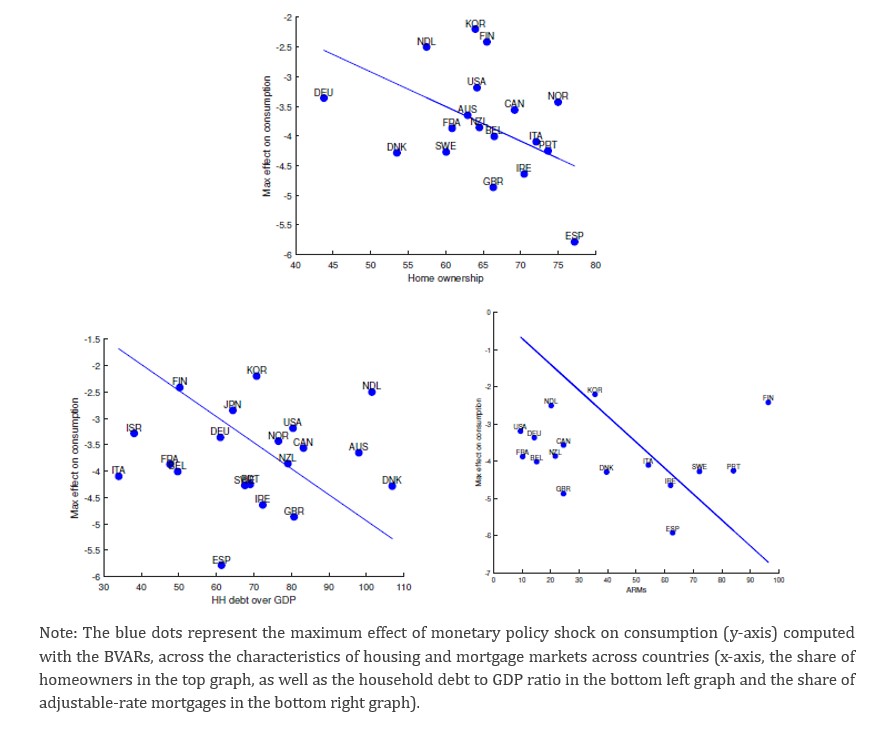
We have three main findings. First, we show that both the peak response of consumption and the peak response of house prices to the monetary policy shock are heterogeneous across countries and related to the differences in the housing and mortgage market characteristics, namely the share of homeowners, the level of household debt over GDP, and the share of adjustable-rate mortgages. For example, as shown in Figure 1, in countries like Spain and Ireland, where the share of homeowners is above 70%, the effects of monetary policy on consumption are significantly larger than in Germany or France, where this share is lower. These findings are in line with the literature, e.g. in Di Casola and Iversen (2019), Corsetti et al. (2022), Battistini et al. (2025) and De Stefani and Mano (2025).
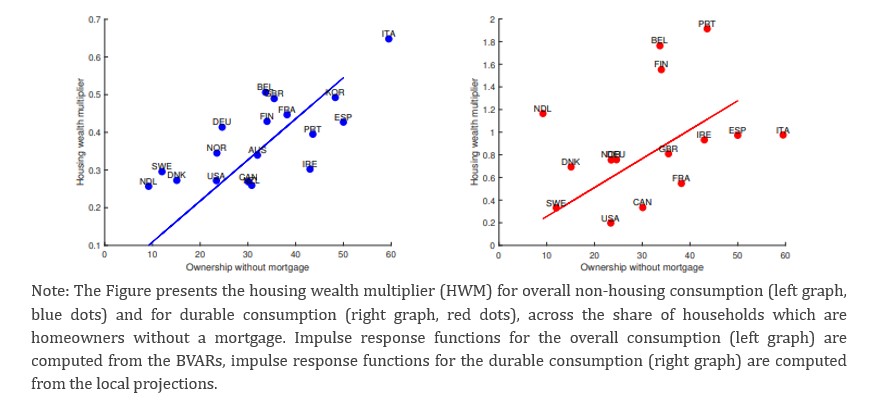
Second, the housing wealth multiplier is strongly correlated with the share of outright homeowners and is higher for durable consumption. Figure 2 shows an overview of the housing wealth multiplier across countries, which illustrates that the sensitivity of consumption to exogenous house price changes substantially differs across countries, ranging from 0.26 in the Netherlands and New Zealand to 0.51 in Belgium and 0.65 in Italy. It is also highly correlated with the share of households who own a house without a mortgage. These households perceive the benefits of an increasing value of their house, since they do not have a debt or a rent to repay and translate the change in the value of their property into a consumption choice. Using local projection analysis, we also show that durable consumption is not only more responsive to housing demand shocks, giving rise to higher housing wealth multiplier, but is also highly correlated with the share of outright homeowners.
Figure 2. Housing wealth multiplier across countries for overall non-housing consumption (left graph) and durable consumption (right graph)
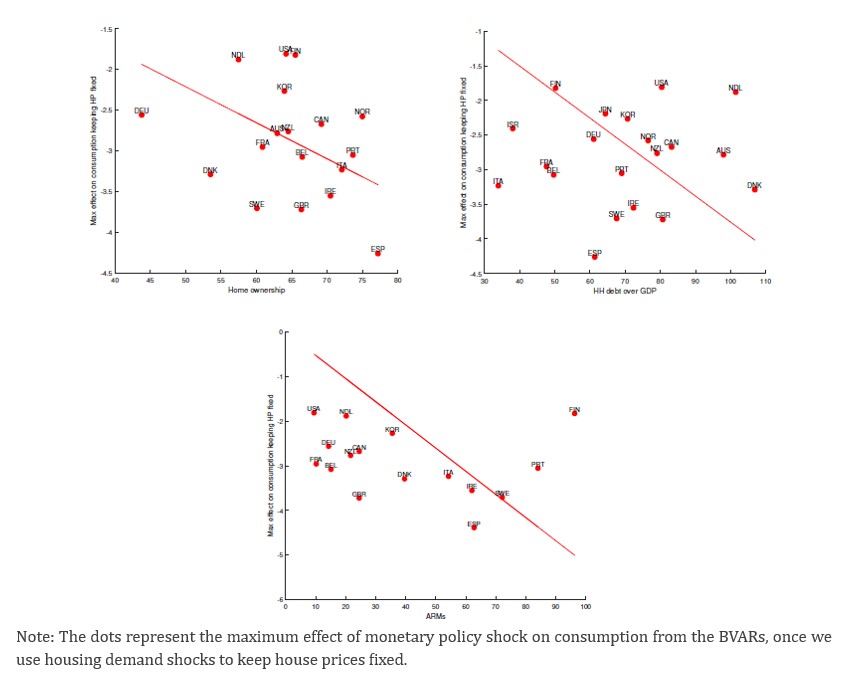
Third, after controlling for the housing wealth effect, the key channel that explains the heterogeneous transmission of monetary policy to consumption turns out to be the cash-flow channel. We show the role of the housing wealth channel of monetary policy, by deriving the effects of monetary policy shocks in each of the 20 economies analysed, once we keep house prices fixed. We control for house prices by using the housing demand shock to counteract the effect of monetary policy on house prices. In this way, the remaining effect of interest rate changes on consumption is due to other channels. Figure 3 shows that the peak effect of monetary policy on consumption is correlated with housing market characteristics that proxy for the severity of debt burden or the sensitivity to changes in the cost of debt, even after controlling for the change in house prices. Consequently, the cash-flow channel of monetary policy is key to rationalising the cross-country differences in the effectiveness of monetary policy on consumption.
Figure 3. Maximum effect of monetary policy shock equal to 1 percentage point interest rate increase on consumption once house prices are kept fixed and characteristics of housing markets across countries
This paper analyses the transmission of monetary policy to consumption via the housing and mortgage market, offering new insights which can be linked to underlying theories of monetary policy transmission via housing. We find that housing wealth and cash-flow channels are key in explaining the heterogeneous transmission of monetary policy across countries. These findings have important implications from the monetary policy perspective, both in terms of the changing patterns of monetary policy transmission over time, as well as the heterogeneity of monetary policy effectiveness across countries. For example, the shares of homeowners with mortgages in the euro area and the levels of household indebtedness are higher now than 15 years ago in many countries. At the same time, the share of adjustable-rate mortgage loans has declined in the last decade, especially in countries where these shares had previously been high (Di Casola, 2023). These factors, which are important determinants of the strength of the cash-flow channel of monetary policy, might have offset one another during the 2022-23 tightening cycle (Baptista et al., 2025), resulting in a transmission broadly in line with historical regularities (Kamps et al., 2025).
Baptista, P., Dossche, M., Hannon, A., Henricot, D., Kouvavas, O., Malacrino, D. & Zimmermann, L. (2025), “The transmission of monetary policy: from mortgage rates to consumption,” Economic Bulletin Articles, European Central Bank, vol. 4.
Battistini, N., Falagiarda, M., Hackmann, A. and M. Roma, “Navigating the housing channel of monetary policy across euro area regions,” European Economic Review, 2025, 171.
Corsetti, G., Duarte, J.B., and Mann, S. (2021), “One Money, Many Markets”, Journal of the European Economic Association, Vol. 20, Issue 1.
De Stefani, A. and R. Mano, “Long-Term Debt and Short-Term Rates: Fixed-Rate Mortgages and Monetary Transmission,” Working Papers 2025/024, IMF 2025.
Di Casola, P. (2023), “The role of housing wealth in the transmission of monetary policy”, ECB Economic Bulletin, Issue 5, box 7.
Di Casola, P, Dieckelmann, D., Grothe, M., Hempell, H., Jarmulska, B., Hannes Lang, J. and M. Rusnak, “Drivers of rising house prices and the risk of reversal,” 2022. Box 2, European Central Bank Financial Stability Review, May 2022.
Di Casola P. and J. Iversen, “Monetary policy with high household debt and low interest rates,” 2019. Staff Memo, Sveriges Riksbank, October 2019.
Kamps, C. et al. (2025), “Report on monetary policy tools, strategy and communication”, Occasional Paper Series, No 372, ECB.