
This article is based on research published for Morgan Stanley Research on July 8, 2026. It is not an offer to buy or sell any security/instruments or to participate in a trading strategy. For important disclosures as of the date of the publication of the research, please refer to the original piece. Contact Morgan Stanley for a copy of the published report. For important current disclosures that pertain to Morgan Stanley, please refer to the disclosures regarding the issuer(s) that are the subject of this article on Morgan Stanley’s disclosure website. https://www.morganstanley.com/researchdisclosures.
Abstract
In the coming decades, governments will need to fund three structural pressures at the same time: ageing-related expenditure, higher defence spending and rising interest payments. We estimate that, absent offsets elsewhere, they would mechanically widen deficits by at least 3 percentage points of GDP by 2040 in most euro area countries. However, borrowing cannot be the only answer. We see the most plausible path as combining a gradual spending freeze, reallocation away from low-multiplier expenditure and protection of public investment, alongside defence-industrial policies supporting domestic and European procurement. Under 1% real growth, this would create fiscal space of around 0.25pp of GDP per year, or around 1.2pp by 2030. In our view, EU-level tools can help, but they do not remove the need for national adjustment. Overall, Europe’s fiscal challenge will amount to a persistent allocation problem. Governments need to decide what to protect, what to slow, what to reform and what to fund jointly.
European fiscal policy is shifting from an era of cheap debt to one of hard allocation choices. For several decades, governments benefited from falling debt-servicing costs and declining defence spending, while expanding the welfare state. That combination allowed public sectors to grow without an immediate market impact. The next decade looks different. Governments now need to fund three structural pressures at the same time: ageing-related expenditure, higher defence spending and rising interest payments. This policy note, based on our recent BluePaper on European fiscal policy, brings together work from our euro area and UK economics teams to answer one question: how can Europe create fiscal space without damaging growth? Our conclusion is that Europe’s fiscal challenge will amount to a persistent allocation problem. Governments need to decide what to protect, what to slow, what to reform and what to fund jointly.
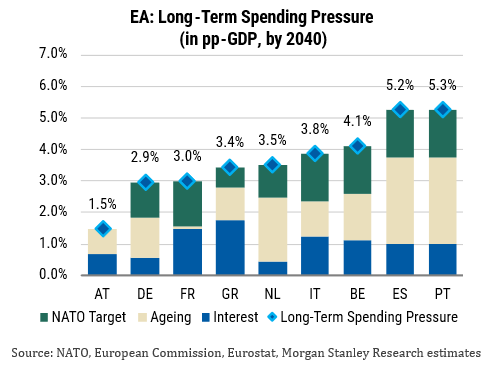
The numbers are large. We estimate that, absent offsets elsewhere, ageing, defence and interest payments would mechanically widen deficits by at least 3pp of GDP by 2040 in most euro area countries. Spain and Portugal face the largest long-term pressures, at just over 5pp of GDP, while Austria is the least exposed at around 1.5pp. The composition of spending pressures differs by country, but the direction is the same: the fiscal tailwind from falling rates and lower defence spending has turned into a headwind. Similarly, ageing is not only a drag on potential growth, it is also a fiscal cash-flow problem. Euro area ageing-related expenditure is set to rise by 1.1pp of GDP by 2040, driven mainly by pensions.
Exhibit 1. Long-term spending pressures ahead
These pressures come at a challenging starting point. The euro area has a large public sector, high debt and budgets dominated by social spending. Public spending is close to 50% of GDP, social benefits and transfers account for almost half of total spending, and public debt is above 100% of GDP in three of the four largest euro area economies. This means that, for most countries, the fiscal debate is not simply about spending more. It is about reallocating within budgets that are inherently rigid. State pensions, healthcare, defence & public order, and interest payments are difficult to cut – and in several cases are more likely to rise than fall. Together, these hard-to-compress areas account for around 23% of GDP. That leaves roughly 26% of GDP in other expenditure categories where adjustment might be more feasible, although still politically difficult, covering areas such as education, economic affairs, climate policies and other public services. Revenue-raising measures could also be part of the solution in some countries, but they are not an answer across the board: existing tax burdens and political constraints mean the revenue lever needs to be assessed on a country-by-country basis.
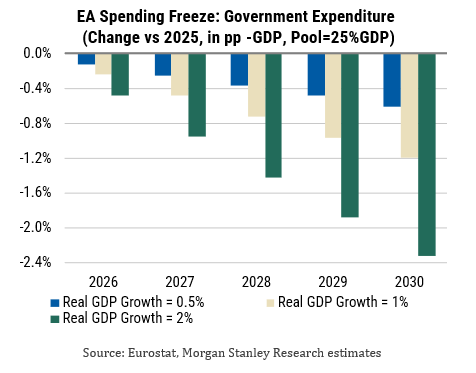
The most achievable fiscal adjustment is therefore likely to be gradual rather than abrupt. Outright spending cuts are difficult to implement at scale. A more feasible route would be to slow the growth rate of selected expenditure items, allowing them to decline as a share of GDP over time. For example, if governments freeze a spending pool worth around 25% of GDP in real terms – meaning that spending rises only with inflation – then GDP growth gradually erodes that spending ratio. Under 1% real growth, this would create fiscal space of around 0.25pp of GDP per year, or around 1.2pp by 2030 (Exhibit 2). Under 2% real growth, the cumulative space would be closer to 2.3pp. Under the more conservative 1%Y growth assumption, spending freezes alone would cover roughly half of the required primary balance improvement under EU fiscal rules, while under the more optimistic scenario of 2%Y growth, the same mechanism could broadly cover the full adjustment needed. This is meaningful, but not a silver bullet. It requires several years of discipline, and the arithmetic is highly sensitive to growth. Stronger growth makes the adjustment easier by raising the denominator and supporting revenues, while weaker growth does the opposite. This is why growth is central to any fiscal outlook, as the same fiscal strategy might create more fiscal space when real GDP growth is stronger.
Exhibit 2. Spending freezes could realistically open 1.2pp of GDP in fiscal space by 2030
The economic cost of consolidation depends on where the adjustment falls. Fiscal multipliers provide a useful framework, even though estimates vary widely across studies and over the cycle. Public investment has the highest multiplier, above 100% in our framework (Exhibit 3), meaning cuts to investment are likely to be the most damaging for growth. Government consumption has a lower but still meaningful multiplier, while transfers have the lowest estimated multiplier among the major spending categories we consider. However, multipliers are not static. They tend to be higher in downturns and lower when debt servicing burdens are elevated or when spending has high import leakage.
Exhibit 3. Public investment is the most growth-effective spending

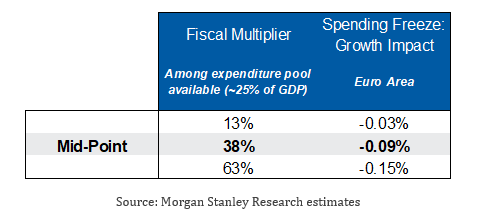
That points to a clear policy hierarchy as regards economic impact. If governments need to create fiscal space, they should, where possible, avoid cutting public investment and instead look to lower-multiplier categories. For the euro area, a real freeze on the available spending envelope would generate a modest direct growth drag. Using a 38% mid-point multiplier, we estimate the impact at around 10 basis points (bp) of GDP (Exhibit 4). If the adjustment were concentrated in transfers, the drag could be closer to 3bp. If concentrated in government consumption, it could rise to around 15bp. The fiscal mix therefore matters as much as the headline consolidation number. That said, transfer restraint should be designed carefully: transfers overall have a low average multiplier, but targeted support to low-income households can have a materially higher multiplier.
Exhibit 4. We estimate that real terms spending freezes could have only a 10 basis point drag on GDP growth
Defence is a special case. Higher defence spending is now a structural policy objective, but its growth impact depends heavily on procurement choices. We estimate the defence multiplier at around 49% under current assumptions, reflecting the fact that a sizeable share of equipment is imported from outside the EU. The multiplier could rise toward 71% if the investment share increases and procurement shifts more decisively toward domestic European suppliers. Targeted defence-industrial policy can therefore support both strategic autonomy and fiscal efficiency.
The euro area’s fiscal problem is shared, but not uniform. Countries differ materially in their starting debt levels, fiscal adjustment requirements, ageing pressures, defence needs, interest-cost exposure and growth outlook. Our analysis assesses for any given country whether these criteria expand or constrain the fiscal space.
The Netherlands screens as having the most fiscal space available, followed by Austria, Germany and Portugal. Spain and Greece sit near the middle of the distribution, with strong economic growth partly offsetting the constraints imposed by their elevated debt ratios. However, in Spain, rising ageing related spending pressures are likely to place additional constraints on fiscal space, an issue that is less pronounced in Greece.
Italy, France and Belgium screen as the most constrained. Italy’s challenge is high debt, high interest expenditure and weak structural growth. France’s challenge is structurally high expenditure and persistent primary deficits. Belgium combines high debt with limited fiscal space. This analysis matters because the same structural pressures will have very different consequences depending on the starting debt levels and growth prospects. Countries with fiscal space can use a broader policy mix; countries with less room need to rely more heavily on reallocation, spending discipline and growth-enhancing reforms.
Under the EU fiscal rules, national plans are required to place debt ratios on a declining trajectory over the medium term with at least a 70% probability. This framework gives the Commission enforcement mechanisms to steer countries towards compliance, although their use is also shaped by political considerations. France, Italy, Belgium and Spain face annual adjustment needs of around 50–60bp of GDP. The next EU budget (MFF) is more likely to reallocate spending than materially increase it – especially once NGEU fades and repayments begin, reducing effective EU spending capacity by around 30bp of GNI versus the early years of the current budget cycle. Changes in budget composition could be supportive, however: the next MFF is more likely to shift resources away from agriculture and cohesion and toward higher-multiplier investment, innovation, competitiveness and defence priorities. Common borrowing can support targeted priorities, especially through loans such as SAFE, but grants face a higher political and legal hurdle. Similarly, a permanent European safe asset remains a much bigger step, constrained by limited EU fiscal powers and the EU’s inability to roll over its debt on a permanent basis.
Ultimately, without policy change, debt ratios would continue to rise in most large euro area economies. Germany’s debt ratio may rise toward the high 70s but should remain sustainable. France and Italy face more difficult trajectories, with debt potentially moving toward the 150% of GDP area by 2040 absent policy change, though for different reasons: structurally high expenditure and primary deficits in France; high debt, high interest expenditure and weak growth in Italy. Spain looks better near term, but ageing pressures could push debt higher again after 2030.
Exhibit 5. UK’s Triple lock will raise pension spending
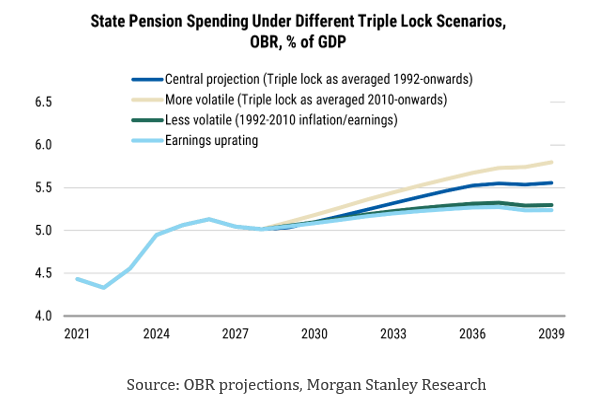
Exhibit 6. Spending freezes would meet half of the increase in primary balances needed to comply with EU fiscal rules, assuming 1%Y real GDP growth …
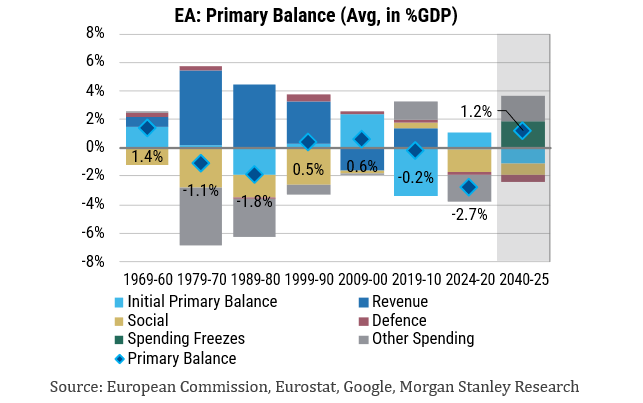
Exhibit 7. … helping offset the rise in interest expenditure
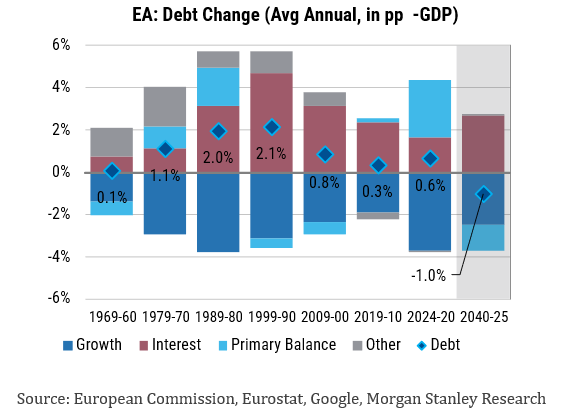
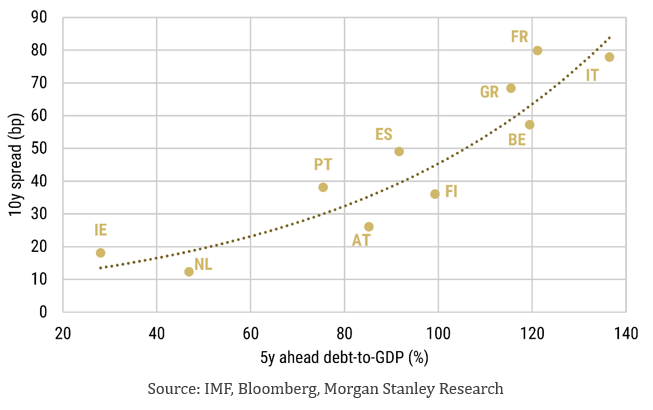
Exhibit 8. Fiscal variables are a strong driver of sovereign yield differentials