

This policy brief is based on Bank of Italy. No. 987 – Italian households’ investments in sovereign securities in the post-pandemic period. The views expressed are those of the authors and not necessarily those of the institutions the authors are affiliated with.
Abstract
Between 2022 and 2024, Italian households’ direct purchases of domestic government bonds rose sharply, bringing households’ total direct holdings to the highest levels since the early 2010s. This renewed interest reflected both the increase in yields following the tightening of monetary policy and the growing role of retail-oriented issuances such as BTP Italia, BTP Futura and BTP Valore.
Combining aggregate data with household-level evidence from the June 2024 wave of the Bank of Italy’s Household Outlook Survey, this brief note shows who held domestic government bonds at that time, the role played by retail-oriented issuances in household portfolios, and whether investors reported an intention to hold bonds until maturity. The survey evidence is merely descriptive. With this caveat, the results suggest that retail-oriented issuances may help broaden the domestic investor base and are associated more often with stated intentions to hold bonds until maturity.
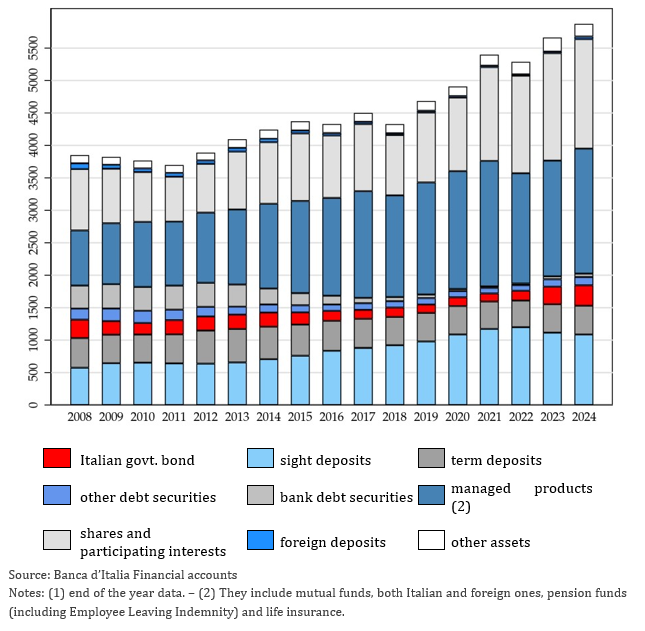
Italian households had gradually reduced their direct exposure to domestic government bonds for much of the decade before the pandemic. This trend reversed after 2021. As inflation rose and the European Central Bank started tightening monetary policy, yields on government securities increased and government bonds once again became attractive to retail investors.
Between 2022 and 2024 Italian households purchased around €195 billion of domestic government bonds. By the end of 2024, their direct holdings of such bonds had reached about €310 billion, equivalent to around 5 per cent of total household financial assets. This share was the highest since 2013.
Households bought domestic securities not only as a response to higher yields. The issuance of bonds explicitly designed to retail investors also sustained purchases: in fact, BTP Italia, BTP Futura and BTP Valore combine simplified subscription procedures with ad hoc characteristics (such as step-up coupons, inflation indexation and loyalty premia for investors holding the bonds until maturity).
These aggregate developments motivate the household-level analysis that follows. Aggregate data show that households increased their exposure to domestic government bonds; survey data help describe which households held them, which securities are included in their portfolios, and what intentions holders reported regarding future purchases and holding behavior.
Figure 1. Italian households’ financial account, 2010–2024 (1)
(euro billion)
The Italian government bonds range from short-term Treasury bills (Buoni Ordinari del Tesoro; BOTs) to long-term securities such as Buoni del Tesoro Poliennali, or BTPs.
In 2012 BTP Italia was introduced: it offers coupons indexed to Italian inflation, includes a loyalty premium for investors who hold the security until maturity, and it is targeted primarily to retail investors. BTP Futura, launched in 2020, and BTP Valore, introduced in 2023, added further retail-oriented characteristics, including step-up coupon structures and quarterly coupon payments.
BTP Italia, BTP Futura and BTP Valore’s design may help lower some barriers to participation, also through simplified placement procedures and financial incentives to hold them until maturity.
The available evidence suggests that retail-oriented BTPs accounted for one third of household purchases during the recent surge.
The Bank of Italy’s Household Outlook Survey conducted in June 2024 (HOS) showed that 15.5 per cent of Italian households held government bonds at the time of the survey. For greater detail on the HOS questions, descriptive statistics and econometric techniques herein applied see https://www.bancaditalia.it/pubblicazioni/qef/2025-0987/index.html
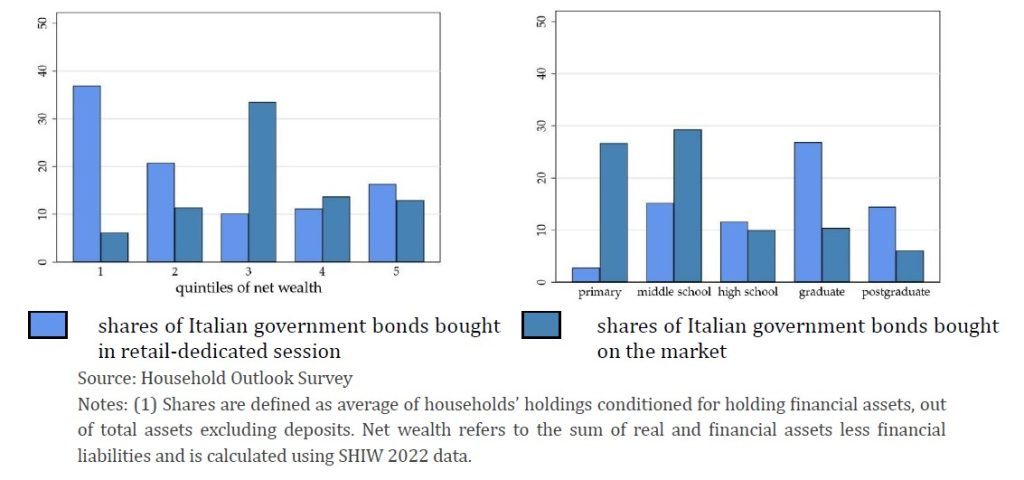
Holding government bonds is more frequent as we move to higher level of household wealth and education, though a particularly high share is recorded among pensioners. These patterns are consistent with standard findings in household finance: participation in financial markets is typically higher among wealthier households, more diversified portfolios and better financially educated.
The HOS also suggests that retail-targeted BTPs were relatively more important in the portfolios of some households with less diversified financial assets, including less wealthy investors. It hints that these instruments may have attracted the attention of households previously less keen on either buying BTPs or, more broadly, participating in the financial market.
Figure 2. Portfolio allocation in government bonds by wealth quintiles and education levels (1)
(percentage)
Buy-and-hold behavior could make the investor base more stable, although the contribution of households could be limited since the latter hold just about 13 percent of total government debt. The HOS records stated intentions of buying BTPs and holding them until maturity at the time of the survey. The results in this section should therefore be interpreted as evidence of expected or intended holding patterns, given expectations at that moment.
With this caveat, the survey pointed to a sizeable share of households declaring the intention to hold all their government bonds until maturity. Estimates based on the HOS highlighted that households with a greater portfolio share of BTP Italia, BTP Futura or BTP Valore were more likely to hold their government bonds until maturity. This pattern could be consistent both with the effectiveness of the incentives embedded in these securities, especially loyalty premia, and with differences – along socio-demographic or economic dimensions – between retail-targeted bond holders and the others.
Other household characteristics were also important. While older households were more likely to hold government bonds, they appeared less likely to report an intention to keep all BTPs until maturity. Households holding a diversified set of assets had a higher propensity to sell before maturity, possibly because they rebalance their portfolios more actively in response to market conditions. Higher education, by contrast, was associated with a greater likelihood to hold until maturity.
The significant surge in household demand raises the question of whether there could have been room for further purchases. The HOS hinted to a mixed answer, again based on stated intentions rather than realized transactions.
Among households that did not hold government bonds at the time of the survey only 6 per cent expressed an interest in buying them in the future. This suggests that the potential for expanding participation among non-holders was expected to be limited in the short run, given the yields, inflation and broader financial conditions at that time.
By contrast, interest in buying more government bonds was much stronger among households that already held them. Current holders were significantly more likely to state that they intended to increase their exposure, hinting to a significant intensive margin.
Wealth and education were also positively associated with the intention to buy more government bonds. Moving up the wealth distribution increased the probability of reporting future purchase intentions; education displayed a positive relationship too, although with some non-linearity. These patterns confirmed that stated demand for government bonds remained closely linked to household financial capacity and financial sophistication.
The survey highlights that retail-oriented issuances may help sustain interest among households already participating in the bond market and may attract some new investors, although this conclusion could depend to some extent on market conditions and expectations at the time of the survey.
The analysis has some implications for public debt management and household finance. These implications should be read in light of the nature of the evidence: aggregate data document the increase in household holdings, while the HOS provides a cross-sectional snapshot of household portfolios and stated intentions in June 2024.
First, retail-oriented issuances may help broaden the investor base, although the evidence is not sufficient to claim that they permanently increase participation. The experience of BTP Italia, BTP Futura and BTP Valore suggests that households respond to instruments that combine attractive yields, simple access and features designed around retail preferences. Yet participation remained uneven across wealth and education groups.
Second, bearing in mind that the evidence refers to intentions rather than realized behavior, the share of respondents stating intentions to hold government bonds until maturity was much higher among households holding a high share of retail-oriented issuances. It is impossible to say whether this is due to the incentives embedded in these securities or to unobservable differences between retail-targeted bond holders and other bond holders. Irrespective of the underlying reason, from a debt management perspective, retail-oriented issuances can help increase a more stable domestic investor base; at the same time, household holdings would likely remain limited relative to the overall stock of public debt.
Third, participation gaps remain important. Wealthier and more educated households were still more likely to express interest in buying more bonds. At the same time, the design of retail-oriented issuances may reduce some barriers to entry as the servicing fees for buying the asset help make even small tranches (such as the minimum one of 1,000 euro) sustainable.
Household-level evidence from the HOS shows which households held government bonds at the time, how retail-oriented issuances featured in their portfolios, and what intentions investors reported regarding future purchases and holding until maturity. The evidence is informative but should not be overinterpreted: it is based on observed holdings and stated intentions at a specific point in time.
The results suggest that the higher the share of retail-oriented issuances of BTPs in the household’s portfolio the more likely households intend to hold bonds until maturity. At the same time, findings indicate that future demand was concentrated mainly among households that already held government bonds, while interest among non-holders remained modest. Participation also continued to depend strongly on wealth and education.
While retail investors cannot replace other funding sources and retail-oriented issuances do not automatically increase participation, well-designed retail-oriented issuances might help broaden the investor base and could be associated, coeteris paribus, with more stable holding intentions among current investors.