

This policy brief is based on “Fiscal and macroeconomic impacts of defence spending”. The views expressed are those of the authors and not necessarily those of the institutions the authors are affiliated with.
Abstract
The relationship between defence spending and growth has recently returned to the centre of policy discourse. This Policy Brief argues that increased military expenditure could in many countries add modestly to economic activity in the near term, while also adding to fiscal pressures. Positive effects are more likely to last if governments seize the moment to improve their procurement practices, cooperate, and pursue related structural reforms.
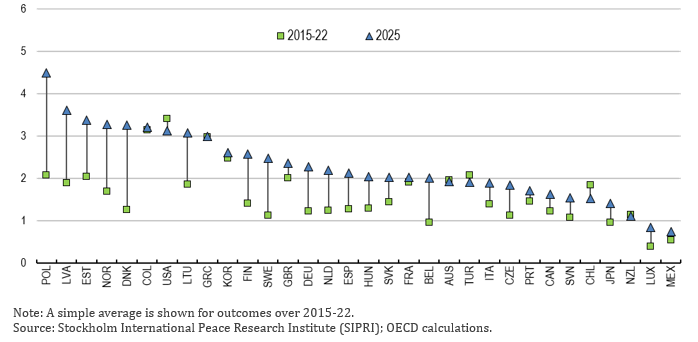
Many countries have begun to raise defence spending significantly (Figure 1). The primary goal is to bolster security, not boost GDP, but it is still important for governments to consider the economic consequences of larger defence budgets. The relationship between defence spending and growth has long been debated and has recently returned to the centre of discourse on industry, fiscal and macroeconomic policy (Ilzetzki, 2025). OECD analysis shows that in many contexts, increased military expenditure could add modestly to economic activity in the near term, while also adding to fiscal pressures (Conigrave and Shin, 2026). Beyond the stabilising effects of improved security, lasting economic benefits from rearmament are far from guaranteed. Positive long-term effects are more likely if governments seize the moment to improve their procurement practices, cooperate on defence purchases and pursue supportive structural reforms.
Relative to national income, defence spending is returning to levels last seen at the end of the Cold War in many OECD countries. Recent military spending increases are also synchronised across countries in a way not seen in decades. In 2025, for instance, defence budgets grew faster than nominal GDP in two-thirds of OECD countries.
Figure 1. Recent defence spending increases have been large
(Military spending in selected OECD countries, % of GDP)
Tilted towards weapons purchases, current defence outlays aim to refill emptied stores of equipment and address gaps in military capability. A challenge in monitoring trends in military expenditure is that “defence”, as an industry or category of spending, is typically not identified in regularly released data on the economy, such as national accounts. Alternative data sources, such as NATO, show a step-up in the share of defence budgets allocated to purchases of equipment. Estimates for 2025 show outlays on equipment, including major weapons systems and related R&D, exceeding 40% of core defence spending in six OECD countries: Finland, Hungary, Lithuania, Luxembourg, Poland and Spain, while remaining below a fifth of defence spending in only two OECD-NATO members: Belgium and Portugal.
The economic effects of higher defence spending will vary across countries. Fiscal multipliers from defence spending – measuring the cumulative GDP gains relative to changes in government expenditure over a given horizon – frequently fall within a range of 0.6 to 1 (Ilzetzki, 2025; Ramey, 2019). Such estimates, which are broadly consistent with macroeconomic modelling of defence spending shocks (e.g. Bokan et al., 2025), suggest that output gains could be expected in the near term, albeit with some crowding out of private activity and leakage of expenditure through higher imports. Outcomes will depend on economic conditions, a country’s industrial structure and the state of public finances. Government policy action – notably in defence, industrial and macroeconomic policy – will also shape economic effects over time.
Defence spending often involves trade-offs between security and economic benefits from expanding domestic production versus the potential efficiency benefits of purchasing arms and equipment from lower-cost producers in other countries. If spare capacity is limited, measures to strengthen domestic military production may add to the costs of rearmament and extend timeframes for programme delivery. Larger output gains from government defence purchases could come at greater cost to the budget and lower productive efficiency.
Arms imports weaken the domestic demand stimulus from government spending, particularly in economies without a large local defence industry. But imports may also reduce pressure on local capacity and help limit the immediate costs of rearmament. More broadly, trade should also help distribute gains within and across national borders. Data for recent years show that trade in defence materiel has risen sharply for some countries. For example, Poland’s weapons and ammunition imports in 2025 were more than ten times their value in 2021 according to UN Comtrade data. Large increases in arms import values were also registered in Czechia and Japan.
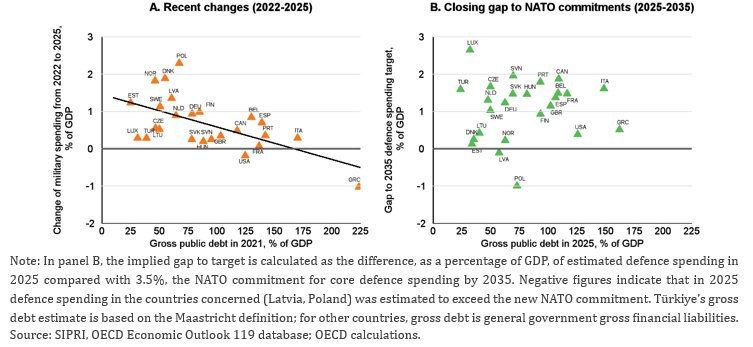
Defence requirements are also adding to mounting fiscal pressure from rising outlays on pensions, health and long-term care, and climate change. While governments have clearly explained the need for bigger defence budgets, less has been said on how to pay for them. Having borrowed to jump-start military build-ups after Russia’s full-scale invasion of Ukraine in 2022, some countries have since raised taxes to prevent rapid debt accumulation (e.g. Latvia and Poland).
Medium-term defence plans and their financing remain to be fully determined in other cases, including in higher-debt countries committed to allocating 3.5% of GDP to core defence needs by 2035, such as in Belgium, France, Italy and Spain. Each of these countries is estimated to have spent around 2% of GDP on defence last year and have public debts close to or exceeding 100% of annual national income (Figure 2).
Figure 2. Recent large military spending increases have tended to occur in lower debt countries
Fiscal rules will accommodate borrowing for defence expenditure in the next few years in some countries, notably in the European Union. Yet tough budget choices must be made if governments are to meet their defence commitments while keeping public debt at manageable levels, especially if defence ministries’ technical assumptions for the costs of energy, equipment, wages or other inputs to defence prove optimistic (Hartley, 2015).
In the short term, activity generated by deficit-financed military purchases could help move those economies with spare capacity closer to potential. In countries such as Germany, defence-related industries, notably manufacturing appear to have spare capacity to absorb the additional public demand. Growth benefits may, however, shrink over time as strains on resources push up prices and interest rates, and as governments consolidate their budgets. In higher-debt countries, expected future fiscal corrections could weaken any stimulus from unfunded increases in military spending, even in the near term (Ilzetzki, Mendoza and Végh, 2013). Over the long run, net income losses might occur if productive non-defence spending shrinks or if tax burdens increase, as is common after a military build-up (Marzian and Trebesch, 2025).
Defence activities compete for labour in a limited pool of human capital. Although expanding military production creates jobs, defence-related recruitment may draw talent away from other sectors and exacerbate labour shortages, including in STEM (science, technology, engineering and mathematics) fields. In some rearming economies, including in the euro area, it is increasing demand for skills – such as in engineering and software development – that have been in short supply.
In most OECD countries, spending on defence personnel, including military wages, has not grown as rapidly as overall defence expenditure. This reflects the overall stability of active personnel numbers, notably in European OECD countries. While several have recently revived mandatory (Latvia, Lithuania) or voluntary military service (France, Germany) or expanded existing military service programmes (Denmark, Norway, Sweden), only a few have significantly enlarged their permanent defence forces in recent years (Poland, Czechia, Estonia and Latvia). Adverse demographics – population ageing and, in some regions, emigration – reduce the available supply of labour and add to the challenge of military recruitment.
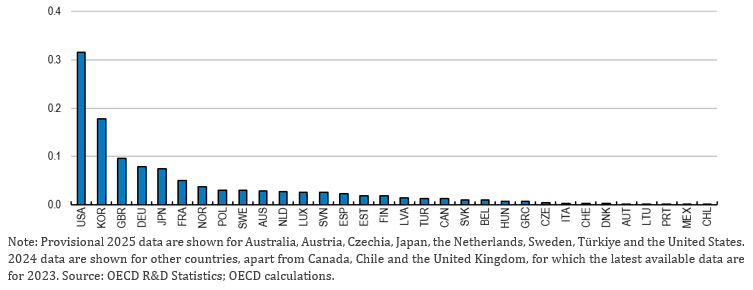
Supply pressures extend to capital and innovation. Some types of defence spending can have positive long-run effects on productivity that are measurable and enduring. For instance, government-funded research has been shown to stimulate private innovation (Moretti, Steinwender and Van Reenen, 2025), while defence-related research is credited with inventions – including contributions to the development of personal computing, GPS and the internet – that brought large efficiency gains in civilian industries. In countries with larger defence R&D budgets (Figure 3), military expenditure might help tilt the composition of government spending towards productivity-enhancing research over time (Antolin-Diaz and Surico, 2025). However, the benefits may be reduced if defence firms draw labour and capital away from more productive uses, particularly if this raises the cost of inputs needed for civilian research and development (Goolsbee, 1998).
Figure 3. Defence R&D budgets are small in most OECD countries
(Defence budget research and development allocations, % GDP, 2025 or latest available)
Effective procurement will be essential if defence ministries are to encourage innovation and strengthen the defence industrial base while containing the costs of capability upgrades. Many economies are now undertaking reforms to improve the speed and coordination of acquisitions, such as by streamlining complex procedures (Germany, Canada), increasing the use of off-the-shelf systems and government-to-government agreements (Poland and the Baltic states) and moving away from unduly rigid contracting practices. Cross-border coordination could enhance efficiency, unlock economies of scale in purchasing and expand markets for highly productive firms. Backed with harmonised standards, improved coordination could also help safeguard interoperability, notably in Europe (IISS (2025); Wolff, Steinbach and Zettelmeyer (2025)). Broader structural reforms to enhance competition, reduce barriers to market entry and alleviate skills shortages would improve the odds that higher defence spending delivers lasting gains in growth and living standards.
Antolin-Diaz, J. and P. Surico (2025), “The Long-Run Effects of Government Spending”, American Economic Review, Vol. 115/7, pp. 2376-2413, https://doi.org/10.1257/aer.20231278.
Bokan, N. et al. (2025), Macroeconomic impacts of higher defence spending: a model-based assessment, European Central Bank, Macroeconomic impacts of higher defence spending: a model-based assessment.
Conigrave, B. and Y. Shin (2026), Fiscal and macroeconomic impacts of defence spending, OECD Economics Department Working Papers, No. 1861, OECD Publishing, Paris, https://doi.org/10.1787/b4860378-en.
Goolsbee, A. (1998), “Does Government R&D Policy Mainly Benefit Scientists and Engineers?”, The American Economic Review, Vol. 88/2, pp. 298–302, http://www.jstor.org/stable/116937.
Hartley, K. (2015), “UK defence inflation and cost escalation”, Defence and Peace Economics, Vol. 27/2, pp. 184-207, https://doi.org/10.1080/10242694.2015.1093757.
IISS (2025), Transforming European Defence Procurement and Industry, The International Institute for Strategic Studies, https://www.iiss.org/publications/strategic-dossiers/progress-and-shortfalls-in-europes-defence-an-assessment/chapter-four-transforming-european-defence-procurement-and-industry/.
Ilzetzki, E. (2025), Guns and growth: The Economic Consequences of Defense Buildups, Kiel Institue for the World Economy, Kiel, https://hdl.handle.net/10419/311212.
Ilzetzki, E., E. Mendoza and C. Végh (2013), “How big (small?) are fiscal multipliers?”, Journal of Monetary Economics, Vol. 60/2, pp. 239-254, https://doi.org/10.1016/j.jmoneco.2012.10.011.
Marzian, J. and C. Trebesch (2025), “How to Finance Europe’s Military Build-up? Lessons from History”, Kiel Policy Brief 184, pp. 1-11, https://www.kielinstitut.de/publications/how-to-finance-europes-military-buildup-lessons-from-history-17963/.
Moretti, E., C. Steinwender and J. Van Reenen (2025), “The Intellectual Spoils of War? Defense R&D, Productivity, and International Spillovers”, Review of Economics and Statistics, Vol. 107/1, pp. 14-27, https://doi.org/10.1162/rest_a_01293.
Ramey, V. (2019), Ten Years After the Financial Crisis: What Have We Learned from the Renaissance in Fiscal Research?, Journal of Economic Perspectives, Vol. 33/2, https://doi.org/10.1257/jep.33.2.89.
Wolff, G., A. Steinbach and J. Zettelmeyer (2025), The Governance and Funding of European Rearmament, Bruegel, https://www.bruegel.org/policy-brief/governance-and-funding-european-rearmament.