

This policy brief is based on Ider, G., Kriwoluzky, A., Kurcz, F. and B. Schumann (2026). “Friend, Not Foe? Monetary Policy and Energy Prices”, Berlin School of Economics Discussion Papers, No. 102. The views expressed are those of the authors and not necessarily those of the institutions the authors are affiliated with.
Abstract
Energy-price shocks are often viewed as a problem that monetary policy can only trade off against output losses. This policy brief shows that energy prices are also part of the transmission mechanism for large energy-importing economies such as the euro area. Using high-frequency monetary policy surprises and euro area macroeconomic data, we show that an unexpected ECB tightening lowers global oil prices and euro area consumer energy prices. Because energy prices adjust quickly, their response strengthens and accelerates the transmission of monetary policy to headline inflation and inflation expectations. In a counterfactual in which ECB policy cannot affect global oil prices, the inflation response to monetary policy is only half as strong as in the baseline case, and the inflation-output trade-off deteriorates considerably. The policy implication is that central banks should account for the endogeneity of energy prices when assessing monetary transmission and designing responses to energy shocks.
Energy prices are often treated as a foe of central banks. When gas or oil prices rise, headline inflation increases immediately, while the output costs of offsetting the shock can be large. This view has shaped the conventional advice that central banks should, under many circumstances, look through temporary energy-price movements and focus on medium-term inflation pressures.
Our evidence points to a more nuanced conclusion. For the euro area, energy prices are not purely external to monetary policy. Because the euro area is a large economy and a major energy importer, European Central Bank (ECB) policy affects (expected) global energy demand and, in turn, global energy prices. As a result, energy prices can also be a friend of the central bank: asthey react quickly and strongly to changes in demand, their reaction amplifies and accelerates the transmission of monetary policy to headline inflation.
This matters for policy design. If monetary policy can influence energy prices, a given tightening achieves more disinflation for a given output cost. If it cannot, the central bank must rely more heavily on slower domestic demand compression. The same energy shock therefore implies a different inflation-output trade-off depending on whether energy prices respond to monetary policy.
Energy prices are often viewed as largely beyond the reach of monetary policy. Our evidence suggests that this view is incomplete for the euro area, whose size in global output and energy imports makes ECB policy relevant for global energy demand.
The analysis combines two sources of evidence. First, high-frequency movements around ECB monetary policy announcements show that unexpected monetary tightening is followed by an immediate decline in Brent crude oil prices. Focusing on narrow windows around policy decisions helps to isolate a causal market reaction to monetary policy news. We find similar effects for the United States, but not for the United Kingdom, consistent with the idea that large economies matter more for global energy demand.
Second, a structural time-series (vector autoregressive) model with high-frequency identification traces the dynamic effects over monthly horizons. A contractionary ECB monetary policy shock lowers both globally traded energy prices and the energy prices paid by euro area consumers, see Figure 1. The fall in energy prices is faster and larger than the response of the overall consumer price index. This pattern is consistent with the fact that energy prices are adjusted much more frequently than prices of most other consumer goods.
Figure 1. Monetary tightening lowers global and domestic energy prices
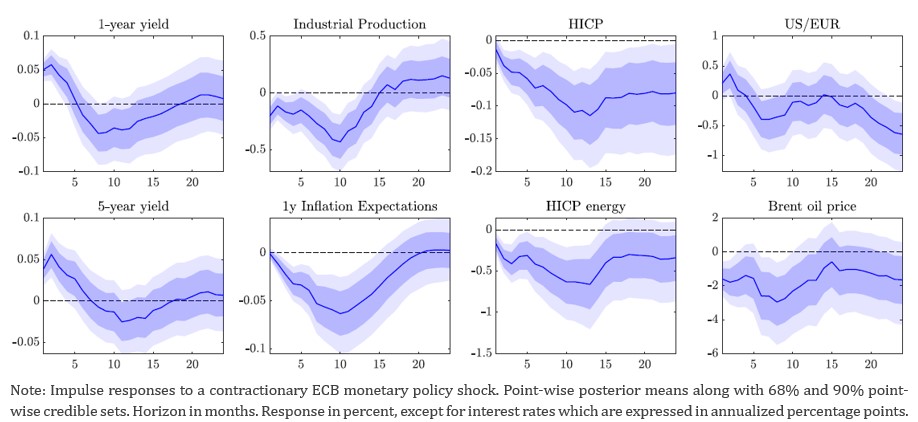
The mechanism is mainly demand-driven. Higher interest rates reduce energy demand directly in the euro area and indirectly through global spillovers. Since energy supply is relatively inelastic in the short run, even a moderate demand shift can translate into a sizeable price response. Energy prices are therefore not only an external source of inflation shocks. For the euro area, they are also part of the monetary transmission mechanism.
Standard discussions of monetary transmission often emphasise that policy affects inflation with long and variable lags. The evidence presented in Figure 1 suggests only a short lag, due in large part to energy prices. They are among the more flexible and visible components of the consumption basket. When they respond to monetary policy, headline inflation and inflation expectations react more quickly than they would through sticky domestic prices alone.
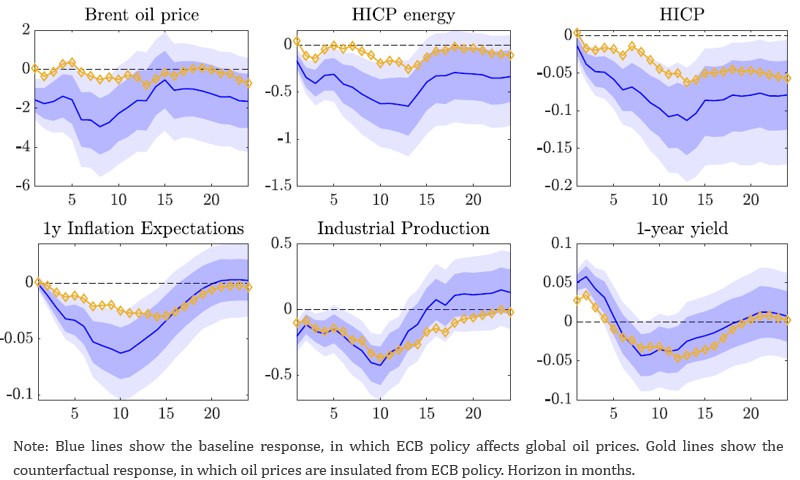
To quantify the importance of this channel, the paper constructs a counterfactual in which euro area monetary policy does not affect global oil prices (with the method developed in McKay and Wolf, 2023). In this scenario, OPEC supply adjustments neutralise the effect of ECB policy on the global oil price. The exercise therefore compares two economies: one in which energy prices respond to monetary policy, and one in which they are insulated from it.
The difference is large: without the energy-price response, monetary transmission to consumer prices and inflation expectations is roughly halved, see Figure 2. Industrial production falls more because the stabilising effect from lower energy prices is absent. In other words, the central bank obtains less disinflation and faces a larger real-economy cost.
This result changes how energy prices should be interpreted in monetary policy analysis. They are usually only seen as a problem for central banks because they can generate large inflation increases. But precisely because they are flexible and salient, they can also amplify monetary transmission when they respond to policy, as we show.
Figure 2. Monetary transmission is weaker when oil prices do not respond
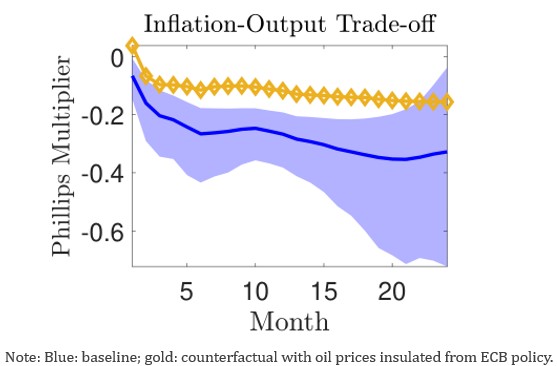
The counterfactual exercise additionally reveals a change in the estimated sacrifice ratio. The paper measures how much inflation falls on average when monetary policy generates a given decline in industrial production. In the baseline, a policy-induced 1% decline in industrial production over the following year lowers average inflation by about 0.27 percentage points. In the counterfactual, the same output cost lowers average inflation by only about 0.12 percentage points. Put differently, the ECB’s leverage over energy prices alleviates the inflation-output trade-off by roughly 55%.
Figure 3 illustrates this difference by plotting the Phillips Multiplier (Barnichon and Mesters, 2021). This statistic measures the amount of disinflation achieved by a policy-induced 1% decline in industrial production. The blue line shows the baseline case, in which global oil prices respond to monetary policy. It is estimated that, when monetary policy affects energy prices, an induced 1% fall in industrial production lowers inflation by 0.25% after about 1 year. The golden line shows the counterfactual case, in which oil prices are insulated from ECB policy. The gap between the two lines shows that monetary policy achieves more disinflation for a given output cost when energy prices are part of the transmission mechanism.
The intuition is that flexible energy prices steepen the relationship between inflation and real activity. When monetary policy affects energy prices, headline inflation responds more strongly to a given change in demand. When energy prices are insulated from monetary policy, inflation stabilisation requires a larger output contraction. Energy prices therefore make disinflation less costly, not because central banks can fine-tune oil prices, but because a flexible component of the price index responds quickly to policy.
Figure 3. Monetary policy achieves more disinflation for a given output cost when energy prices respond to policy
The results do not imply that central banks should mechanically tighten after every energy shock. The optimal response depends on the policy mandate and on the trade-off facing the central bank. A rise in oil or gas prices raises headline inflation and reduces real income, hence a policy tightening can dampen inflation but may also deepen the decline in activity.
The paper studies this dilemma by considering the transmission of an oil supply shock under two mandate-based objectives: one focused on medium-term price stability and one that balances inflation and output deviations. When the central bank can influence global oil prices, a price stability mandate calls for a modest, front-loaded tightening. This response leans against the rise in energy prices and reduces headline inflation relatively quickly, but it does not require an excessive rate increase because part of the adjustment occurs through flexible energy prices. Under a more balanced mandate, the optimal response is closer to a classical looking-through strategy. The central bank accepts a somewhat higher inflation path in the short run to avoid a larger contraction in activity. This response is also closer to our estimated historical reaction of the ECB in the data.
The key lesson comes from comparing these outcomes with the counterfactual scenario. If the central bank cannot influence oil prices, optimal policy requires substantially stronger tightening, regardless of the mandate, and delivers a worse inflation-output allocation. Therefore, if the central bank cannot move oil prices, then it must rely more heavily on demand compression to stabilise inflation.
The ability to move global energy prices therefore affects not only how monetary policy is transmitted, but also what policy response is appropriate. For a large energy-importing economy such as the euro area, treating energy prices as fully outside the reach of monetary policy can lead to misleading policy prescriptions.
Energy prices need not be only a constraint on monetary policy. In a large energy-importing economy, they can also be part of the transmission mechanism. For the euro area, monetary tightening lowers global energy prices and euro area consumer energy prices. As those prices adjust quickly, they accelerate the response of headline inflation and inflation expectations.
These findings have immediate policy relevance. They imply lower output costs of stabilising inflation and change the mandate-optimal policy response to energy supply shocks. Central banks should therefore account for the endogeneity of energy prices when assessing inflation dynamics, estimating the sacrifice ratio and designing policy responses to energy-price shocks.
Ider, G., Kriwoluzky, A., Kurcz, F. and B. Schumann (2026). “Friend, Not Foe? Monetary Policy and Energy Prices”, Berlin School of Economics Discussion Papers, No. 102.
Barnichon, R. and G. Mesters (2021). “The Phillips Multiplier”. Journal of Monetary Economics 117, 689–705.
McKay, A. and C. Wolf (2023). “What Can Time-Series Regressions Tell Us About Policy Counterfactuals?” Econometrica 91 (5), 1695–1725.