

This policy brief is based on wiiw Working Paper No. 274. The views expressed are those of the authors and not necessarily those of the institutions the authors are affiliated with.
Abstract
We provide empirical evidence that fiscal tightening shocks in advanced economies increase political instability: government approval ratings fall and the probability of government crises and protest activity rises in the short term. However, public support declines more sharply when consolidation takes place during an economic downturn or relies solely on spending cuts. The deterioration in economic activity following fiscal tightening explains the drop in government popularity. Consolidation measures with limited contractionary effects may help safeguard political stability.
In many EU member states, fiscal deficits and public debt ratios remain significantly above their pre–COVID-19 pandemic and energy crisis levels. As a result, governments are under increasing pressure to consolidate public finances and comply with EU fiscal rules. Countries such as France, Finland, Austria, Belgium, Romania and Slovakia are already among the EU member states pursuing a contractionary fiscal stance (European Commission 2025). Looking ahead, the requirements of EU fiscal rules will necessitate further fiscal tightening in the coming years (Darvas et al. 2025).
While the economic literature and public debate typically center on the economic and social consequences of fiscal tightening measures (e.g. Guajardo et la. 2014; Alesina et al. 2015), our study focuses on their political implications. The success of fiscal consolidation depends critically on whether it secures broad public support (e.g. Ponticelli and Voth 2020; Jacques and Haffert 2021). If it instead triggers political instability, it may ultimately undermine economic development.
In a seminal paper, Alesina et al. (1996) conceptualise political instability as the likelihood that a government will fall from office. Building on this idea, we employ a broader understanding of political instability that incorporates both institutional and societal dimensions. Institutional instability refers to threats to government survival, including coalition breakdowns and leadership turnover, while social instability captures manifestations of public discontent and unrest. Accordingly, we interpret changes in incumbent approval, episodes of major government crisis, and forms of collective mobilisation such as strikes and demonstrations as expressions of political instability.
While much of the existing literature examines more distant political outcomes – such as voting behaviour or governments’ re-election prospects (e.g. Arias & Stasavage, 2019; Alesina et al., 2024) – our approach focuses on more immediate indicators of political reactions. Electoral outcomes are shaped by long and complex causal processes in which the effects of fiscal consolidation may be obscured by a range of intervening factors. By contrast, measures such as government approval, government crises, and protest activity provide a more direct indication of contemporaneous public responses to fiscal adjustment, including the extent to which fiscal tightening undermines public support (Jacques & Haffert, 2021; Ponticelli & Voth, 2020). In addition, these indicators are available at higher and more regular frequencies than electoral data, making it possible to analyse short-term responses to fiscal consolidation shocks.
We analyse how tax increases and spending cuts affect government popularity and the likelihood of government crises and protest activity. Our analysis relies on internationally comparable data on government approval (Carlin et al. 2025) and political instability events (Banks 2010). We further use the action-based International Monetary Fund (IMF) dataset on consolidation measures since the 1980s, which documents both the size and timing of such measures (Adler et al. 2024). Our data cover 17 OECD countries from 1980 to 2020: Austria, Australia, Belgium, Denmark, Germany, Finland, France, the United Kingdom, Ireland, Italy, Japan, Canada, the Netherlands, Sweden, Spain, Portugal, and the United States. The results remain robust when the analysis is restricted to the 12 EU countries in our sample.
A key empirical challenge in analysing the effects of fiscal consolidation is the identification of exogenous variation in fiscal policy. Changes in headline budget balances are endogenous to the business cycle since automatic stabilisers cause tax revenues and social spending to fluctuate with economic activity. To address endogeneity concerns, the literature has increasingly adopted the “narrative approach”, which identifies fiscal consolidation measures that were explicitly motivated by deficit- and debt-reduction objectives rather than by short-term economic conditions. This approach is based on detailed reviews of official policy documents, budget statements and economic reports. However, narrative measures should also not be used directly as a measure of the size of tightening in econometric work given that they may partly reflect announced policy intentions rather than the scale or implementation of measures, which can lead to mismatches between the recorded shock and the actual economic impulse.
We therefore build on the literature by instrumenting changes in cyclically adjusted fiscal balances with the IMF’s narrative fiscal consolidation shock series. We implement this identification strategy within a local projection framework (Jorda 2005) to estimate the dynamic effects of fiscal consolidation shocks on political instability. In the first stage, changes in the cyclically adjusted primary balance are regressed on the narrative shocks; in the second stage, the political instability variable of interest is regressed on the instrumented structural balance change within the local projection framework. The first-stage results are strong, enabling a decisive rejection of the null hypothesis that the narrative instrument lacks explanatory power for changes in the structural balance.
Our identification strategy rests on the assumption that the IMF’s narrative-based consolidation measures capture policy actions that governments use with the primary objective of reducing fiscal deficits, rather than in response to business cycle fluctuations or changes in political stability. The narrative shocks affect political outcomes only through their impact on the structural fiscal balance. The construction of the IMF’s narrative series supports this assumption as it focuses on measures motivated by the desire to reduce the fiscal deficit.
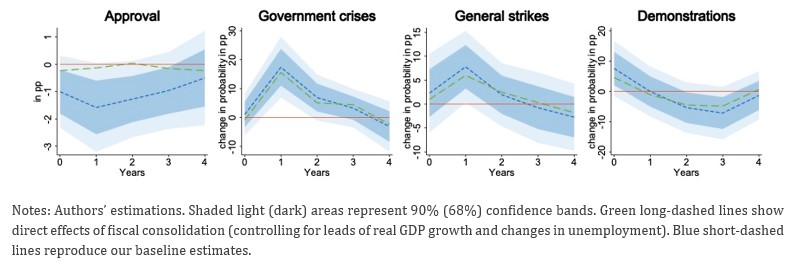
Our results capture the average political effects of fiscal consolidation equivalent to one percentage point of GDP (see Figure 1). Government approval declines by about 1.6 percentage points within one year following consolidation across the 17 advanced economies studied. By augmenting our baseline local projection specification by including leads of real GDP growth and changes in the unemployment rate, we show that this drop in popularity is primarily explained by negative macroeconomic developments following a fiscal consolidation shock.
At the same time, consolidation increases the short-term probability of anti-government demonstrations by 7.5 percentage points and of general strikes by 7.8 percentage points. It also raises the likelihood of a major government crisis – threatening the survival of the government – by 17.5 percentage points. However, these effects are temporary and fade over the medium term.
Governments often pursue consolidation to stabilise public borrowing costs. Our findings highlight the political costs of such measures. Fiscal tightening does not automatically lead to political instability. Most consolidation packages do not result in widespread protests or government collapse. Nevertheless, short-term distributional conflicts and losses for political interest groups increase the risk of events such as government crises, protests, and strikes.
Figure 1. The effects of a fiscal consolidation shock of 1%-point of GDP on political instability
As the economic channel matters for the political instability effects of fiscal consolidation, we hypothesise that the effect of fiscal consolidation on political outcome variables may vary according to specific economic environments. To capture possible state dependence, we estimate state-dependent local projections.
Our results show that fiscal consolidation has little effect on government approval during economic upswings but significant negative effects during downturns (see Figure 2). In a downturn, approval ratings fall by about 2.1 percentage points within one year in response to a consolidation shock of one percentage point of GDP. Similarly, the likelihood of government crises increases substantially in periods characterised by weak economic conditions. In an upswing, the effects are small and statistically indistinguishable from zero. These findings suggest that the macroeconomic effects of consolidation – more negative during downturns – indirectly influence public support for the government’s restrictive fiscal stance.
Figure 2. The responses of political instability variables to fiscal consolidation
in weaker economic conditions (lower regime) and stronger economic conditions (upper regime)
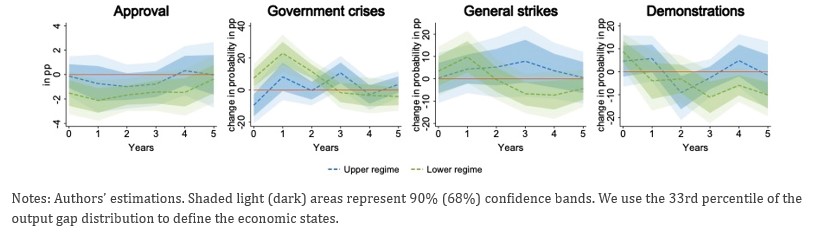
This suggests that fiscal consolidation is politically destabilising primarily when implemented in weaker economic environments, whereas its effects are muted in stronger economic environments. However, the increase in the likelihood of strikes and demonstrations is similarly pronounced during periods of economic expansion and downturn, as distributive conflicts and opportunities for mobilisation likely play a greater role in these cases than indirect macroeconomic effects.
Finally, to examine whether the political instability consequences of fiscal tightening depend on the composition of the adjustment, we allow the dynamic effects of consolidation shocks to vary with the tax-spending mix. We show that consolidation packages that rely solely on spending cuts lead to a stronger decline in government approval than those that also include tax-based measures. This may reflect larger negative economic effects of spending cuts, particularly during downturns (e.g. Gechert and Rannenberg 2018).
Our results are robust across alternative specifications, estimation approaches, sample periods, country samples and sets of control variables. As part of these robustness checks, we address concerns that narratively identified consolidations may reflect political selection, whereby governments undertake fiscal consolidation when they are politically well positioned to absorb the associated costs. To do so, we exploit the EU’s Excessive Deficit Procedure (EDP) as a source of external consolidation pressure in sensitivity analyses restricted to EU member states. Specifically, we instrument fiscal consolidation using interactions between the narrative measure and either active EDP status or breaches of the Maastricht 3% deficit threshold, thereby isolating consolidations undertaken under stronger external constraints and reducing concerns about endogenous political timing. Reassuringly, both instruments exhibit strong first-stage relevance and produce results consistent with the baseline findings.
For EU member states, our results imply that the current consolidation path would entail greater political risks if it were to coincide with an economic downturn. So far, several countries have implemented fiscal tightening during a phase of economic recovery. While this recovery has not been fully self-sustaining, it has nonetheless improved the conditions for fiscal policy. However, external shocks – such as escalating conflict in the Middle East and the associated rise in energy prices – have already started to weigh on economic conditions. As a result, fiscal consolidation may exert a stronger negative effect on government popularity.
As tightening shocks that rely solely on spending cuts lead to a stronger decline in government approval, incorporating tax-based measures can help mitigate negative effects on public support and enhance political stability. In particular, fiscal tightening that places a greater burden on financially well-off actors – who are better able to absorb income losses by drawing on savings or reserves – may reduce the adverse macroeconomic effects of consolidation (IMF 2024).
Evaluations of government performance, measured as approval, influence election outcomes. Approval ratings and protests provide early signals of declining support. Existing research shows that fiscal tightening measures – especially in difficult economic times – have contributed to the rise of populist parties in Europe (Gabriel et al. 2026; Baccini and Sattler 2025). Therefore, the design of consolidation packages is important. Both their timing and composition can help limit political instability.
Adler, G., Allen, C., Ganelli, G., & Leigh, D. (2024). An updated action-based dataset of fiscal consolidation. IMF Working Paper No. 24/210.
Alesina, A., Ozler, S., Roubini, N., & Swagel, P. (1996). Political instability and economic growth. Journal of Economic Growth, 1(2), 189–211.
Alesina, A., Favero, C., & Giavazzi, F. (2015). The output effect of fiscal consolidation plans, Journal of International Economics, 96(S1), S19-S42.
Alesina, A., Ciminelli, G., Furceri, D., & Saponaro, G. (2024). Austerity and elections. Economica, 91(363), 1075–1099.
Arias, E. & Stasavage, D. (2019). How large are the political costs of fiscal austerity? Journal of Politics, 81(4), 1517–1522.
Baccini, L. & Sattler, T. (2025). Austerity, economic vulnerability, and populism. American Journal of Political Science, 69(3), 899–914.
Banks, A. (2010). Cross-National Time-Series Data Archive.
Carlin, R., Hartlyn, J., Hellwig, T., Horne, W., Love, G., Martinez-Gallardo, C., Singer, M., Cruces, J., & Sert, J. (2025). Executive Approval Dataset. OSF. 13 May 2025.
Darvas, Z., Welslau, L., & Zettelmeyer, J. (2025). Sovereign debt and fiscal integraton in the European Union. Journal of Economic Perspectives, 39(4), 49–74.
European Commission (2025). European Economic Forecast – Autumn 2025, European Economy Institutional Paper No. 327.
Gabriel, R., Klein, M., & Pessoa, A. (2026). The political costs of austerity. Review of Economics and Statistics, 108(1), 145–161.
Gechert, S. & Rannenberg, A. (2018). Which fiscal multipliers are regime-dependent? A meta-regression analysis. Journal of Economic Surveys, 32(4), 1160–1182.
Guajardo, J., Leigh, D., & Pescatori, A. (2014). Expansionary austerity: New international evi- dence. Journal of the European Economic Association, 12(4), 949–968.
Heimberger, P., Matzner, A. (2026). Fiscal consolidation and political instability, wiiw Working Paper No. 274.
IMF (2024). Putting a lid on public debt. In Fiscal Monitor: October 2024 (pp. 1–23). Washington, DC: International Monetary Fund.
Jacques, O. & Haffert, L. (2021). Are governments paying a price for austerity? Fiscal consolidations reduce government approval. European Political Science Review, 13(2), 189–207.
Jorda, O. (2005). Estimation and inference of impulse responses by local projections. American Economic Review, 95(1), 161–182.
Ponticelli, J. & Voth, H.-J. (2020). Austerity and anarchy: Budget cuts and social unrest in Europe, 1919-2008. Journal of Comparative Economics, 48(1), 1–19.
Yang, W., Fidrmuc, J., & Ghosh, S. (2015). Macroeconomic effects of fiscal adjustment: A tale of two approaches. Journal of International Money and Finance, 57(8), 31–60.