

This policy brief is based on IMF Working Paper No. 2025/269. The views expressed in this brief are those of the authors and do not necessarily represent the views of the IMF, its Executive Board, or IMF management.
Abstract
Green financial policies are used in many countries to support the transition to a low-carbon economy. Yet there is little evidence about the effectiveness of such policies. Using a new heterogeneous-firm model with financial constraints and endogenous adoption of cleaner capital, this policy brief shows that the loosening of financial constraints through broad credit policies can raise output but also increase emissions, as firms scale up energy-intensive production. In contrast, well-targeted green credit policies that support the adoption of frontier clean technologies can simultaneously boost output and reduce emissions. In the presence of financial frictions, free emissions permits can mitigate output losses of carbon pricing without undermining environmental goals. These findings highlight the importance of policy design and targeting in green finance.
Green financial policies — such as preferential credit lines, green lending targets, or subsidized loans for clean investment — have become a key pillar of climate policy frameworks in many countries. In Europe, for example, carbon pricing under the EU Emissions Trading System is complemented by large-scale green lending programs supported by the European Investment Bank. The European Central Bank is also shifting its collateral and asset purchase frameworks to incorporate climate-related risks. These policies are used widely because limited financial access can shape firms’ ability to invest in cleaner and more productive technologies. However, prior work offers little evidence on whether financial policies can simultaneously achieve emissions reductions and output growth, and how the design of policies shapes their likely impact.
To examine whether financial constraints shape productivity and environmental performance, we combine firm-level data on verified emissions, balance sheets, and income statements for more than 3,200 manufacturing firms, headquartered in 30 European countries covered under the EU Emissions Trading Scheme (EU ETS) between 2005 and 2021. Following Ottonello and Winberry (2024), we construct net worth — the difference between assets and the existing debt stock — as a proxy for financial constraints, capturing borrowing capacity.
Two clear patterns emerge from the data: firms facing tighter financial constraints tend to be less productive and dirtier. We examine the relationship between net worth, productivity, and emission efficiency within the same 4 digit SIC industry and country. Firms with higher net worth are more productive. Moreover, more productive firms have smaller environmental footprints relative to the scale of their operations: they have lower emissions relative to value added than within-industry peers.
Figure 1. Net worth, productivity and emission intensity
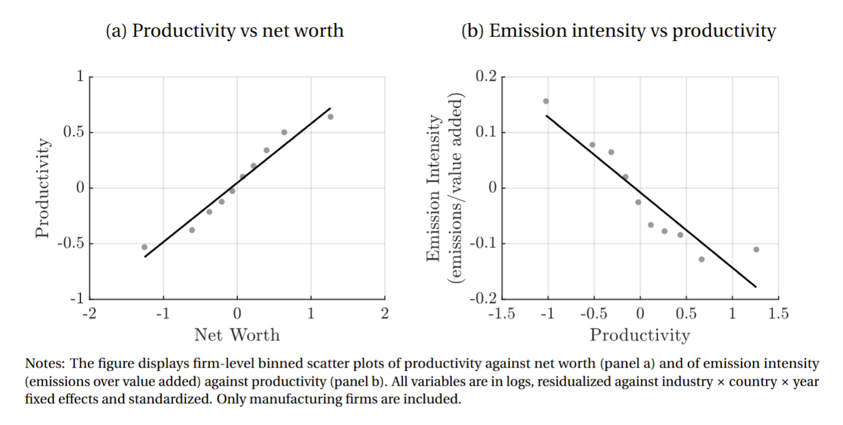
To interpret this evidence and study how green finance shapes firm behavior, we develop a small open-economy heterogeneous-firm general equilibrium model in which firms choose both investment and capital vintage subject to financial constraints. Newer capital vintages have higher productivity and are cleaner — emit less CO2 per unit of energy consumed — but they are also more expensive (Capelle et al., 2024). Firms differ in their productivity and net worth. Their net worth determines the extent to which they are constrained in borrowing, limiting both their scale of operation and their ability to adopt newer capital vintages.
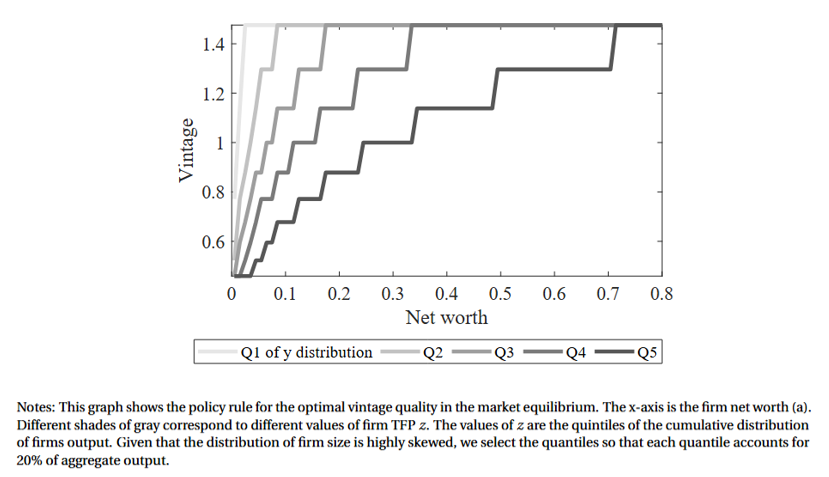
Financially constrained firms face a trade-off in our model: they can either expand production using cheaper, dirtier capital or invest in cleaner technologies at the cost of a smaller scale. This generates a ‘pecking order’ of vintages, in which constrained firms gradually upgrade the quality of the capital that they use for production as they accumulate net worth and lessen their financial constraints, until they reach the frontier green technologies.
Figure 2. Optimal capital vintage for different levels of productivity and net worth
To facilitate quantitative counterfactual analysis, the model is calibrated to match key moments from European manufacturing data, including firm-level productivity, emissions, and balance sheet indicators.
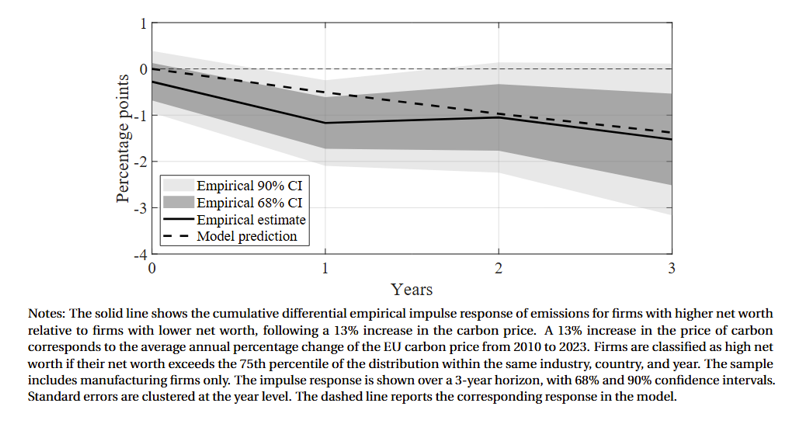
The model replicates the relationships seen in Figure 1 as well as other key untargeted empirical patterns. Using instrumental-variable local projections (Jordà et al., 2015) and exogenous carbon price shocks from Känzig (2023), we find that firms with higher net worth reduce emissions to a greater extent following carbon price increases. The model quantitatively matches this untargeted pattern. This helps validate the model’s core mechanisms.
Figure 3. Differential emissions response of firms with higher net worth to a carbon price increase
Green Credit Policies: We first evaluate policies that relax financial constraints for firms, aiming to boost output and reduce emissions through technology upgrading. In our model, the effects depend critically on how the policy is calibrated.
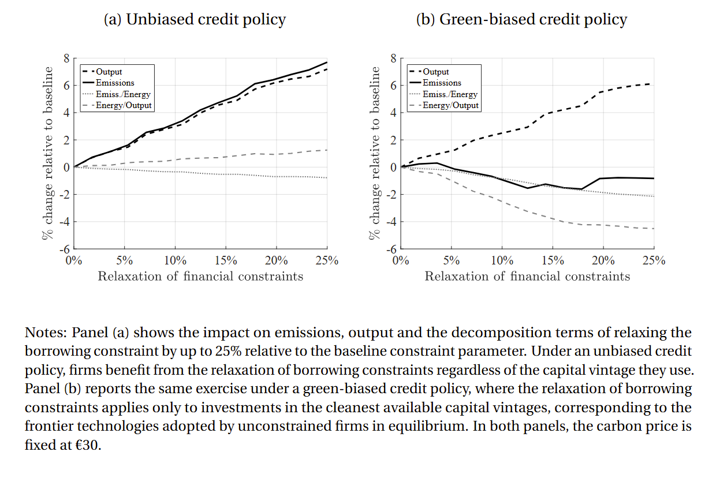
We begin by considering untargeted credit policies, which raise borrowing capacity across all firms and investments. These policies boost aggregate output, as firms scale up production. However, they also increase total emissions, as firms expand energy-intensive operations faster than they adopt cleaner technologies, offsetting environmental gains (Panel a in Figure 4).
In contrast, targeted green credit policies relax financial constraints only when firms invest in the cleanest available technologies. Under this design, firms are more likely to upgrade to frontier green capital, improving energy efficiency and reducing emissions while still supporting output growth (Panel b in Figure 4). For example, a 15% relaxation of borrowing constraints conditional on adopting frontier technologies reduces emissions by about 1.5% while raising output by 4%. Both environmental and economic benefits depend critically on policy design: as credit support becomes less tightly linked to clean investment, its emissions-reduction impact diminishes.
Figure 4. Output and emissions under alternative credit policies
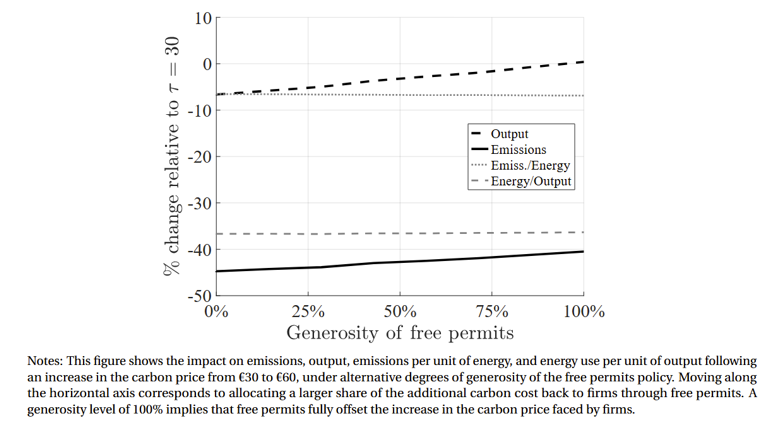
Free Emission Permits: Carbon pricing can be highly effective at reducing emissions, but its economic costs are magnified in the presence of financial constraints. In our model, doubling the carbon price from €30 to €60 per ton reduces long-run emissions by around 45%, primarily through reductions in energy use per unit of output. However, this comes with a 7% decline in aggregate output, highlighting the trade-off between climate goals and economic activity (corresponding to 0% generosity in Figure 5).
Introducing free emissions permits can substantially ease this trade-off in our model. Free permits reduce firms’ carbon compliance costs while preserving incentives to cut emissions, ameliorating the tightening of financial constraints and allowing firms to retain earnings, expand production, and invest in cleaner technologies more rapidly. In our calibrated model, providing free permits to fully offset the increase in costs due to carbon taxation achieves a 41% reduction in emissions with no output loss relative to the baseline (corresponding to 100% generosity in Figure 5); our analysis shows that achieving the same emission cut with carbon pricing alone would lower output by over 6%. These results show that free permit allocation can enhance the effectiveness of carbon pricing while mitigating its macroeconomic costs, especially in an economy where financial constraints and endogenous firm entry matter.
Figure 5. Carbon price and free permit policy effects on output and emissions
Financial constraints play a central role in shaping firms’ environmental and economic outcomes. Counterfactual analysis from our model incorporating the impact of financial constraints yields three important insights about the interaction between climate policy and financial factors.
First, financial frictions should be accounted for when evaluating climate policies. The output costs of price-based instruments can be much larger in models that account for financial constraints.
Second, our results underscore the importance of targeting. Financial interventions that are linked to the adoption of frontier clean technologies have very different economic and environmental effects than untargeted credit expansions in our model.
Third, the findings highlight that green finance and carbon pricing operate as complements rather than substitutes. Financial policies can enhance the effectiveness and political feasibility of carbon pricing in a model that incorporates borrowing constraints for firms.
Capelle, Damien, Divya Kirti, Nicola Pierri, and German Villegas Bauer, “Mitigating Climate Change at the Firm Level: Mind the Laggards”, International Monetary Fund, Working Paper No. 2023/242, 2024
Capelle, Damien, Eduardo Espuny Diaz, Divya Kirti, German Villegas-Bauer, and Sharan Banerjee, “Financial Constraints and the Effectiveness of Green Financial Policies”, International Monetary Fund, Working Paper No. 2025/269, 2025.
Jordà, Òscar, Moritz Schularick, and Alan M. Taylor, “Betting the house,” Journal of International Economics, 2015, 96, S2–S18.
Känzig, Diego R, “The unequal economic consequences of carbon pricing,” Technical Report, National Bureau of Economic Research, Working Paper No. 31221, 2023.
Ottonello, Pablo and Thomas Winberry, “Capital, Ideas, and the Costs of Financial Frictions,” Technical Report, National Bureau of Economic Research, Working Paper No. 32056, 2024.