

This policy brief is based on IMF Working Paper No. 2026/51. The views expressed in this brief are those of the authors and do not necessarily represent the views of the IMF, its Executive Board, or IMF management.
Abstract
This policy brief discusses the results of estimating debt overhang thresholds separately for 105 countries using a Kalman Filter approach applied to a standard growth model. The results reveal pronounced heterogeneity in the estimated thresholds, both within and across country groups but limited time-variation. In a second step, we explore the structural factors underlying this heterogeneity. The empirical results underscore that a strong payment track record, high quality institutions and governance, public debt composition (currency, maturity, and creditor base), and financial market size and development are associated with higher public debt overhang thresholds.
Global public debt reached about USD 111 trillion in 2025—around 95 percent of global GDP—according to estimates by the IMF. While still below the pandemic peak, public debt levels remain historically high and have followed a gradual, near linear upward trend since the mid 2010s, abstracting from the temporary COVID 19 peak in 2020–21. This has intensified policy concerns along two dimensions: the sustainability of public finances, and the implications of elevated public debt for medium term economic growth.
This policy brief focuses on the second concern by examining the conditions under which additional accumulation of public debt begins to weigh on per capita economic growth. To this end, we estimate country specific public debt overhang thresholds for 105 countries, allowing thresholds to evolve over time. The underlying intuition is that the relationship is nonlinear: at moderate levels of public debt, the marginal growth impact of additional borrowing may be limited or even positive when debt finances productive investment, whereas at high debt levels the marginal effect may turn negative.1
The novelty of our analysis lies in the use of a Kalman filter approach to estimate country specific thresholds, which captures slow moving changes over time while preserving a stable long run structure. Our findings point to substantial heterogeneity in debt overhang thresholds across countries, consistent with the existing literature showing that no single debt threshold applies universally. At the same time, estimated thresholds are remarkably stable over time, exhibiting little systematic trend. We then go on to analyze the sources of cross country heterogeneity in estimated debt overhang thresholds. We focus on five sets of explanatory drivers for this heterogeneity—sovereign debt repayment history, institutional and governance quality, public debt composition, the size of the domestic financial sector, and financial sector development and efficiency.
This study departs from static panel regressions by estimating a state‑space model with a Kalman filter for 105 countries over several decades (subject to data availability). We model per‑capita growth as a function of public debt and standard controls, while allowing the marginal effect of debt to vary with the debt level—so the implied turning point (the debt overhang threshold) is determined endogenously and can evolve smoothly over time. A key advantage is that thresholds are identified separately for each country, reducing cross‑country pooling bias.
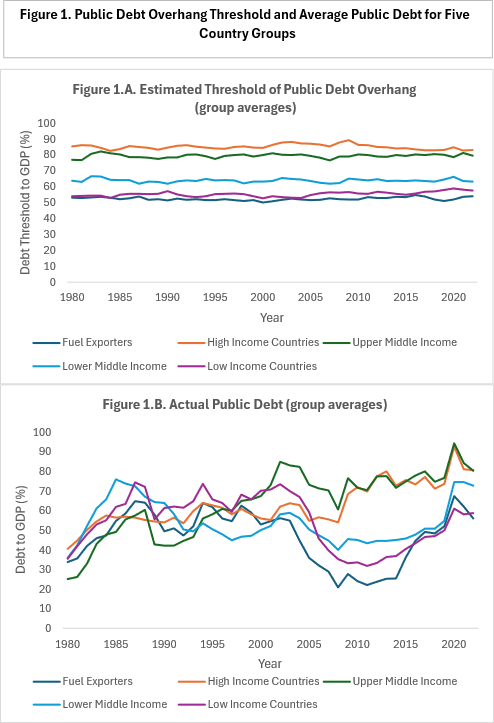
The results show wide cross‑country dispersion in estimated public debt overhang thresholds (Table 1). Differences are evident across broad income groups—high‑income and upper‑middle‑income economies tend to exhibit higher thresholds than low‑income countries—but heterogeneity within groups is also substantial. For example, among high‑income economies, estimated thresholds range from about 33 percent to over 200 percent of GDP, while for low‑income countries they span from roughly 20 percent to more than 140 percent of GDP. At the same time, the estimated debt threshold paths generally do not display any notable trends over time and exhibit much less time variation than observed public debt levels themselves. (Figures 1 A and 1 B). This suggests that while debt overhang thresholds differ markedly across countries, they are largely driven by slow‑moving structural factors rather than short‑term cyclical fluctuations.

What factors can explain the striking cross-country heterogeneity in estimated debt overhang thresholds?
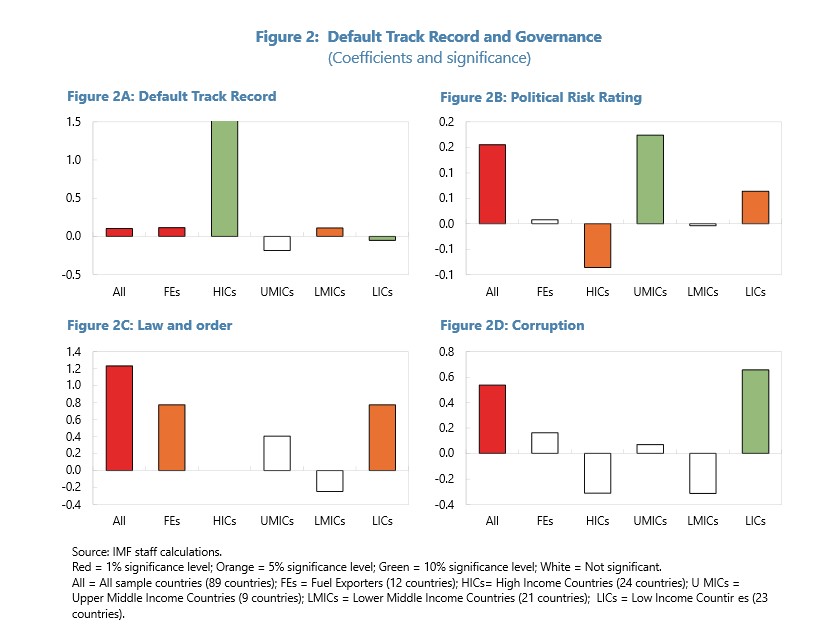
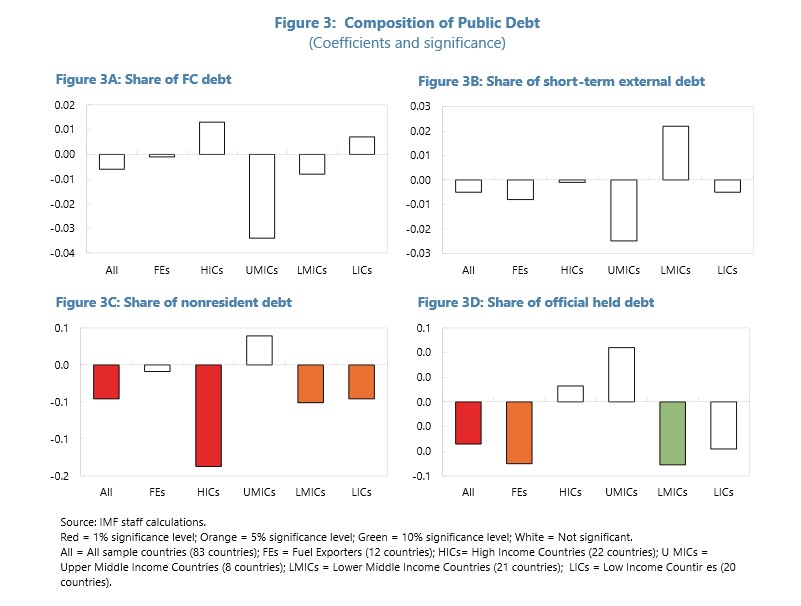
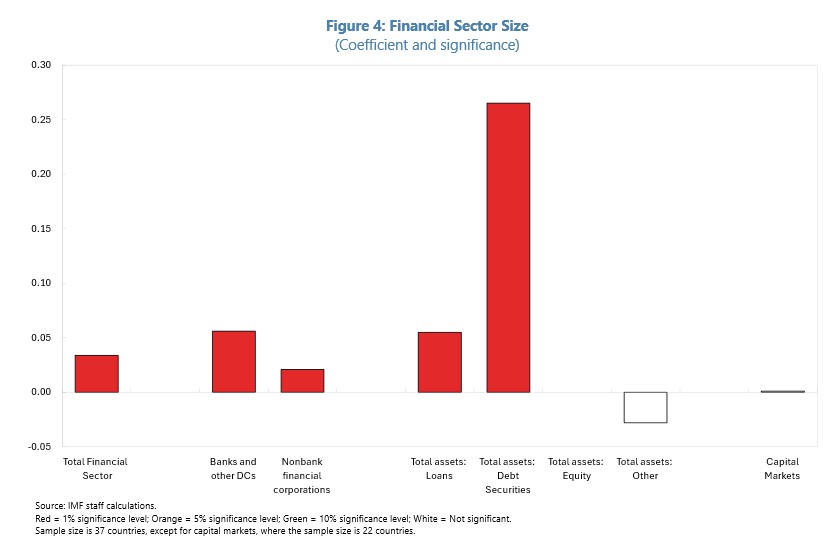
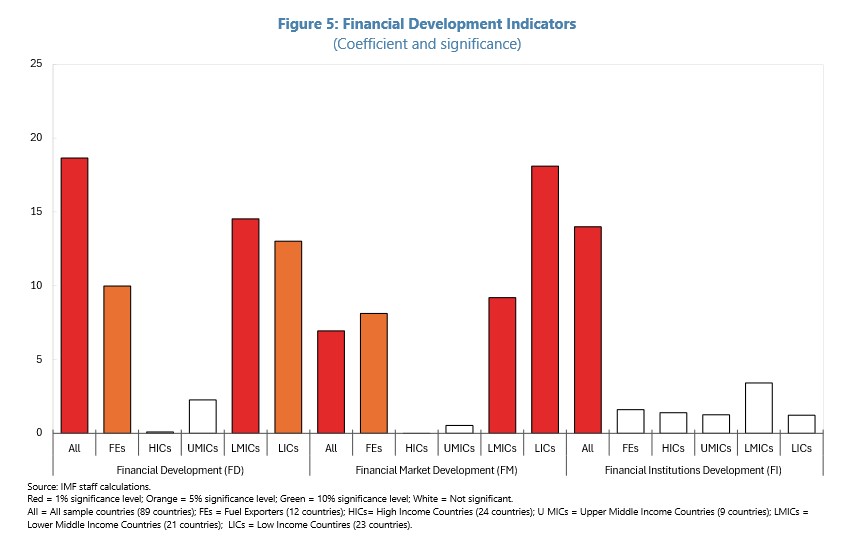
Overall, our empirical results indicate that several structural characteristics are systematically associated with debt overhang thresholds, including a country’s sovereign debt repayment track record, institutional and governance quality, the composition and structure of public debt (currency, maturity, and creditor base), and the size and development of the domestic financial sector (see Figures 2–5). These factors represent key dimensions within a broader set of structural and policy features shaping the debt–growth relationship.
More specifically, a stronger payment track record is associated with higher debt overhang thresholds, although the magnitude of this effect varies across country groups. Stronger institutions—captured by measures of law and order and bureaucratic quality—are also consistently linked to higher thresholds, suggesting that institutional strength enhances a country’s capacity to sustain higher public debt without adverse effects on economic growth. This finding is in line with previous studies, including Gomez Puig et al. (2022), which document the importance of governance and institutional quality in shaping the debt–growth nexus.
By contrast, a higher share of public debt held by non residents or official creditors is associated with lower debt overhang thresholds, pointing to greater vulnerability to external financing conditions. Related work, such as Schularick and Taylor (2012) and Gomez Puig et al. (2022), similarly emphasizes the role of debt structure and external exposure in amplifying adverse growth effects. We also find that a larger share of short term external debt in total external debt is linked to lower thresholds for some country groups, consistent with heightened rollover risk.
Finally, our results suggest that the size of the domestic financial sector is positively associated with the debt overhang threshold, and this applies both to banks and deposit-taking financial institutions and to nonbank financial corporations. However, capital market size—measured by stock market capitalization and the outstanding stock of public and private debt securities relative to GDP—does not appear to exert a significant effect, possibly reflecting the small sample size. More broadly, we find that greater financial development—covering indicators of depth, access, and efficiency of a country’s domestic financial sector and encompassing both financial institutions and financial markets—is associated with higher debt overhang thresholds, albeit with notable variation across country groups.
Estimated public debt overhang thresholds vary widely across country groups and also display substantial heterogeneity within groups. At the same time, estimated debt overhang thresholds are remarkably stable over time within countries, not displaying any notable trends over time and exhibiting much less time variation than observed public debt levels themselves.
Our analysis further indicates that structural measures to strengthen governance and institutional quality, and to improve public debt management, can raise public debt tolerance endogenously and expand an economy’s medium-term fiscal space without relying on inflation or financial repression. Importantly, our results suggest that developing and deepening domestic financial markets can significantly expand an economy’s public debt carrying capacity. In particular, issuance of public bonds in domestic currency with a range of medium- and long-term maturities can result in a considerable extension of the domestic yield curve.
This in turn can promote a larger, broader and deeper domestic market for government debt and lower the cost of debt issuance for the government. These structural explanatory factors themselves tend to change only gradually over time, reinforcing the interpretation that the cross country variation identified in the data reflects persistent, long run differences in economic and institutional structures, rather than transitory conditions. Taken together, these findings suggest that assessments of public debt risks and fiscal space should be country specific rather than based on uniform benchmarks. The strong cross country variation, combined with the stability of thresholds over time, points to the importance of persistent structural characteristics in shaping debt overhang thresholds. While the analysis does not establish causal relationships, it indicates that differences in institutions, debt structures, and financial systems are closely associated with countries’ capacity to sustain public debt without adverse growth effects. This underscores the value of incorporating structural, long run country characteristics into debt and growth assessments.
Aghion, P., and Kharroubi, E. (2013), Cyclical macroeconomic policy, financial regulation and economic growth. BIS Working Papers 434, Bank for International Settlements.
Barro, R. J. (1979), On the determination of public debt. Journal of Political Economy, Vol. 87(5), pp. 940–971.
Barro, R. J. (1990), Government Spending in a Simple Model of Endogenous Growth. Journal of Political Economy, 98(5), pp. 103–S125.
Gómez-Puig, M., Sosvilla-Rivero, S., and Martínez-Zarzoso, I., (2022), On the heterogeneous link between public debt and economic growth, Journal of International Financial Markets, Institutions and Money,, Elsevier, Vol. 77, pp. 1–21.
Krugman, P. (1988), Financing vs forgiving a debt overhang. Journal of Development Economics, 29(3), pp. 253–268.
Saint-Paul, G. (1992), Fiscal policy in an endogenous growth model. Quarterly Journal of Economics, 107(4), pp. 1243–1259.
Sargent, T. J., and Wallace, N. (1981), Some unpleasant monetarist arithmetic. Federal Reserve Bank of Minneapolis Quarterly Review, 5(3), pp. 1–17.
Schularick, M., and Taylor, A.M. (2012), Credit booms gone bust: monetary policy, leverage cycles, and financial crises, 1870–2008. American Economic Review, 102(2), pp. 1029-1061.
According to the conventional view in the theoretical literature, public debt accumulation, in essence fiscal deficit financing, can stimulate aggregate demand and output in the short run (in the absence of non-Keynesian effects). In the long-run, however, public debt can crowd-out capital and reduce output by (i) lowering national savings, thereby pushing up interest rates and reducing investment (Barro, 1990; Saint-Paul, 1992); (ii) creating a debt overhang problem – a situation where a large share of output accrues to foreign lenders, thereby creating disincentives to invest or to undertake growth-promoting structural reforms (Krugman, 1988); (iii) expectations of future distortionary taxation (Barro, 1979) or of significant cuts in public spending, with adverse effects on long-term economic growth; (iv) expectations of emerging inflationary pressures due to fiscal dominance (Sargent and Wallace, 1981); (v) higher volatility of economic growth due to constrained scope for counter-cyclical fiscal policy (e.g., Aghion and Kharroubi, 2013); and (vi) higher uncertainty about future policy and prospects.