

This policy brief is based on Benguria, Rojas, and Saffie (2026) NBER Working Paper No. 35272. The views expressed are those of the authors and not necessarily those of the institutions the authors are affiliated with.
Key Messages
The debate over dollar dominance often focuses on reserves, payments, or the currency used in new contracts. But there is a more basic balance-sheet problem. Many governments already owe dollar-denominated debt. If geopolitical fragmentation changes where they sell goods, how those transactions are invoiced, and which currency is used to settle payments, the currency composition of their repayment capacity can move faster than the currency composition of their liabilities.
That mismatch is the starting point. A country can owe dollars while increasingly earning revenues linked to yuan. This need not reflect an abrupt decision to abandon the dollar. It can arise gradually from changes in trade patterns and settlement practices. Higher barriers with dollar-linked markets can redirect exports toward yuan-linked markets. Greater frictions in using dollars in those transactions can make yuan settlement more attractive. The result is a sovereign balance sheet in which inherited dollar liabilities become less naturally matched by dollar-linked revenues.
The relevant question is whether inherited dollar debt can become fragile, even if the dollar remains dominant. Governments with dollar liabilities can continue to repay in dollars, default, or restructure those claims into yuan. The third margin is still rare, but it is no longer purely hypothetical. Kenya has converted Chinese railway loans from dollars into yuan, Ethiopia has reportedly entered talks with China to convert part of its Chinese dollar debt into yuan-denominated loans, and Zambia has reportedly been watching the Kenya deal closely. These episodes do not imply that a global restructuring wave is underway. They show that dollar-to-yuan restructuring is a real policy option.
China is now a major official creditor to developing and emerging economies. Yet Chinese creditor relationships do not automatically imply yuan-denominated liabilities. In the loan-contract data assembled by Gelpern et al. (2023), Chinese-creditor contracts are predominantly denominated in dollars. In our sample, the dollar accounts for 62.5 percent of contracts and 87.0 percent of loan commitments.
Figure 1 summarizes two dimensions of this mismatch. Panel A shows that Chinese-creditor loans are often dollar loans. Panel B shows that, for many countries, dollar public-debt exposure exceeds dollar export-invoicing exposure.
Figure 1. Two Dollar Mismatches
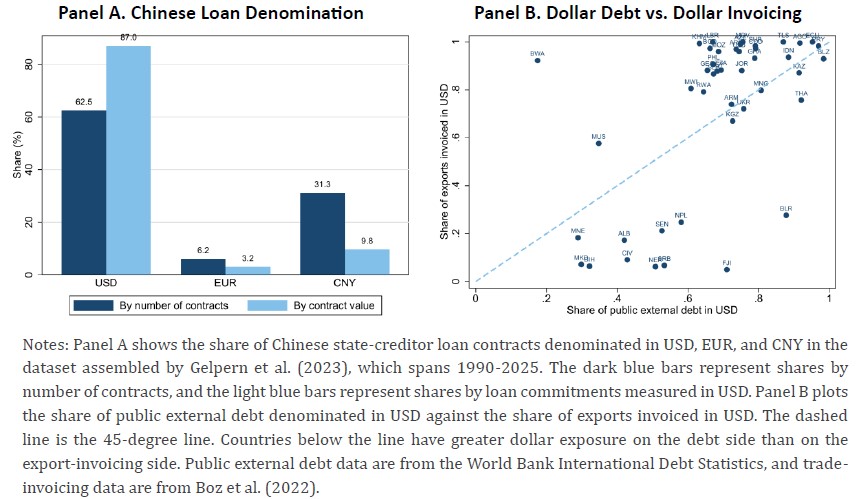
Panel A highlights the policy problem. A government may have a Chinese creditor but still face a dollar repayment obligation. If its export revenues and trade settlement become more yuan-linked, the relevant mismatch concerns the currency of the liability relative to the currency composition of repayment capacity, rather than the nationality of the creditor or borrower.
Panel B shows that the same logic applies more broadly. Dollar export invoicing is related to exposure to dollar-linked markets, but dollar invoicing also extends well beyond direct exports to the United States. In many countries, the dollar share of public external debt exceeds the dollar share of export invoicing. These countries face a particular vulnerability: they must service dollar liabilities even when a smaller share of export revenues is naturally dollar-linked.
Fragmentation can make this vulnerability more severe. It can redirect trade away from dollar-linked markets and increase the use of alternative settlement currencies. If the debt stock remains in dollars, the mismatch widens.
Consider a government that enters a fragmentation episode with inherited dollar debt. It has three options.
First, it can continue to repay in dollars. This is attractive when dollar markets remain liquid and the country’s revenues are still dollar-linked. But repayment becomes more costly when revenues become increasingly linked to another currency bloc.
Second, it can default. Default avoids repayment but brings legal, financial, output, and geopolitical costs. It is a discontinuous and costly adjustment margin.
Third, it can restructure the inherited dollar claim into yuan. This option becomes more attractive when the country has more yuan-linked revenues and when yuan refinancing costs are low enough.
The last point is the key. Restructuring is not just an individual balance-sheet decision. If enough inherited dollar claims are converted into yuan claims, yuan debt markets become deeper. Deeper yuan markets lower refinancing costs (Coppola et al., 2026). Lower refinancing costs make restructuring attractive for additional governments. One country’s restructuring can improve the terms faced by others.
The mechanism therefore has two opposing forces. Fragmentation raises yuan-linked repayment capacity, making yuan restructuring attractive for more borrowers. But dollar markets begin with a large liquidity advantage. As long as yuan markets remain thin, restructuring into yuan is costly and dollar dominance persists.
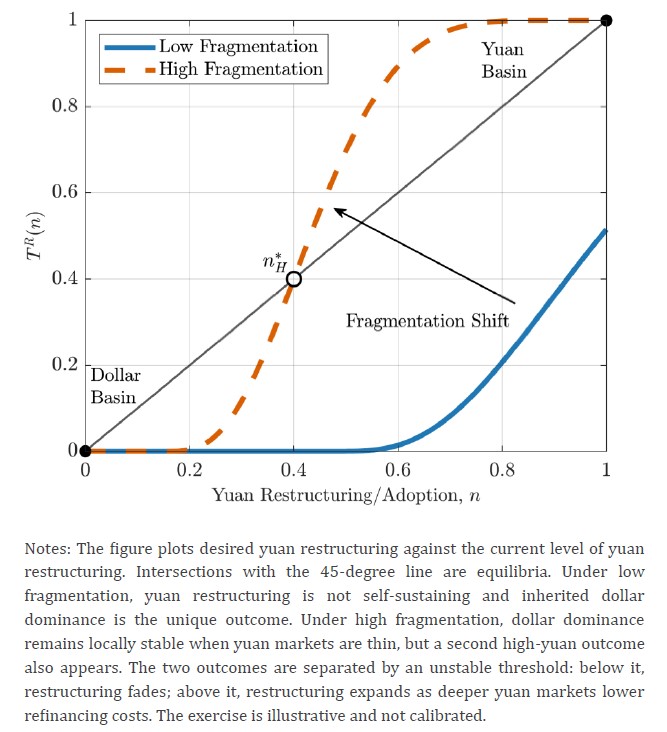
The transition depends on whether enough countries move at once to generate a liquidity feedback. If only a small mass restructures, yuan markets remain too thin and the system returns to dollar dominance. If restructuring crosses a critical threshold, yuan refinancing costs fall enough to induce further restructuring. The process can then become self-reinforcing.
Figure 2 shows the logic. The solid blue line represents a low-fragmentation environment. For every positive level of yuan restructuring, the desired amount of restructuring remains below the 45-degree line. Dollar dominance is the unique outcome. The dashed orange line represents higher fragmentation. Dollar dominance remains locally stable: when yuan markets are thin, few countries want to restructure. But the same economy also has a second stable outcome in which yuan restructuring is widespread. The two basins are separated by an unstable threshold. Below it, restructuring fades. Above it, restructuring expands.
This is a tipping argument, but not a mechanical de-dollarization argument. Dollar dominance is robust when yuan markets are thin, when restructuring costs are high, or when countries are dispersed in their yuan-linked revenue exposure. A cascade requires the liquidity feedback from yuan restructuring to be strong enough relative to that dispersion.
Figure 2. Restructuring Map and Tipping Dynamics
First, creditor identity is not enough. A loan from a Chinese creditor can still be a dollar liability. What matters for vulnerability is the currency of repayment obligations relative to the currency composition of revenues. Surveillance should therefore track debt denomination and repayment-currency exposure jointly.
Second, dollar dominance can be robust and fragile at the same time. It is robust because dollar markets are deep, liquid, and supported by a broad investor base. It is fragile in the specific sense that inherited dollar liabilities can become exposed to discontinuous restructuring incentives if repayment capacity shifts toward another currency bloc.
Third, policy can move countries across restructuring thresholds. Dollar-bloc interventions can preserve dollar dominance by maintaining dollar liquidity, reducing rollover stress, and making dollar repayment less costly. Yuan-bloc interventions can move the economy in the opposite direction by lowering the cost of yuan refinancing, expanding yuan settlement infrastructure, or supporting the conversion of inherited dollar claims into yuan claims. Neither side needs to move every borrower. Near a tipping threshold, targeted interventions can matter disproportionately.
Fourth, debt management should look at the whole balance sheet. Sovereign debt managers should not evaluate currency risk only by looking at creditor identity or the currency composition of new issuance. They should compare the denomination of the whole debt stock with the currency composition of future repayment capacity. In a fragmenting world, that repayment capacity can change.
The argument should not be read as a prediction that yuan debt will rapidly replace dollar debt. The model identifies the conditions under which such a shift can occur, without treating it as inevitable. Dollar dominance persists when yuan debt markets remain thin, when countries’ yuan-linked revenues are dispersed, when restructuring costs are high, or when default and renegotiation frictions dominate any refinancing gains.
Nor does the argument imply that every Chinese loan is a step toward yuan internationalization. One of the central facts is precisely the opposite: many Chinese-creditor loans are dollar-denominated. That is why inherited balance sheets matter. The stock of dollar claims can persist even when the geography of trade and settlement changes.
The narrower message is that geopolitical fragmentation can make dollar debt dominance more state-dependent. If repayment capacity shifts toward yuan-linked revenues and a sufficiently large stock of inherited dollar claims can be restructured into yuan, dollar dominance may depend not only on today’s market depth but also on expectations about future restructuring.
Dollar debt remains dominant because dollar markets are deep and liquid. That dominance is not easy to displace. But fragmentation changes the question. The choice of currency for new borrowing is only part of the problem. The inherited stock of dollar liabilities also matters when repayment capacity becomes less dollar-linked.
Dollar-to-yuan restructuring creates a potential bridge between trade fragmentation and debt-market fragmentation. It can remain limited, with dollar dominance intact. Or, if enough restructuring occurs to deepen yuan debt markets and lower refinancing costs, it can become self-reinforcing. The policy challenge is to monitor when countries are merely mismatched and when the system is close to a restructuring threshold.
Benguria, F., E. I. Rojas, and F. Saffie (2026). “Geopolitical Fragmentation, Sovereign Debt, and Dollar Dominance.” NBER Working Paper No. 35272.
Boz, E., C. Casas, G. Georgiadis, G. Gopinath, H. Le Mezo, A. Mehl, and T. Nguyen (2022). “Patterns of invoicing currency in global trade: New evidence.” Journal of International Economics 136, 103604.
Coppola, A., A. Krishnamurthy, and C. Xu (2026). “Liquidity, Debt Denomination, and Currency Dominance.” Journal of Finance, forthcoming.
Gelpern, A., S. Horn, S. Morris, B. Parks, and C. Trebesch (2023). “How China lends: A rare look into 100 debt contracts with foreign governments.” Economic Policy 38(114), 345-416.
Horn, S., C. M. Reinhart, and C. Trebesch (2021). “China’s overseas lending.” Journal of International Economics 133, 103539.