

This policy brief is based on the author’s working paper. The views expressed are solely those of the author.
Abstract
Do macroeconomic shocks affect labor mobility differently depending on the type of recession? Using state-dependent local projections on US data spanning 1947–2025, I examine how nine identified shocks—spanning demand, financial, uncertainty, geopolitical, and supply categories—transmit to sectoral worker reallocation across different business cycle states. The central finding is that recession type matters substantially. Shocks that appear ineffective in standard unconditional analysis reveal strong mobility responses during demand recessions but muted effects during stagflation. The fiscal news shock provides the starkest example: no significant baseline effect, yet large and persistent state dependence when distinguishing demand recessions from stagflation. The mechanism operates through downward nominal wage rigidity: when inflation is low, firms cannot adjust real wages through price increases, forcing adjustment through worker reallocation. These findings imply that stabilization policy must account not only for whether the economy is in recession, but what kind.
Economies are constantly evolving. Demand shifts from manufacturing to services; trade displaces workers in import-competing industries; new technologies create jobs in some sectors while destroying them in others. The speed and efficiency with which workers move across sectors—sectoral labor mobility—determines how smoothly economies adapt to these changes.
When mobility is high, workers flow from declining to expanding industries, accelerating the transition to more productive activities. When mobility is low, workers become trapped in shrinking sectors, prolonging unemployment and slowing recovery. This makes labor mobility a critical channel through which macroeconomic shocks—fiscal stimulus, financial stress, uncertainty—transmit to real economic outcomes. Yet we know surprisingly little about how this channel operates across different types of economic downturns.
In December 2008, the US economy was hemorrhaging 700,000 jobs per month. Inflation had collapsed to near zero. Policymakers deployed massive fiscal stimulus—the American Recovery and Reinvestment Act—hoping not just to boost aggregate demand, but to facilitate the reallocation of workers from housing and finance toward more sustainable sectors. Fast forward to 2022: inflation had surged to 9% amid supply chain disruptions. The policy playbook reversed entirely. Fiscal expansion now risked fueling inflation without generating beneficial restructuring.
Policymakers intuitively understood something that standard macroeconomic models often miss: the source of a downturn matters as much as its depth. A demand-driven recession with collapsing spending and low inflation may call for aggressive stimulus to facilitate reallocation. A supply-driven stagflation with high inflation and structural bottlenecks may not. But does the distinction actually matter for labor mobility? Does fiscal stimulus facilitate worker reallocation equally in both environments? This brief presents evidence that it does not—and the differences are substantial.
Figure 1 displays a measure of US labor mobility spanning nearly eight decades. I construct this index using sectoral employment data from FRED, following the Chodorow-Reich-Wieland (2020) methodology as applied in García-Cabo, Lipińska, and Navarro (2023). Higher values indicate more workers moving between industries—the churning that accompanies economic restructuring.
Figure 1. U.S. Sectoral Labor Mobility, 1947–2025
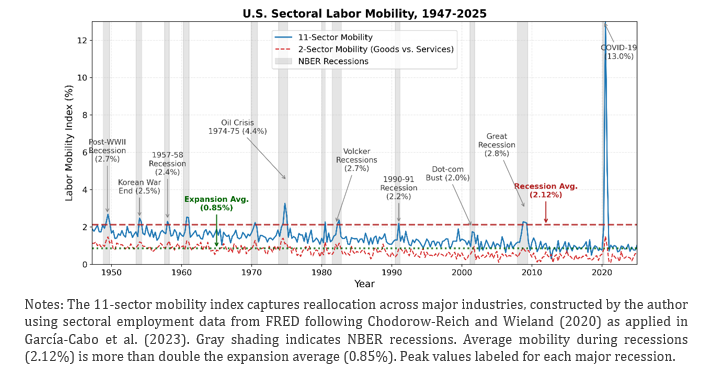
The countercyclical pattern is unmistakable: mobility spikes during every recession, averaging 2.12% compared to 0.85% during expansions. But look closer. The 1974–75 oil crisis sent mobility to 4.4%. The 2008 Great Recession peaked at 2.8%. The 1990–91 and 2001 recessions barely exceeded the recession average. COVID-19 produced an unprecedented 13% spike. These are not small differences—they span an order of magnitude. What explains this heterogeneity?
The theoretical explanation centers on downward nominal wage rigidity (DNWR)—the well-documented resistance of nominal wages to cuts. Following Jo and Zubairy (2025), consider how this rigidity interacts with inflation:
This mechanism generates a testable prediction: demand-side shocks (like fiscal news) should have larger mobility effects during demand recessions than during stagflation.
I test these predictions using state-dependent local projections applied to nine identified macroeconomic shocks spanning demand, financial, uncertainty, geopolitical, and supply categories. The empirical strategy follows Ramey and Zubairy (2018) for binary states (slack vs. expansion) and Jo and Zubairy (2025) for four-state decomposition distinguishing demand recessions from stagflation.
The baseline results in Figure 2 tell a familiar story. Uncertainty shocks dominate: macroeconomic uncertainty generates persistent positive mobility responses throughout the forecast period, consistent with the “wait-and-see” mechanism where uncertainty freezes hiring while layoffs continue. Financial conditions (EBP, NFCI) and trade policy uncertainty show similar patterns. These results align with existing literature on uncertainty and labor market dynamics.
But notice the fiscal news panel: no statistically significant effects at any horizon. A researcher examining only baseline results might reasonably conclude that fiscal policy has no effect on sectoral labor allocation. This conclusion would be premature.
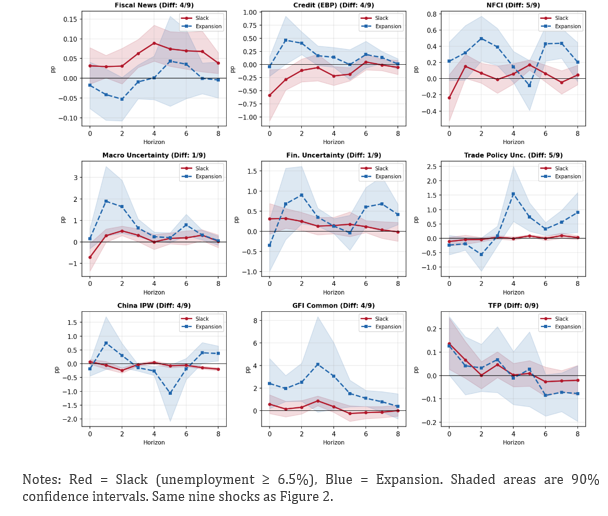
Figure 3 reveals why. When I allow responses to differ between slack and expansion periods following Ramey and Zubairy (2018), a “hidden effect” emerges. Fiscal news now shows positive mobility responses during slack, near-zero during expansions, with the difference statistically significant at medium-term horizons. Trade policy uncertainty exhibits even stronger state-dependence, suggesting workers displaced by trade uncertainty face fewer alternatives when labor markets are weak.
Figure 2. Baseline (Unconditional) Impulse Responses
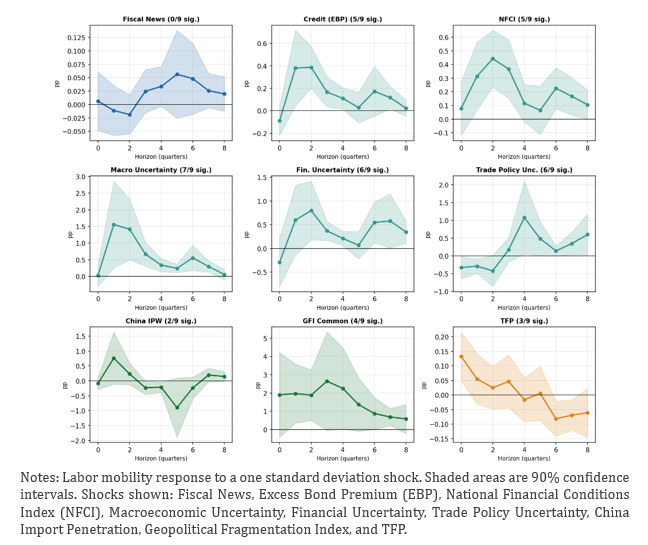
Figure 3. Ramey-Zubairy State-Dependent Responses (Slack vs. Expansion)
This raises a deeper question: is it merely being in a recession that matters, or does the type of recession matter?
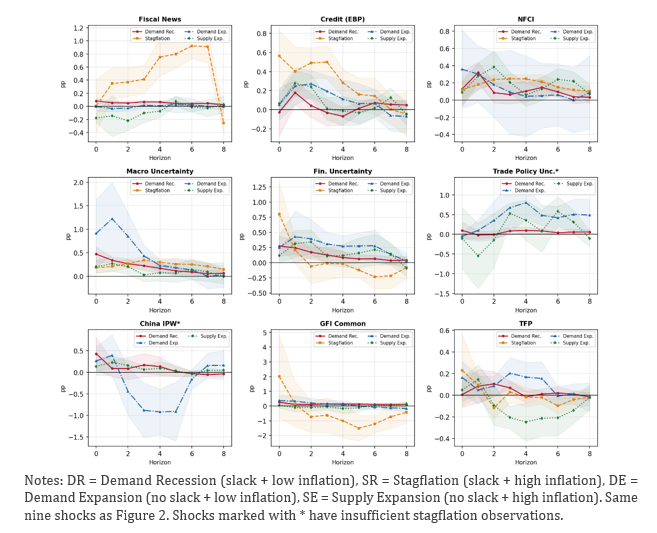
Figure 4 provides the answer: recession type matters substantially. The top-left panel shows the paper’s central result for fiscal news. During demand recessions (red), mobility rises sharply on impact, peaks around horizon 4, and remains elevated through two years. During stagflation (orange), the response is flat and statistically indistinguishable from zero. The difference between these two recession types is statistically significant throughout the forecast period—the strongest state-dependence finding in the study.
The economic logic follows directly from DNWR theory. Fiscal stimulus creates differential hiring across sectors—defense, construction, and healthcare typically expand more than others. During demand recessions with low inflation, DNWR binds tightly: workers cannot price themselves into jobs through wage concessions, so they must physically relocate to expanding sectors. During stagflation, inflation allows firms to cut real wages without nominal reductions, reducing the need for forced reallocation. The same fiscal shock, transmitted through radically different labor market adjustment mechanisms.
Figure 4. Four-State Decomposition—Does the Type of Recession Matter?
The central implication cuts across all shock categories: stabilization policy should be calibrated to recession type, not just recession depth. The same policy instrument can have dramatically different labor market consequences depending on the inflation environment. More specific implications follow for each policy domain:
Physicians have long understood that effective treatment requires accurate diagnosis. The evidence presented here suggests macroeconomic policy operates under a similar principle. The same shock can trigger substantial worker reallocation during demand recessions but leave sectoral employment patterns largely unchanged during stagflation. This is not a subtle difference—for fiscal news, the state-dependent gap is statistically significant and economically large throughout the two-year forecast horizon.
The mechanism — downward nominal wage rigidity binding more tightly when inflation is low — has been theorized in the fiscal multiplier literature but, to my knowledge, not previously documented in labor mobility data. The “hidden effect” phenomenon also carries a methodological warning: standard approaches that average across business cycle phases may systematically miss important policy channels, leading researchers to incorrectly conclude that certain shocks are ineffective.
When the next recession arrives, policymakers will face a familiar question: how aggressively should we stimulate? These findings suggest they should first answer a different question: what kind of recession is this?
Chodorow-Reich, G., & Wieland, J. (2020). Secular Labor Reallocation and Business Cycles. Journal of Political Economy, 128(6), 2245–2287.
García-Cabo, J., Lipińska, A., & Navarro, G. (2023). Sectoral Shocks, Reallocation, and Labor Market Policies. European Economic Review, 156, 104494.
Jo, Y., & Zubairy, S. (2025). State Dependent Government Spending Multipliers: Downward Nominal Wage Rigidity and Sources of Business Cycle Fluctuations. American Economic Journal: Macroeconomics, January 2025, 17(1).
Ramey, V. A., & Zubairy, S. (2018). Government Spending Multipliers in Good Times and in Bad: Evidence from US Historical Data. Journal of Political Economy, 126(2), 850–901.
Sabaj, E. (2026). State-Dependent Labor Mobility Responses to Macroeconomic Shocks: Does the Type of Recession Matter? Working Paper.