

This policy note is based on the Banque de France Working Paper No. 1033. The views expressed are those of the authors and do not necessarily reflect the position of the Banque de France.
Abstract
We explore the consequences of debt structure on the reaction of interest expense to interest rate changes, focusing on the case of euro area non-financial corporations (NFCs) aggregated by home country. We leverage detailed data on bank loans and debt securities to build NFC debt’s aggregate structure by maturity and interest type, and run a model to simulate the progressive repayment of borrowed amounts refinanced by issuing new debt at prevailing conditions, as well as the effect of variable-rate interests, given any joint future trajectory of outstanding amounts and interest rates, as represented by a full yield curve structure. The outcome evidences a strong dependence of the interest expense trajectory on debt structure, as the share of fixed-rate long-term debt varies widely across countries. We quantify the resulting differences in expense sensitivities to future interest rate changes.
When market interest rates rise, so does the cost of debt for economic agents. Those indebted at a variable rate see their interest charge increase with reference rates, and all indebted agents pay a higher cost on new debt. The exact timing and magnitude of the rise in interest expense depends on the structure of the “debt portfolio”, in particular on the allocation between fixed vs. floating rates and short vs. long maturities.
This brief examines the interest rate sensitivity of the cost of debt of non-financial corporations (NFCs, hereafter “companies”) in the euro area, aggregated by home country, as corporate debt exhibits a large geographical heterogeneity in structure, both in terms of maturity and of interest rate type (fixed vs. variable). We consider both past observations and future evolution as projected by a financial debt evolution model1.
The launch of AnaCredit by the Eurosystem in 2018 has made it possible to build a near-exhaustive picture of bank loans to corporate entities in the euro area. Another Eurosystem data source, the Central Securities Data Base (CSDB), provides similar information on debt securities, a less usual but still significant form of corporate debt. These databases provide precise information on each bank loan taken out and each debt security issued by companies, and in particular their current interest rate, type (fixed- or variable-rate), maturity and repayment schedule.
By design, AnaCredit and CSDB cover only part of NFCs’ interest-bearing liabilities. A comprehensive view of aggregate NFC debt, i.e. debt securities and loans, is provided country by country in the euro area’s national accounts, published in the ECB’s QSA (Quarterly Sectoral Accounts) database, cf. Figure 1. While the amounts of issued securities are close to the CSDB totals, a material proportion of loans are not in scope of AnaCredit reporting, which only covers loans granted by euro area banks. Hence, for instance, a loan granted to a European NFC by a bank in the United States, or a treasury facility provided by a foreign non-bank subsidiary, is not reported in AnaCredit. Such loans taken outside euro area banks are displayed in grey in Figure 1.
Figure 1. Coverage by country of consolidated NFC debt amounts
(as recorded in sectoral accounts at the end of 2024)
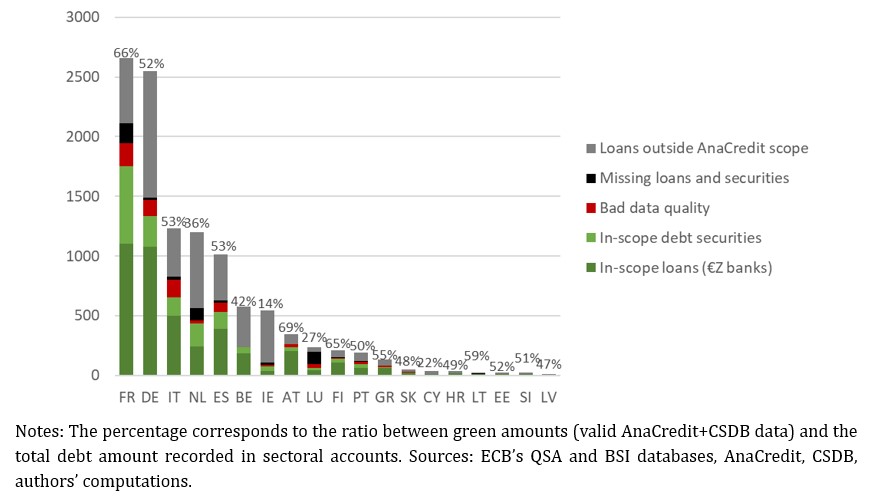
Out of the euro area bank loans and issued securities found in the sectoral accounts, we also exclude small amounts corresponding either to mismatches between sectoral accounts and detailed databases (black in Figure 1) or to missing or inconsistent maturity dates or interest rates (red in Figure 1).
Overall, the debt set on which reliable structural information is available represents 52% of the NFC consolidated debt amounts recognised in the national accounts at end-2024, at euro area level. When splitting by NFC home country, this share varies widely, from 69% for Austria and 66% for France, down to 27% for Luxembourg or even 14% in the case of Ireland. The remainder of this note focuses solely on the sub-perimeter where detailed information is available.
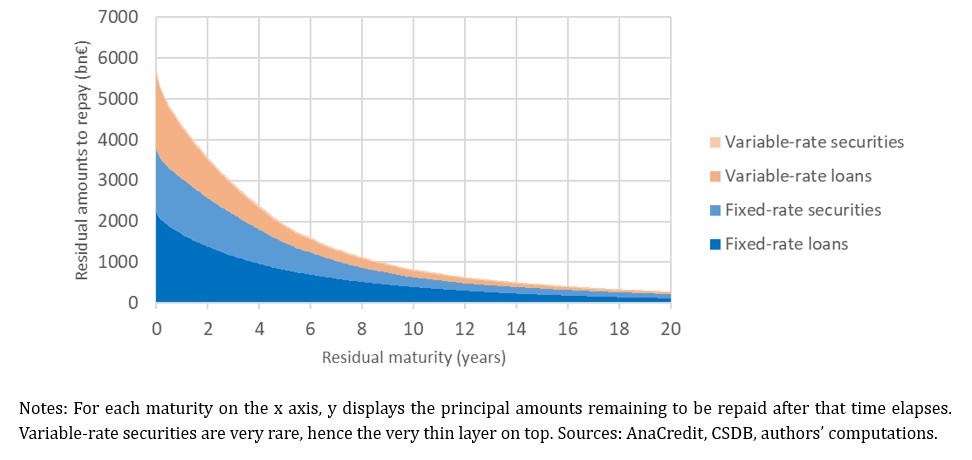
First considering all euro area NFCs together, Figure 2 displays the debt residual maturity structure as of the end of 2024 by product type (bank loans vs. debt securities) and by interest rate type (fixed- vs. variable-rate). 34% of the debt amount features a variable interest; it consists almost entirely of bank loans and tends to have a shorter maturity than fixed-rate debt. The median residual maturity is 3 years and two months. This figure takes loan amortisation into account: for most bank loans, the principal is progressively repaid through time, so that an amortising loan with a nominal residual maturity of 6 years actually has, in terms of principal repayments, an average residual maturity of about 3 years. Very long-term debt is quite rare, but some products extend to very long periods; there are even a few perpetual bonds with no defined maturity.
Figure 2. End-2024 structure of aggregated euro area NFC debt
(covered part)
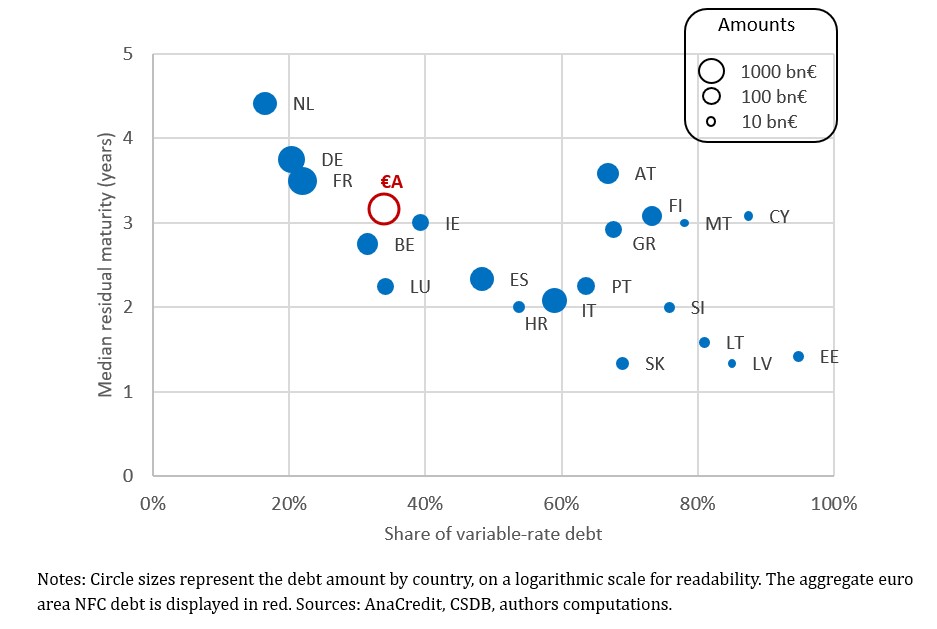
Considering now the repartition of the debt by home country of the corresponding NFCs, we can compute the same indicators (median maturity and variable-rate share) for each of the 20 euro area countries, cf. Figure 3. The chart shows a striking variety of profiles. On the left-hand side, the debt of French, German and Dutch companies (60% of the total debt) has a fairly long median maturity — around 4 years — and pay a large majority of fixed rates (around 80%). This means that their interest expense features a high degree of inertia and only gradually reacts to any change in the interest rate environment. On the right-hand side, more than 80% of the debt taken on by companies in the three Baltic states have variable rates, with a median maturity of hardly 18 months: this profile means that interest expenses react almost immediately to any rise or fall in interest rates. Most other countries, including Spain and Italy, are located between these two profiles, with a small group (Austria, Finland, Greece) combining longer maturities with a large share of variable rates. Although progressive changes of structure can be observed over time, these country-by-country characteristics are overall stable in the period 2020–2024. We offer no explanation for this heterogeneity, which would make for an interesting research topic in its own.
Figure 3. End-2024 structure of aggregated NFC debt by home country (modelled part): median residual maturity and share of variable-rate debt
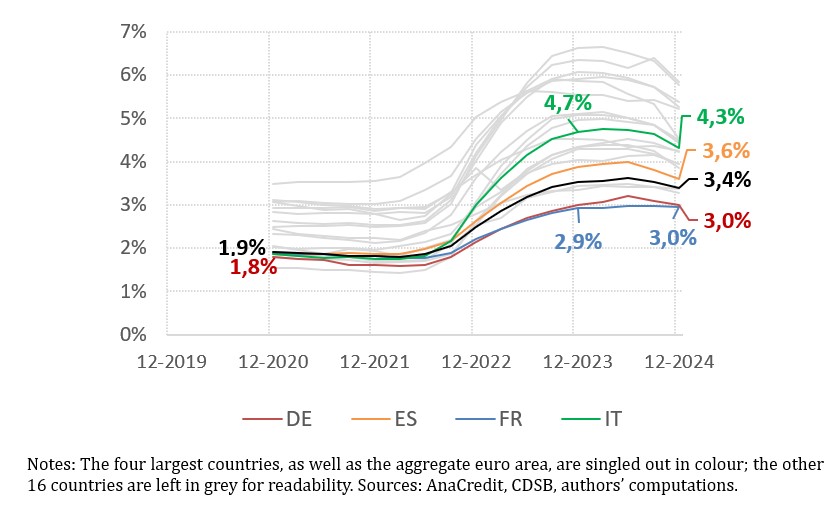
The market interest rate rise of 2022–23 enables us to confirm the expected relationship between changes in the cost of corporate debt and its structure. Between the end of 2021 and the end of 2023, euro short-term rates have risen by more than 4% and long-term rates by 2%. Over that same period, average interest rates on corporate debt rose in all euro area countries, but with wide differences in amplitude: within large economies, the interest rate for Italian NFCs have risen by +3% while French NFCs have only registered a +1% shock (cf. Figure 4).
A comparison with the debt structure reveals a strong correlation: the countries with shorter-maturing debt and larger proportions of variable rates are exactly those where interest charges have risen the fastest. This confirms that the structure of corporate debt largely determines the speed of adjustment of companies’ costs when interest rates change, even though other differentiating factors, such as risk premia, may also come into play. Consistently with that observation, when interest rates started falling back in 2024, Figure 4 shows that the cost of debt retreated in countries with short/variable debt, whereas the more gradual increase in cost continued in countries with long/fixed debt, as inexpensive fixed-rate loans taken out before 2022 kept being replaced by more expensive ones.
Figure 4. Average interest rate of the outstanding debt of euro area non-financial corporates
(aggregated by country)
The reaction of the cost of debt to a changing interest rate environment thus turns out to be a mostly predictable consequence of two effects: an immediate effect for variable-rate loans and a deferred effect for fixed-rate loans. It should then be possible to derive the timing and magnitude of the rise in interest expense from the allocation between fixed vs. variable rates, and short vs. long maturities.
To that effect, we built a simple yet flexible financial model to project the future interest expense attached to any debt portfolio whose structure is sufficiently well known, under any exogenous scenario prescribing the future evolution of debt amounts and market interest rates. The model simulates the run-off and re-issuance of existing debt, and interest rate adjustments through time. The future evolution of outstanding debt amounts is considered as exogenous, and the associated interest cost is then made to evolve, in a step-by-step approach, through three distinct processes: (1) extinction of maturing debt, (2) automatic adjustment of variable rates, and (3) issuance of new debt at then-prevailing interest rates. The model is based only on the present structure of the debt portfolio: outstanding amounts and average interest rate by debt type and by residual maturity, obtained by aggregating loan-by-loan and security-by-security information. In particular, the model does not rely on econometric estimations based on past behaviour; its main assumption is that debt structure is sufficiently stable. This forward-looking dimension makes it particularly well-suited for scenario analysis, including stress-testing, as the model can accommodate a wide variety of scenarios in terms of market interest rates and debt amounts, including dynamic scenarios, e.g. timed rise and fall of interest rate levels.
We run this model on each country’s aggregate NFC debt as of Dec. 2024 and over a five-year period (2025–29), using three different interest rate scenarios:
For the sake of the exercise, we assume that the amount of NFC debt increases uniformly over the period with an annual growth rate of 3%, extrapolated from recently observed evolutions. Nominal interest amounts in euros have little meaning in themselves, given the significant data gap between our inputs and actual debt amounts evidenced in Figure 1, so that we will restrict ourselves to showing average effective interest rate trajectories.
Running the reference market interest rate scenario, we obtain the 2025–29 projections for each of the 20 average effective interest rates, displayed in Figure 5. After the divergence caused by the rapid interest rate changes in 2022–23, the projection forecasts a return to less dispersed effective rates (abt. 2% difference between highest and lowest average rate, similar to the 2020 dispersion). On the short term, the projection features declining costs for countries with more short-term and variable-rate debt, a direct consequence of lower interest rates, that mirrors the sharper rise in costs in 2022–23. For countries with more long-term and fixed-rate debt, where the 2022–23 cost increase was much slower, the 2025 cost decline is small or even (for French NFCs) absent: a significant amount of low-rate pre-2022 debt is still outstanding, so that the gains from lower short-term rates are cancelled out by the losses from rolling over cheap maturing debt.
Figure 5. Average interest rate of the outstanding debt of euro area NFCs, “risk-neutral” scenario
(aggregated by country)
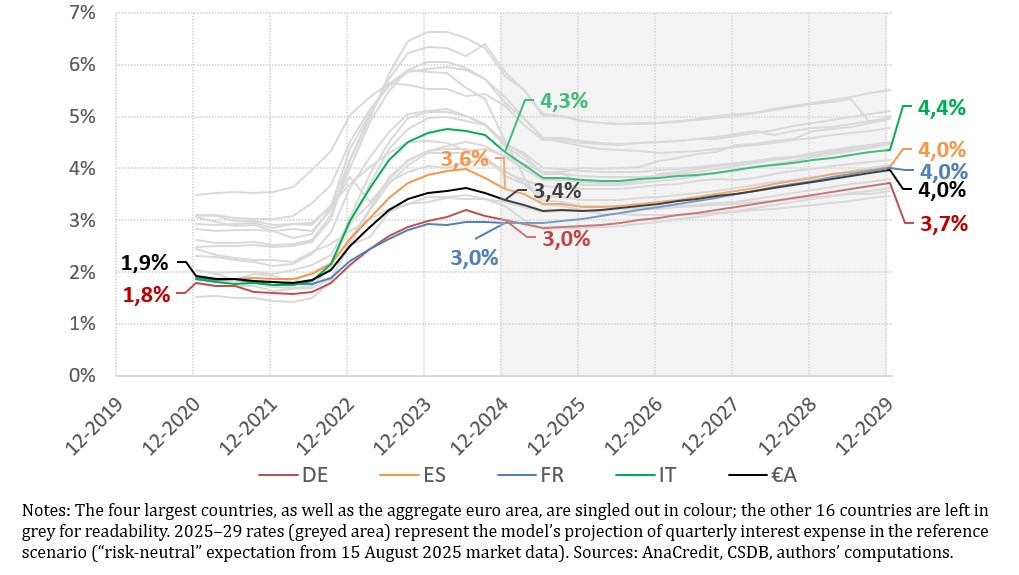
On the longer term, the slow increase in cost of debt in 2026–29 can be traced back to the scenario’s slow but persistent interest rate rise. Absent any brutal market interest rate variations, the consequences of debt structure heterogeneity are not directly visible, but the overall increase in average interest rate is projected higher for countries with longer debt structures: between Dec. 2025 and Dec. 2029, the model projects an average increase of 1.0% for French NFCs and 0.8% for German NFCs, compared to 0.6% for Italian NFCs. This can be understood both in terms of the persistence and slow disappearance of old debt contracted in a low market rate environment, and in terms of an upward-sloping term structure featuring more expensive interest rates for longer maturities.
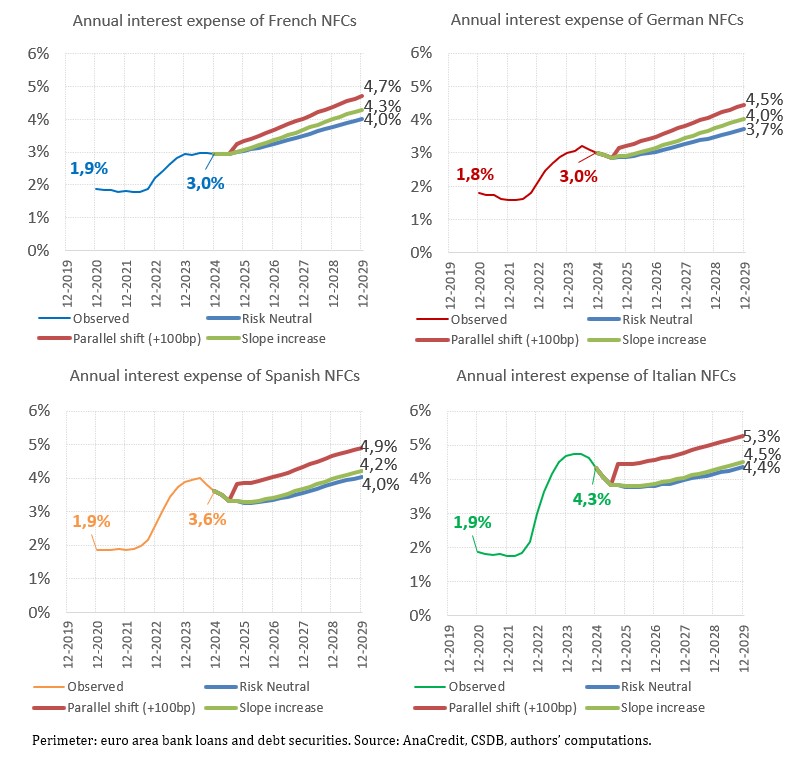
Structural differences are more obvious when turning to alternative interest rate scenarios. Isolating the four largest economies of the Eurozone, we confirm the expected sensitivity differences between long-term, fixed-rate debt (France and Germany) and shorter-term, variable-term debt (Spain and Italy), cf. Figure 6. In the parallel shift scenario, the average cost of debt of European NFCs increases abruptly for Italian or Spanish NFCs, whereas the effect on French and German ones is initially low and only builds up progressively, consistently with their respective debt structures. After 5 years of projection, the entire +100bp shock on market interest rate has not yet been fully transmitted to the total debt amount, since the fixed-rate debt with residual maturities higher than 5 years will still be outstanding at the simulation horizon.
The slope increase scenario quantifies how much company borrowing costs are affected by longer-term interest rates. In this scenario, and after 5 years, the French and German NFCs are projected to pay on average 29bp and 31bp more on their debt compared to the reference scenario, whereas Spanish and Italian NFCs, where long-term funding plays little role, are much less affected (+18bp and +14bp).
Figure 6. Interest rate cost sensitivity to interest rates for the aggregate NFCs
(of the four largest euro area countries)
As evidenced in the case of euro area non-financial corporations, the cost of debt of economic agents can be modelled and projected, following a simple financial approach, provided enough data on their debt structure. The model used in this brief performs well in terms of back-testing over 2019–24, as shown in the working paper. Given the differences in aggregate NFC debt structure between euro area countries debt costs, the model predicts a progressive convergence of average interest rates across euro area countries in stable scenarios, and a new split between “variable/short” and “fixed/long” countries in case of further interest rate shock.
See the related working paper (Banque de France Working Paper No. 1033) for a detailed exposition of this model, including another application to French public debt cost.