

This policy brief is a shortened, policy-oriented version of De Luigi et al. (2025), which contains all necessary technical details and a more extensive description of the empirical results. The views expressed are those of the authors and not necessarily those of the institutions the authors are affiliated with.
Abstract
This policy brief explores how monetary policy interacted with macroprudential policies in eleven EU countries from Central, Eastern, and Southeastern Europe (CESEE) between 2000 and 2019. Based on a smooth-transition vector autoregressive model, we analyse how the effects of monetary policy (interest rate) shocks depend on both the macroprudential policy stance and the type of exchange rate regime in place. We find that in countries with a flexible exchange rate regime, monetary tightening tends to persist longer and is often offset by easing macroprudential measures, particularly when they were already stringent to begin with. This pattern is less evident in fixed exchange rate countries, where shocks to the interest rate do not always represent independent monetary policy actions. Overall, muted macrofinancial responses across the sample suggest that macroprudential measures may counterbalance the effect of monetary policy shocks, and that traditional monetary tools were less effective in the latter half of our sample period. These results underline the importance of incorporating macroprudential indicators into monetary policy analysis and contribute to discussions on policy coordination, offering insights for optimizing policy mixes to enhance economic and financial resilience.
Understanding the interplay between monetary and macroprudential policies is crucial for designing measures that consider both price and financial stability. Both theoretical and empirical studies suggest that these policies are often complementary: macroprudential tools can reduce macroeconomic volatility over the long term and are better suited to address risks in specific financial segments, while monetary policy influences the broader economy. However, there is less consensus on their short-term interaction. Because both operate through similar transmission channels – such as lending, balance sheets, and risk-taking – their combined effects may produce unintended consequences (for a broader discussion, see Albertazzi et al., 2021).
Countries in Central, Eastern, and Southeastern Europe (CESEE) provide compelling case studies for jointly analysing macroprudential and monetary policies. These economies introduced a broad range of macroprudential tools earlier than many advanced peers and experienced notable shifts in monetary policy regimes. Eller et al. (2021a)1 examine how the effectiveness of macroprudential policy in CESEE depends on the monetary policy stance. They find that tighter macroprudential measures effectively contain domestic private credit growth and gross capital inflows, with these effects being stronger and more immediate in a low-interest-rate environment.
Building on this line of research, we adopt a similar approach to Eller et al. (2021a) but address the reverse question, analysing how the effectiveness of monetary policy, captured by short-term interest rate shocks2, varies across environments with different degrees of macroprudential policy tightness. We focus our analysis on the eleven CESEE EU member states over the period 2000–2019.3
Over the past three decades, monetary and macroprudential policies in CESEE have evolved substantially as these economies moved from post-transition stabilization toward EU integration. Initially, most countries adopted fixed or tightly managed exchange rate regimes to anchor expectations and curb inflation. Over time, several economies – including Czechia, Poland, Hungary, and Romania – shifted toward inflation-targeting frameworks with greater exchange rate flexibility, while others, such as the Baltic states, Slovakia, Slovenia, Bulgaria, and Croatia, maintained fixed pegs and eventually joined the euro area.
In parallel, CESEE countries were early adopters of macroprudential measures, initially introduced as “administrative” tools to curb excessive credit growth in the years before the global financial crisis (GFC). Following the GFC, macroprudential policy first stabilized somewhat and then tightened again in the region after 2010, with an increasing emphasis on borrower-based measures and the introduction of capital buffers from 2014 onward. To assess macroprudential policy tightness, we rely on the intensity-adjusted Macroprudential Policy Index (MPPI) developed by Eller et al. (2020). This index integrates capital-, liquidity-, and borrower-based instruments, as well as minimum capital and reserve requirements.4
Chart 1 illustrates the evolution of the two key policy variables – the short-term interest rate (STIR) and the MPPI – across the eleven CESEE countries between 2000 and 2019. The early part of the sample shows high volatility in short-term rates in several economies, while the post-GFC period is characterized by generally lower interest rates. At the same time, MPPI exhibits a steady upward trend in several countries, reflecting the increasing use of macroprudential instruments in the second half of the sample. These opposing developments – monetary easing alongside macroprudential tightening – especially in the years following the GFC and preceding the COVID-19 pandemic, highlight the importance of understanding how the two policy domains interact in supporting price and financial stability.
Chart 1. Evolution of the macroprudential policy index and the short-term interest rate in CESEE.
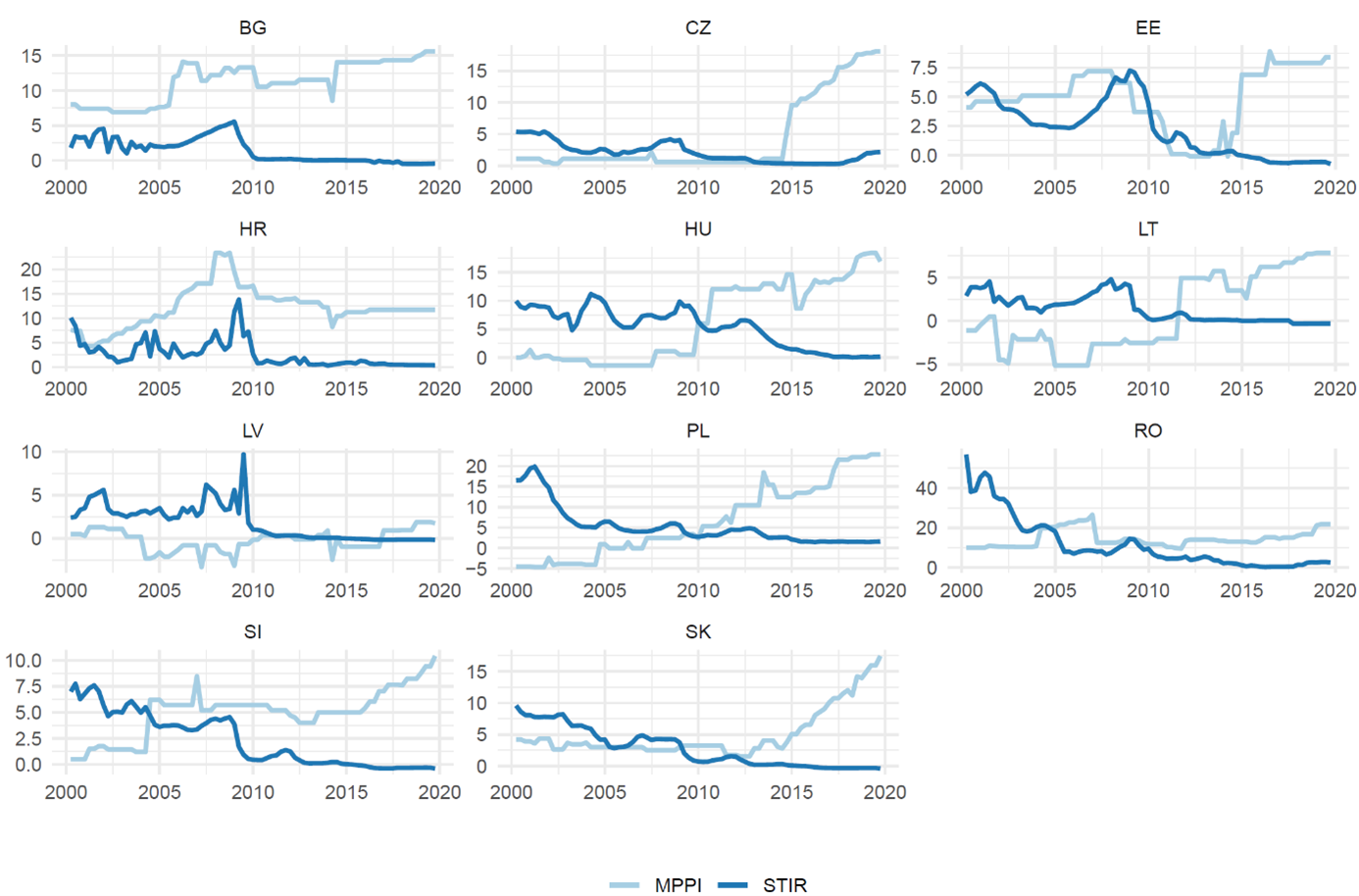
Notes: Macroprudential policy index (MPPI) in index points (source: Eller et al., 2020) and short-term interest rate (STIR, typically 3-month money market rate) in percent (source: IMF International Financial Statistics).
To explore the country-specific responses to a monetary policy shock, depending on whether the economy faces a comparatively tight or loose macroprudential policy environment, we utilize a smooth-transition vector autoregression (ST-VAR) framework. ST-VAR models are particularly useful for analysing shocks in different policy environments, as they enable the identification of potential nonlinear policy effects conditional on a selected indicator variable, in our case, the MPPI (for more details, see De Luigi et al., 2025). Based on the results from this framework, charts 2 and 3 display the country-specific responses of selected macrofinancial variables to a one-standard-deviation tightening shock in short-term interest rates, measured one year after impact, and under different levels of macroprudential policy tightness.5
Chart 2 presents the results for the flexible exchange rate countries (Poland, Hungary, Czechia, and Romania). It becomes apparent that within a relatively loose macroprudential policy environment (L), the impact of monetary policy tightening tends to linger longer, as indicated by positive median responses of the STIR. This suggests that the effectiveness of monetary policy tightening might be partially mitigated by the more lenient macroprudential policy stance, potentially necessitating a prolonged period of tighter monetary policy. In Czechia, persistence in the monetary policy tightening shock can also be observed within a tight macroprudential policy environment. Turning to the macroprudential policy response, we observe predominantly negative median responses, particularly in cases of an already tight macroprudential policy regime. This suggests that monetary tightening might be partially offset by subsequent macroprudential easing, corroborating the findings of Kim et al. (2019). Tightening monetary policy within an already tight macroprudential policy environment could worsen financing conditions and exacerbate loan repayment pressures. Therefore, some macroprudential easing could alleviate these pressures and allow monetary policy to remain tight for an extended period if needed.
Chart 3 moves the focus to fixed exchange rate countries (Bulgaria, Estonia, Latvia, Slovenia, Slovakia, Lithuania, and Croatia). Here the results reveal a more distinct pattern compared to the flexible exchange rate countries previously discussed. We can no longer observe that there is more persistence in the short-term interest rate shock in a loose macroprudential policy environment. On the contrary, the persistence of the interest rate tightening shock is now more strongly pronounced within a tight macroprudential policy environment (T). Given the constrained flexibility of monetary policy and limited role of the exchange rate channel for the transmission of interest rates in these countries, other economic policy areas, such as macroprudential policy, may need to align in the same direction to achieve the desired effects. However, responses of the MPPI vary significantly across fixed exchange rate countries, with both positive and negative responses, highlighting the complexity of policy interactions. Notably, while an easing macroprudential response to positive interest rate shocks was consistently observed among flexible exchange rate countries, for fixed exchange rate countries this pattern appears only in Bulgaria and Croatia under a loose, and in Lithuania under a tight, macroprudential policy environment.
Overall, our analysis uncovers notable variations in the effects of monetary policy (interest rate) shocks, influenced by the tightness of macroprudential policies and differences between flexible and fixed exchange rate regimes. In flexible exchange rate countries, monetary policy shocks tend to persist longer, and macroprudential policies often respond with easing measures, suggesting a counterbalancing effect that mitigates some macrofinancial impacts of monetary tightening. This pattern is less evident in fixed exchange rate countries, except in active users of macroprudential policies like Bulgaria and Croatia.
For both flexible and fixed exchange rate countries, responses of macrofinancial variables to interest rate shocks are often subdued, possibly due to the counterbalancing effect of macroprudential policies (as also documented in Imbierowicz et al., 2019; Kim et al. 2019; Acharya et al., 2020; Buch et al., 2022), and the challenges central banks faced in elevating inflation rates with conventional monetary policy tools post-GFC – a phenomenon not unique to CESEE. However, the results also reveal some counterintuitive patterns – such as inflation and credit puzzles – particularly in fixed exchange rate countries, which lack an independent monetary policy and are more vulnerable to external shocks, often leading to greater macroeconomic volatility (as highlighted by Khan, 2017).
Chart 2. Responses to a monetary policy tightening shock under different levels of macroprudential policy tightness, flexible exchange rate countries.
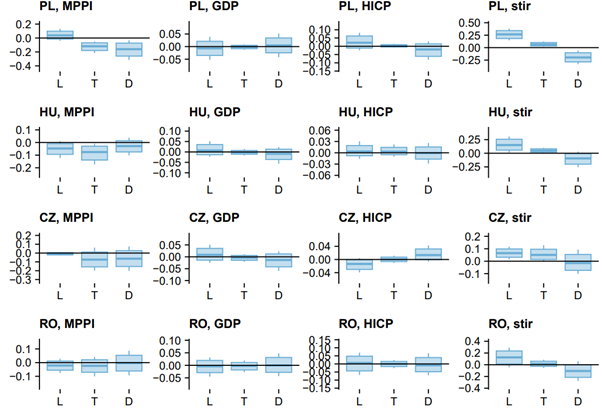
Source: De Luigi et al. (2025). Notes: Impulse responses of the macroprudential policy index (MPPI), quarter-on-quarter real GDP growth (GDP), quarter-on-quarter inflation (HICP), and the short-term interest rate (STIR) to a one-standard-deviation tightening shock in the STIR, one year after impact, are summarized in form of a boxplot. The solid line indicates the median response, the shaded box represents the middle 50% of the posterior distribution, and the whiskers mark the 68% posterior credible set. Responses are reported separately for a tight (T) and loose (L) macroprudential policy stance. In addition, we show the difference in responses between the tight and loose regime (D).
Chart 3. Responses to a monetary policy tightening shock under different levels of macroprudential policy tightness, fixed exchange rate countries.
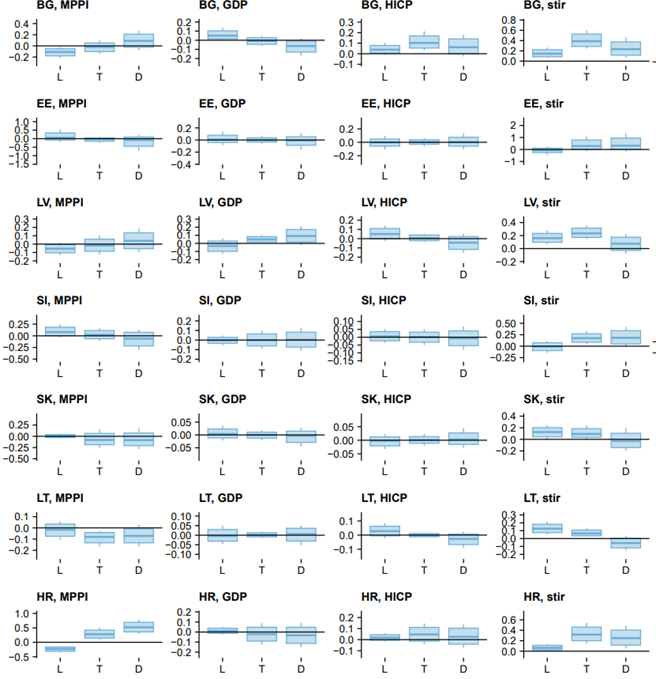
Source and notes: see chart 2.
We have examined the interaction between monetary and macroprudential policies in CESEE countries, using a smooth-transition VAR model to assess how the macroprudential policy environment influence the effects of nominal short-term interest rate shocks.
We find that macroprudential policies often dampen the impact of interest rate adjustments, particularly in countries with flexible exchange rates. In this context, macroprudential easing can offset the effects of monetary tightening – particularly when macroprudential conditions are already tight – by easing loan repayment pressures and allowing monetary policy to remain restrictive for longer if needed. This aligns with Detken et al. (2025), who argue that early activation of macroprudential measures such as the countercyclical capital buffer builds resilience and creates policy space. By releasing buffers when financial conditions tighten, macroprudential authorities can support the monetary policy effectiveness without compromising financial stability.
In contrast, in fixed exchange rate countries, the interaction between interest rate shocks and macroprudential policies is less straightforward. The constraints imposed by fixed exchange rates limit the scope of monetary policy actions, necessitating more nuanced macroprudential interventions. In such environments, we observe that macroprudential policies need to be particularly well-calibrated to ensure they complement any changes in interest rates effectively.
The variation of policy interactions across different regimes suggests that a one-size-fits-all policy approach may not be appropriate. Our results highlight that policymakers can learn about the speed and strength of monetary policy transmission when taking the macroprudential policy stance into account. Even outside CESEE, monetary authorities should factor in the specific macroprudential environment when designing and implementing policy measures, as these factors can significantly influence the success and repercussions of policies. Furthermore, effective communication between monetary and macroprudential authorities are essential to align policies and manage potential conflicts, which is particularly important in the euro area with its diverse economic landscape.
Our findings contribute to the broader debate on optimal policy mixes, particularly in regions with more volatile macrofinancial environments. Future research could build on this and explore the long-term policy interactions or compare the effectiveness of monetary policy depending on the stringency of different macroprudential tools (e.g., capital-based versus borrower-based measures), offering deeper insights into how macroprudential frameworks shape monetary policy transmission.
Acharya, V. V., B. Imbierowicz, S. Steffen, and D. Teichmann. 2020. Does the Lack of Financial Stability Impair the Transmission of Monetary Policy? Journal of Financial Economics 138 (2): 342–65.
Barmeier, M., M. Eller, and R. Martin. 2025. Navigating through high-interest environment: macroprudential policy in CESEE. SUERF Policy Brief no. 1210, July 2025.
Buch, C. M., S. Eickmeier, and E. Prieto. 2022. Banking Deregulation, Macroeconomic Dynamics and Monetary Policy. Journal of Financial Stability 63: 101057.
Albertazzi, U. et al. 2021. The role of financial stability considerations in monetary policy and the interaction with macroprudential policy in the euro area. ECB Occasional Paper no. 272, September 2021.
De Luigi, C., M. Eller, and A. Stelzer. 2025. Conditional dynamics of monetary policy shocks: the mitigating role of macroprudential policy in CESEE. OeNB Bulletin Q1/25. 22–49.
Detken, C., H. S. Hempell, and M. Pirovano. 2025. Macroprudential and monetary policy interaction: the role of early activation of the countercyclical capital buffer. ECB Macroprudential Bulletin 31, August 2025.
Eller, M., R. Martin, H. Schuberth, and L. Vashold. 2020. Macroprudential Policies in CESEE–an Intensity-Adjusted Approach. Focus on European Economic Integration Q 2: 65–81.
Eller, M., N. Hauzenberger, F. Huber, H. Schuberth, and L. Vashold. 2021a. The Impact of Macroprudential Policies on Capital Flows in CESEE. Journal of International Money and Finance 119: 102495.
Eller, M., N. Hauzenberger, F. Huber, H. Schuberth, and L. Vashold. 2021b. The impact of macroprudential policies on capital flows in CESEE. SUERF Policy Brief no. 199, October 2021.
Eller, M., R. Martin, H. Schuberth and L. Vashold. 2020. Macroprudential policies in CESEE – an intensity-adjusted approach. OeNB Focus on European Economic Integration Q2/20. 65–81.
Imbierowicz, B., A. Löffler, and U. Vogel. 2019. The transmission of bank capital requirements and monetary policy to bank lending. Discussion Papers 49/2019. Deutsche Bundesbank.
Khan, N. 2017. Monetary Regimes and External Shocks Reaction: Empirical Investigations on Eastern European Economies. The Romanian Economic Journal 20 (66): 63–81.
Kim, J., S. Kim, and A. Mehrotra. 2019. Macroprudential Policy in Asia. Journal of Asian Economics 65: 101149.
This paper was also summarized in SUERF Policy Brief No. 199 (Eller et al., 2021b).
We use the short-term interest rate as a proxy for the monetary policy stance and refer to monetary policy and interest rate shocks interchangeably. It should be noted, however, that in some of the countries under study – those operating with varying degrees of fixed exchange rate arrangements – monetary policy is constrained, and domestic interest rates may partly reflect movements in the anchor country’s rates. Despite the limited scope for independent monetary policy in such cases, short-term interest rate changes still capture shifts in overall monetary conditions that influence credit dynamics and economic activity, whether these shifts originate domestically or from external sources.
The choice of the time sample reflects data availability and the high volatility of several series before 2000 and after 2019, following the outbreak of the COVID-19 pandemic.
It weights and aggregates these measures according to their implementation impact and legal force, distinguishing between recommendations and binding regulations, and between announcement and implementation dates. An update of the index, together with a discussion of how macroprudential policy in CESEE adapted to the post-pandemic environment of high inflation and rising interest rates, is provided in SUERF Policy Brief No. 1210 (Barmeier et al., 2025).
The full set of results, including responses one quarter after impact and for additional macrofinancial variables, is presented in De Luigi et al. (2025).