
This policy brief is based on Banca d’Italia Working Papers No. 1541. The views expressed are those of the author and not necessarily those of the institutions the author is affiliated with.
Abstract
Unexpected cold spells can have larger short-run macroeconomic effects than unexpected heat. For the United States over 1975-2019, cold shocks reduce industrial production and consumer prices and are followed by lower short-term interest rates, while heat shocks have no statistically significant aggregate effects in the baseline estimates. Winter cold also depresses consumption, raises macroeconomic uncertainty and disaster risk, and is followed by weaker investment. The findings suggest that climate adaptation should account for unexpected cold extremes as well as heat.
Climate risks are usually discussed through rising average temperatures and heat waves. Yet short-lived cold extremes can also matter for the business cycle, especially when they arrive unexpectedly and disrupt spending, production and prices.
The paper therefore focuses on temperature surprises. Households and firms can anticipate normal seasonality and adapt gradually to persistent local changes; an unusual concentration of very hot or cold days in a short time span relative to recent local experience is harder to absorb. Measured this way, heat and cold have very different macroeconomic effects.
The analysis uses daily temperatures for 3,053 US counties and constructs monthly surprises from 1975 to 2019. For each county and month, unusually hot or cold days are compared with what would have been expected from the previous five years. The thresholds therefore adjust to local climate experience.
County surprises are then combined into nationwide shocks using population weights. The sample covers more than 98% of US population, employment and personal income by the end of the period.
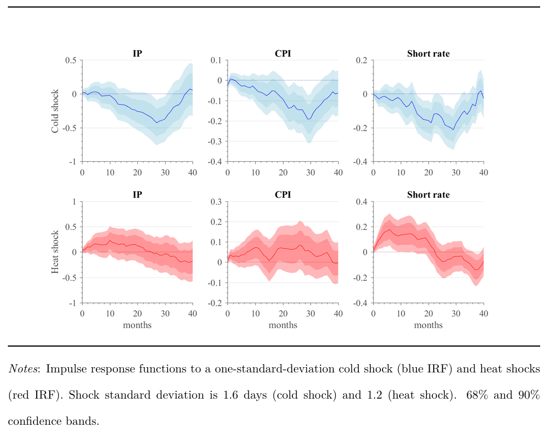
Following an unexpected cold spell, industrial production declines gradually, consumer prices fall and short-term interest rates move down, with the largest effects roughly 20-30 months after the shock. Heat shocks, by contrast, have no statistically significant aggregate effects in the baseline estimates.
Two features of the cold-shock response are especially important for policy.
First, cold shocks behave mainly like demand shocks: output and prices fall together, while short-term rates decline as monetary policy responds to weaker activity and inflation.
Second, the effects are economically meaningful: a one-day cold surprise lowers industrial production by about 0.27% after 28 months, the CPI by 0.12%, and the three-month rate by 13 basis points.
The asymmetry also appears in local data: county GDP falls after cold surprises, while heat surprises have no significant effect. The main findings are robust to alternative definitions of extremes, aggregation weights and learning windows.
Treating “extreme temperature” as a single shock can therefore hide economically important differences between hot and cold events.
Consumption is the first channel. Apart from the increase in electricity consumption observed in both cases, winter cold reduces both goods and services spending, while summer heat mainly shifts expenditure from services toward goods, leaving aggregate consumption broadly unchanged.
Uncertainty appears to be a second transmission channel. Macroeconomic uncertainty rises immediately after winter cold shocks, while the response to summer heat shocks is not statistically significant. This matters because higher uncertainty can weigh on spending and investment decisions, helping to propagate the initial demand shock over time. Consistent with this mechanism, at quarterly frequency GDP declines on impact following a cold shock, while investment contracts more gradually, suggesting that the effects extend beyond the immediate disruption and contribute to the persistence of the downturn.
Geography reinforces the asymmetry. Cold shocks have been strongest in the northern United States, as well as in California and parts of the East Coast, while heat shocks are concentrated more heavily in the Sun Belt. Cold shocks also tend to hit areas with higher per-capita consumption.
Overall, cold shocks combine a broad fall in spending with higher uncertainty and disaster risk; heat shocks trigger more limited expenditure reallocation.
The findings carry several implications for adaptation, economic surveillance and monetary policy.
First, adaptation should not focus exclusively on heat. Preparedness for unexpected cold spells can remain economically relevant even in a warming world, particularly where infrastructure, households and firms are less adapted to unusual winter conditions.
Second, climate shocks can matter through uncertainty as well as through the direct effects of weather. Cold shocks are followed by more natural disasters and higher macroeconomic uncertainty, while investment responds more gradually than output. Monitoring climate risk therefore also requires attention to the potential knock-on effects on confidence, investment and financial conditions.
Third, not every climate-related shock is an inflationary supply disturbance. In this US sample, cold shocks lower both output and prices and are followed by lower short-term rates. Policymakers need to distinguish whether weather mainly disrupts supply, depresses demand or raises uncertainty.
Figure 1. Baseline estimates: cold versus heat shocks