

The views expressed are those of the author and not necessarily those of the institutions the author is affiliated with.
Abstract
Building on D’Orazio (2025), this policy brief analyses climate-related financial policies (CRFPs) in African countries from 2000–2025. African financial systems face growing physical and transition risks, but regulatory responses are fragmented and often voluntary. Using a new CRFP dataset, we cover five areas: prudential tools, green credit allocation, sustainable finance guidelines, disclosure rules, and green bond frameworks. Governments and central banks have advanced prudential and disclosure measures, while market actors favour voluntary initiatives. Cluster analysis yields five country groups, from comprehensive mandatory frameworks (e.g., Ghana and South Africa) to minimal measures in many economies. Adoption rose after the Paris Agreement, then slowed. Priorities: enforce rules, deepen sustainable finance markets, and harmonise regionally.
African economies contribute a small share of global greenhouse gas emissions but are among the most exposed to climate shocks and to the financial fallout from the low-carbon transition (IPCC, 2023). Physical risks – droughts, floods, storms and heatwaves – threaten productive assets, collateral values and sovereign debt sustainability, while transition risks – driven by global decarbonisation, changing investor preferences and technology shifts – can undermine fossil-fuel-dependent business models and strain public finances (Atwoli et al., 2022). These vulnerabilities interact with existing structural constraints, including shallow financial markets, high informality, limited fiscal space and weaker supervisory capacity, so that, without credible climate-related financial policies (CRFPs), climate shocks and transition dynamics can propagate rapidly through banking systems, capital markets and sovereign balance sheets, amplifying macro-financial instability (Fowowe and Folarin, 2019). In this context, climate-related financial regulation should not be regarded as an optional ESG complement, but as an integral element of the financial stability framework and a necessary condition for mobilising private capital at scale towards climate-resilient and low-carbon investment (BCBS, 2021; NGFS, 2019). For African regulators, ignoring climate risk is now a financial stability risk in itself.
Empirical evidence based on ND-GAIN indicators shows large cross-country differences in exposure, vulnerability and institutional readiness for climate adaptation. Countries in the Sahel and parts of East and Southern Africa exhibit high exposure to climate hazards, while several Central African economies combine high vulnerability with very limited readiness. By contrast, countries such as South Africa, Morocco and Mauritius display stronger institutional and financial capacity to manage climate shocks.
Transition risks are most acute in fossil-fuel-intensive economies – notably South Africa, Algeria, Egypt, Nigeria and Angola – where carbon-intensive sectors underpin export earnings, employment and fiscal revenues. As global demand for coal, oil and gas declines, these economies face heightened risks of stranded assets, deteriorating credit profiles and capital outflows unless they proactively manage the transition.
The asymmetry is stark: many African economies are simultaneously highly climate-vulnerable and financially fragile, yet operate in an increasingly climate-sensitive global financial system. This underscores the need for coherent climate-related financial policies (CRFPs) that both contain risk and crowd in climate-aligned investment.
Using an updated database of climate-related financial policies in Africa covering 2000–2025 recent research (D’Orazio 2025) classifies measures into five core areas: green prudential regulation, green credit allocation, sustainable finance guidelines, disclosure requirements and green bond frameworks, with a further breakdown by bindingness (mandatory, voluntary, unspecified) and implementing authority.
The database shows that South Africa, Kenya, Morocco and Egypt are among the most active jurisdictions in adopting climate-related financial policies, while many Central and West African economies, such as Chad, have introduced only a handful of measures. Across the continent, mandatory instruments are largely issued by governments and central banks, whereas disclosure requirements and green finance guidelines promoted by stock exchanges and banking associations remain predominantly voluntary.
The first striking pattern is the strong momentum in policy adoption followed by a recent deceleration. The number of climate-related financial policies expanded steadily from around 2010, with a clear acceleration after the 2015 Paris Agreement and a peak in new measures around 2017. Since then, the flow of new initiatives has slowed, even though cumulative coverage continues to grow. This suggests that many countries have already implemented relatively straightforward measures, and that additional progress increasingly requires more complex reforms, greater inter-agency coordination and enhanced technical capacity.
A second pattern is that the policy landscape across the continent is predominantly voluntary rather than binding. Prudential measures are the main exception: when climate risk is integrated into supervisory frameworks, this is typically done through mandatory tools that apply to regulated institutions. By contrast, disclosure requirements, sustainable finance guidelines and numerous green bond frameworks are often issued as voluntary codes, best-practice principles or soft-law instruments. While these initiatives can play an important signalling and learning role, their non-binding nature limits their enforceability and impact.
The third pattern concerns the distribution of institutional leadership. Governments, central banks and financial supervisors account for most mandatory policies and effectively provide the regulatory backbone of the emerging climate-related financial architecture. Market actors, such as stock exchanges and banking associations, tend to concentrate on voluntary initiatives that encourage environmental, social and governance disclosure or promote green lending and issuance. The result is a dual-track system in which a relatively narrow set of public authorities anchor binding rules, while a wider ecosystem of private and quasi-public institutions promotes voluntary practices. This configuration has facilitated experimentation but has also constrained the overall credibility and effectiveness of the framework, given that a large share of measures remains outside the scope of formal enforcement.
The analysis groups African countries into five distinct clusters using K-means and hierarchical clustering, based on the mix of climate-related financial policy instruments and the extent to which they are mandatory or voluntary. This typology highlights the diversity of regulatory approaches and the different stages of development of climate-related financial governance across the continent. Figure 1 summarises the geographic distribution of these five clusters across Africa.
Figure 1. Geographic distribution of climate-related financial policies in Africa using K-means clustering
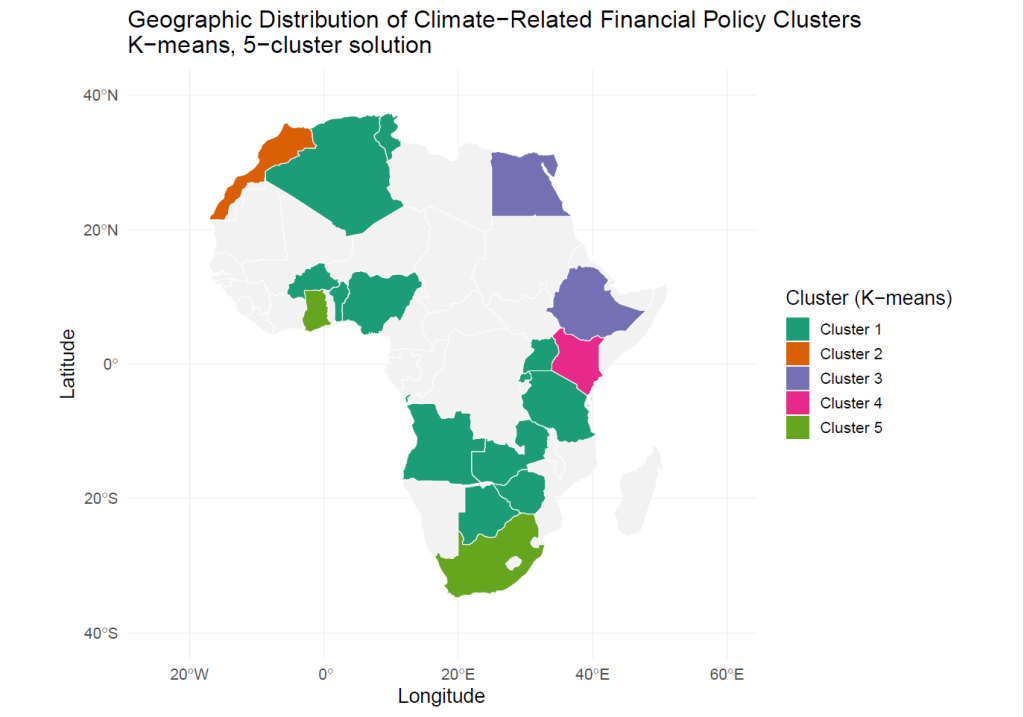
The first group comprises regulatory frontrunners, notably Ghana and South Africa. These countries have developed the most comprehensive and diversified frameworks, combining green prudential standards, sustainable finance guidelines and disclosure requirements, alongside emerging green bond markets. Their policy architecture is relatively mature, with a strong emphasis on mandatory instruments, and they are well placed to act as regional reference points for regulatory practice and market standards.
A second configuration is represented by Kenya, which can be characterised as an emerging green finance hub. Kenya has built a rapidly evolving framework centred on sustainable finance guidelines and disclosure tools, supported by an active banking initiative and growing market engagement. However, a significant share of these measures remains voluntary, and institutional capacity for climate risk supervision is still being strengthened, implying that enforcement and integration into core prudential processes are works in progress.
A third group includes countries such as Egypt and Ethiopia, which can be described as market-led transitioners. Their frameworks place relatively greater weight on disclosure requirements and green bond instruments, with a blend of voluntary and mandatory elements. These countries are leveraging capital markets to drive climate-related financial innovation but would benefit from a more systematic integration of climate risks into prudential regulation and supervisory practice in order to underpin market developments with a stronger regulatory foundation.
Morocco forms a more focused but narrower framework type. Its climate-related financial policies are concentrated on green bond standards and sustainable finance guidelines, often aligned with international investor expectations and global market practices. While this focus has helped to support specific segments of sustainable finance, the overall framework would need to be broadened to encompass prudential tools, supervisory expectations and more comprehensive disclosure rules if it is to provide a full climate-risk governance architecture.
The largest cluster consists of early-stage adopters, which include many Sub-Saharan economies such as Algeria, Angola and Nigeria. These countries have introduced only a small number of climate-related financial policies, and most of these are voluntary. Their policy portfolios are thin, with limited use of prudential measures or binding disclosure requirements, reflecting both capacity constraints and competing policy priorities. In many of these jurisdictions, climate-related financial governance is still at an exploratory or pilot stage.
Taken together, this five-cluster typology underscores that there is no single African model of climate-related financial regulation. Countries differ markedly in terms of ambition, instrument mix and institutional robustness. Policy roadmaps must therefore be tailored to each cluster’s starting point, risk profile and administrative capacity, rather than relying on generic templates or one-size-fits-all recommendations.
Advancing from symbolic commitments to effective climate-related financial governance in Africa requires a strategic shift from fragmented, predominantly voluntary measures towards coherent and enforceable frameworks. A first priority is to upgrade voluntary codes and guidelines into proportionate but binding standards. This involves introducing mandatory climate-risk disclosure requirements for banks, insurers and listed companies, aligned as far as feasible with evolving international norms, and embedding climate considerations in supervisory methodologies such as portfolio reviews, risk dashboards and, over time, climate stress tests and scenario analysis. It also implies clarifying and, where necessary, revising the mandates of central banks and supervisory authorities so that they explicitly encompass climate-related financial stability risks and provide a robust legal basis for intervention.
A second priority is to scale up green bond markets and broader sustainable finance activities so that regulatory frameworks are matched by actual capital flows. This requires the development of clear and credible national or regional taxonomies that are interoperable with global frameworks and minimise the risk of greenwashing, as well as the standardisation of green bond guidelines and sustainability-linked lending principles to reduce transaction costs and enhance investor confidence. Public development banks and guarantee schemes can play a catalytic role by de-risking early transactions, demonstrating viable structures and crowding in private investors who might otherwise be reluctant to enter nascent markets. Scaling up green bond markets and sustainable finance activities is essential if regulatory frameworks are to translate into actual capital flows, rather than remain largely declaratory.
A third priority is to address transition risks in fossil-fuel-dependent economies more directly and systematically. Countries with high reliance on coal, oil or gas need targeted assessments of financial sector exposures to carbon-intensive sectors and sovereigns, to understand potential channels of stress and to plan for a managed reallocation of capital. Just-transition financing strategies that combine concessional resources, blended finance instruments and labour-market and social policies are necessary to mitigate the distributional impacts of asset stranding and sectoral restructuring. Financial policies in these jurisdictions must be coordinated with energy, industrial and fiscal strategies so that the move towards a low-carbon economy is orderly rather than disruptive.
A final priority is to deepen regional coordination and mobilise international support. Harmonisation of taxonomies, disclosure requirements and supervisory expectations at regional or sub-regional level can reduce fragmentation, support cross-border investment and create more predictable conditions for both domestic and foreign investors. African regional institutions and peer-learning platforms can be used more systematically to disseminate good practice, share methodologies and pool scarce technical resources, particularly for complex tools such as climate stress tests. At the same time, targeted international assistance, in the form of technical support, capacity-building and concessional finance focused on data infrastructure and supervisory capabilities, will be essential to enable many African regulators and policymakers to operationalise ambitious climate-related financial policy agendas that match the scale of the risks they face.
Africa’s climate-related financial policy landscape is expanding but remains highly uneven and largely voluntary. A small group of countries is building comprehensive, mandatory frameworks; many others are still experimenting with guidelines and principles that lack enforcement power. Meanwhile, physical and transition risks are intensifying, and international investors are increasingly integrating climate risk into credit assessments and portfolio decisions. The strategic imperative is clear: African policymakers and regulators need to move from fragmented, mainly voluntary initiatives to coherent, enforceable and regionally coordinated CRFPs. Doing so will not only safeguard financial stability but also position African economies to access climate-aligned capital and manage the transition to a low-carbon, climate-resilient growth model.
ATWOLI, L., G. E. Erhabor, A. A. Gbakima, A. Haileamlak, J.-M. K. Ntumba, J. Kigera, L. Laybourn-Langton, R. Mash, J. Muhia, F. M. Mulaudzi, et al. (2022). COP27 climate change conference: urgent action needed for Africa and the world. The Lancet Psychiatry 9 (12), e49–e51
BCBS (2021). Climate-related risk drivers and their transmission channels. Technical report, BCBS – Basel Committee on Banking Supervision – Bank for International Settlements.
D’ORAZIO P., (2025), Financial regulation for climate resilience: a comparative analysis across African economies, Climate Policy, DOI: https://doi.org/10.1080/14693062.2025.2598683
IPCC (2023). AR6 synthesis report: Climate change 2023. Technical report, Intergovernmental Panel on Climate Change.
NGFS (2019). A call for action – climate change as a source of financial risk, first comprehensive report. Network for Greening the Financial System.