

This policy brief is based on a larger OeNB Report as well as a recent OeNB Blog. The views expressed are those of the authors and not necessarily those of the institutions the authors are affiliated with.
Abstract
China has shifted from being primarily a host of greenfield foreign direct investment (FDI) to becoming a major outward investor. Since the mid-2010s, outward greenfield projects have exceeded inward flows, with investment increasingly concentrated in electronic components, electric vehicles and renewable energy. At the same time, Chinese capital has been reallocated toward ASEAN economies, the Middle East and selected European countries, while relative shares in several advanced economies have declined. This policy brief documents these structural and geographical shifts and interprets them as part of a broader reconfiguration of global value chains driven by industrial upgrading, trade fragmentation and risk diversification, with important implications for Europe.
China has transitioned from being primarily a host of greenfield foreign direct investment (FDI) to becoming a major outward investor. Since the mid-2010s, outward greenfield projects by Chinese firms have exceeded inward projects, marking a structural shift in China’s position within global production networks.
Outward investment is concentrated in technology- and transition-related sectors such as electronic components, electric vehicles (EVs), renewable energy and communications. Geographically, Asia remains the anchor region, but Chinese capital has increasingly been reallocated toward ASEAN economies, the Middle East, Latin America and selected European countries. Relative shares in several advanced economies have declined amid heightened geopolitical frictions and expanded investment screening.
These developments reflect industrial upgrading, supply chain diversification and firms’ responses to trade and technology restrictions. For Europe, they imply adjustments in trade exposure, increased competitive dynamics and regulatory influence. Policy responses need to balance openness with resilience while maintaining integration in global value chains (GVC).
In this short piece we focus on greenfield FDI. Greenfield FDI captures the establishment of new production facilities and therefore provides a useful indicator of durable changes in global production structures. Unlike mergers and acquisitions, greenfield projects involve new capacity creation, local employment and deeper embedding in host economies.
Chart 1 documents a pronounced transformation. During the 2000s, China was predominantly a net recipient of greenfield investment, reflecting its integration into global manufacturing networks. Foreign firms established production platforms in China to benefit from scale, cost advantages and export integration.
Chart 1. China’s inward and outward greenfield FDI
(USD billion)
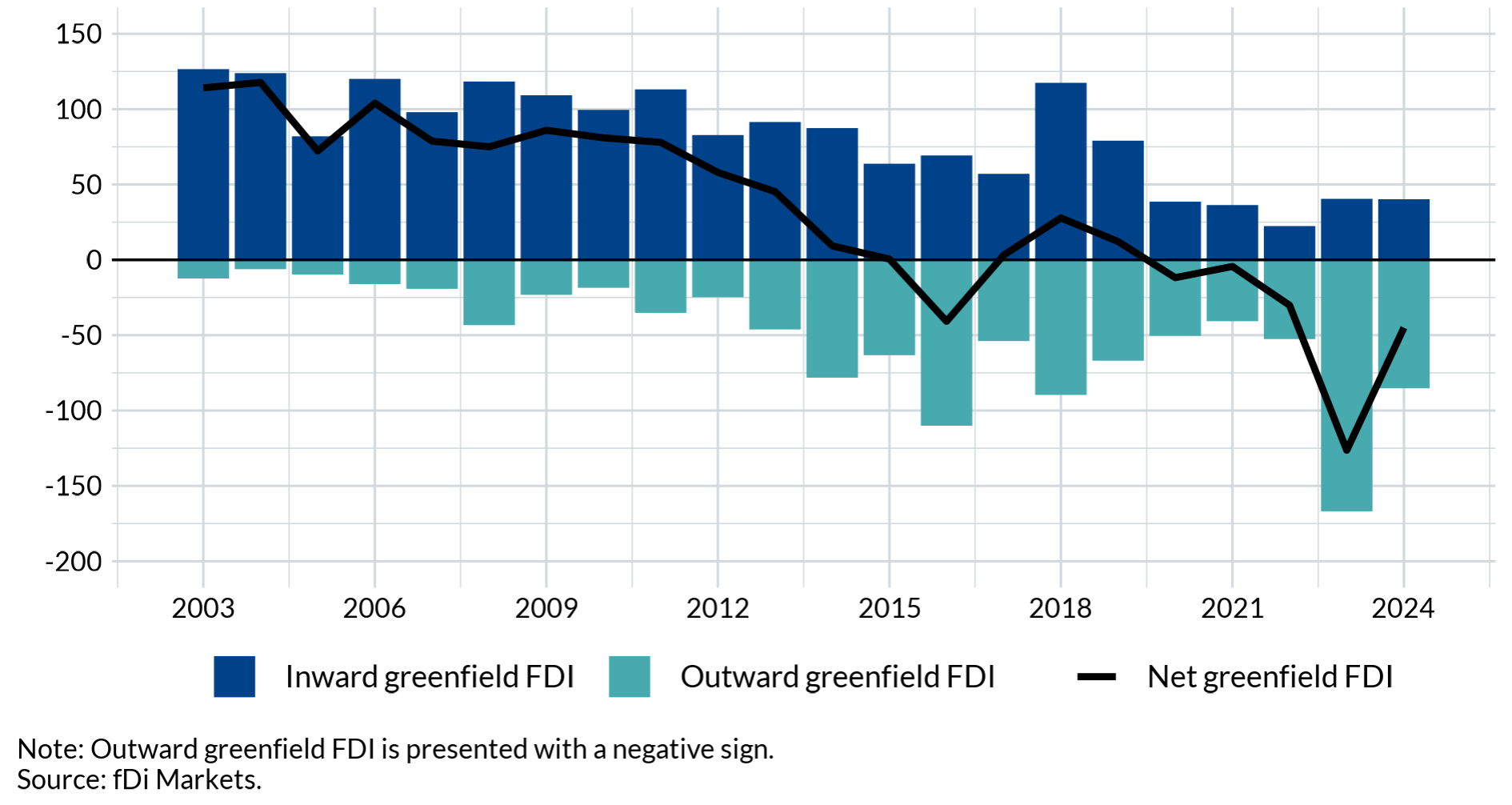
From the mid-2010s onward, outward greenfield FDI expanded markedly, and China became a net outward investor in greenfield terms. The period around 2017–2018 represents a structural turning point. Outward flows accelerated as trade tensions with the United States intensified. The pandemic temporarily depressed both inflows and outflows in 2020, but from 2022 onward outward greenfield FDI surged again, reaching USD 85.23 billion in 2024, compared with inward flows of USD 40.23 billion.
This reversal reflects several interrelated drivers: the increased sophistication of domestic firms and their produce, the external dimension of industrial policy, e.g. Made in China 2025, the Belt and Road Initiative (BRI), and the Dual Circulation strategy introduced after the pandemic. Outward FDI increasingly serves not only market-seeking motives but also risk diversification and technological upgrading.
China’s role has thus evolved from primarily hosting production to actively reshaping cross-border production networks.
Chinese outward greenfield FDI is characterized by a distinctive regional distribution. Chart 2 shows that Asia remains the primary destination, frequently accounting for more than half of outward projects. ASEAN economies such as Vietnam and Malaysia have gained prominence since 2018, consistent with “China+1” strategies and regional production integration under frameworks such as RCEP.
Chart 2. China’s outward greenfield FDI flows per region
(in percent)
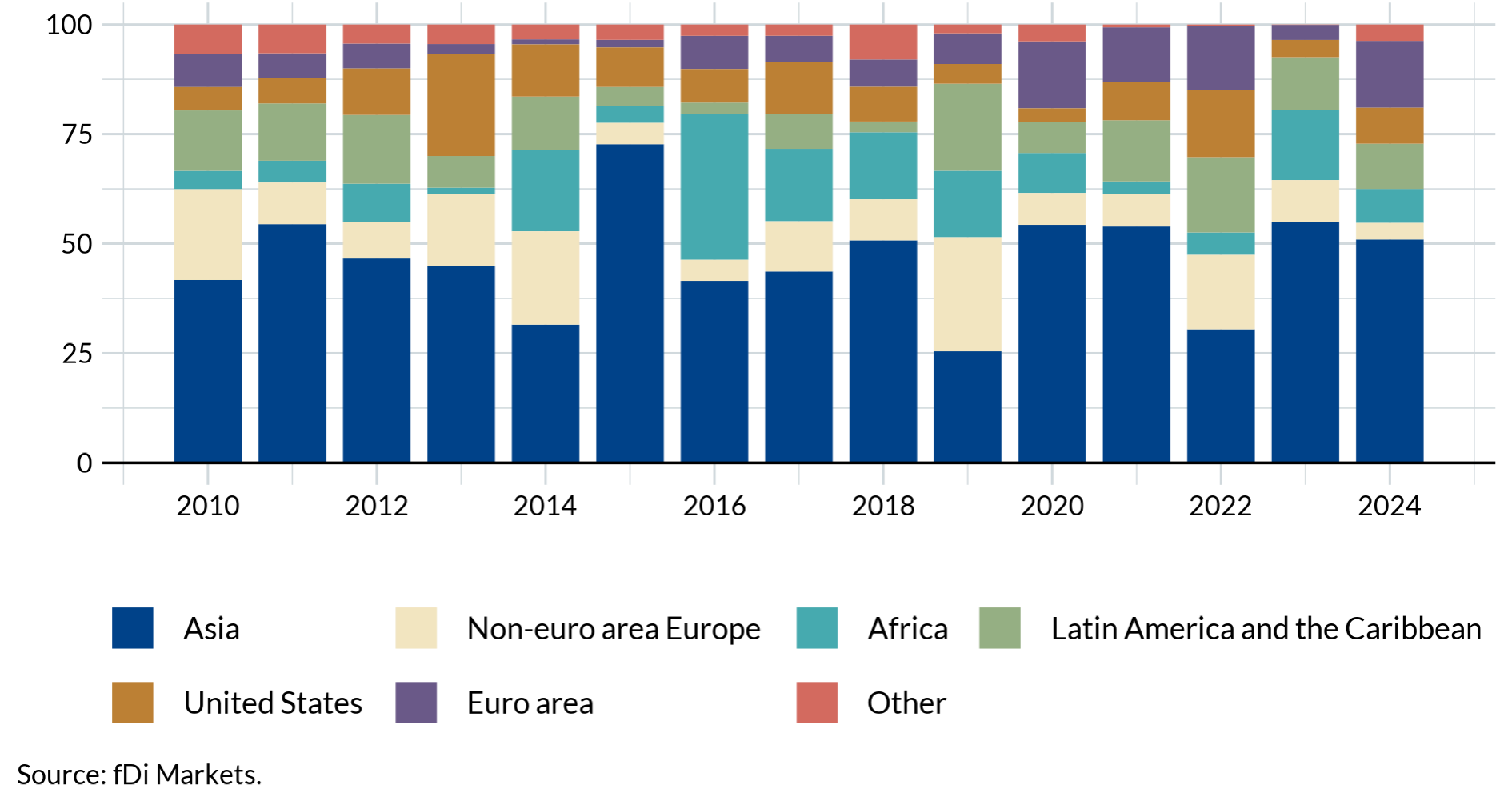
At the same time, relative flows to the United States have moderated compared to earlier periods, reflecting tighter screening and technology restrictions. The euro area has experienced selective increases, largely driven by EV- and battery-related investments in countries such as Spain. The Middle East and Latin America have absorbed rising shares, particularly in renewables, energy processing and near-market manufacturing platforms. Mexico, for instance, has become an important production base for serving the North American market under USMCA rules.
The regional pattern therefore combines proximity-based anchoring in Asia with strategic diversification across major trade blocs.
Beyond aggregate shares, changes in destination weights provide further insight into structural reorientation. Chart 3 indicates rising shares for Southeast Asia, parts of the Middle East (e.g. Saudi Arabia), selected Latin American economies and certain European periphery countries. In some smaller economies, Chinese projects account for a large fraction of total inward greenfield FDI, increasing host-country exposure to Chinese capital.
Chart 3. Change in destinations’ shares of China’s total outward greenfield FDI
(Percentage point changes, 2015 – 2017 vs. 2024 – 2024)
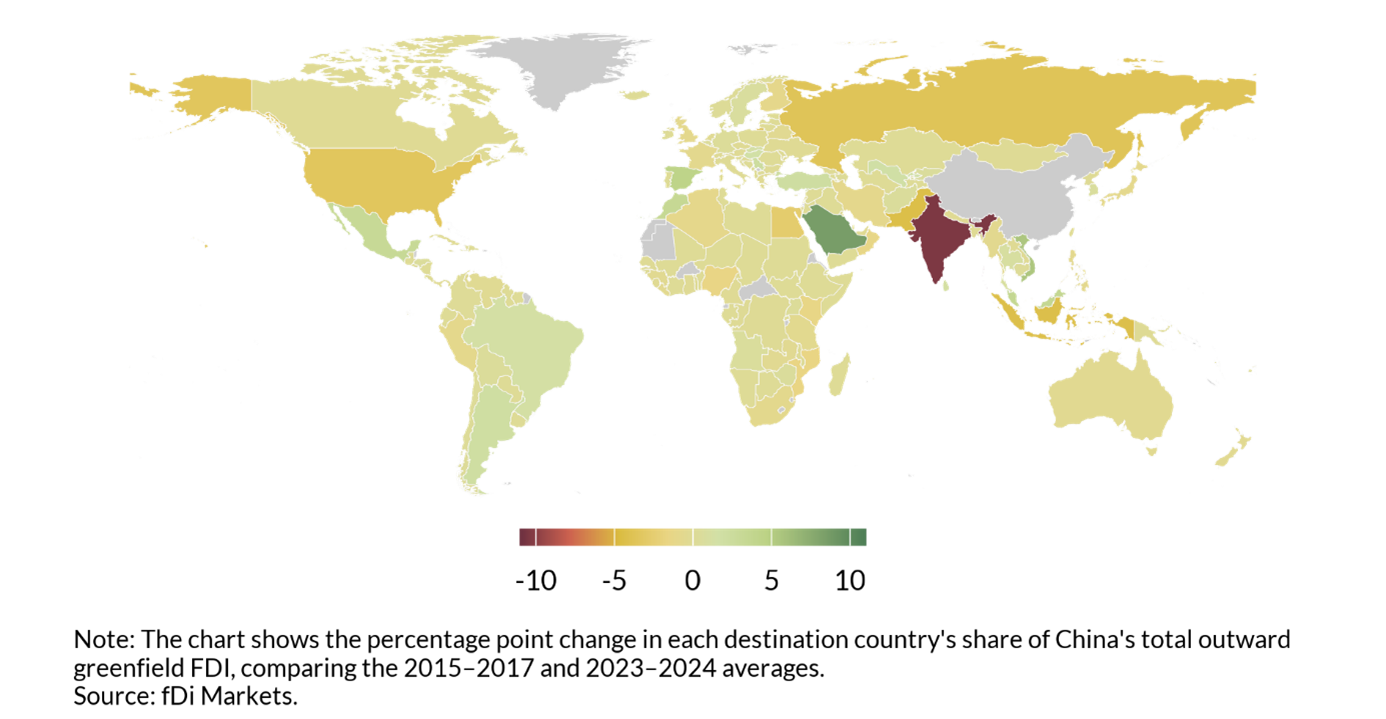
By contrast, several advanced economies have recorded declining or stagnant shares. India stands out as a case where the share of Chinese greenfield FDI declined the most, perhaps owing to geopolitical conflicts between both countries in recent years. Similar, but less pronounced patterns, are observable in the United States, Russia, as well as parts of Africa and Latin America. This reallocation is consistent with multiple drivers: tariff and trade defense measures, expanded investment screening, and supply chain risk management.
The sectoral allocation of outward greenfield FDI highlights its structural orientation and contrasts sharply with inward investment patterns. Chart 4 shows that electronic components account for 20.6% of outward flows, followed by renewable energy (13.9%), automotive OEM (13.2%) and communications (12.5%). These sectors are central to digitalization and decarbonization and align closely with China’s industrial policy priorities.
Chart 4. China’s outward greenfield FDI flows by sector (2024)
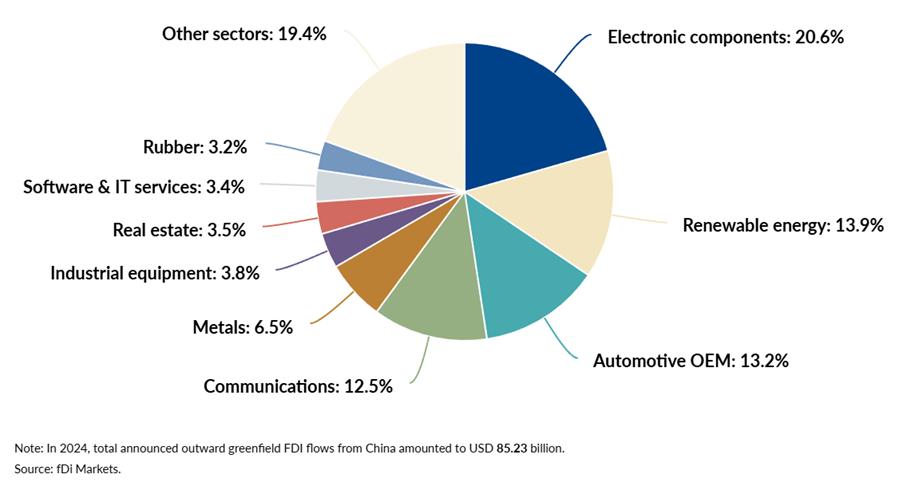
Outward FDI in electronics reflects efforts to mitigate the effects of export controls and local content requirements on semiconductor and electronics value chains. Investments in EVs and batteries serve dual purposes: capturing global market growth and reducing exposure to trade defense measures. Renewable energy projects support international expansion of solar, wind and storage technologies, often embedded in BRI-related infrastructure initiatives. In this sense, outward FDI complements domestic industrial upgrading. It facilitates access to markets, secures inputs (e.g. battery metals), and establishes production in jurisdictions that mitigate tariff and regulatory risks. Rather than representing generic capital export, it reflects sectorally targeted expansion.
As a final example, the interaction between sectors and host economies further illustrates this targeted allocation. Chart 5 shows that sectoral concentration translates into differentiated geographic platforms. Electronic component investments are distributed across Spain, the United States, Vietnam, Indonesia, Saudi Arabia and Turkey, at least partly reflecting integration into established electronics clusters. Renewable energy projects feature prominently in destinations such as Saudi Arabia, Australia, Spain and Uzbekistan, consistent with large-scale energy and infrastructure initiatives. Automotive investments are clustered in Slovakia, Turkey, Mexico, Brazil, Indonesia, and Vietnam, indicating platform production within major trade blocs and emerging manufacturing hubs.
Chart 5. China’s outward greenfield FDI by destination and sector (2024)
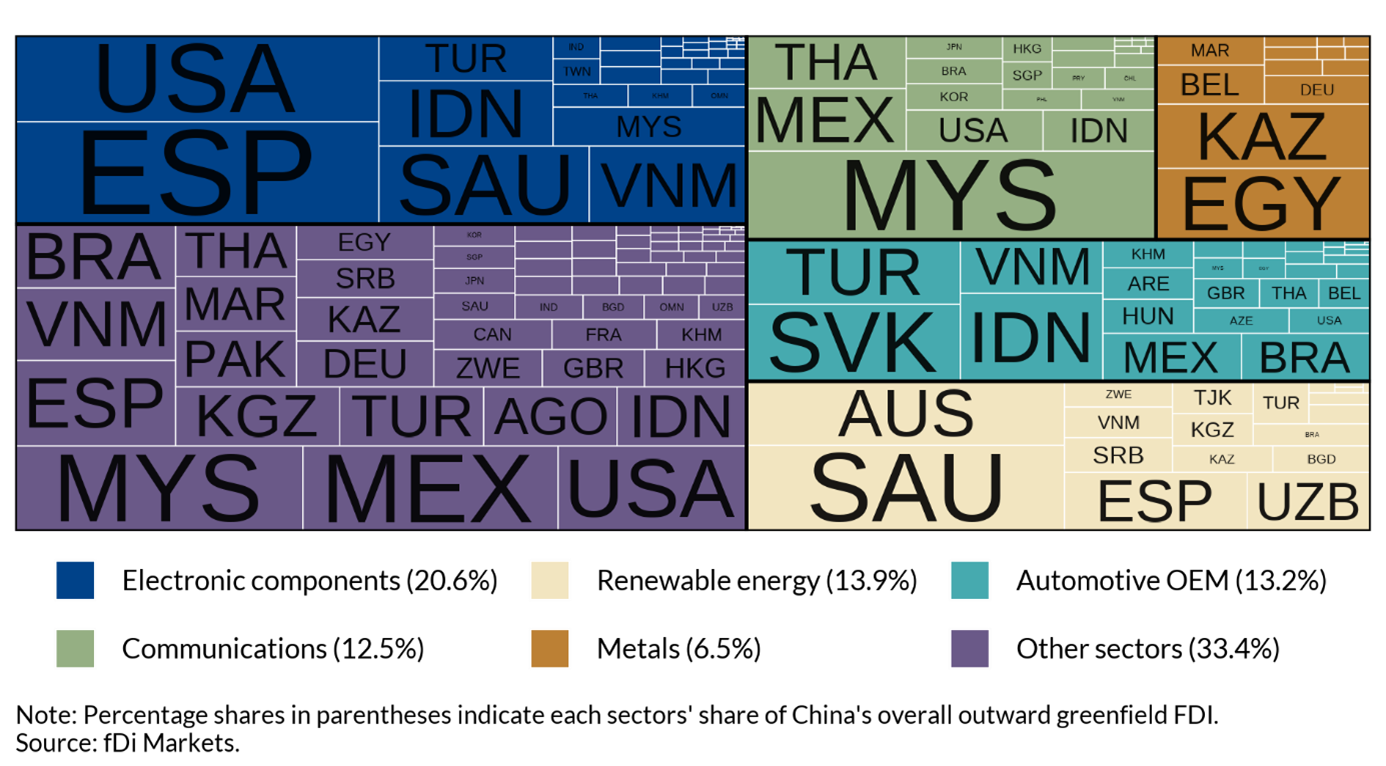
Metals and resource-linked projects are concentrated in diverse economies such as Egypt, Kazakhstan, Belgium or Germany, while communications investments span both advanced and emerging markets – from Malaysia to the United States.
The chart underscores that outward FDI is not uniformly dispersed but structured around sector-specific host advantages, trade agreements and resource endowments. It highlights the spatial organization of GVCs across upstream resource extraction, midstream processing and downstream assembly. The next section is a stylized representation of such a GVC.
The production chain of an electric vehicle provides a stylized illustration of these broader patterns of vertical fragmentation and geographic dispersion.
In Indonesia, Chinese firms invest in nickel mining and processing facilities critical for battery production. This represents upstream integration into resource-rich economies. For host countries, such projects offer opportunities for upgrading along the value chain beyond raw material extraction. At the same time, concentration of investment in a single sector and investor group can increase macroeconomic and political exposure.
In Spain, the CATL–Stellantis battery project embeds Chinese capital within the European EV ecosystem. This midstream stage involves capital-intensive manufacturing and technology diffusion. Such investments contribute to decarbonization objectives and industrial activity in host economies, while also influencing competitive dynamics and technological positioning within Europe.
In Mexico, Chinese firms establish EV manufacturing facilities serving the North American market within the USMCA framework. This downstream platforming reduces tariff exposure and satisfies rules-of-origin requirements. It exemplifies how outward FDI interacts with trade architecture and enables firms to serve major markets from third countries.
This stylized EV chain mirrors the empirical evidence: resource anchoring in emerging markets, technology-intensive production in advanced economies and export platforming within major trade blocs. Similar patterns are observable in solar modules, battery storage and selected electronics segments.
For Europe, China’s outward greenfield FDI has implications along several channels.
Overall, Europe is simultaneously host, competitor and regulator in this evolving landscape. For European policymakers, three elements appear particularly relevant.
China’s outward greenfield FDI reflects a durable adjustment in global production patterns driven by industrial upgrading, trade fragmentation and risk diversification. For Europe, the central challenge is to remain integrated, competitive and resilient within an increasingly multi-polar configuration of global value chains.
Additional data, interactive charts and publications on this topic, as well as on the broader issue of “(de)globalization,” can be found in the GloMo-Dashboard.