

This policy brief is based on the research presented in the NBS Working Paper 5/2006 and ESRB Working Paper 154. The views expressed are those of the authors and not necessarily those of the institutions the authors are affiliated with.
Abstract
Central bank communication on financial stability has been less studied than communication on monetary policy. We contribute to the growing literature in this area, looking at communication by central banks in Central, Eastern and South-Eastern Europe, Austria and the ECB. Bank ownership in the CESEE region is largely foreign-owned and the sample contains euro area and non-euro area countries. Using large language models combined with country-specific contextual analysis, we study executive summaries of central banks’ Financial Stability Reports published since the early 2000s. First, we construct a novel financial stability sentiment index and find that central bank communication is overall strongly risk focused. There are differences between central banks, however. Secondly, we look at the link between financial stability sentiment communication and the use of borrower-based macroprudential measures. Such a link can only be seen for some central banks and mostly during the build-up phase of BBM measures. Finally, comparing central banks’ communication on financial stability and monetary policy, we find that euro area national central banks and the ECB’s Financial Stability Reports communicated about the rising risks of post-Covid inflation in a timely manner, ahead of the ECB’s monetary policy communication.
Central bank communication on financial stability remains far less studied than monetary policy communication. A key reason for this difference is that central banks have long experience with monetary policy. By contrast, central banks started to deal much later with financial stability and specific policy tools to ensure financial stability. We refer to these tools as macroprudential policy (MPP) measures. Many central banks only developed their financial stability frameworks and their macroprudential policy toolkit after the 2008–2009 Global Financial Crisis (GFC). In tandem, central bank communication on financial stability and macroprudential policy also gained in importance.
In addition to the more limited ‘historical’ experience, financial stability communication faces a number of other challenges:
This policy brief and the underlying working papers aim to contribute to the understanding of financial stability communication. First, we construct an internationally comparable sentiment indicator of central bank communication in this field. Second, we assess the extent to which the communicated financial stability sentiment is related to MPP implementation. Third, we compare central banks’ communication on financial stability and monetary policy. The second and third part are very much work in progress, where further work is needed and on-going.
To construct the internationally comparable sentiment indicator of central bank communication on financial stability we use a large language model (LLM)–based text analysis, similarly to Silva et al (2025). Using primarily ChatGPT API platform “4o-mini”, we investigate how seven central banks in Central, Eastern and South-Eastern Europe (CESEE)1, plus Austria and the ECB, have communicated financial stability risks in their Financial Stability Reports (FSR) since the early 2000s. We believe that this approach is superior to traditional dictionary-based method such as in Correa et al (2021).
The CESEE region provides a natural laboratory for this type of analysis. First, financial systems are deeply interconnected with a significant presence of Austria-headquartered banking groups in all CESEE countries. Furthermore, we can compare the communication of the four CESEE euro area central banks with the communication by the ECB. For euro area member countries, financial stability responsibilities are shared between the respective national central banks and the ECB.
The construction of the sentiment indicator is done in five steps:
1. We split the executive summaries of FSRs into separate sentences and assign one of the following topics to each sentence, using a ChatGPT prompt:
• Global economic or market developments,
• Household indebtedness and residential real estate market,
• Banking sector resilience,
• Commercial real estate,
• Sovereign and geopolitical risks,
• Domestic economic developments.
• Sentences that do not belong to either of these categories are categorised as “other.
2. We evaluate the sentiment of each sentence, classifying sentences as neutral (sentiment score = 0), expressing strong/increasing financial stability concerns (sentiment score = 1), or weak/decreasing financial stability concerns (sentiment score = -1). To improve accuracy, ChatGPT also receives the preceding sentence as context. We enhance prompt precision by including definitions of what constitutes an improvement or deterioration in financial stability. Some sentences convey an ambiguous sentiment—for example, a rise in real estate prices could be positive if aligned with economic fundamentals or negative if indicating market overheating. Regulators often clarify their interpretation in the text. Absent such clarification, the sentiment is marked as unclear.
3. Once all sentences have been assessed, we calculate for each FSR the sum of the scores for each topic. A high (low) score indicates that sentences expressing greater (less) financial stability concern dominate. Scores near zero indicate either a neutral sentiment or the absence of the topic in the FSR.
4. The score for each topic is then normalized by the total number of sentences in the FSR executive summary. This step ensures that scores are comparable across countries, accounting for the length of the report, i.e., preventing systematically higher (lower) scores in countries with longer (shorter) reports.
5. The normalized scores for each topic are summed up to an overall financial stability sentiment, ranging from -1 (low/modest financial stability concerns) to +1 (strong financial stability concerns).
Central bank communication about financial stability is persistently risk averse. This is not a very surprising result. This is by mandate: in the field of financial stability, central banks are tasked with the timely identification of financial stability risks. Moreover, the failure of limiting the build-up of systemic risks prior to the GFC may have increased central banks’ inclination to err on the cautious side. Finally, prudential concerns can relate both to the build-up phase of systemic risks during booms and the materialization of these risks during crises/busts.
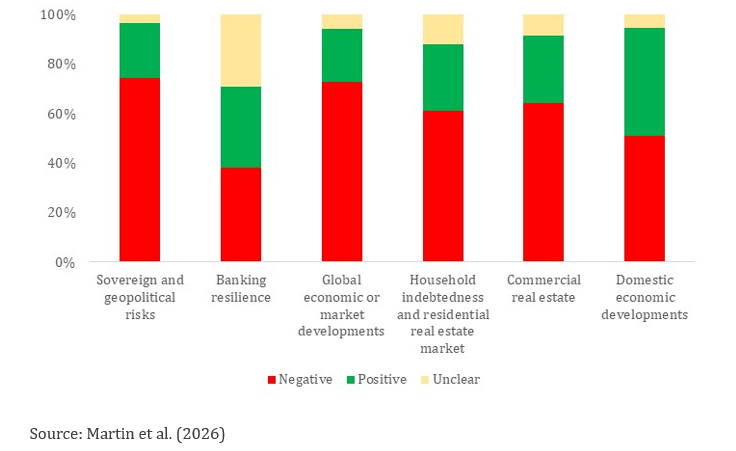
Figure 1 shows central banks’ financial stability sentiment regarding the six main FSR topics across the full observation period and all central banks. For four topics, sovereign and geopolitical risks, global economic or market developments, household indebtedness and residential real estate market and commercial real estate, negative sentiment clearly dominates. Regarding banking sector resilience, the overall picture is more balanced, including also a large share of unclear messages. For domestic economic developments, the overall sentiment is almost evenly split between positive and negative messages.
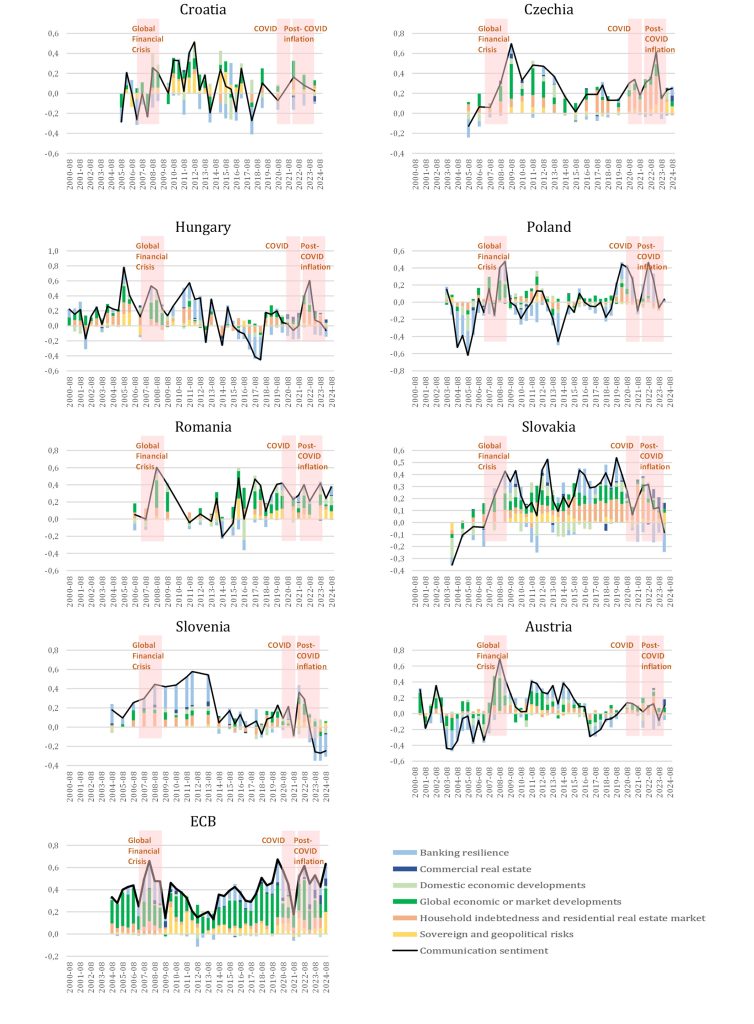
There are substantial differences in the level of risk aversion between the central banks in our sample. The ECB appears to be the most risk-focused, expressing a clear negative, “net” financial stability sentiment during the entire sample period. Most CESEE central banks have also been rather vocal about financial stability risks, particularly after the GFC. They are, however, more varied in their financial stability sentiment over time.
Figure 1. Central bank financial stability sentiment by topic for the full period
Continuously communicating high levels of concern carries risks. It is called the “crying wolf” syndrome, which may lead markets and the public to discount the strength of financial stability concerns precisely at the time when such risks are truly building up. We do not find clear evidence of this in our sample although the risk of “crying wolf” syndrome may be more relevant for some central banks than for others. Memories of the GFC still loom large and have been reinforced by subsequent shocks such as the pandemic, the post-Covid inflation shock, or the US mid-size bank crisis in the spring of 2023.
Looking at the relative importance of the different risk types, ”bank resilience” is a central topic for national central banks. However, we found a surprisingly large share of “ambiguous” statements – neither negative nor positive. This may be due to several factors, including efforts to strike a balance between risk transparency and market sensitivity. At the same time, unclear messages can give rise to confusion and create credibility issues.
The ECB placed less emphasis on bank resilience than other central banks, even after the creation of the Single Supervisory Mechanism (SSM) in 2014. This may be linked to the fact that the SSM is organisationally separate from the ECB, and the nature of its shared macroprudential policy mandate, where the ECB and national supervisory authorities share complementary responsibilities. It will be important to investigate further if markets and households across Europe fully appreciate this complementarity and whether communication coordination among the various national authorities and the ECB is sufficient in this regard.
Prior to the GFC, financial stability sentiment in CESEE central banks tended to be more concerned than that in Austria, the home supervisor of many banks in that region. Communication by CESEE central banks appeared generally more concerned about banks than that by the Austrian central bank. This changed dramatically after the GFC, when the Austrian central bank paid much more attention to the CESEE region in its policy communication.
Figure 2. Communication sentiment on financial stability by country/institution
Assessing the link between financial stability communication and the activation of MPP tools is not straightforward. First, MPP tools apply only to banks and not to other parts of the financial sector. Second, they can only be used to deal with certain financial stability risks, in particular those arising from excessive lending and asset price disequilibria, notably in real estate. Third, some countries in our sample did not activate MPP measures or used them only for a very short period of time. Against this background, we look only at the link between (1) the financial stability sentiment sub-index related to household indebtedness and residential real estate markets and (2) a subset of MPP tools, namely so-called Borrower-Based measures, designed to restrict access of households to mortgages (Figure 3).2
Figure 3. Macroprudential communication and BBMs
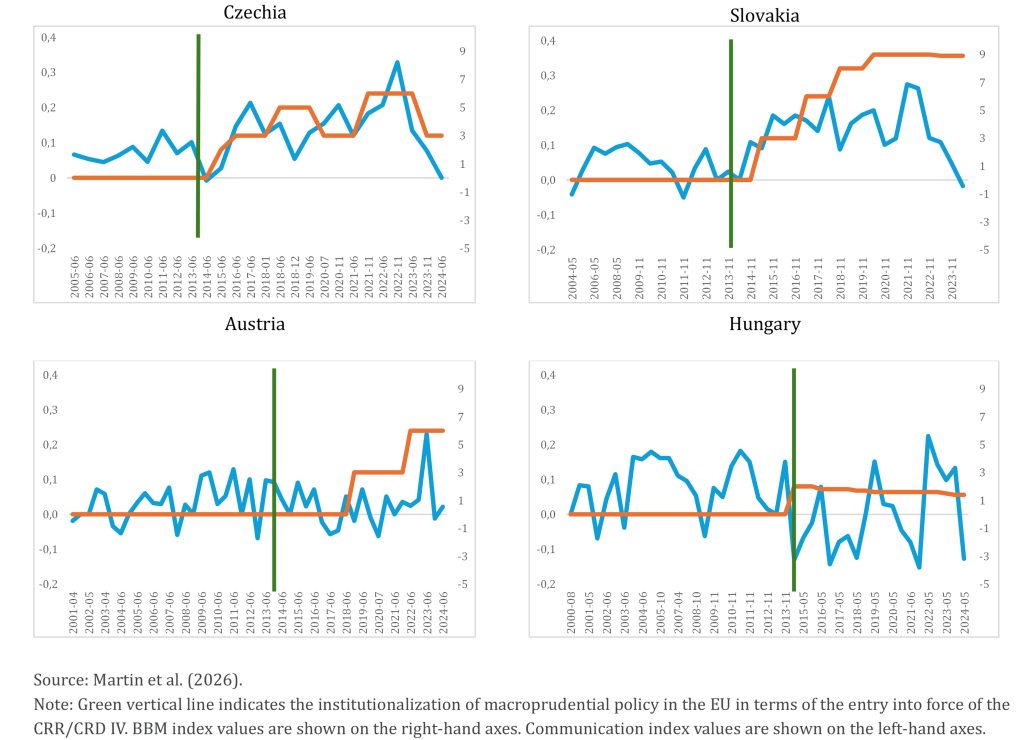
Visual inspection suggests that the link between financial stability communication and the activation of MPP tools is quite different across countries. In Czechia and Slovakia there is some correlation between the increase in negative sentiment about household indebtedness and residential real estate markets on the one hand and the activation of BBM measures on the other hand. In Czechia, however, the indicator of BBM measures shows a lot more volatility over time. In Austria, BBM measures were activated at a time when communication suggested a neutral stance regarding indebtedness and real estate markets. In Hungary, there appears to be no clear link. Except in Czechia, there appears to be no link between improved sentiment in this area and a reduction of BBMs. This may be due to the long lead time associated with their activation and a desire to keep them activated in a more ‘structural’ way.
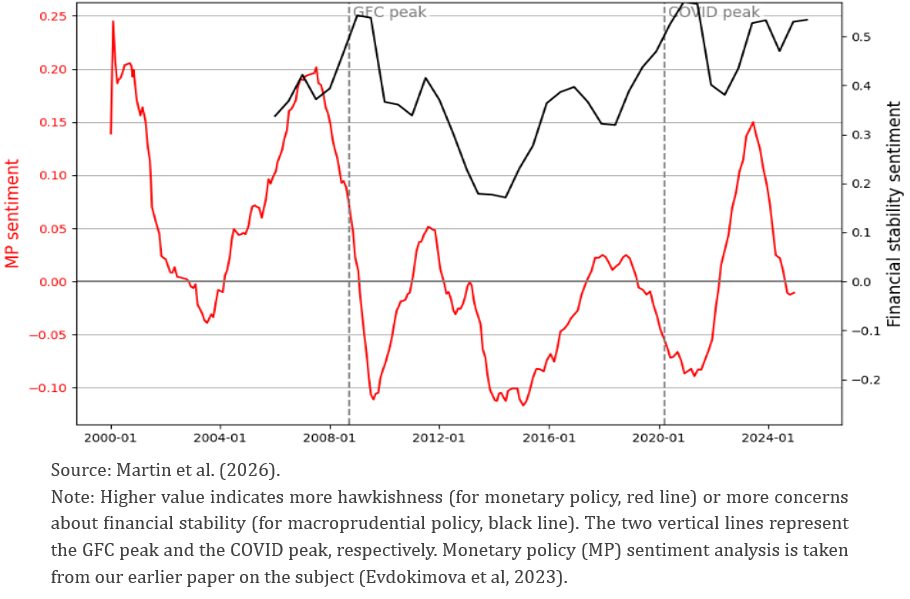
In the third part of the paper, we compare the communication sentiment on monetary policy and financial stability of central banks. As regards the euro area as a whole and individual euro area countries in our sample, we find that the reaction to post-Covid inflationary and macroeconomic pressures has been timelier in financial stability communication (and underlying policy) than in monetary policy.3 The ECB and euro area national central banks communicated the increase in financial stability risks in a timely manner, including those from post-Covid inflationary pressures, while communication on monetary policy reacted with a lag. This finding needs further investigation. We suspect that the experience of the GFC still loomed large on financial stability staff and policymakers, more so than the experience with the last high-inflation period. By contrast, central banks outside the euro area showed no such inconsistency/lag in their monetary policy and financial stability communication.
Figure 4. Financial stability versus monetary policy sentiment, ECB
Central bank communication on financial stability has come a long way since the GFC and, despite being central banks’ “overshadowed sibling”, it has overall proven to be very useful to the markets and the public. Nevertheless, central bank communication on financial stability remains less developed and researched than communication on monetary policy. This is due to a combination of shorter history, the complexity of financial stability and its associated policy toolkit, the sensitivity of financial market communication and split oversight responsibilities. At the same time, since the GFC it is widely agreed that successful financial stability communication is critical for policymakers to contain systemic risks and avert future crises.
Our research contributes to the emerging work on central bank communication on financial stability, using artificial intelligence tools and large language models. We cover a group of Central, Eastern, and Southeastern European countries and Austria. Their financial sectors are linked through cross-country ownership. We also include the ECB in our sample, which became the supervisor of larger systemic banks in the euro area in late 2014.
We find that in general, financial stability communication is very risk averse. By definition, central banks use their FSRs largely to communicate their concerns related to systemic risks. In addition, the degree of risk-aversion may be a response to the failure of limiting the build-up of systemic risks before the GFC. Moreover, prudential concerns can relate to both phases of the financial cycle: the build-up of systemic risks during booms and the materialization of these risks during the crisis/bust periods. For some central banks we find a link between communication on household indebtedness and residential real estate market and the activation of borrower-based MPP measures. Finally, we find that the reaction to post-Covid inflationary and macroeconomic pressures has been timelier in financial stability communication than in monetary policy in the euro area. Further work will be needed to go deeper into these topics.
BIS, 2016. Objective-setting and communication of macroprudential policies. CGFS Papers No 57.
Correa, R., Garud, K., Londono, J. M. & Mislang, N., 2021. Sentiment in Central Banks’ Financial Stability Reports. Review of Finance, 25(1), pp. 85-120.
Cukierman, A., 2009. The Limits of Transparency. Economic Notes, 38(1-2), pp. 1-37.
Evdokimova, T., Nagy Mohácsi, P., Ponomarenko, O. & Ribakova, E., 2023. Central banks and policy communication: How emerging markets have outperformed the Fed and ECB. Peterson Institute for International Economics Working Paper WP 23-10.
Martin, R., Mohácsi, N. P., Evdokimova, T., Klacso, J., Ponomarenko, O. (2026). Central Bank Communication on Financial Stability – A Shadowed Sibling? ESRB WP 154.
Silva, T. C., Moirya, K. & Veyrune, R. M., 2025. From Text to Quantified insights: a Large-Scale LLM Analysis of Central Bank Communication. IMF Working Paper No. 2025/109.
Croatia, Czechia, Hungary, Poland, Romania, Slovakia, and Slovenia.
In the underlying paper we conduct a similar analysis for the Countercyclical Capital Buffer (CCyB) as well.
The monetary policy communication sentiment is from Evdokimova et al. (2023).