

This policy brief is based on ECB Working Paper Series, No 3192. The views, opinions, findings, and conclusions or recommendations expressed in this paper are strictly those of the authors. They do not necessarily reflect the views of the Banco de España, Bank for International Settlements (BIS), the Central Bank of Chile, the Deutsche Bundesbank, the European Central Bank, the European Commission, the Swiss National Bank, or the Eurosystem.
Abstract
Carbon-intensive energy price increases can pose a significant challenge for central banks as they affect inflation and thus central banks in ensuring their price-stability mandate. We compare the responses of six institutional multi-sector macroeconomic models used by central banks and international organisations to assess how carbon-intensive energy price shocks propagate through the economy. For a temporary shock, the models deliver a robust, common message: inflation increases sharply, monetary policy tightens, and output declines, with differences mainly in timing and magnitude. For a permanent increase, inflation outcomes are less clear-cut and depend crucially on how monetary policy interprets the associated decline in potential output.
The transition towards a green economy is essential to address climate change. At the same time, it can pose significant challenges for central banks, as it may affect inflation dynamics and thus complicate the pursuit of price stability. Energy price shocks are among the most important channels through which climate policy, geopolitical tensions and the transition away from fossil fuels can shape macroeconomic outcomes. A key insight is that these effects cannot be fully understood without taking sectoral developments into account. Climate policies, for example, may affect some sectors much more strongly than others, with potentially important implications for financial stability, monetary policy transmission, and aggregate growth (e.g., Aguilar et al., 2023).
Our paper (Burgert et al., 2025a) studies this issue through a model comparison exercise, which helps to account for model uncertainty. When different models point to similar mechanisms, the resulting policy message is more robust. At the same time, differences across models are informative in their own right, as they highlight where results depend on modelling choices and where uncertainty is particularly high. Finally, the range of outcomes supports a more realistic assessment of the economic impacts.
Our comparison brings together several institutional multi-sector macroeconomic models developed at central banks and international organisations: BIS-MS (Burgert et al., 2025b), SEEM (Beltran et al., 2024), C-EAGLE (Garcia et al., 2026), EMuSe (Hinterlang et al., 2023), NAWM-E (Coenen et al., 2024) and E-QUEST (Varga et al., 2022). While these models differ along several dimensions, including country coverage, sectoral structure, energy modelling and nominal rigidities, they share a detailed representation of sectoral linkages, particularly those related to the energy sector. As New Keynesian models, they are well suited to analysing inflation dynamics and the monetary policy response to exogenous shocks. More broadly, this class of models has become increasingly important for central banks assessing the macroeconomic implications of the green transition (e.g., Nakov and Thomas (2023), Olovsson and Vestin (2023), Ferrari and Nispi Landi (2024), Sahuc et al. (2024), Kaldorf and Rottner (2025) among many others).
The multi-sector models of this study are used to analyse both temporary and permanent increases in energy prices. In the temporary shock scenario, the models point to a broadly consistent pattern: inflation rises while output falls. This creates a familiar but uncomfortable policy trade-off. A forceful monetary policy response can help contain inflationary pressures but also dampens real activity. In case of a permanent energy price increase, the real effects are more persistent. The inflation response, however, depends crucially on how monetary policy interprets the associated decline in potential output.
The first exercise considers a temporary 25% increase in the price of carbon-intensive energy in the euro area. The shock lasts for four quarters before gradually fading. While the models differ in how they implement the shock, the exercise is harmonised around a common target path for the carbon-intensive energy price.1
Figure 1 shows that inflation consistently increases across all models on impact. The average response is around 2 percentage points, with most models reaching a peak between 2 and 3 percentage points. The shock is therefore clearly inflationary in the short run. In most models, however, the inflation response is relatively short-lived: inflation gradually returns towards the baseline after a few quarters as the energy price shock fades. Simultaneously, output falls, with an average decline of about 0.3%.
Monetary policy tightens following the energy price shock, which is transmitted through sectoral energy and production linkages. The policy rate increases in all models, in line with the central bank’s reaction to the rise in headline inflation. On average, it remains elevated for several quarters before gradually returning to baseline as inflationary pressures subside.
Across all models, the qualitative responses are consistent: inflation rises, monetary policy tightens, and output declines. The main differences concern timing and magnitude. In some models, inflation peaks immediately, while others imply a more gradual pass-through from energy costs to consumer prices. This reflects differences in how energy enters production and consumption, the degree of price and wage stickiness, and the structure of sectoral linkages.
Figure 1. Temporary carbon-intensive energy price shock: mean and range across models.
Responses of euro area inflation, real output and the policy rate to a temporary 25% increase in carbon-intensive energy prices
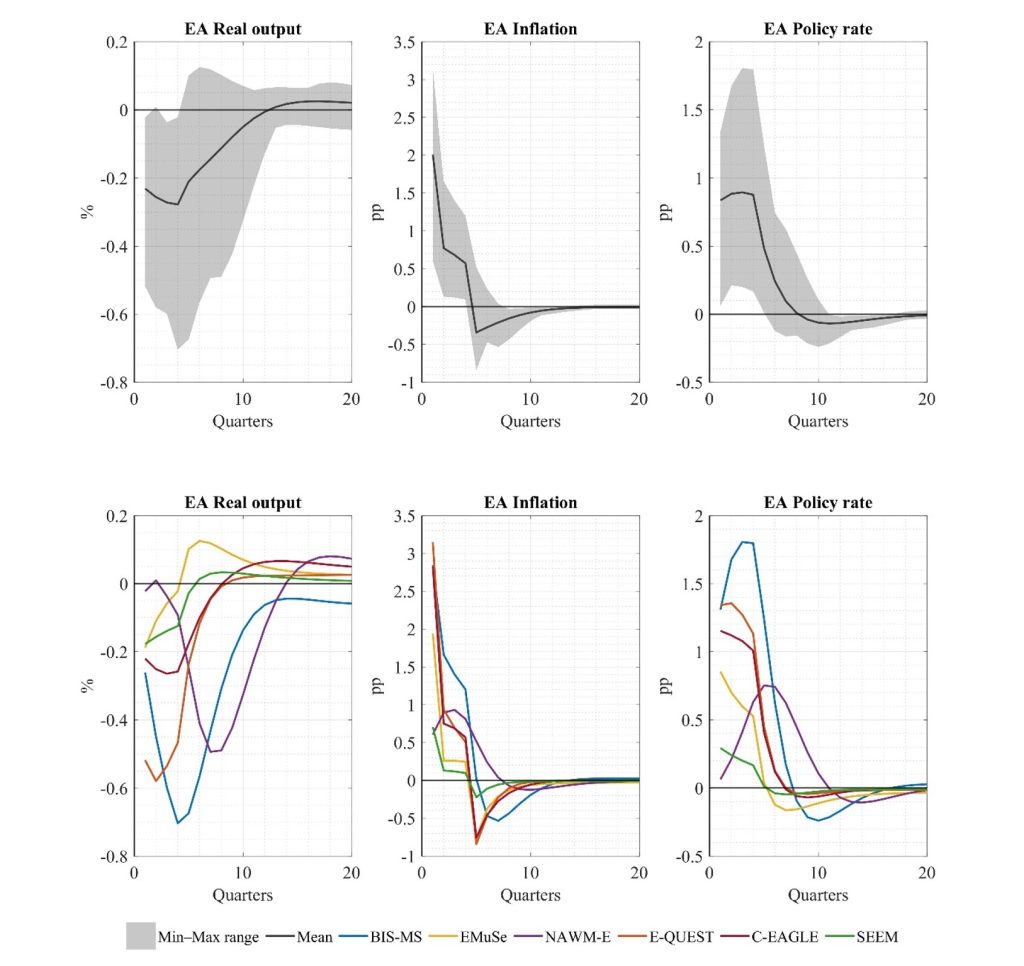
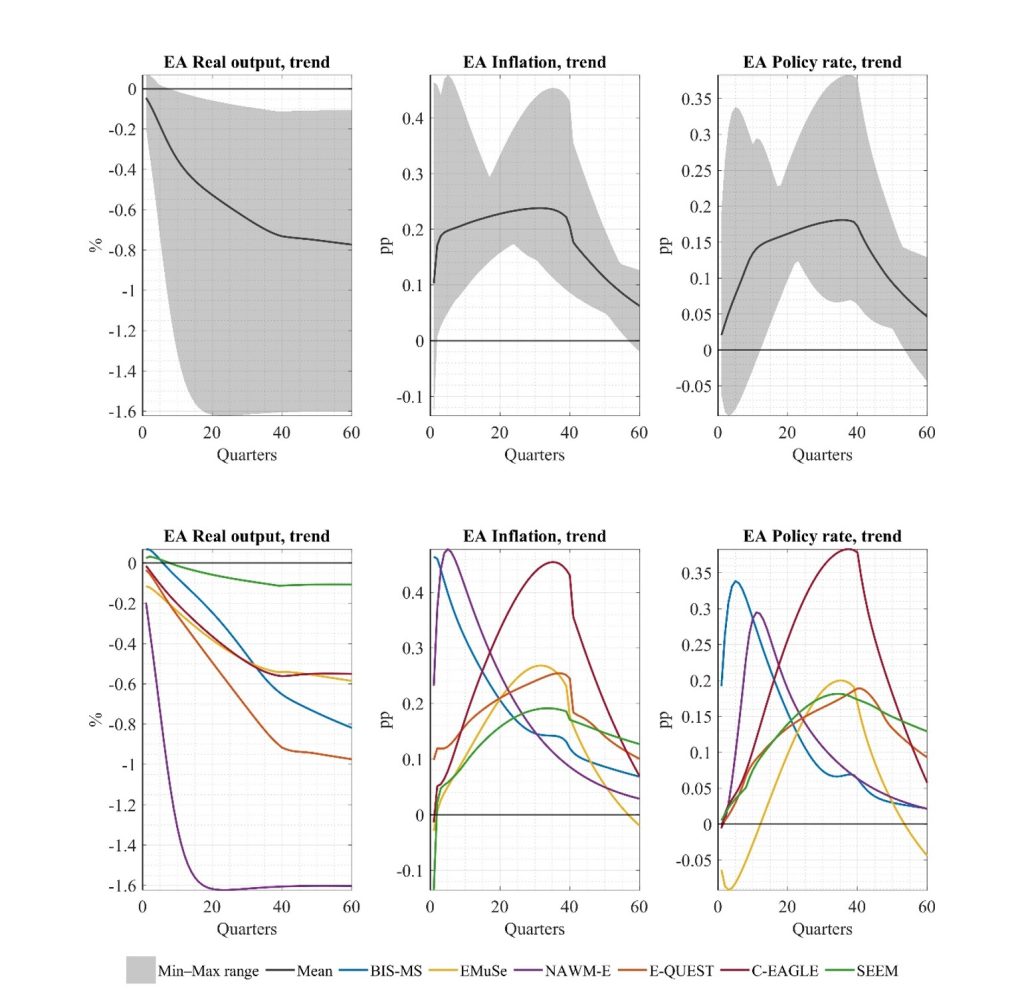
Figure 2. Permanent carbon-intensive energy price shock: mean, range and model-specific responses.
Responses of euro area inflation, real output and the policy rate to a permanent 25% increase in carbon-intensive energy prices, when monetary policy targets output relative to a slowly adjusting long-run trend.
The second exercise considers a permanent increase in carbon-intensive energy price, which is constructed by gradually increasing the price of carbon-intensive energy by 25% over ten years.
As shown in Figure 2, the permanent shock leads to a persistent decline in real output. In the model comparison, average output is still around 0.7% below baseline after 40 quarters. This is the key real-side effect of a permanent energy price increase. The figure also suggests that a permanent price increase is associated with an inflation surge.
The inflation response is, however, less clear-cut and depends strongly on the monetary policy rule. Different rules can reflect, in part, how the central bank perceives the transition to a new, lower level of potential output. If, for example, monetary policy fully and immediately accounts for the lower future level of output, it can lead the central bank to provide relatively less stimulus to aggregate demand. However, this reduction does not fully compensate for the contraction in consumption and investments arising from the anticipated lower future income, eventually leading to deflation in equilibrium. If, instead, the adjustment to the lower long-run level of output is perceived as gradual, the central bank provides more accommodation, leading to an inflationary outcome, as shown in Figure 2.
Carbon-intensive energy price shocks pose a recurring challenge for monetary policy. When the shock is temporary, the main difficulty is managing a short-run trade-off: inflation rises sharply while output falls. Monetary policy can help contain inflationary pressures, but it cannot fully offset the price effect without imposing additional real costs.
When the shock is permanent, the impact is less clear. While the economy moves towards a lower level of output, inflation dynamics depend on how monetary policy responds and measures the transition. If policy targets output relative to a trend that adjusts only slowly, accommodation can support demand but also generate inflationary pressure. Recognising changes in potential output is therefore important to avoiding policy mistakes.
More generally, changes in carbon-intensive energy prices require careful macroeconomic diagnosis. The key questions are not only whether energy prices rise, but whether the increase is temporary or permanent, how it propagates across sectors, and how monetary policy responds.
Aguilar, P., B. González and S. Hurtado (2023): “Green Policies and Transition Risk Propagation in Production Networks,” SUERF Policy Brief, No. 515.
Beltrán, F., L. Durand, M. González-Frugone, and J. Moreno (2024): “A preliminary assessment of the economic effects of energy and climate in Chile,” Latin American Journal of Central Banking, 100146.
Burgert, M., M. Darracq Pariès, L. Durand, M. González, R. Priftis, O. Röhe, M. Rottner, E. Silgado-Gómez, N. Stähler, and J. Varga (2025a): “Macroeconomic effects of carbon-intensive energy price changes: a model comparison,” BIS Working Papers, No 1313.
Burgert, M., G. Cornelli, B. Erik, B. Mojon, D. Rees, and M. Rottner (2025b): “The BIS multisector model: a multi-country environment for macroeconomic analysis,” BIS Working Papers, No 1297.
Coenen, G., M. Lozej, and R. Priftis (2024): “Macroeconomic effects of carbon transition policies: An assessment based on the ECB’s New Area-Wide Model with a disaggregated energy sector,” European Economic Review, 167(C).
Ferrari, A. and V. Nispi Landi (2024): “Will the green transition be inflationary? Expectations matter,” IMF Economic Review, 1–64.
García-Sánchez, P., P. Jacquinot, Č. Lenarčič, K. Mavromatis, N. Papadopoulou, and E. Silgado-Gómez (2026): “Green Transition in the Euro Area: Domestic and Global Factors,” European Economic Review, 182.
Hinterlang, N., A. Martin, O. Röhe, N. Stähler, and J. Strobel (2023): “The Environmental Multi-Sector DSGE model EMuSe: A technical documentation,” Deutsche Bundesbank Technical Paper, 03/2023.
Kaldorf, M. and M. Rottner (2025): “Climate Minsky moments and endogenous financial crises,” BIS Working Papers, No 1248.
Nakov, A. and C. Thomas (2023): “Climate-conscious monetary policy,” ECB Working Paper, No 2845.
Olovsson, C., and D. Vestin (2025): “Greenflation?,” European Economic Review, 105237.
Sahuc, J.-G., F. Smets, and G. Vermandel (2024): “The New Keynesian Climate Model,” Banque de France Working Paper, No 977.
Varga, J., W. Roeger, and J. in ’t Veld (2022): “E-QUEST: A multisector dynamic general equilibrium model with energy and a model-based assessment to reach the EU climate targets,” Economic Modelling, 114, 105911.
For instance, while some models might attribute the shock exclusively to oil others might also account for other sources of carbon-intensive energy, such as coal and gas, which is an input of electricity production.