

This Policy Brief is based on the European Central Bank (ECB) Working Paper No. 3273. The views expressed are those of the authors and do not necessarily reflect those of the ECB.
Abstract
Private investment growth has slowed in many advanced economies over the past decade, despite mounting investment needs. We show empirically that structural reforms in product and labour markets could play a crucial role in reviving private investment. A major labour market reform typically raises the level of real private investment by around 5% over six years; a major product market reform by around 3%. Crucially, the reform dividend is larger where firms have good access to external finance. Financial reforms, such as the EU’s Savings and Investment Union, and structural reforms can thus be seen as mutually reinforcing elements of a comprehensive policy agenda to improve the investment outlook.
Private investment growth has slowed significantly in many advanced economies over the past decade, despite major investment needs related to digitalisation, artificial intelligence and the transition to a low-carbon economy. In Europe in particular, closing the “investment gap” has become a central theme of the policy debate.
International policy institutions — including the IMF, the OECD and the European Commission — have long promoted structural reforms in product and labour markets as a way to strengthen investment and long-term growth prospects. Yet, empirical evidence directly linking structural reforms to private investment remains surprisingly scarce.
To fill this gap, we examine the extent to which structural reforms in product and labour markets stimulate private investment and under which conditions such reforms are most effective. We draw on a narrative dataset of major structural reforms in 26 OECD countries over the period 1975–2020, constructed by Duval et al. (2018) and updated by Wiese, Jalles and de Haan (2024). Our empirical approach — which relies on the so-called local projections augmented inverse probability weighting (LP-AIPW) estimator — is designed to trace the dynamic response of private investment to structural reforms, while taking into account that reforms are not adopted at random.
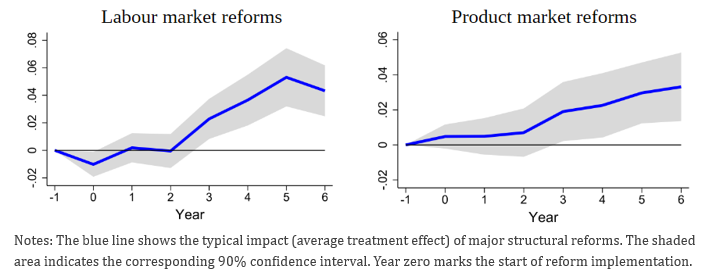
Our estimates indicate that major reforms in both labour and product markets typically lead to a strong and sustained increase in private investment, although the effects take time to fully materialise. A major labour market reform typically increases real private investment by 5% after six years, compared to 3% for product market reforms (Figure 1). The stronger effect of labour market reforms likely reflects their scope: they are generally economy-wide, whereas the product market reforms in our database usually target individual network industries. For both reform types, the positive effects on private investment become statistically significant at the 90% level after three years and build up gradually afterwards. This is a politically inconvenient but important finding: the payoff from structural reform may arrive beyond the typical electoral horizon.
Figure 1. Impact of major structural reforms on real private investment
(cumulative level impact)
From a policy perspective, a crucial question is under which conditions structural reforms are most effective in stimulating private investment. We answer this question by focussing on the role of financial conditions, which has so far received little attention in the literature. Intuitively, good access to finance should enable firms to exploit the business opportunities created by structural reforms.
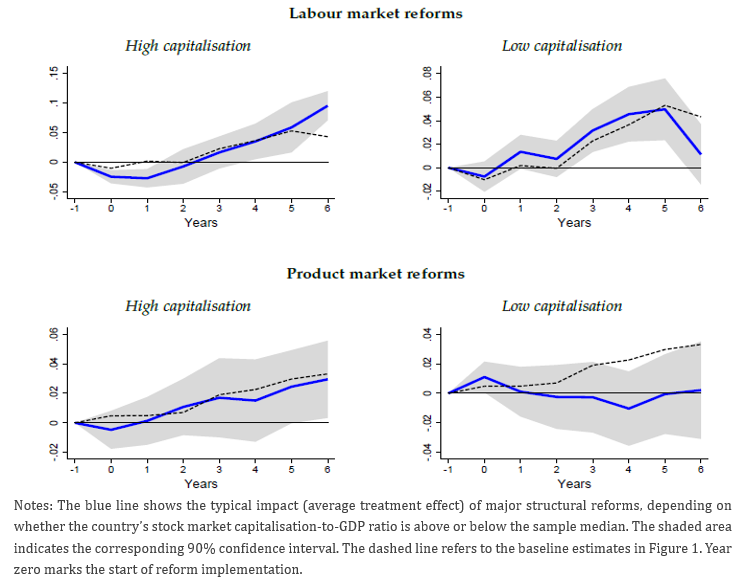
Our empirical findings confirm that structural reforms are most effective where firms enjoy good access to finance. To start with, we proxy access to finance by the stock market capitalisation-to-GDP ratio. This widely used indicator captures the size and depth of equity markets and firms’ access to market-based financing (e.g. Levine, Loayza and Beck, 2000). Where stock market capitalisation is high, a major labour market reform typically raises private investment by approximately 10% after six years, roughly double the average effect (Figure 2). Where capitalisation is low, the effect peaks at much lower levels and loses statistical significance by year six. Similarly, product market reforms increase private investment by around 4% after six years when market capitalisation is high, while estimates remain close to zero and statistically insignificant in shallow-market environments.
We obtain qualitatively similar results when access to finance is proxied by the credit-to-GDP ratio or the private credit-to-deposit ratio. These results are documented in Mavrogiannis, Zorell and Zwick (2026), together with estimates pointing to an important role for a country’s institutional quality in shaping reform effectiveness. Overall, our findings suggest that well-developed financial markets ease financing constraints and enable firms to respond more strongly to the investment opportunities created by structural reforms.
Figure 2. Impact of major structural reforms on real private investment by stock market capitalisation
(cumulative level impact)
Our findings carry important policy implications.
First, structural reforms remain a powerful and underused instrument for reviving private investment. Unfolding this potential will require a step-up in reform efforts, considering the scarcity of major labour and product market reforms in Europe and other advanced economies over recent years. This may necessitate enhancing reform incentives within national and EU policy frameworks, given that the benefits of structural reforms often extend beyond electoral cycles.
Second, structural reforms and the development of European capital markets are mutually reinforcing. Our estimates show that the investment payoff from certain structural reforms is roughly twice as large where firms enjoy deep access to market-based finance. Therefore, efforts to improve the workings of financial markets — for instance through the EU’s Savings and Investment Union — should not be seen as substitutes for, but rather as complements and critical enablers of successful structural reforms. Pursued in tandem, structural and financial reforms can mutually reinforce one another, enabling private investors to effectively meet the challenges posed by AI and climate change.
Duval, R., D. Furceri, B. Hu, J. T Jalles, and H. Nguyen. 2018. “A narrative database of major labor and product market reforms in advanced economies.” International Monetary Fund, IMF Working Papers 2018/019.
Levine, R., N. Loayza, and T. Beck. 2000. “Financial intermediation and growth: causality and causes.” Journal of Monetary Economics, 46(1): 31–77.
Mavrogiannis, C., N. Zorell and C. Zwick. 2025. “Can structural reforms unleash private investment?”, ECB Working Paper No. 3273.
Wiese, R., J. T. Jalles, and J. de Haan. 2024. “Structural reforms and income distribution: new evidence for OECD countries.” Oxford Economic Papers, 76(4): 1071–1088.