

This policy brief is based on Bruegel Working Paper 12/26 “How trade restrictiveness and trade policy uncertainty affect FDI: an empirical investigation”. The views expressed in this policy brief are those of the author(s) and do not necessarily represent the views of the IMF, its Executive Board, or IMF management.
Abstract
Using data on bilateral FDI flows from 243 source countries to 35 OECD host countries over 1985–2023, we show that trade restrictions and trade policy uncertainty reduce cross-border investment. A one-standard-deviation rise in trade restrictions lowers FDI inflows by about 15% of their sample mean after one year, while a comparable uncertainty shock reduces them by around 50% and remains significant five years later. The effects extend beyond average FDI, as trade-policy uncertainty and unexpected restriction shocks also increase future FDI uncertainty. Moreover, the impact is stronger when host countries have more open capital accounts and when global value chain linkages are deeper, while countercyclical fiscal policies and greater exchange rate stability help mitigate these effects. Predictable trade policies and macroeconomic stability are therefore key to sustaining international investment in a more fragmented global economy.
Foreign direct investment is a key channel through which firms organize production across borders, transfer technology and connect economies to global value chains. Yet the environment for international investment has become increasingly difficult. The renewed use of tariffs, non-tariff barriers and strategic trade measures, together with unusually high uncertainty about the future direction of trade policy (Ernst et al. 2026; Ahir, Bloom and Furceri, 2025), are changing where firms invest and how they organize production.
Trade restrictions may reduce FDI by increasing the cost of moving goods and inputs across borders. They can also disrupt production networks that depend on stable access to foreign suppliers and markets (Aguilar et al. 2024). Trade policy uncertainty creates an additional drag. Because FDI projects involve large sunk costs and long planning horizons, firms may postpone or scale back investment when future market access and policy conditions are unclear.
Drawing on Ahir et al. (2026), this brief examines how trade restrictions and trade policy uncertainty affect bilateral FDI inflows. The analysis covers investment from 243 source countries to 35 OECD host countries over 1985–2023. Trade restrictions are measured using the Measurement of Aggregate Trade Restrictions index developed by Estefania-Flores et al. (2025). Trade policy uncertainty is captured by the World Trade Uncertainty Index developed by Ahir, Bloom and Furceri (2022). Their effects are estimated using gravity-based local projections, which trace the response of bilateral FDI over five years.
Both trade restrictions and trade policy uncertainty lead to large and persistent declines in bilateral FDI inflows (Figure 1).
Figure 1. The impact of trade restrictions and uncertainty on FDI inflows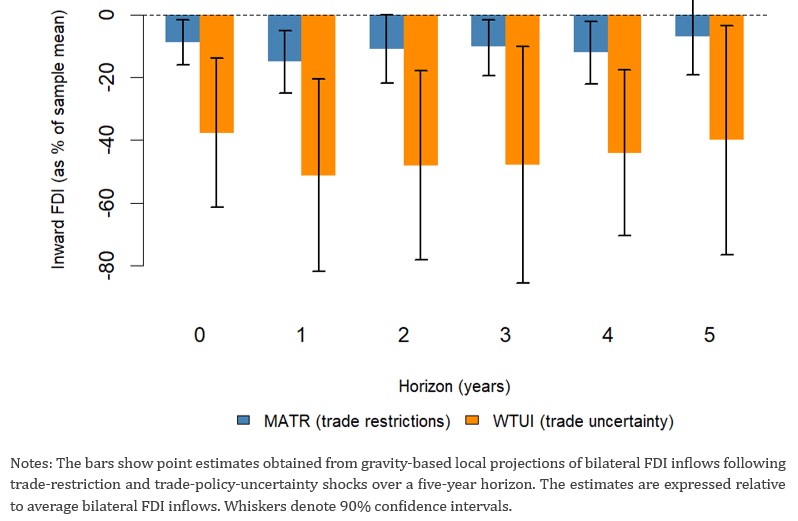
A one-standard-deviation increase in trade restrictions — comparable to the tightening of non-tariff barriers introduced by Colombia in the mid-1990s — reduces FDI inflows by about 10% of their sample mean on impact. The effect reaches around 15% after one year before gradually fading.
The effect of trade policy uncertainty is much larger. A one-standard-deviation increase in trade uncertainty lowers FDI inflows by almost 40% on impact and by around 50% after one year. The decline remains economically large and statistically significant five years later.
The difference between the two effects is important. An enacted restriction changes current trading conditions. Uncertainty affects a wider range of future outcomes: firms may not know which products will be targeted, how long measures will remain in place, whether other countries will retaliate or whether further restrictions will follow.
Because foreign investment is costly to reverse, this uncertainty raises the value of waiting (Bloom, 2009). Policy ambiguity can therefore discourage FDI even before any new restriction is introduced.
Average effects do not tell the whole story. Trade-policy shocks may also have substantial second-moment effects on FDI inflows.
To examine this, the analysis employs a location-scale approach (Adrian, Boyarchenko and Giannone, 2019; Furceri et al., 2025), which allows us to assess the effects of trade shocks on the dispersion of the future distribution of FDI inflows, thereby providing useful information on their impact on investment risk. The results show that trade policy uncertainty—and unexpected increases in trade restrictions—have positive scale effects, implying that these shocks increase uncertainty surrounding future FDI inflows (Figure 2).
Figure 2. Effects of trade restrictions and trade uncertainty on the scale of the FDI inflows distribution
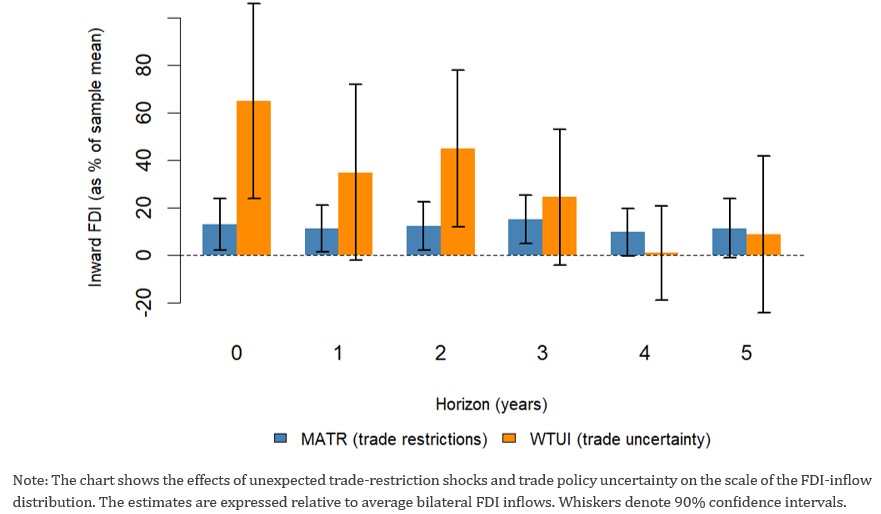
This result is particularly relevant for policymakers. Trade shocks not only reduce average FDI inflows, but also increase uncertainty about future investment outcomes, making vulnerable investment relationships even more exposed to adverse developments. Monitoring average inflows alone may therefore understate the true investment risks created by trade-policy shocks.
The effects vary substantially across host-country policy environments and bilateral relationships (Figure 3).
Figure 3. The effects of trade restrictions and uncertainty on FDI inflows depending on host- and source-country characteristics
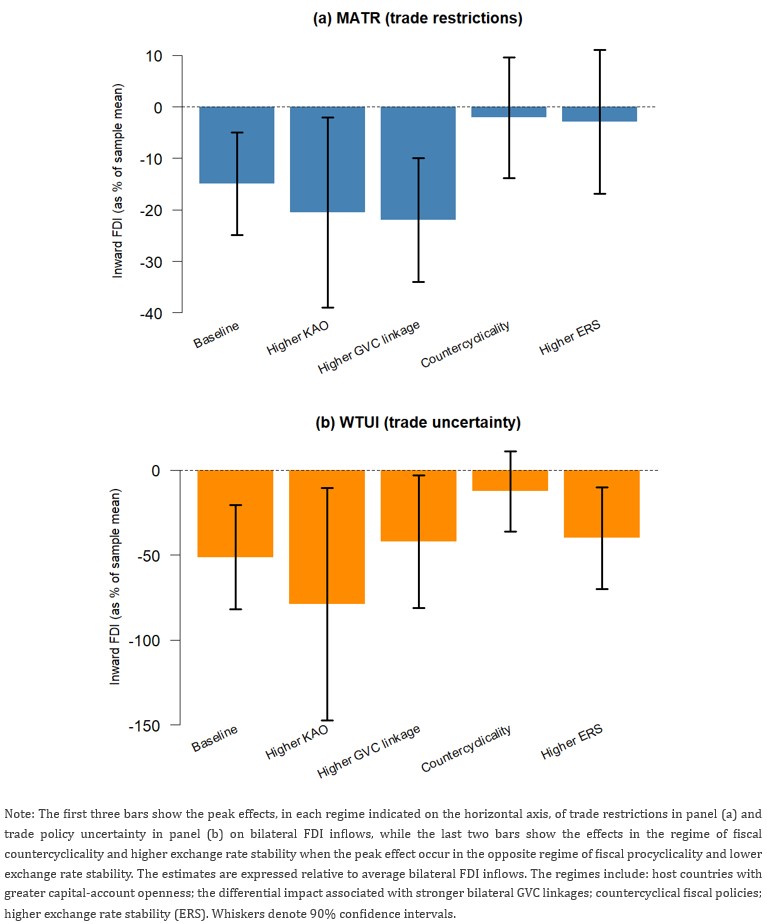
First, the effects are larger in host countries with more open capital accounts. Financial openness facilitates international investment, but it also allows investors to reallocate capital more quickly when trade conditions deteriorate.
Second, stronger bilateral global value-chain (GVC) linkages between host and source countries amplify the impact. The second bar in Figures 3(a) and 3(b) reports the differential effect associated with above-median versus below-median GVC intensity. The negative and statistically significant differential effect suggests that economies that are more deeply integrated into international production networks are also more exposed to disruptions stemming from trade restrictions and policy uncertainty. Firms operating in tightly integrated production networks rely on predictable cross-border flows of intermediate inputs. Trade barriers and policy uncertainty therefore impose larger costs where trade and investment are most closely interconnected. While trade and financial integration generate substantial efficiency gains, they also increase exposure to sudden policy shifts. Economies deeply embedded in global production networks are especially vulnerable when the rules governing those networks become less predictable.
Third, domestic macroeconomic policies matter. Countercyclical fiscal policy helps stabilize demand and cushion shocks, thereby mitigating the adverse effects of trade-policy shocks on FDI inflows. Exchange-rate stability also reduces vulnerability. Maintaining stable exchange rates lowers uncertainty about future investment returns, helping to mitigate the effects of trade restrictions and policy uncertainty.
The findings point to four policy lessons.
First, the costs of trade restrictions extend beyond trade. Measures designed to protect domestic production or reduce foreign dependence can also weaken cross-border investment, particularly in economies closely integrated into global value chains.
Second, uncertainty may be more damaging than restrictions themselves. Clear objectives, advance notice, transparent implementation and credible policy communication can reduce uncertainty even when policy changes are unavoidable. Sudden announcements, repeated reversals and unclear implementation schedules can discourage investment well before restrictions take effect.
Third, policymakers should monitor not only the average level of future investment outcomes but also the uncertainty surrounding them, in order to implement timely and targeted policies that may help reduce future FDI risks.
Fourth, domestic macroeconomic policy can strengthen resilience. Countercyclical fiscal policy helps stabilize demand when trade shocks weaken investment, while credible macroeconomic frameworks that limit excessive exchange-rate volatility reduce the additional risk faced by foreign investors. Moreover, the stronger response in financially open economies should not be interpreted as an argument for capital controls. Rather, it highlights the need for stronger buffers and greater policy credibility where international capital can adjust rapidly.
In an increasingly fragmented global economy, governments may face legitimate pressures to strengthen economic security and reduce strategic dependence. But these policies carry wider costs. Trade restrictions weaken international investment, while uncertainty about future restrictions can be even more damaging.
Preserving FDI therefore requires a dual strategy: making trade policy as transparent and predictable as possible, while using macroeconomic policy to prevent external shocks from being amplified domestically.
Adrian T., Boyarchenko N., and Giannone D. “Vulnerable Growth.” American Economic Review 109.4 (2019): 1263-1289.
Aguilar, A., Caballero, J., Frost, J., Hernández J. R., Nuguer, V., and Upper, C. (2024). “Are investment flows following the realignment in trade?”. SUERF policy brief no. 1044, December 2024.
Ahir H., Bloom N., and Furceri D. (2022). “The World Uncertainty Index.” National Bureau of Economic Research, (No. w29763).
Ahir, H., Bloom, N., and Furceri, D. (2025). “Uncertainty about uncertainty”. Finance & Development Magazine, International Monetary Fund, September.
Ahir, H., Bettarelli, L., Furceri, D., Frangiamore, F., Ostry, J. D., and Scianna, F. (2026). “Trade Restrictions, Trade Policy Uncertainty and FDI Flows” (No. 21524). Centre for Economic Policy Research.
Bloom N. (2009). “The impact of uncertainty shocks”. Econometrica, 77(3), 623-685.
Ernst, A., Hinterlang, N., Jäger, M., and Stähler, N. (2026). “More harm than good: Economic and welfare effects of punitive tariffs”. SUERF policy brief no. 1479, June 2026.
Estefania-Flores J., Furceri D., Hannan S. A., Ostry J. D., and Rose A. K. (2025). “A measurement of aggregate trade restrictions and their economic effects”. The World Bank Economic Review, 39(3), 684-710.
Furceri D., Giannone D., Faizaan K., Raphael L. W., and Li H. (2025). “Debt-at-Risk”. IMF Working Papers No. 2025/086.