

This Policy Brief is based on Leippold and Matthys (2025), “Beyond Carbon Pricing: Integrating Mitigation, Adaptation, and Carbon Removal.” The views expressed are those of the authors and do not necessarily reflect those of their institutions.
Abstract
Relying solely on carbon pricing to meet Paris Agreement targets imposes prohibitive economic costs. We show that achieving the 2°C stabilization goal through taxation alone requires carbon prices reaching approximately $474/tCO2, a level that would trigger widespread capital divestment. To resolve this dilemma, we develop a dynamic stochastic integrated assessment model that optimizes a portfolio of carbon taxation, clean-capital subsidies, adaptation investment, and carbon dioxide removal (CDR). Our analysis identifies CDR as a necessary condition for stabilization rather than a supplementary measure. In the optimal portfolio, net carbon removal scales from 0.04 to 3.7 GtCO 2 /year by 2050 to maintain temperature targets at a feasible cost. These instruments act as economic complements: carbon pricing and subsidies target new emissions, CDR reduces the legacy atmospheric stock, and adaptation protects the economic base from immediate damages. Consequently, the economic gains from the integrated portfolio significantly exceed the sum of individual instrument effects. We conclude that optimal climate policy requires shifting from a price-centric framework to a diversified approach in which carbon removal and adaptation serve as policy instruments in order to decarbonize the global economy.

Global CO₂ emissions have continued to rise over the past two decades, interrupted only briefly by the pandemic. Fossil fuels still supply roughly 80% of global energy. The Climate Action Tracker projects end-of-century warming of about 2.7°C under current policies, and even full implementation of stated pledges would deliver roughly 2.1°C — still above the Paris benchmark. The gap is therefore not about the existence of long-run targets; it is about the pace and implementable climate policies composition of near-term action.
Binding political-economy constraints are a central obstacle to efficient carbon pricing at the global level. Concentrated near-term losses in fossil-intensive sectors, concerns about energy security, the risk of abrupt capital scrapping or even outright political opposition towards climate policies, routinely limit both the level and the credibility of carbon taxes. At the same time, climate stabilization is inherently a stock problem: because atmospheric CO₂ persists for centuries, a flow-based instrument — even if well designed — cannot rapidly reduce the existing atmospheric burden and would require steadily rising prices as past emissions continue to accumulate.
These realities matter because large-scale emissions reductions in the near term are unlikely. As a result, a comprehensive policy framework must also consider (i) the scale up adaptation expenditures to protect the global capital stock against increasingly frequent and severe climate disasters, and (ii) deployment of negative-emissions technologies to reduce the legacy stock of CO₂ if emissions remain elevated for longer.
Finally, our framework highlights that the policy instruments are tightly interconnected: improving the effectiveness of one tool reshapes the optimal intensity of the others, sometimes in ways that work against the original objective.
To quantify the impact of our policy framework, we develop a continuous-time stochastic general equilibrium model that couples a tractable climate module (an enhanced two-component energy balance model with time-varying carbon sinks) to a dynamic macroeconomic environment with clean and dirty capital stocks, endogenous clean-sector R&D, and climate disaster risk. The planner jointly optimizes four instruments: (i) a carbon tax on dirty capital that internalizes the emissions externality; (ii) clean-capital subsidies and directed R&D policy that accelerate the energy transition; (iii) adaptation investment that reduces the damage elasticity to temperature and extreme events; and (iv) carbon dioxide removal (CDR) that actively draws down the atmospheric stock. The model is calibrated to match both observed economic aggregates (global GDP, sectoral investment, adaptation spending, disaster losses) and the RCP4.5 climate pathway—an intermediate stabilization trajectory consistent with roughly 2°C of warming.
| 2020–2035 | Clean subsidies dominate to overcome path dependence; moderate carbon taxes complement. |
| 2030–2050 | CDR scales aggressively as the imperative shifts from reducing emission flows to drawing down the atmospheric stock. |
| Post-2050 |
CDR becomes decisive; adaptation spending rises with temperature and disaster frequency; subsidies phase out as clean capital becomes self-sustaining. |
This dynamic pattern reflects the distinct timescales on which different market failures operate: mitigation addresses the flow problem, adaptation manages ongoing damages, and removal tackles the legacy stock.
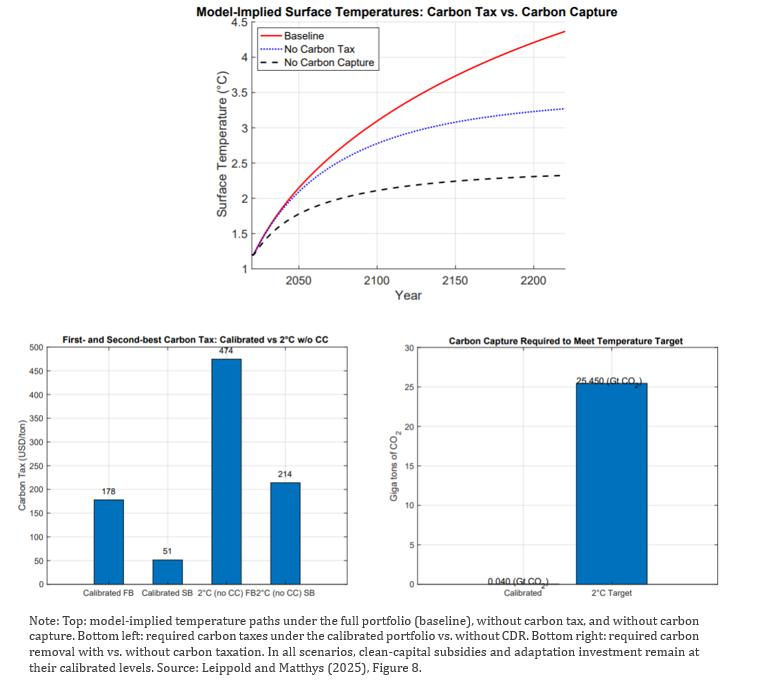
The figure illustrates why a diversified policy portfolio is necessary. We consider two counterfactual thought experiments. First, suppose carbon removal is shut down and the 2°C objective must be achieved through carbon pricing alone. In that case, the Pigouvian carbon price required to meet the target rises from $178/tCO₂ to roughly $474/tCO₂ — a level that is economically and politically infeasible in the model because it would induce rapid divestment of dirty capital. Even if we impose that the carbon tax should not lead to divestment of dirty capital investment, the implementable (second-best) carbon price still needs to increase to about $214/tCO₂, which corresponds to around 45% of the first-best tax.
Second, suppose carbon pricing is set to zero and the 2°C objective is pursued through carbon removal alone. The required removal then exceeds 25 GtCO₂/year — roughly seven times the benchmark level — at annual costs on the order of several percent of global GDP. Moreover, sustained removal at roughly 24 GtCO₂/year would exhaust the prudent planetary storage limit of about 1,460 GtCO₂ by around 2080, making a CDR-only strategy physically unsustainable. By contrast, the coordinated portfolio achieves stabilization with economically and physically plausible reliance on each instrument, and on a timescale consistent with realistic implementation.
Figure 1. Policy analysis for achieving the 2°C target
The four instruments act on distinct margins — emission flows (carbon taxation), capital reallocation (clean subsidies), disaster exposure (adaptation), and the atmospheric stock (carbon removal) — and are most effective when deployed as a coordinated portfolio. Carbon pricing reduces new emissions and thereby lowers the future burden on carbon removal. Clean subsidies accelerate the shift from fossil to clean capital, reducing the economic and political cost of sustaining a meaningful carbon price during the transition. Adaptation protects the capital stock, making it easier to maintain investment in mitigation and removal. Carbon removal addresses the legacy stock of atmospheric CO₂ that flow-based instruments cannot unwind.
At the same time, the instruments interact in ways that can create trade-offs if any single tool is relied upon too heavily. Greater adaptation effectiveness reduces expected damages, but it can also lower the equilibrium carbon price and slow the pace of decarbonization, increasing the residual emissions that must eventually be offset through carbon removal. A similar logic applies to carbon removal itself: scaling CDR is essential for managing the legacy stock, but it does not substitute for emissions reduction and can weaken incentives for mitigation if treated as a stand-alone solution. In our framework, pricing and the transition to clean technologies remain central because they determine the long-run direction of the energy system; adaptation and removal are complements that buy resilience and address the inherited stock problem, but they do not, on their own, eliminate the source of emissions.
Clean subsidies highlight an additional design trade-off. They can jump-start adoption when clean technologies face a cost or productivity disadvantage, but if subsidies fully close the clean–dirty profitability gap, they can reduce incentives to innovate in the clean sector. Effective policy therefore uses subsidies to overcome early transition frictions, while preserving incentives for productivity improvements and phasing support down as the clean sector becomes competitive.
Overall, the framework points to a state-dependent rebalancing of the policy mix as conditions evolve — rather than a uniform scaling-up of all instruments — while keeping the primary objective clear: accelerating the transition away from fossil inputs, complemented by adaptation and carbon removal to manage near-term risks and the atmospheric stock
Broaden the policy package. Carbon pricing remains an essential instrument, but it is unlikely to deliver climate stabilization on its own when capital stocks are long lived or when political economy frictions impair the successful implementation of carbon taxes. Policy frameworks centered exclusively on pricing therefore risk underperforming relative to coordinated portfolios that also facilitate carbon removal and strengthen adaptation capacity.
Scale carbon dioxide removal earlier. Carbon removal should not be treated as a residual tool reserved for the second half of the century. In the calibrated scenarios, meeting temperature objectives requires a material scale-up of removal within the next few decades. This points to the value of credible early deployment policies — such as procurement commitments or targeted public investment — that can accelerate carbon capture and reduce their unit costs over time.
Integrate adaptation into the stabilization strategy. Adaptation is often framed as a response to unavoidable warming, yet it also shapes the optimal mitigation path by limiting expected damages and protecting the economy’s capital stock. In the model, higher adaptation effectiveness changes the optimal intensity of other instruments through equilibrium feedbacks and can generate unintended interactions that complicate efficient policy implementation.
Design transition support with an exit strategy. Clean-capital subsidies are most valuable early in the transition, when clean technologies remain at a cost or productivity disadvantage and when complementary policies can accelerate capital reallocation. As innovation and diffusion narrow the gap, continuing subsidies at unchanged rates can weaken incentives for further productivity improvements and misallocate resources. An effective policy design needs to take this into account and phases subsidies down as clean technologies become competitive.
Climate stabilization requires more than pricing the externality: it also requires actively managing the atmospheric carbon stock and protecting the economic production base from increasingly severe climate risks. In our calibrated global framework, the Pigouvian benchmark implied by the social cost of carbon is about $178/tCO₂ but fully implementing it would violate the dirty-investment viability constraint and trigger abrupt scrapping of existing fossil capital; the implementable (second-best) carbon price is about $51/tCO₂. This wedge is not a policy proposal for the carbon price. It measures how far a price-only strategy can go in practice, given limits to rapidly increasing carbon taxes and the fact that today’s energy infrastructure cannot be replaced overnight.
The same logic explains why a portfolio is indispensable. If carbon removal is shut down, meeting the 2°C objective through pricing alone would require carbon prices around $474/tCO₂ (and even the constrained second-best rises to about $214/tCO₂), which is economically and politically untenable in the model because it forces rapid divestment of dirty capital. Conversely, if carbon pricing is set to zero, required removal rises above 25 GtCO₂/year, quickly pushing against physical storage constraints. The practical implication is a sequenced policy mix: clean subsidies and moderate carbon pricing play the dominant near-term role in bending the emissions curve, while adaptation and carbon dioxide removal must scale aggressively from the mid-2030s onward, with CDR rising from today’s ~0.04 to about 3.7 GtCO₂/year by 2050. Moreover, the portfolio is inherently state-contingent: higher climate tail risk shifts the mix toward stronger carbon pricing, whereas more effective adaptation or weaker natural uptake shifts emphasis toward adaptation investment and carbon removal rather than mechanically increasing every instrument. In conclusion, getting carbon pricing right remains necessary — but in the decades ahead, getting durable carbon storage right will be decisive.
Leippold, M. and F. H. A. Matthys (2025). “Beyond Carbon Pricing: Integrating Mitigation, Adaptation, and Carbon Removal.” Working Paper, University of Zurich and ITAM.
Golosov, M., J. Hassler, P. Krusell, and A. Tsyvinski (2014). “Optimal Taxes on Fossil Fuel in General Equilibrium.” Econometrica, 82(1), 41–88.
Hong, H., N. Wang, and J. Yang (2023). “Mitigating Disaster Risks in the Age of Climate Change.” Econometrica, 91(5), 1763–1802.
Acemoglu, D., P. Aghion, L. Bursztyn, and D. Hemous (2012). “The Environment and Directed Technical Change.” American Economic Review, 102(1), 131–166.
Fuss, S. et al. (2018). “Negative Emissions—Part 2: Costs, Potentials and Side Effects.” Environmental Research Letters, 13(6), 063002.
Gidden, M. J. et al. (2025). “A Prudent Planetary Limit for Geologic Carbon Storage.” Nature, 645, 124–132.
Bilal, A. and D. R. Känzig (2024). “The Macroeconomic Impact of Climate Change: Global vs. Local Temperature.” NBER Working Paper 32450.
Climate Action Tracker (2021). “Glasgow’s 2030 Credibility Gap.” New Climate Institute and Climate Analytics.