

This policy brief is based on ECB Working Paper Series, No 3086. This paper should not be reported as representing the views of the European Central Bank (ECB). The views expressed are those of the authors and do not necessarily reflect those of the ECB.
Abstract
We build and estimate a heterogeneous-agent New Keynesian (HANK) model for the euro area to analyse the distributional effects of monetary policy. The model features households that differ in wealth and income. Estimated on euro area data for 2000–2019, the model captures aggregate dynamics while allowing us to trace how policy affects households across the wealth distribution. We show that an earlier tightening of monetary policy during the inflationary episode of the early 2020s would have imposed disproportionate consumption losses on poorer households, mainly through the labour income channel. Richer households are affected primarily through declines in the value of their assets, but can smooth their spending more effectively. These findings highlight that monetary policy has unequal effects across households and that accounting for heterogeneity is essential for a full assessment of its transmission and welfare consequences.
Macroeconomic analysis has often relied on representative-agent models, in which a single “average” household is used to capture the behaviour of the whole economy. These models have been very useful in understanding aggregate dynamics, but by construction they abstract from differences across households. In reality, households vary in their wealth, in the assets they hold, in the risks they face, and in how easily they can adjust consumption when conditions change. This heterogeneity can be important for understanding how monetary policy is transmitted.
For central banks, these differences matter. If monetary policy affects some households much more strongly than others, the aggregate impact on demand and inflation depends on who adjusts. Households with high marginal propensities to consume, typically those with low wealth, respond more strongly to shocks, amplifying aggregate consequences. The link between heterogeneity and macroeconomic outcomes is therefore tighter than the representative-agent framework suggests.
Recent research has highlighted these insights. HANK models show that monetary policy transmits not only through the familiar intertemporal substitution channel but also through distributional channels, as different households respond differently to interest rate changes (Kaplan, Moll and Violante 2018; Auclert 2019). Building on this work, we develop and estimate a HANK model for the euro area (Kase and Rigato 2025). Our objective is to quantify how monetary policy affects different households and to examine the welfare implications of policy timing during the recent inflation episode.
We incorporate several dimensions of household heterogeneity to better capture the reality observed in euro area data. In particular, the model is calibrated to reproduce the wealth distribution documented in the Household Finance and Consumption Survey (HFCS). This ensures that the different balance sheet positions of households are realistically represented. At the same time, we discipline the model to match empirical evidence on the heterogeneity of marginal propensities to consume, so that differences in spending responses to shocks are consistent with micro evidence.
Households are also subject to individual income shocks, which cannot be insured against. As a result, even households that look similar at the outset may end up with very different income paths, consumption levels, and asset holdings. This mechanism generates dispersion across households and makes some of them much more vulnerable to aggregate shocks than others.
We also incorporate information frictions. In line with the empirical evidence on expectation formation, not all households update their views immediately and fully in response to new information about inflation or monetary policy. Instead, expectation updating is staggered, with some households adjusting only occasionally. This feature introduces persistence into aggregate dynamics and affects the timing and strength of policy transmission (Mankiw and Reis 2002).
On the empirical side, the model is calibrated to match key features of the household distribution in the euro area, including the wealth distribution and consumption shares across income groups. Estimation is then carried out using Bayesian methods on quarterly euro area data from 2000 to 2019. By combining calibration at the micro level with estimation at the macro level, we ensure that the model matches both household heterogeneity and aggregate dynamics.
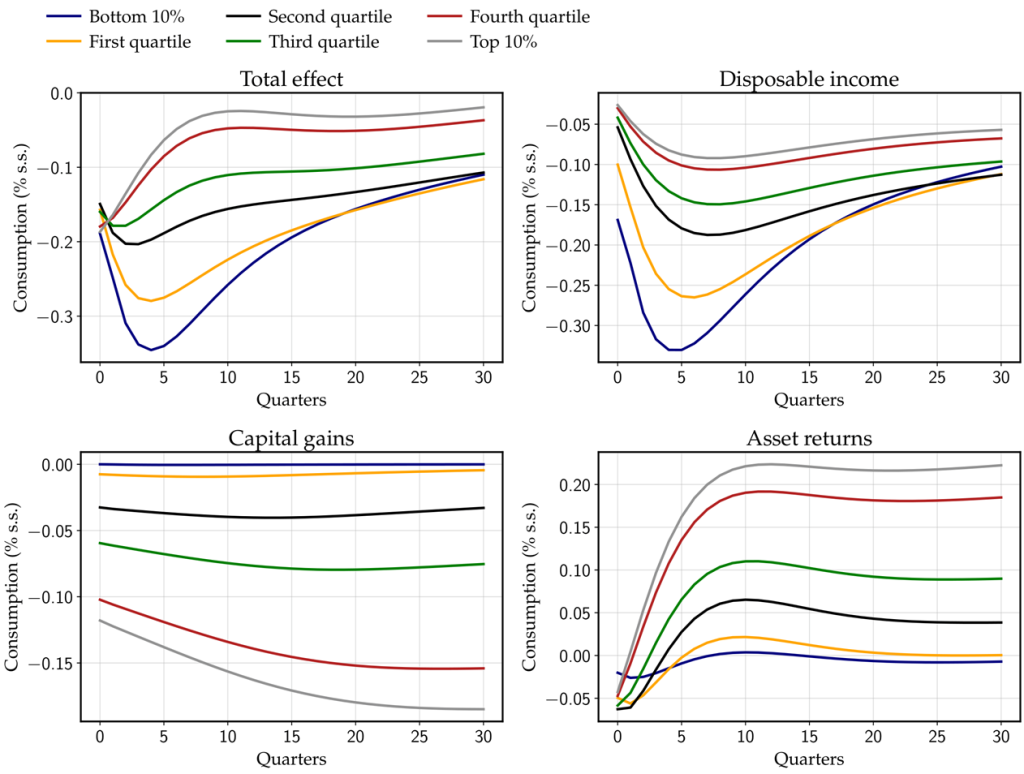
An important feature of the framework is that it allows us to decompose the consumption response to a monetary shock into three components. The first is a disposable income channel, capturing how policy affects households’ disposable labour income. The second is a capital gains channel, reflecting the immediate impact of unexpected changes in asset values when interest rates move. The third is an asset returns channel, which captures how higher interest rates translate into different returns on households’ assets over time.
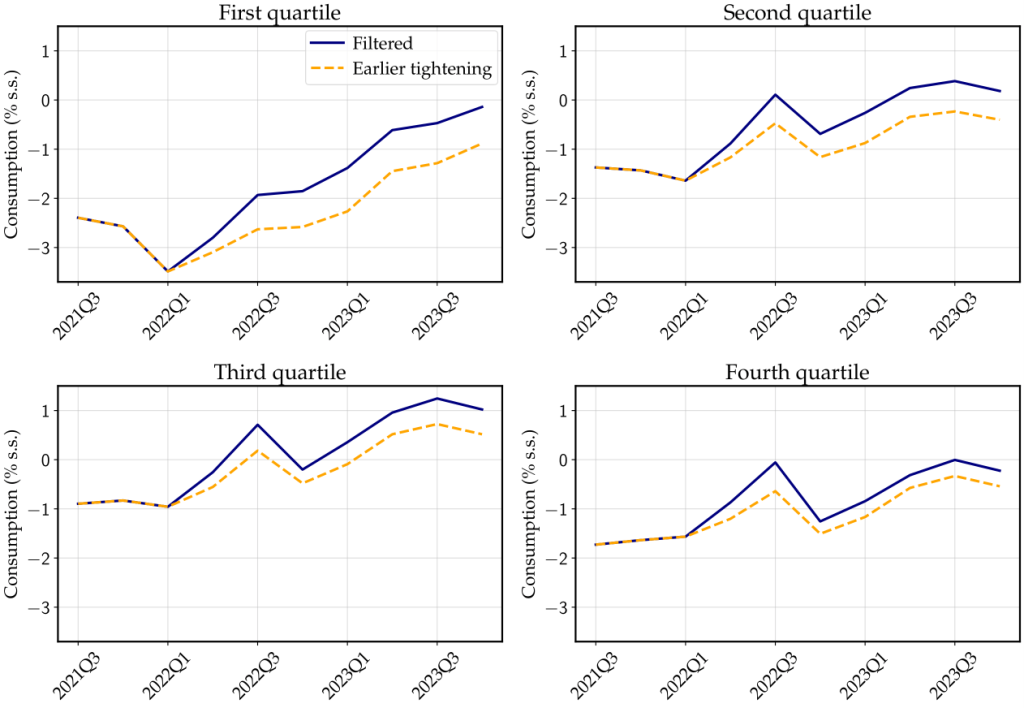
The central quantitative exercise in the paper considers a counterfactual in which the ECB had raised policy rates earlier during the inflationary episode of the early 2020s. Debates at the time suggested that earlier action might have helped prevent inflation expectations from drifting upward, while others cautioned that the recovery was still fragile. Our model allows us to evaluate the distributional consequences of such an earlier tightening.
Model-based filtered data indicate that poorer households were already in a weaker position before tightening. Their consumption remained more subdued than that of wealthier households, reflecting smaller buffers and stronger exposure to earlier shocks. Entering a tightening cycle from this position made them more vulnerable, but the result does not depend only on initial conditions. Even if their starting point had been more favourable, low-wealth households would still have been affected more severely than richer ones because of their limited scope to smooth shocks.
Figure 1. Model-filtered consumption across wealth quartiles (blue) and a counterfactual scenario with an earlier interest rate tightening (yellow)
The mechanisms behind these unequal responses can be understood through the decomposition introduced earlier. The disposable income channel is strongest at the bottom of the wealth distribution. For households with few or no assets, the consumption decline closely mirrors the fall in disposable income, consistent with very high marginal propensities to consume. By contrast, consumption at the top of the distribution is much less sensitive to disposable income changes, since these households can smooth fluctuations with their assets. The capital gains channel and the asset returns channel matter very little for the poorest households but become important for the rest of the distribution, especially at the top. A monetary contraction generates a sudden drop in asset prices, reducing consumption at the top, which corresponds to the capital gains channel. However, it also generates persistently higher asset returns going forward, which work in the opposite direction – the asset returns channel. In the near term, however, higher returns can also dampen consumption slightly through stronger incentives to save.
Figure 2: Effects of a monetary policy contraction across the wealth distribution decomposed into disposable income, capital gains, and asset returns channels.
The timing of monetary policy therefore has inequality consequences. An earlier tightening would have widened existing consumption gaps and generated consumption losses that fell disproportionately on low-wealth households. While such a policy might have accelerated disinflation, it would also have imposed significant costs on those least able to bear them. These results illustrate why it is important to look beyond average responses when evaluating monetary policy.
Our analysis shows that monetary policy in the euro area affects households unequally across the wealth spectrum. In a counterfactual where policy rates had been raised earlier during the inflation surge of the early 2020s, poorer households would have faced larger consumption losses than richer ones. Their spending was already lagging behind before tightening began, and when policy rates rose, they were hit hardest through the disposable income channel. By contrast, richer households were more affected through capital gains and asset returns, but their buffers allowed them to smooth consumption more effectively. The timing of monetary policy therefore matters not only for inflation but also for distribution: acting earlier may have brought prices down faster, but at the cost of widening consumption gaps.
To study these effects, we developed and estimated a heterogeneous-agent New Keynesian model for the euro area. The model incorporates differences in households’ assets, exposure to productivity shocks, and the way expectations are updated. It is calibrated to match the euro area wealth distribution and estimated on aggregate data using Bayesian methods. This setup allows us to capture aggregate dynamics while at the same time tracing how monetary policy transmits through disposable income, capital gains, and asset returns across the wealth distribution.
The results underline the importance of going beyond average responses. Aggregate consumption and output figures conceal differences in how households are affected, which matters for understanding the full consequences of monetary policy. Heterogeneous-agent models can match aggregate outcomes while providing this distributional dimension. Incorporating such models into policy analysis can therefore improve the assessment of monetary transmission in the euro area, making clear not just how policy works in the aggregate, but also who is most affected.
Auclert, A. (2019). “Monetary Policy and the Redistribution Channel.” American Economic Review, 109(6), 2333–2367.
Auclert, A., Rognlie, M., & Straub, L. (2020). “Micro Jumps, Macro Humps: Monetary Policy and Business Cycles in an Estimated HANK Model.” NBER Working Paper 26647.
Kaplan, G., Moll, B., & Violante, G. L. (2018). “Monetary Policy According to HANK.” American Economic Review, 108(3), 697–743.
Kase, H., & Rigato, R. D. (2025). Beyond averages: heterogeneous effects of monetary policy in a HANK model for the euro area. ECB Working Paper No. 3086.
Mankiw, N. G., & Reis, R. (2002). “Sticky Information Versus Sticky Prices: A Proposal to Replace the New Keynesian Phillips Curve.” Quarterly Journal of Economics, 117(4), 1295–1328.