

This policy brief is based on van der Cruijsen et al. (2026). The views expressed in this paper are our own and do not necessarily reflect those of DNB, the Eurosystem or the Money Wise platform.
Abstract
How couples divide payment tasks has received little scholarly attention, despite being a basic part of everyday life. Using novel survey data from Dutch households, we shed new light on this topic. We find that payment responsibilities are often specialised within couples, meaning that one partner typically executes or arranges specific payments. Social norms, enjoyment of payment tasks, and time availability are most strongly linked to who takes the lead, while knowledge, financial resources, and personality traits also play a role. Taking the lead in household payments is associated with greater financial influence, better preparedness to step in, and quicker recognition of financial problems. A smooth handover is more likely when partners have strong payment knowledge, experience with digital payments, and stay informed about each other’s payment activities.
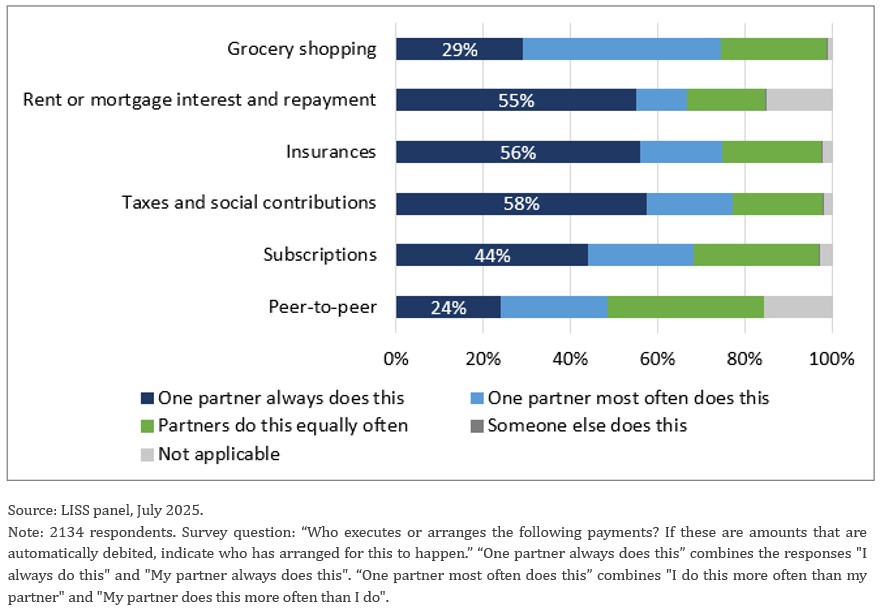
Within many couples, payment tasks are not shared equally but divided along clear lines between partners (Figure 1). For three of the six payment types, most respondents report that one partner always handles the payments: taxes and social contributions (58%), insurances (56%), and rent or mortgage interest and repayment (55%). By contrast, grocery payments, peer-to-peer payments (payments to family, friends and acquaintances), and subscription payments are more often handled jointly. Marked gender differences appear. Women more often take charge of grocery shopping and peer-to-peer payments, while men more often lead in the other four categories. A traditional pattern emerges: fixed household expenses are more often managed by men, while women more often handle day-to-day spending. Four in five respondents say the allocation of payment tasks is the same as when they started living with their current partner.
Figure 1. Payment task specialisation is present in many households
Several factors are associated with who tends to take the lead in payment tasks. Social norms, enjoyment of these tasks, and time availability stand out most clearly. For example, women who believe that grocery shopping is usually handled by women in couples of their age are more likely than men with the same view to take the lead. People who enjoy making payments and have more time for this task than their partner are also more often in charge. In addition, greater payment knowledge and more experience with digital payments are associated with taking the lead. Financial differences within the couple matter too: partners with stronger financial resources are more likely to lead most payment tasks, with grocery shopping as the exception. Personality differences are also related to who takes the lead. For example, respondents who see themselves as more controlling, caring, organised and impulsive than their partner are more likely to take the lead with peer-to-peer payments.
Greater involvement in payment tasks is associated with stronger financial influence, better preparedness to take over payment tasks, and a greater ability to quickly recognise financial problems. When one partner handles most payments, the other may have fewer opportunities to gain payment-related knowledge, experience, and confidence. This can reduce their ability to manage payments independently, step in when needed, and recognise financial problems early. One in ten respondents say they would not be able to easily take over their partner’s payment tasks if needed. Women are less likely than men to feel able to step in. A smooth handover of payment tasks is more likely when partners have strong payment knowledge, digital payment experience, and stay informed about each other’s payment activities.
Our findings are relevant not only for households themselves, but also for policymakers, financial institutions, consumer organisations, and debt prevention agencies working to strengthen financial inclusion and reduce household financial problems. They suggest that these stakeholders can help by encouraging couples to stay jointly engaged in household payments and by supporting them in building the knowledge and skills needed to manage payments independently. The moment couples start living together is a particularly important opportunity: opening a joint account or arranging shared financial products could be paired with practical prompts to discuss who does what, share access to financial information, and periodically rotate tasks. Strengthening payment knowledge and mutual awareness may help households stay financially resilient and better prepared to deal with life events such as illness and separation. Financial education may also have a role to play. Policymakers and educators could place greater emphasis on preparing young people to manage household payment tasks independently, while recognising the influential role parents play through both explicit financial upbringing and the example they set in organising financial responsibilities within the household. Payment task specialisation is unlikely to be unique to the Netherlands, suggesting that our recommendations are relevant beyond the Dutch context. Further research is needed to determine how widespread this pattern is internationally.
van der Cruijsen, C., Kunkel, D. & R. Nijkamp (2026). Who manages the household purse? Payment task allocation between partners, associated factors, and implications. De Economist. https://doi.org/10.1007/s10645-026-09473-1