

This Policy Brief draws on the author’s doctoral research on emerging markets, market-based finance and systemic risk, including published work on commodity-shock transmission, BRICS integration and macro-financial blind spots. The views expressed are solely those of the author.
Abstract
Emerging market economies have strengthened bank regulation and macroprudential frameworks since the global financial crisis, yet they remain vulnerable to global financial shocks. This Policy Brief argues that the persistence of vulnerability reflects a shift in systemic risk from bank balance sheets towards market-based channels: funding liquidity, collateral haircuts, margin calls, non-bank leverage and cross-border portfolio rebalancing. Drawing on doctoral research on commodity shocks, financial integration and macro-financial blind spots, it proposes a market-plumbing dashboard for emerging-market supervisors. The central policy implication is that bank resilience is necessary but insufficient: central banks and regulators must monitor the channels through which stress travels between banks, non-bank intermediaries and global portfolios.
Emerging market economies have spent much of the post-global financial crisis period strengthening their financial systems. Banks are better capitalised, liquidity regulation is more demanding, supervisory capacity has improved and macroprudential tools are more widely used. These reforms were necessary. They reduced the probability that a conventional banking crisis would spread through weak capital positions, excessive maturity transformation or fragile wholesale funding.
Yet they did not eliminate vulnerability to global financial shocks. Episodes of global monetary tightening, commodity-price volatility, dollar strength and risk-off portfolio rebalancing continue to affect emerging markets through capital flows, exchange rates, asset prices and market liquidity. This creates a resilience paradox: the banking system may be safer, while the broader financial system remains exposed.
The paradox arises because the locus of systemic risk has changed. Risk has not disappeared; it has migrated. Market-based finance and non-bank financial intermediation now play a central role in credit allocation, liquidity transformation and cross-border portfolio flows. Investment funds, hedge funds, pension funds, insurers, broker-dealers and other non-bank intermediaries are essential to modern financial markets. They diversify funding sources and support market development. But they also create new channels through which leverage, liquidity mismatch and correlated selling can amplify shocks.
For emerging markets, this matters because domestic stress often begins outside domestic institutions. A local bond sell-off may be triggered by global fund redemptions. A currency depreciation may be amplified by margin calls and hedging flows. A decline in equity prices may reflect commodity shocks or global portfolio rules rather than a sudden deterioration in domestic fundamentals. The relevant question for supervisors is therefore no longer only whether banks are individually sound. It is whether authorities can see how stress travels between banks, non-bank intermediaries and markets.
A useful way to understand this problem is to distinguish three layers of vulnerability.
The first layer is external shock transmission. Emerging markets are exposed to global prices and global funding conditions that they do not determine. Commodity prices, dollar liquidity, international interest rates and global risk appetite can move domestic asset prices even when local fundamentals are stable. In doctoral research on large emerging economies, one empirical strand shows that global energy-price movements can precede equity-market movements in BRIC countries. This is consistent with the broader view that emerging markets often operate as price-takers in global commodity and financial cycles.
The second layer is integration without insulation. Financial and economic integration can support growth, improve capital allocation and deepen domestic markets. It can also create new channels of interdependence. Evidence on BRICS and related emerging-market integration suggests that financial linkages, infrastructure and innovation can strengthen economic interaction, but do not remove exposure to global disturbances. Integration changes the geography of vulnerability; it does not abolish it.
The third layer is market-based amplification. Once a shock enters the system, it may be amplified through funding liquidity, collateral valuation, margining practices, open-ended fund redemptions, dealer balance-sheet constraints and non-bank leverage. These mechanisms often operate outside the traditional bank regulatory perimeter, but they remain deeply connected to banks through clearing, custody, repo financing, derivatives, prime brokerage, credit lines and market-making.
This is the central macro-financial blind spot. Emerging markets can improve bank regulation and still remain exposed to risks transmitted through activities that are not fully captured by bank-centred supervision.
Market plumbing refers to the operational infrastructure through which finance works: repo and securities financing, collateral management, derivatives clearing, margining practices, settlement systems, dealer intermediation and liquidity in bond and foreign-exchange markets. These elements often appear technical, but they determine whether stress is absorbed gradually or amplified suddenly.
A traditional bank run is visible. Depositors withdraw funding and liquidity vanishes. A market-based run is less visible. It occurs when secured funding is not rolled over, when haircuts rise, when margin calls force investors to raise cash or when funds sell assets to meet redemptions. The mechanics differ from a deposit run, but the outcome can be similar: forced deleveraging, falling prices, weaker liquidity and tighter financial conditions.
The mechanism is straightforward. When volatility rises, margin requirements and collateral demands can increase. Investors then need cash. If cash is scarce, they sell assets. If many investors sell at the same time, prices fall and market liquidity deteriorates. Falling prices may trigger further collateral pressure, additional margin calls and more selling. What begins as ordinary repricing can become a liquidity spiral.
The Financial Stability Board’s work after the March 2020 market turmoil highlighted this point. As non-bank financial intermediation has grown, market liquidity has become more central to financial resilience. The same lesson is visible in more recent international policy work on margin and collateral calls. The problem is not that margining or collateralisation are undesirable. They are essential risk-management tools. The problem is that, under stress, they can become procyclical if liquidity preparedness is weak.
The scale of the issue is now too large to be treated as peripheral. The FSB reported that non-bank financial intermediation reached $256.8tn in 2024 and grew at twice the pace of the banking sector. This is not a niche segment of finance. It is a central part of the global system in which liquidity, leverage and risk-taking are formed.
Banks remain crucial in this architecture. They may not be the original source of the shock, but they are often the bridge through which non-bank stress returns to the regulated system. They provide repo funding, clearing services, custody, derivatives intermediation, credit lines, market-making and prime brokerage. For this reason, supervising banks without mapping their links to market-based finance leaves a significant part of systemic risk outside the field of vision.
Emerging-market supervisors need a more systematic way to monitor the space between banks and markets. The aim is not to regulate every fund like a bank. Banks are special because of deposits, payments, credit creation and monetary transmission. The aim is to ensure that similar risk-creating activities are visible wherever they occur.
A practical market-plumbing dashboard should focus on the channels through which external shocks become domestic financial stress.
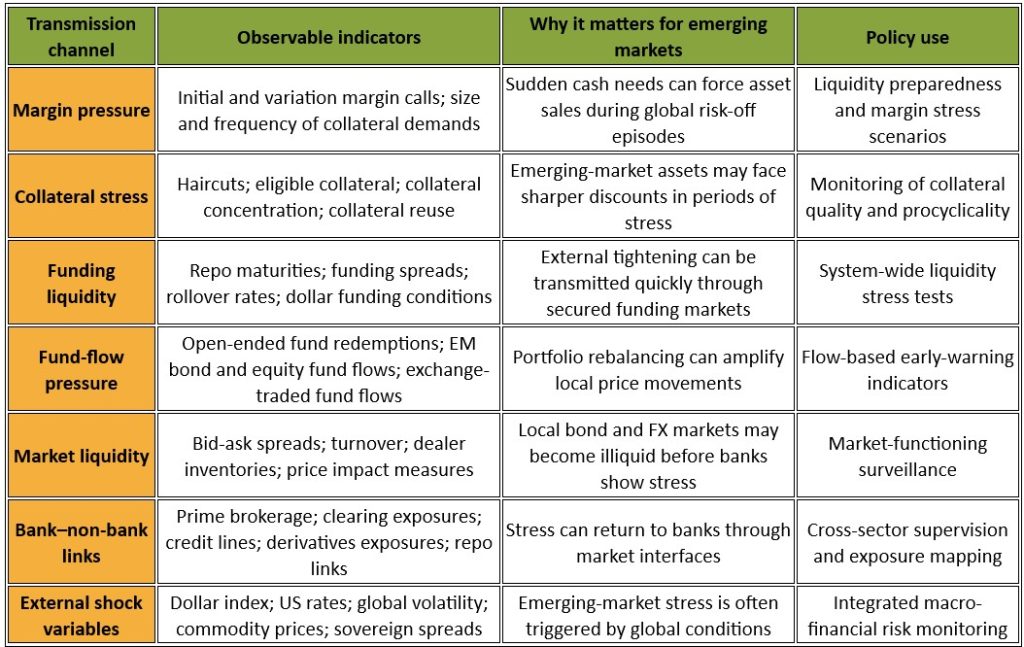
This dashboard would not replace existing bank supervision. It would complement it. Capital ratios and liquidity coverage remain necessary, but they are not enough to detect stress that begins in market-based finance. Supervisors need to know which non-bank actors are most connected to banks, which markets are most vulnerable to forced selling and which external shocks are most likely to trigger liquidity pressure.
The dashboard should also be used dynamically. Its purpose is not to produce a static list of indicators, but to identify combinations of stress. A rise in global volatility may be manageable on its own. A rise in volatility combined with widening repo spreads, fund outflows, increasing margin calls and falling local bond liquidity is a different situation. The systemic signal lies in the interaction.
The first implication is conceptual. Policymakers should distinguish bank resilience from system resilience. Stronger banks reduce one set of vulnerabilities, but do not automatically neutralise liquidity spirals, collateral shocks or non-bank deleveraging. Macroprudential policy must therefore move from an institution-centred view of stability towards a transmission-channel view.
The second implication is supervisory. Central banks and regulators should map the links between banks and non-bank intermediaries. This includes repo financing, derivatives, custody, clearing, prime brokerage, committed credit lines and market-making. These links are often the channels through which market stress becomes banking stress.
The third implication concerns liquidity stress testing. Emerging-market authorities should develop liquidity stress tests that include market-based channels, not only bank balance sheets. Scenarios should consider increases in margins and haircuts, reductions in repo rollover, fund redemptions, FX market pressure and forced sales of local-currency assets.
The fourth implication is institutional. Relevant information is often divided among central banks, banking supervisors, securities regulators, exchanges, clearing houses and finance ministries. In emerging markets, this fragmentation is costly because external shocks arrive quickly and domestic market liquidity can be shallow. Crisis protocols should be established before stress episodes, not improvised during them.
The fifth implication is international. Many of the relevant shocks originate offshore. Emerging-market authorities cannot fully control global funding liquidity, foreign fund redemptions or margin practices in international markets. But they can improve information sharing, participate actively in international standard-setting discussions and adapt global recommendations to domestic market structures.
None of this implies that authorities should prevent asset prices from adjusting. Markets must be allowed to reprice risk. The policy objective is narrower and more important: to prevent ordinary repricing from becoming forced selling, funding stress and systemic instability.
The next emerging-market financial shock may not start in a bank. It may start with a collateral call, a redemption wave, a funding rollover problem or a global portfolio adjustment. But if supervisors cannot see the channels through which that stress travels, it can still end as a banking and macro-financial crisis.
The post-crisis regulatory era made banks safer. The next stage of macroprudential policy must make the system more visible. For emerging markets, this means monitoring the market plumbing that connects banks, non-bank intermediaries and global portfolios. Financial resilience now depends not only on the strength of institutions, but on the capacity to observe the activities through which risk is transmitted.
Bank resilience is necessary. It is no longer sufficient.
Aramonte, S., Schrimpf, A. and Shin, H.S. (2021), “Non-bank financial intermediaries and financial stability”, BIS Working Papers No. 972, Bank for International Settlements.
Brunnermeier, M.K. and Pedersen, L.H. (2009), “Market liquidity and funding liquidity”, Review of Financial Studies, 22(6), pp. 2201–2238.
Calvo, G.A. (1998), “Capital flows and capital-market crises: the simple economics of sudden stops”, Journal of Applied Economics, 1(1), pp. 35–54.
Financial Stability Board (2020), Holistic review of the March market turmoil.
Financial Stability Board (2024), Liquidity preparedness for margin and collateral calls.
Financial Stability Board (2025), Global monitoring report on non-bank financial intermediation 2025.
Pessoa, G., Ponkratov, V., Philippov, D., Shvyreva, O., Kuznetsov, N., Elyakova, I., Mikhina, E., Kotova, N., Pozdnyaev, A., Durmanov, A. and Bloshenko, T. (2024), “Energy price impact on BRIC stock markets: a Granger causality analysis”, Emerging Science Journal, 8(6), pp. 2385–2403.
Pessoa, G., Vlasova, Y., Shkalenko, A., Kaldibayev, N., Ponkratov, V., Kuznetsov, N., Elyakova, I., Bloshenko, T., Kireeva, E. and Romanenko, E. (2025), “Modeling and forecasting the dynamics of BRICS socioeconomic integration in context of global economic fragmentation”, Emerging Science Journal, 9(5), pp. 2797–2828.
Pessoa, G.H.R. and Rochman, R.R. (2026), “Macro-financial blind spots in emerging markets: non-bank intermediation, funding liquidity, and the persistence of global shock transmission”, International Journal of Financial Studies, 14(2), 40.
Rey, H. (2015), “Dilemma not trilemma: the global financial cycle and monetary policy independence”, NBER Working Paper No. 21162, National Bureau of Economic Research.