

This policy brief is based on Jiménez, Miguel, Sarasa-Flores, David and Ugarte-Ruíz, Alfonso (2026). Assessing Structural Geopolitical Risk. BBVA Research Working Paper. The views expressed are those of the authors and not necessarily those of the institutions the authors are affiliated with.
Abstract
This paper introduces a novel measure of Structural Geopolitical Risk (SGR), designed to capture the long-run conditions that shape the likelihood of geopolitical tensions, conflicts, and fragmentation. Complementing existing geopolitical risk measures and constructed for nearly all countries worldwide over 1960-2025, the SGR aims to measure the latent structural factors that increase the likelihood of future geopolitical disruptions. Crucially, for each country, the index includes not only internal variables, but also those of all other countries weighted by geographical and ideological distance. We show that global SGR has risen steadily since the late 2000s, reaching levels comparable to those of the late Cold War by 2025. Quantitative analysis indicates that higher SGR is associated with weaker trade and investment, greater financial vulnerability, a higher probability of future conflicts and geopolitical risk events, and a stronger transmission of realized geopolitical shocks to economic activity.
Geopolitical risk has become a major concern for policymakers and financial institutions. Existing indicators (Caldara and Iacoviello’s GPR (2022) and Baker et al.’s EPU (2016), among others) mostly measure realized events, uncertainty, or perceptions. However, what remains largely absent is a measure of the structural conditions that make geopolitical shocks more likely to occur. A recent European Central Bank and European Systemic Risk Board (2026) report provides one of the most comprehensive reviews and classifications of geopolitical risk indicators currently available in the literature and policy practice, and in their extensive review the absence of a structural conditions-based indicator remains evident.
This note introduces the Structural Geopolitical Risk (SGR) index defined, and inspired by Caldara & Iacoviello (2022), as “the latent factor underlying the occurrence of adverse events associated with wars, tensions, and conflicts among states and political actors, which may disrupt the peaceful course of international relations”. In turn, the SGR index is constructed by combining two main sub-components, an internal (ISGR) and an external one (ESGR):
Internal risk (ISGR): captures the structural characteristics that lead any given country more likely to become involved in international conflicts, which are political polarization, democracy, rule of law, inequality and military preparedness.
External risk (ESGR): reflects the exposure of a country to risks arising from its interactions with other countries. Such risks arise from neighbors, bordering countries and geopolitical rivals, that display the same characteristics that increase the internal risk plus the risk associated with being more ideologically distant to other countries. The key innovation here is the calculation of an external dimension, which assigns a certain weight to those external countries considered military rivals (R) according to their military expenditure and their ideological distance. Then, the remaining weight in the ESGR comes from countries that share a border (C) or that are geographically near (N).
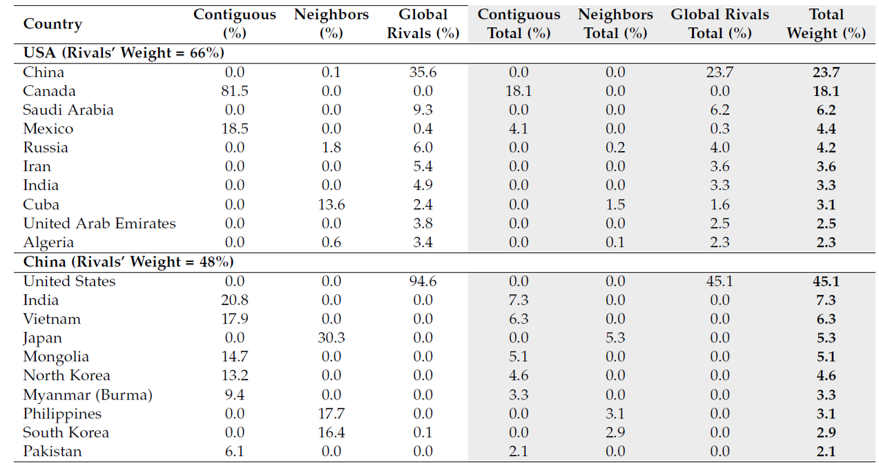
Table 1 shows the average weights between 2015 and 2025 for the ESGR of US and China. The first three columns present the weights given to each type of foreign country, (R), (C) and (N). Columns 4 to 6 display the final weights given to each type of external partner, taking into account the weight given to each dimension: Political, Military and Ideology. The last column displays the final weight assigned to the top 10 countries that contribute the most to external risk for the US and China. We can observe, for instance, that China and Canada are the countries that contribute the most to the US’s external risk, the first one because it is the largest military rival in the World and the second one because of being the largest country sharing a contiguous border.
Table 1. Top 10 Countries Contributing Most to US and China’s External Risk by Selected Countries
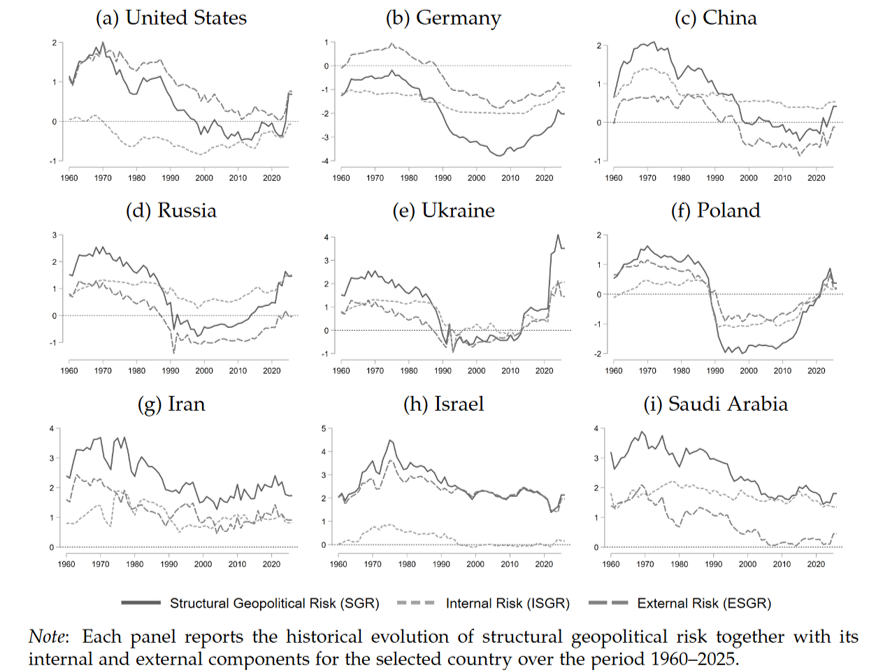
In Figure 1 we display the historical evolution of the internal (ISGR), external (ESGR) and total (SGR) indices for a selection of geopolitically-relevant countries. As illustrated in the figure, geopolitical risk in the United States, Germany and Israel is driven predominantly by the external component, reflecting exposure to ideological fragmentation, regional political instability and military rivalry. By contrast, China and Russia exhibit comparatively higher contributions from internal geopolitical risk, associated with political polarization, institutional characteristics, and sustained military buildup, to a larger extent in Russia. Finally, Iran and Saudi Arabia display high levels of risk in both the internal and external dimensions, resulting in persistently elevated levels of SGR.
Figure 1. Historical Evolution of Structural, Internal, and External Geopolitical Risk (1960–2025)
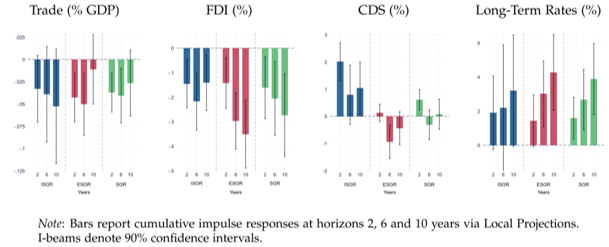
Once the indices are built for a large number of countries from 1960 to 2025, we estimate impulse response functions (IRFs) of a number of macroeconomic and financial variables to the SGR and its components, -internal and external risk-, via Panel Local Projections using long-differences of the dependent variable. In particular, we estimate the dynamic response of trade, FDI, credit default swaps (CDS) and long-term interest rates after SGR shocks. The results, illustrated for selected time horizons in Figure 2, indicate that higher SGR is associated with:
Moreover, the impact of the external component is higher for trade, inflows and long-term interest rates, whereas we document a divergence between the impact of the internal and external components on risk premia: while the ISGR has a clear positive correlation with sovereign risk, the ESGR might, on average, reduce sovereign CDS, possibly reflecting a relative safe-haven effect.
The findings indicate that an environment characterized by high structural geopolitical risk entails measurable and statistically significant economic consequences, even in the absence of realized geopolitical conflicts.
Figure 2. IRFs to a Shock in SGR and Components
Two additional results in our analysis provide compelling evidence that SGR could be capturing the underlying factors behind geopolitical events. First, as presented in Figure 3 (panels (a), (b) and (c)), higher SGR is associated with a higher probability of future military conflicts, with the effects remaining significant for even one decade after. Moreover, we show that countries with high SGR are also more likely to experience future realized geopolitical risk events measured by shocks on Caldara and Iacoviello’s GPR index (Figure 3, panel (d)).
Thus, the estimated correlations with macroeconomic and financial variables, together with the documented association with future geopolitical conflicts and events, support our claim that the SGR acts as a latent factor underlying future geopolitical shocks.
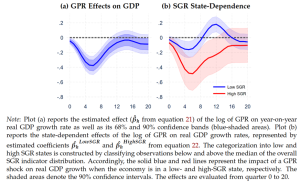
Finally, we investigate whether SGR acts as a latent structural factor shaping the persistence and macroeconomic transmission of the geopolitical risk shocks captured by the GPR index. An analysis based on a state-dependent local projection model shows (Figure 4) that in periods characterized by high SGR, GPR shocks exert substantially larger and more persistent negative effects on GDP growth. By contrast, during low-SGR periods, the adverse effects are considerably weaker and become statistically indistinguishable from zero at medium-term horizons, suggesting that SGR could act as a latent structural amplification mechanism of geopolitical risk shocks.
Figure 3. Effect of SGR on the Probability of Occurrence of Military Conflicts and Geopolitical Shocks
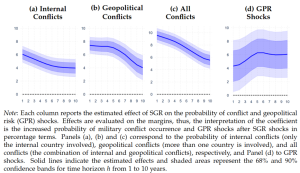
Figure 4. SGR-Driven State-Dependent Effects of GPR on Economic Activity
The emergence of news-based indicators of geopolitical shocks has helped researchers and policy makers understand how these shocks transmit to the economy. However, by construction, news-based indicators can only be observed once they occur. Policy makers, by contrast, might seek to monitor, anticipate and prepare for risks before they materialize. This, in turn, requires identifying and measuring the underlying structural conditions that increase the likelihood of geopolitical shocks. Our paper is an effort in this direction, while also providing evidence that structural geopolitical vulnerabilities can have economic consequences on their own, even without the onset of large geopolitical conflicts.
Caldara, Dario, and Matteo Iacoviello. 2022. “Measuring geopolitical risk.” American Economic Review, 112(4): 1194–1225.
European Central Bank, and European Systemic Risk Board. 2026. “Financial Stability Risks from Geoeconomic Fragmentation.” ECB and ESRB.
Baker, S. R., Bloom, N., & Davis, S. J. (2016). Measuring economic policy uncertainty. The Quarterly Journal of Economics, 131(4), 1593-1636.