

This policy brief is based on the IMF Regional Economic Outlook Note, November 2025, entitled ‘How Can Europe Pay for Things That It Cannot Afford?’ The views expressed are those of the authors and not necessarily those of the institutions the authors are affiliated with.
Abstract
European governments are facing an unprecedented financing challenge, as they deal with increased spending demands — such as defence costs and growing interest payments. Without action, debt may spiral out of control. How can they cover these costs while preserving fiscal sustainability? A three-pillar strategy is proposed. For the typical European country, about one third of the adjustment could be accomplished with moderate reforms, while the remaining two thirds would come from fiscal consolidation. For countries with high debt, this policy package is likely still inadequate. If so, a more fundamental rethink of the scope of government activities and the social contract may be required to close the financing gap.
European governments are facing an era of rapidly growing demands on public spending from aging populations, the energy transition and defense. At the same time, public debt is already elevated in many countries and political appetite for higher taxation, lower spending or privatization remains limited. How can European governments pay for growing needs while preserving fiscal sustainability? Addressing this requires a clear understanding of future debt trajectories and a thorough evaluation of policy options to address the fiscal challenge, including structural reforms, fiscal consolidation, and potentially a reconsideration of the scope of government itself.
Figure 1. General Government Debt (Percent of GDP, Simple average of European countries)
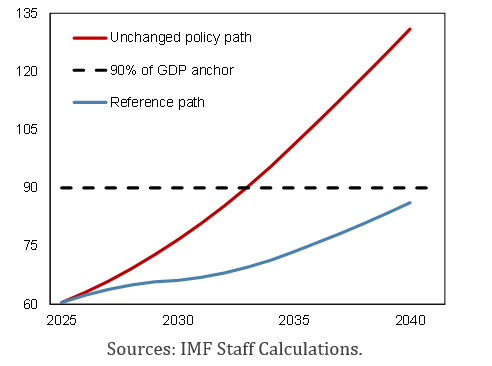
Recent IMF staff analysis shows that, if left unaddressed, public debt in the average European economy would double over the next 15 years (Figure 1, red line). This is because the additional spending pressures add to deficit levels, and this effect grows over time.
What is a preferrable debt trajectory? Our research describes a sustainable “reference” debt path, anchored by a long-term target of 90 percent of GDP (blue line). This 90 percent benchmark is an average across countries and is considered a relatively “safe” debt level according to various IMF measures. Along the reference path, countries currently above the 90 percent threshold are assumed to stabilize their debt-to-GDP ratios in the medium term and then reduce them gradually — in the spirit of the European Union fiscal framework. Countries with lower debt, which comprise most of the sample, are assumed to accommodate the spending pressures, and change policies only if needed to keep debt below 90 percent of GDP over the next 15 years.
The core question is whether a feasible combination of reforms and policy tools can help countries’ debt move from the unsustainable baseline to this new reference trajectory. We consider policy packages based on three pillars:
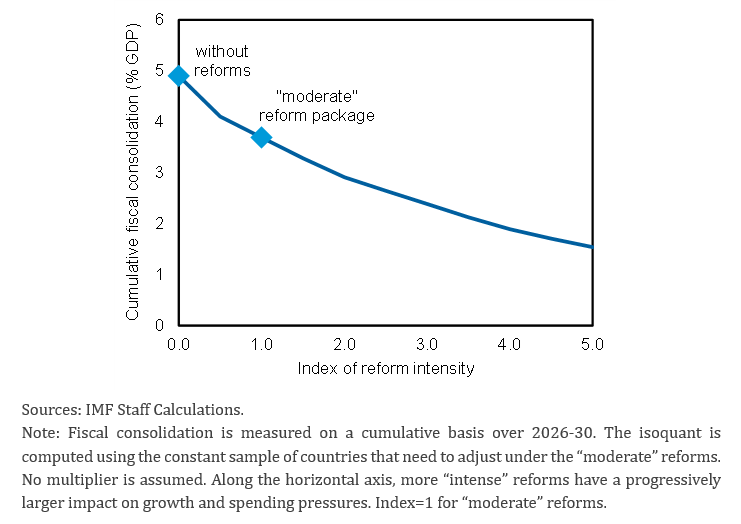
Figure 2. Fiscal Consolidation (Simple average of European countries, cumulative 2026-30, percent of GDP)
Our study analyses a set of productivity-enhancing and fiscal reforms. These include national product and labour market reforms, some relatively modest steps to strengthen the EU single market, pension changes, catalysation of private investment, and increased centralization of spending at the EU level.
Many of these reforms take time to yield measurable fiscal gains; in our analysis, their effects are assumed to materialize largely in the decade following a five-year implementation period. Still, their long‑run impact is significant: even a “moderate” set of these reforms could close roughly one‑third of the gap between the explosive baseline debt path and the sustainable reference path for the average European country. Notably, pension reforms and growth‑enhancing domestic reforms are particularly important to reduce fiscal pressures in our analysis.
Medium-term fiscal consolidation is essential because structural reforms by themselves cannot fully address increasing spending demands in most countries. Simulations indicate that nearly three-quarters of European countries require fiscal consolidation — even with a “moderate” reform package — to reliably keep debt sustainable.
The magnitude of required consolidation depends heavily on how ambitious a country’s reforms are. Without reforms, the average European country would need to consolidate by about 5 percent of GDP cumulatively over five years (roughly 1 percent of GDP annually). When countries adopt the “moderate” set of reforms assumed in the analysis, the necessary consolidation falls to about 3½ percent of GDP over the same horizon — still substantial, but more in line with historical experience. And more ambitious reforms would lower fiscal adjustment needs further. The relationship between reforms and consolidation can be visualized as an “isoquant”: the greater the reform effort (which boosts revenue and reduces spending pressures), the smaller the required fiscal consolidation (Figure 2).
Some high‑debt countries face consolidation needs that exceed what has historically been achieved, even with meaningful reforms. Roughly a quarter of European countries fall into this category. For them, a broader conversation about the sustainability of the European socio‑economic model seems unavoidable. Although Europe does not follow a single social or economic model, many countries share common characteristics: relatively large public sectors, extensive welfare systems, universal health care, and widely accessible or low‑cost education. These features have long supported economic growth, social cohesion, and stability. Today, however, this model is under strain, requiring difficult trade‑offs, where advancing one priority may increasingly come at the expense of another.
To illustrate this point, we collect public-private financing data by country in health, education, pensions, infrastructure, and climate. Our analysis shows that aligning public‑to‑private financing ratios with OECD averages in these areas could generate average savings approaching 3 percent of GDP annually in Europe. Such changes, however, cut to the heart of the social contract and thus require careful deliberation, extensive consultation, and long transition horizons.
There is no silver bullet for Europe’s financing challenge. The complexity and scale of spending pressures demand a multipronged strategy involving both national and regional approaches that blend reforms, consolidation, and long‑term institutional evolution. Structural reforms boost long-term growth and fiscal capacity, while consolidation improves fiscal balances more quickly. Countries should balance these approaches — greater reform can reduce the pain of consolidation.
Even with strong reforms and fiscal discipline, high-debt nations may need to reprioritize public services and reconsider which ones are provided by the state or private sector. Successful episodes of major fiscal adjustment in the past have emphasized transparent communication about the scale of the challenge, the trade-offs at stake, and the consequences of inaction. Governments that engage openly with citizens will be better positioned to build trust and ensure durable support for the adjustments ahead.