The views expressed are those of the authors and not necessarily those of the institutions the authors are affiliated with.
Abstract
Markets are treating recent geopolitical shocks as transient; firms are treating them as a reason to delay capex. That decoupling creates a risk of divergence — between asset prices and the investment needed for future growth.
A pattern has emerged in the latest round of geopolitical stress: financial markets rebounded quickly and keep a positive bias, both in the US and in Europe; while firms in the real economy are threatened by risk, delay investment and remain in a wait and see mood. For policymakers, this matters because it might signal a growing mismatch between buoyant market valuation and real economy fundamentals.
The Iran war — now in its seventh week — has coincided with a decoupling – a widening gap between headline equity performance and firms’ reading of fundamentals. US equities are trading back above pre-conflict levels and show a bias towards positive news, even as the probability of persistent disruption remains elevated. A simple way to characterise the episode is to compare the typical magnitude of up moves with down moves. Using an asymmetry ratio — average gain on up days divided by average loss on down days — equities tilted sharply toward good news. The ratio is about 2.0× in the US for the S&P 500 ex financials and 1.5× in Europe for the STOXX 600 ex financials, consistent with a market that drifted down under uncertainty but snapped back quickly when a focal “resolution” headline appeared and overall reacts asymmetrically, on a risk-on mood.
Figure 1. Equity Markets (excluding financial sector) in the US and Europe since the start of the war
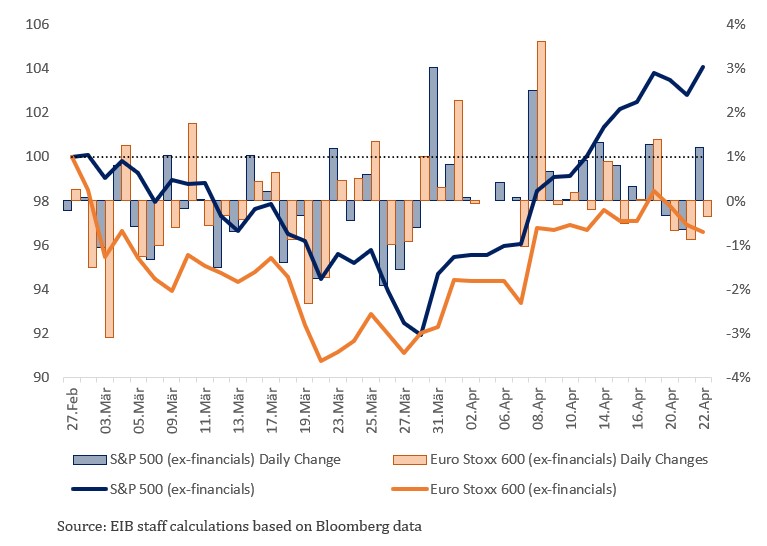
More in details, since the Iran war shock started, the path down was drawn-out. The S&P 500 ex-financials declined about 8% over 22 trading days — roughly a quarter of a percent per session — while absorbing major escalations (including the Dimona strike and the Hormuz closure) in single-day moves of only 1.2–1.7%. Europe, with greater direct energy exposure, sold off more: the STOXX 600 ex-financials fell nearly 12%. Still, the pattern was similar: a multi-week grind rather than a discrete crash.
The path back up was different in character. A ceasefire announcement triggered a 2.7% one-day jump in the S&P 500 ex-financials and a 3.7% surge in the STOXX 600 ex-financials — Europe’s largest one-day gain in more than four years. Put differently, the recovery from trough back to pre-war levels took roughly 14 trading days, roughly half the time that it took to reach the through.
No single story fully explains the asymmetry, but three forces have plausibly reinforced each other: (1) a market microstructure that increasingly “looks through” uncertainty until it is forced not to; (2) an implicit belief that disruptive policy will be reversed if asset prices or inflation expectations react too violently; and (3) strong discounting of the positive effects on the economy of the AI transformation and index-level concentration in long-duration technology and AI names that are less sensitive to near-term macro shocks than the median listed firm.
If equity markets appear to treat geopolitical risk as a shock that can be faded, firms often treat it as a reason to pause. That distinction is not just anecdotal. Evidence from the European Investment Bank Investment Survey (EIBIS) points that firms are starting to consider geopolitical shocks, tariffs and supply chains disruptions as permanent indeed. The EIB Investment Report (2026) details how uncertainty represent the key constrain for firms’ investment in Europe. An experiment, testing firms’ reaction to shocks, shows a systematic asymmetry in firms’ investment responses: negative geopolitical scenarios reduce investment meaningfully, while “good news” scenarios (a reduction in uncertainty) tend to produce little additional investment beyond business as usual.
Figure 2. Expected duration of disruptions, by market (% of firms)
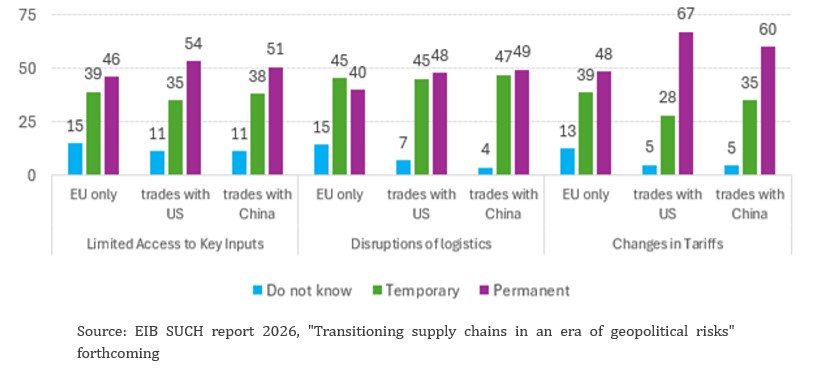
Europe’s long-standing growth model—anchored in open trade and globally fragmented supply chains — is being tested by a shift toward a more multipolar global order. A sequence of shocks (the pandemic, the 2022 energy crisis, renewed US tariff threats, and most recently the Iran conflict) has increased uncertainty for EU firms and strengthened the political case for “de-risking”. In that environment, understanding how uncertainty transmits into investment is central: capex is where today’s risk perceptions become tomorrow’s productivity and potential growth.
To measure these effects more directly, EIBIS included in 2025 an online experimental module covering about 710 EU firms. Each firm was randomly shown eight hypothetical scenarios (drawn from a set of 28) spanning different uncertainty sources—regulation, competition, US tariffs and geopolitical risk — and asked how it would adjust an ongoing investment project: increase investment, reduce investment, or abandon the project. Because the survey also records the type and stage of investment plans, responses can be interpreted in the context of firms’ planning horizons and commitments.
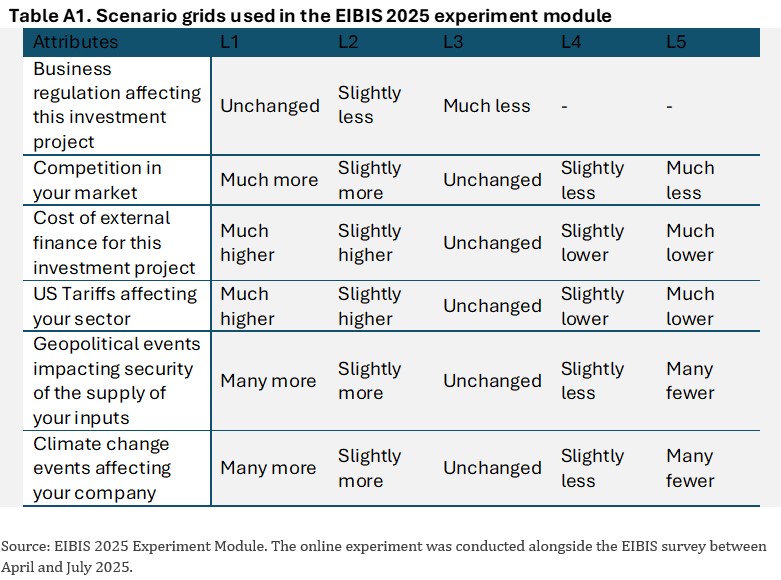
For the purpose of contrasting “policy” and “security” uncertainty, focus on two scenario families: (i) US tariffs that affect firms’ sector, and (ii) geopolitical events that disrupt the security of input supplies. Scenarios ranged from “slightly higher” to “much higher” risk (and symmetrically “slightly lower” to “much lower”), relative to a baseline of unchanged conditions. Responses are summarised using a net balance: the share of firms planning to invest more minus the share planning to invest less.
Figure A1. Firms’ investment responses to hypothetical scenarios of US tariffs and geopolitical disruptions to input supply
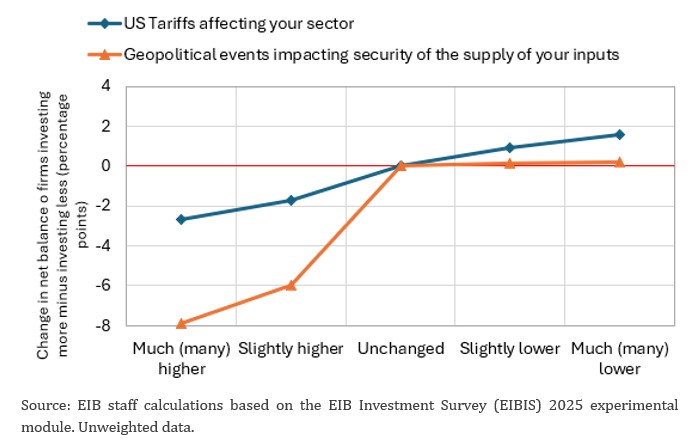
The experiment indicates that both geopolitical disruptions to inputs and tariff risk depress EU firms’ investment plans. In Figure A1, Scenarios with a slightly higher or much higher frequency of disruptive geopolitical events lead to net investment reductions of around 6% and 8% of firms, respectively. Strikingly, the mirror-image scenarios — slightly or much fewer disruptions — do not translate into higher investment. Firms seem to maintain business-as-usual plans when conditions improve, but cut or delay when risk rises. That is the real-economy counterpart to the market asymmetry above, but with the sign flipped: markets lean toward upside rebounds; firms lean toward downside precaution. A similar asymmetry is associated to US tariffs. Scenarios with slightly or much higher US tariffs generate net investment reductions of roughly 2–3% of firms relative to an unchanged baseline, while scenarios with lower tariffs produce only a very modest net increase of about 0.9–1.6%. In other words, even for trade policy — investment responds more to bad news than to good news.
Figure A2. Investment responses to much higher US tariffs and much greater geopolitical disruption to input supply, by firm category
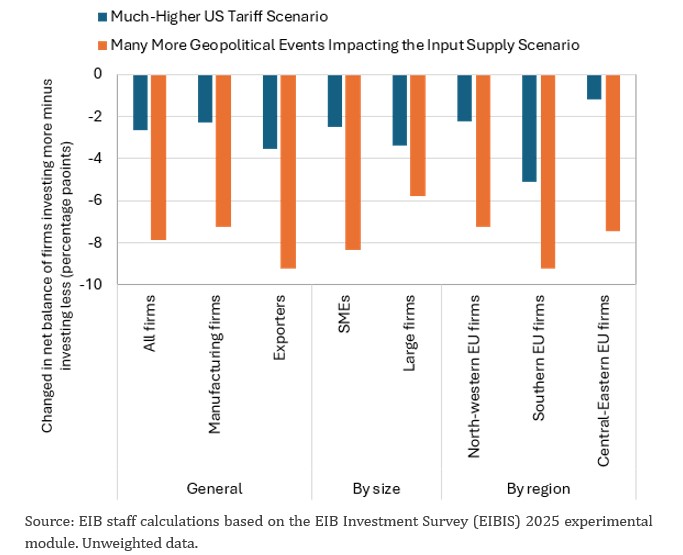
Responses also vary across firms (Figure A2). For geopolitical disruptions, the responses are larger across the board: exporters (about –9.2%) and SMEs (about –8.3%) are especially likely to reduce investment when input supply becomes unreliable. For the tariff shock, exporters, larger firms and firms in Southern Europe show stronger sensitivity: under “much higher” US tariffs, the net share cutting investment is about 3.5% for exporters (vs 2.7% overall), –3.4% for large firms and –5.1% for Southern Europe.
The asymmetry is consistent with standard investment theory under uncertainty. When projects are partly irreversible (specialised equipment, hiring, supplier contracts), firms hold a real option: they can wait for information. A rise in geopolitical risk widens the distribution of outcomes, increasing the value of delaying commitment — even if the expected return is unchanged. But when uncertainty falls back, firms do not automatically “catch up”, because some opportunities have passed, internal budgets have been reallocated, and management attention has moved on.
Repeated shocks can also generate hysteresis. If firms respond to each adverse episode by trimming or postponing capex, the capital stock and productivity path can drift lower over time, even if each individual shock later “reverts”. That mechanism is amplified when uncertainty interacts with tighter financing, higher energy-input risk, or costly supply-chain redesign. In short: markets can price a V-shaped narrative, while firms behave as if the state of the world has become permanently more volatile.
The market/firm decoupling has three practical implications.
In the current environment, the central risk is not only the next shock, but the slow accumulation of postponed investment that follows from living with frequent shocks. Markets may continue to “shrug” until hard data force repricing. By then, however, the real economy may already have moved onto a weaker path. Bridging that gap — by reducing avoidable uncertainty and protecting long-horizon investment — should be a core objective of economic policy in a more volatile geopolitical era.
EIB (2026): EIB Investment Report 2026: Capitalising Europe’s strengths.