

This policy brief is based on the IJCB paper “Monetary Tightening and Financial Stress During Supply- versus Demand-Driven Inflation“ published in April 2025. The views expressed are those of the authors and not necessarily those of the institutions the authors are affiliated with.
Abstract
We examine how a monetary tightening affects financial stress when inflation is driven by supply rather than demand factors. Using U.S. monthly data for 1990-2019, high-frequency monetary policy surprises, and a decomposition of core PCE inflation into supply- and demand-driven components, we find that the same rate hike can have very different consequences in terms of financial stress depending on the source of inflation. A surprise tightening occurring when supply-driven inflation is elevated raises financial stress, and the effect becomes stronger and faster as supply-driven inflation increases. Conversely, the effect of a tightening is much smaller and can even reduce financial stress when it occurs during high demand-driven inflation. The intuition is that adverse supply shocks weaken output and borrowers’ cash flows, while strong demand provides a natural buffer and may allow tightening to curb financial imbalances. The results are robust across alternative measures of stress, sample splits, and a broader country sample. Our findings imply that the source of inflation pressure matters for calibrating tightening cycles and for judging when monetary policy may face a price-stability versus financial-stability trade-off.
Inflation can be driven by different underlying shocks. Supply-driven inflation typically reflects adverse developments such as supply-chain disruptions, energy-price spikes, or productivity losses. Demand-driven inflation, by contrast, is more likely to arise in expansions, for example, after fiscal stimulus, pent-up demand, or other positive demand shocks.
This distinction matters for financial resilience. In a supply-driven episode, inflation is often accompanied by weaker real activity and lower borrower cash flows. In that setting, higher policy rates can weaken borrowers’ creditworthiness, widen credit spreads, and intensify financial stress. In a demand-driven episode, stronger income and profits can absorb part of the rate increase, while tighter policy may also restrain the build-up of credit and asset-price excesses. The same policy move can therefore interact very differently with the financial system depending on the inflation environment.
Our baseline empirical analysis is conducted for the United States at monthly frequency over 1990-2019. We estimate the dynamic impact of exogenous high-frequency monetary policy surprises on measures of financial stress using local projections. To distinguish inflation regimes, we use Shapiro’s (2026) decomposition of core PCE inflation into supply-driven, demand-driven, and ambiguous components.
Our main measure of financial stress is the Federal Reserve Board Staff Stress Index, built from spreads and volatility measures across key U.S. markets. The model specification allows monetary policy surprises to have a different impact on financial stress depending on the levels of supply- and demand-driven components of inflation. The specification allows us to estimate both the average effect of a surprise tightening, as well as how that effect changes with the level and composition of inflation at the time the policy move occurs.
An unexpected 25 bp increase in the monetary policy rate tends to raise our measure of financial stress by 5 standard deviations on average (Figure 1).
But this average masks strong heterogeneity. Once we take the inflation mix into account, the effect becomes much more pronounced when inflation is supply-driven (Figure 2). The amplification appears quickly, within the first month, and remains economically relevant for well over a year.
The mechanism is intuitive. Adverse supply shocks push prices up while simultaneously weakening the economy’s productive side. Borrowers face lower cash flows just as financing conditions tighten. In the presence of credit frictions, rising default risk can feed back into wider spreads and higher external finance premia, producing financial-accelerator dynamics. In that case, a monetary tightening aimed at containing inflation can bring previously hidden financial fragilities to the surface.
Figure 1. Unconditional Effect of a Monetary Tightening on Financial Stress
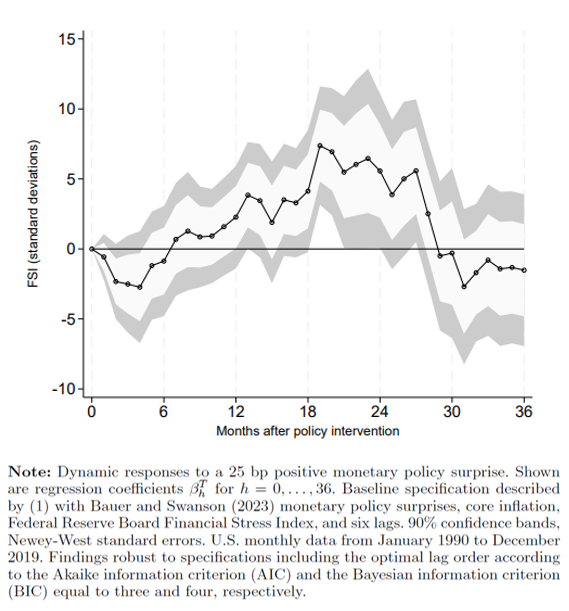
Figure 2. Additional State-Dependent Effect of a Monetary Tightening on Financial Stress
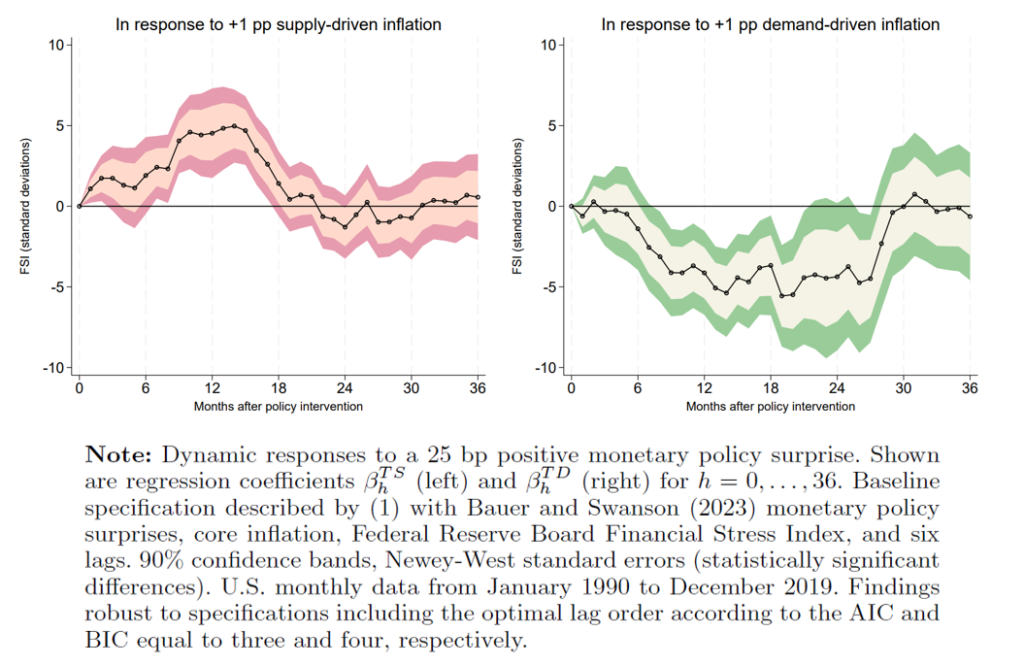
The picture is very different when inflation is demand-driven. Here, the interaction terms are negative over most of the horizon. This means that the tightening-induced rise in financial stress is offset by the stronger macroeconomic conditions associated with demand-driven inflation. When demand-driven inflation is moderate, the net effect of a rate hike on stress is close to zero. When it is sufficiently strong, our findings imply that financial stress can decline in the medium term.
One interpretation is that strong demand improves borrowers’ repayment capacity and acts as a natural hedge against higher rates. At the same time, tighter policy may lean against the accumulation of financial imbalances generated by a demand boom. In that environment, a rate hike can cool credit and asset markets without triggering the same kind of immediate stress that arises after a supply shock.
We conduct a broad set of robustness checks. The results hold when alternative financial stress indices are used, including the Kansas City Fed, St. Louis Fed, Bloomberg and ECB indicators, as well as credit spreads, excess bond premia, and financial conditions indices. They also survive changes in lag structure, alternative samples, and the exclusion of the Global Financial Crisis and zero lower-bound periods.
We also extend the analysis to other economies, including Canada, the United Kingdom, France, Australia, and Sweden, under tighter data constraints. While identification is less precise outside the United States, the broad pattern remains similar: tightening appears more destabilizing when inflation is supply-driven than when it is demand-driven.
The main policy lesson is that a rate hike in response to supply-driven inflation may involve a sharper price-stability versus financial-stability trade-off than a rate hike of similar size undertaken in a demand-driven boom. This does not mean central banks should refrain from tightening when supply shocks hit. Rather, it means the broader policy mix matters more in that environment. If the inflation episode is supply-driven and the financial system is already fragile, macroprudential tools and close supervisory monitoring may be needed to preserve room for monetary tightening.
Bauer, M. and E. Swanson (2023): “A Reassessment of Monetary Policy Surprises and High-Frequency Identification.”, NBER Macroeconomics Annual 2022, Vol. 37, ed. M. Eichenbaum, E. Hurst, and V. A. Ramey, 87–155 (chapter 2). University of Chicago Press.
Boissay, F., F. Collard, C. Manea and A. Shapiro (2025): “Monetary tightening and financial stress during supply- versus demand-driven inflation”, International Journal of Central Banking, 21(2), 147-173, April.
Shapiro, A. (2026): “Decomposing supply- and demand-driven inflation”, Journal of Money, Credit and Banking, vol. 58(2), 365-388, March.