

This policy brief is based on Deutsche Bank Research Institute, Fixed Income Research special report, March 2026.
Abstract
The strategic importance of the Middle East to the dollar’s role as the world’s reserve currency should not be underestimated. The long-term legacy of the Iran conflict could be the way it tests the petrodollar regime. The foundations of the petrodollar were under pressure even before the conflict given changing Gulf trade relationships, the creation of new payment rails, and intentions to localize defence. The recent conflict may expose further fault lines, by challenging the US security umbrella for Gulf infrastructure and maritime trade. A bigger risk could come if the world moves away from globally traded oil and gas itself. Countries that become more self-sufficient in defence and energy would also hold less USD reserves. There could thus be significant downstream effects to the dollar’s use in global trade and savings.
The dollar is the world’s reserve currency for a very simple reason: the world pays for global goods and services in dollars and is willing to save resulting surpluses in dollar assets. From 1945-1971, the dollar was “backed” by gold – namely, global central banks were able to exchange $35 for 1oz at the Fed. This was the foundation of the international monetary system known as Bretton Woods. In 1971, the US broke the dollar’s link to gold. Since then, the dollar has been in a purely fiat regime – one that is backed by the sovereign credit worthiness of the US and willingness of the world to save in its debt.
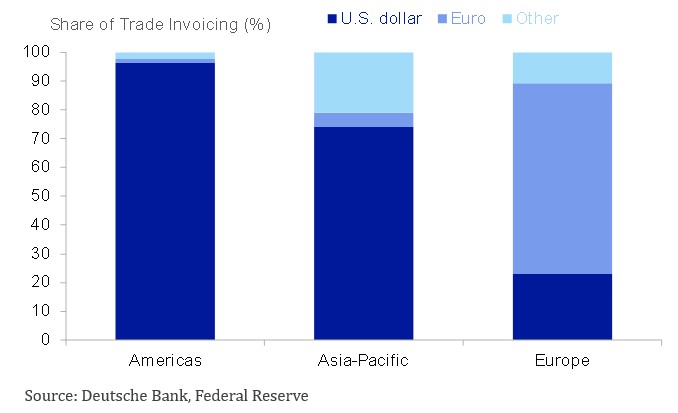
Enduring support for the fiat dollar arguably comes from the dominance of the dollar in the pricing of cross-border trade. Globally traded goods and services are largely priced in USD, with payments exchanged over US controlled payment rails. Global surpluses are thus built in USD and mostly invested back into US assets. Corporates are incentivized to save and borrow in the currency of their payables and receivables, banking systems are dollarized, and central banks save in dollars to act as effective lenders of last resort (Gopinath and Stein, 2021)1. This drives demand for USD reserves.
A crucial anchor to this system is the petrodollar: the fact that most globally traded oil is priced and invoiced in dollars. Because oil is so central to global manufacturing processes – from petrochemicals, fertilizers and transport, to running factories and offices – companies are incentivized to price end products in dollars as a natural currency hedge to a key cost. This is a big reason global goods and services are priced and traded in US dollars.
The reason oil is priced in dollars can be traced back to the 1974 petrodollar arrangement between the US and Saudi Arabia. In simple terms, Saudi Arabia agreed to price its oil exports in USD and invest oil surpluses into US Treasuries. In exchange, the US provided security guarantees and military protection. The rest of the GCC followed. Structural foreign demand for US debt lowered the funding costs of the US government, acting as an indirect means of payment for the security umbrella extended to the region. To the extent that this arrangement supported broader global invoicing and saving in USD, it has been crucial to the USD’s role as the world’s reserve currency.
The current conflict has arguably shaken some core foundations of the petrodollar regime: the security-for-oil-pricing arrangement. US military assets and bases in the Gulf have come under attack in the war. Oil infrastructure in the Gulf has also been hit. And the US ability to provide the maritime security to ensure the global flow of oil has been challenged with the closure of Hormuz. The US security umbrella has been fundamentally tested.
The legacy of this conflict for the dollar could be the ways in which it tests the foundations of the petrodollar regime. In the long-run, if the world uses less oil, the Gulf draws more deeply on existing dollar savings, if the Gulf moves closer to Asia in its trade and investment relationships, and eventually prices less oil in dollars – there could be significant downstream effects to the dollar’s usage in global trade and savings.
Figure 1. The dominance of the dollar in cross-border trade has a lot to do with the petrodollar
A lot had already begun to change before the US-Israel-Iran war broke out. We highlight a few key shifts that were underway:
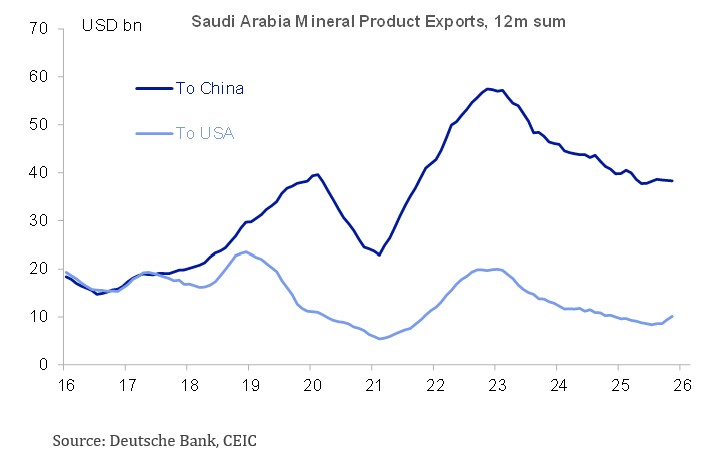
Figure 2. Saudi Arabia sells four times as much oil to China now as to the US
First, the US security umbrella has been tested with Gulf economies facing attacks on US bases, oil fields and infrastructure in a war that began with US military action in the region. Aside from the Gulf, pain has arguably been disproportionately felt by traditional US allies: Europe, Japan and Korea that are large energy importers exposed to the Straits.
Second, direct diplomacy rather that US-led maritime security was the conduit for oil to pass through the Strait of Hormuz during the conflict. Tankers heading for China, India and Japan were reportedly allowed passage. Bilateral relations served countries.
Third, and crucially there were reports that Iran was negotiating to allow passage of ships through the Strait of Hormuz if oil payments or tolls were paid in yuan. This adds further credence to the enormous power of oil pricing. The conflict could be the catalyst for erosion in petrodollar dominance and the beginnings of the petroyuan.
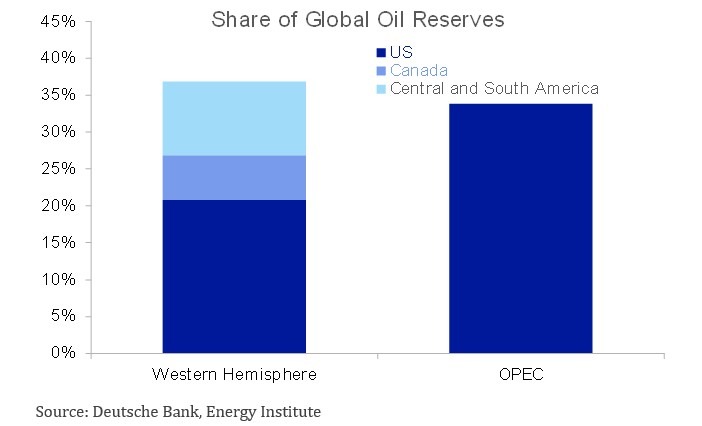
To be sure, there are numerous mitigants to consider. While the US is no longer the biggest global buyer of oil, it may well be on track to be the world’s biggest supplier. If indeed, the US controlled the entire Western Hemisphere’s oil – either directly or by proxy – it would have more reserves than OPEC, putting it in a better position to set the terms of global oil trade.
In a best-case scenario, the dollar could remain the dominant currency for oil trade if the US controls a majority of the world’s supply, although further development of reserves would be required to produce surpluses sufficient to be the world’s biggest tradeable supplier.
Figure 3. If the US controlled Western Hemispheric oil, it would have more reserves than all of OPEC
In a worst case scenario, one may see a fracturing of global oil pricing along trade routes and corridors. One might imagine Middle East oil passing through the Straits of Hormuz to Asia being priced in yuan, while oil from the Western Hemisphere sold across the Atlantic and Pacific to historical US allies may be priced in USD.
Another important mitigant is that Gulf economies are very invested in the USD. The GCC runs USD pegs that are backed by enormous USD savings. To maintain pegs, it makes sense for them to add weight with USD receivables. Any sign of moving away from USD revenues could invite self-fulfilling attacks on pegs.
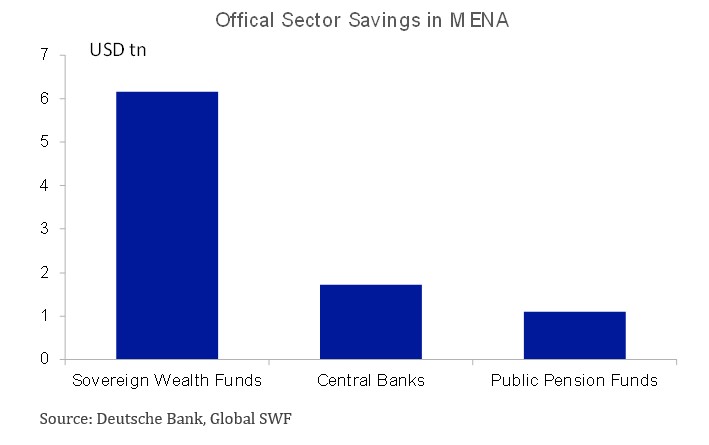
However, the Gulf may need to unwind dollar savings due to this crisis itself. The war has already led to damage of oil and civil infrastructure in Gulf economies. Escalation or a prolonged conflict could worsen this. Hydrocarbon economies could suffer both from near-term hits to physical production and reduced long-term demand for fossil fuels. Moreover, services sectors such as finance, tourism, aviation may face scarring if there remains an overhang of security risk. All of this could mean Gulf economies need to redeploy more of their externally held dollar savings domestically to support local economies and potentially reorient diversification programs to a different regional climate. To be sure, reserves are plentiful: the MENA region has roughly USD2tn in central bank managed reserves, and around USD6tn in sovereign wealth funds, according to Global SWF. But if USD savings are being drawn down for domestic investments, this could reduce the hurdle to other currency changes.
Figure 4. A majority of the Gulf region’s savings are held in sovereign wealth funds
Perhaps the biggest long-term risk comes not just from the Gulf moving away from dollar pricing, but if the world begins to move away from oil itself.
There are many parallels between now and the 1970s. Most obviously: we have now seen a second major oil and gas shock this decade. In the 1970s, the 1973 oil embargo was followed by the 1979 Iranian Revolution, while this time, Russia’s invasion of Ukraine (2022) has been followed by the 2026 US-Israel-Iran war. Global prices may remain structurally higher beyond the end of the current conflict if production facilities in the Gulf are damaged. And the historic weaponization of the Straits could introduce more risk premium into energy that moves on ships. Increasing self-sufficiency and domestic resilience would make sense even if oil prices came down.
The 1973 oil embargo by Arab nations on Western economies motivated big energy shifts in efficiency, diversification, and reserve building. It accelerated the development of alternative oil sources in Canada, Gulf of Mexico, Alaska, and the North Sea that helped the OECD diversify away from Middle East oil. It also led to the creation of Strategic Petroleum Reserves, and created the political will for initial investments in renewable and nuclear power.
The US may see the least change. Unlike the 1970s, the US is now energy independent in oil & gas. US industry will not be hurt from a Straits closure in the way that economies not receiving physical oil will be, and US oil producers will benefit. While there could be a consumption shock from higher pump prices, the US arguably retains the option of an export ban to manage domestic prices. WTI-Brent-Oman spreads already reflect the very different prices being paid around the world. The US growth impact is thus the most ambiguous and likely the least negative. This should mean the US remains relatively more invested in fossil fuels.
But energy-dependent regions like Europe, Asia and many parts of the Global South – that are facing multiple threats to global trade in fossil fuels – arguably have three key options:
The first option is to source more fossil fuels domestically. Regions that have the ability to explore and develop more of their own oil and gas may be more motivated to do so, from the UK to Brazil, while Europe and parts of Asia may also turn back to domestic sources of coal. Even if the world does not move away from fossil fuels, global trade in it could well decline, and this is what matters for FX.
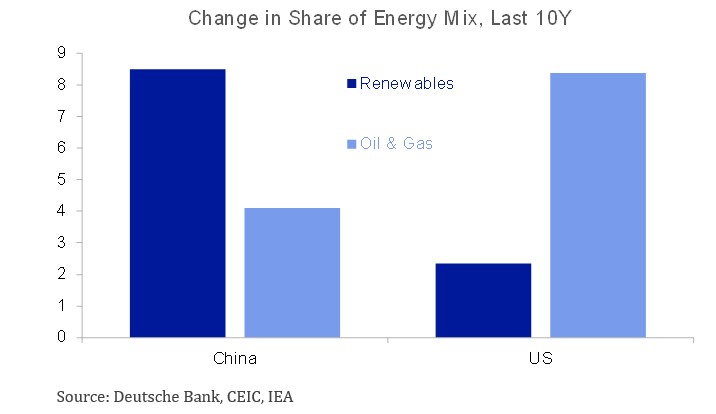
The second option is to double down on renewable energy. Renewables are far more appealing on relative cost today than they were in the 1970s, due to the enormous industrial build out in China. China produces 80% of world’s solar panels, 70% of the wind turbines, and 70% of lithium batteries. China’s overcapacity may well have been strategic, with China now extremely well placed to supply into new demand. Many Global South economies could accelerate this shift. But ultimately, this second option also comes with new dependencies on a mostly single industrial actor.
Figure 5. China has been leaning more towards renewable energy, while the US has been doubling down on fossil fuels
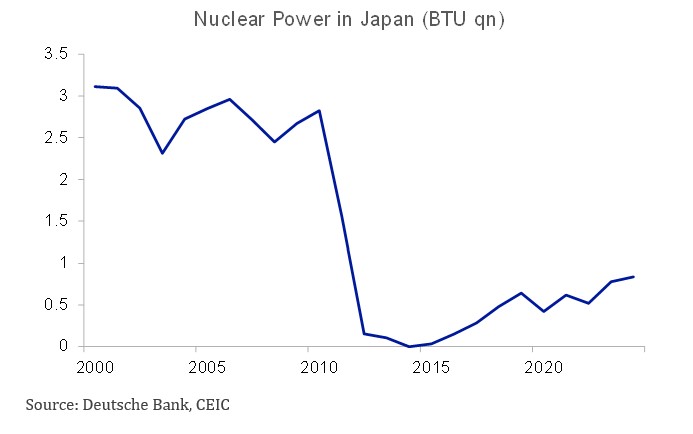
Genuine energy independence may only be created by a third option: nuclear power. One could perhaps expect a significant focus on this in Europe, Japan, and South Korea – traditional US allies. Just like their defence buildouts, nuclear power will have very long multi-year lead times but could have very significant FX implications.
Figure 6. Japan and Europe could ramp up nuclear power to build more energy independence
To be sure, there will be limits to how much the world can fully move away from oil. Many industries rely on the fractionalization of oil for manufacturing. And as we have argued in our earlier work, oil is crucial to militaries: while passenger cars can run on electricity – military jets, tanks and navy ships are likely to be powered by oil for a long time. Nevertheless, there is scope for greater parts of the energy mix to transition to more reliable, secure, and potentially cheaper sources of energy. If the world shifts away from globally traded oil and gas, to more domestic sources of fuel, renewable or nuclear power, the most obvious long-term impact would be reduced oil and gas deficits in Europe and North Asia, and reduced energy surpluses in the Middle East. Reduced global oil trade would also create more room for pricing of goods and services to shift away from the USD.
The move away from oil could be as powerful as the pressure to price it in other currencies. The petrodollar system could be at risk from both the ‘petro’ and the ‘dollar’ legs.
In the near term, US energy independence might have been worth some safe-haven premium on the dollar. The US is the only major economic region in the world that is both energy independent and is itself far from a battleground. However, there are important offsetting factors from growing US fiscal risk around greater military spending, to the unwind of US Treasury holdings in Asia and the Middle East even in the short term.
The more interesting and lasting impact of this crisis on the dollar could be on the long-term foundations, namely the willingness of the world to price traded goods and services in dollars and to save resulting surpluses in dollar assets.
The foundations of the petrodollar regime were under pressure even before this conflict. There were already signs of instability to the long-standing arrangement to price GCC oil in dollars in exchange for security: most Middle East oil is sold to Asia now not the US; sanctioned oil has already been trading off dollar rails; Saudi Arabia has been localizing defence and experimenting with non-dollar payment rails alongside other Global South central banks.
The current conflict may have exposed further fault lines, by challenging the US security umbrella for Gulf infrastructure, the maritime security for global trade in oil, and encouraging a potential unwind in Gulf dollar savings. In this context, reports that the passage of ships through the Strait of Hormuz could be granted in exchange for oil payments in yuan were significant. The conflict could be the catalyst for erosion in petrodollar dominance and the beginnings of the petroyuan.
A bigger risk perhaps comes if the world begins to move away from globally traded oil and gas itself, to more resilient sources of energy from domestically available fuels, renewable energy, and nuclear power. The energy choices of the Global South, Europe and North Asia will be particularly crucial to track. The move away from oil could be as powerful as the pressure to price it in other currencies.
A world that is looking to become more self-sufficient in defence and energy would also likely be a world that will hold less USD reserves. If economic security is now a key part of national security, building greater energy resilience should be seen as complementary to the increased focus on defence spending. Reserves hitherto held in foreign assets will increasingly be needed to build domestic capacity that supports strategic autonomy. Future surpluses could themselves reduce and be accumulated less in dollars. These are long-term dollar negatives. The huge strategic importance of the Middle East to the dollar’s role as the world’s reserve currency should not be underestimated. The current conflict may be the perfect storm for the petrodollar.
Gita Gopinath, Jeremy C Stein, Banking, Trade, and the Making of a Dominant Currency, The Quarterly Journal of Economics, Volume 136, Issue 2, May 2021, Pages 783–830.