

This brief is based on the paper by the same authors, entitled “Uncertainty, data dependence and interest rate volatility”, published as Banca d’Italia Working Paper No. 1513, December 2025. The views expressed here are those of the authors and do not necessarily represent the views of Banca d’Italia or the Eurosystem.
Abstract
This policy brief summarizes recent evidence on how central bank communication about uncertainty shapes financial market reactions to macroeconomic news. Focusing on the euro area, it shows that when markets perceive the central bank to be operating in a high-learning environment — characterised by elevated uncertainty and repeated forecast errors — interest rates respond more strongly to inflation surprises and less to central bank assessments of the outlook. A simple framework of imperfect information and Bayesian learning helps interpret these findings by modelling central bank projections as noisy signals of the persistent component of inflation, whose perceived precision governs how markets weight projections relative to incoming data. The analysis highlights that communicating the confidence attached to projections is not a neutral transparency device, but an active policy instrument. Clear and state-contingent communication about uncertainty can help balance the trade-off between anchoring expectations and avoiding excessive market volatility.
In recent years, central banks have increasingly emphasized that monetary policy decisions are data dependent (Clarida, 2020; Lane, 2024). The term has become central to policy communication, especially in the aftermath of large and persistent macroeconomic shocks. Yet, despite its reassuring commitment to flexibility, data dependence is not interpreted unambiguously by financial markets.
In its most common usage, data dependence refers to state-contingent policy making. Under this interpretation, future policy decisions are conditional on the evolution of the macroeconomic outlook rather than on a pre-announced or calendar-based path. Data dependence therefore signals optionality and serves as a commitment device against premature policy lock-in.
A conceptually distinct interpretation becomes salient in periods of heightened uncertainty. When the economic environment is unstable and forecasting models perform poorly, data dependence reflects an active learning process: incoming data are used not only to update projections, but also to reassess the underlying economic structure and the reliability of existing models. In such circumstances, policymakers operate in what Lane (2024) characterizes as a high-learning environment.
In this brief we focus on the second interpretation.
Following a prolonged period of low and stable inflation, the inflation surge of 2021–22 was accompanied by unusually large and persistent forecast errors. Central banks, like other forecasters, repeatedly underestimated inflation, reflecting both unexpected shocks and possible structural changes in the economy.
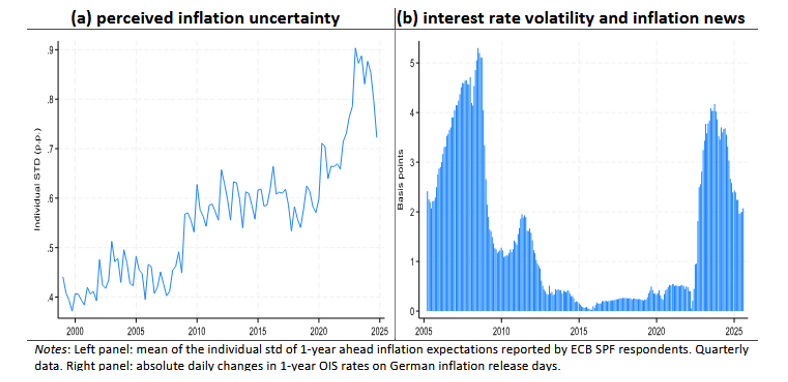
Survey-based evidence shows that this episode coincided with a sharp rise in perceived inflation uncertainty. Professional forecasters reported wider probability distributions around their inflation expectations, pointing to increased uncertainty rather than greater disagreement. At the same time, financial markets displayed heightened reactions to inflation releases, particularly at short maturities.
High-frequency evidence confirms that the sensitivity of interest rates to macroeconomic news varies systematically over time, in line with recent research on time-varying market responsiveness to news (Cieslak et al., 2024; Bauer et al., 2024). When markets perceive the central bank to be operating in a high-learning environment, interest rates react more strongly to inflation surprises. Conversely, the response to information conveyed directly by the central bank about its macroeconomic assessment weakens.
This reallocation of informational weights translates into higher interest rate volatility. Crucially, the increase is not driven by broad measures of uncertainty — such as financial market volatility or energy price fluctuations — but by a more specific uncertainty surrounding the central bank’s own assessment of the outlook (Figure 1).
Figure 1. Perceived inflation uncertainty and interest rate volatility
Periods of elevated perceived inflation uncertainty coincide with stronger market reactions to inflation news,
contributing to higher short-term interest rate volatility.
Central banks convey their assessment of economic conditions through multiple communication channels, including projections, policy statements, press conferences, and speeches (Ehrmann et al., 2019; Hansen et al., 2019). In periods of elevated uncertainty, communication about the reliability of this assessment becomes particularly important.
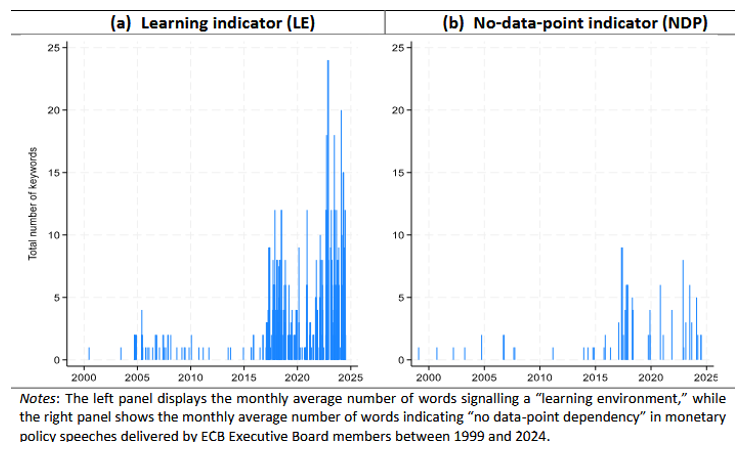
Empirical evidence from the euro area shows that markets respond not only to the content of central banks communication about the outlook, but also to signals about policymakers’ confidence in that outlook. Text-based indicators constructed from policy speeches reveal systematic variation in references to learning, forecast errors, and data-driven decision making.
When such references are frequent, markets interpret them as signals that the central bank is operating in a high-learning regime. In this environment, investors place greater weight on incoming macroeconomic data and discount central bank assessments, which are perceived as more uncertain.
By contrast, communication that explicitly stresses that policy decisions are not driven by individual data points tends to have the opposite effect. Even when uncertainty remains elevated, such statements rebalance market reactions by strengthening the impact of central bank communication and dampening the amplification of inflation news. Markets therefore distinguish between learning from data and reacting mechanically to data releases (Figure 2).
Figure 2. Central bank signal of a high (or low) learning environment
Text-based indicators from ECB communication show systematic variation
between periods emphasizing learning and periods stressing that policy is not driven by individual data points.
Why does communication about confidence matter so much? Related theoretical work emphasizes the role of noisy public signals and learning in shaping expectations (Melosi, 2017; Gáti and Handlan, 2025).
In practice, neither the central bank nor the private sector can perfectly disentangle persistent movements in inflation from transitory fluctuations. Central banks process incoming data through forecasting models and publish projections, which markets interpret as signals about the persistent component of inflation.
Crucially, markets form beliefs not only about the inflation outlook, but also about the precision of these signals. Central bank projections are therefore not treated as hard information, but as noisy public signals whose reliability varies over time.
When projections are perceived as relatively precise, markets assign them substantial weight in expectation formation. Interest rates then respond less to individual data releases, and volatility is dampened. When projections are perceived as noisy, markets rely more heavily on realized data, amplifying the response of interest rates to news.
This mechanism implies that the interest rate volatility is not driven solely by the magnitude of economic shocks, but also by how information is processed — a process that depends directly on central bank communication.
The analysis highlights a fundamental trade-off faced by central banks.
On the one hand, signaling high confidence in projections can stabilize expectations in tranquil times. When uncertainty is low and forecasting models perform well, such communication reinforces the anchoring role of projections and limits unnecessary market volatility.
On the other hand, in periods of elevated uncertainty and structural change, projecting excessive confidence may be counterproductive. If markets place too much weight on imprecise projections, they may underreact to new information, increasing the risk that misguided expectations become entrenched.
Conversely, signaling low confidence can enhance market discipline in turbulent times by encouraging agents to incorporate incoming data more actively. Yet if used when uncertainty is low, this strategy may weaken the stabilizing role of projections and generate avoidable volatility.
The key implication is that communication about uncertainty should be state-contingent, much like policy itself. There is no single optimal level of communicated confidence that applies across all environments.
Three policy implications stand out.
First, communication about uncertainty should not be viewed solely as a transparency-enhancing device. By shaping how markets process information, it directly affects financial conditions and interest rate volatility. Communicating confidence is therefore an active policy choice.
Second, central banks should provide clearer guidance on the reliability of their projections. Qualitative statements, fan charts, or explicit references to learning and forecast uncertainty can help markets interpret projections appropriately, reducing the risk of over- or underreaction to news.
Third, communication interacts with conventional policy tools. A more forceful policy stance may require projections to be perceived as sufficiently reliable to avoid excessive market reactions. Conversely, acknowledging greater uncertainty may call for a more measured policy response to limit volatility.
Recent experience shows that monetary policy increasingly operates in environments characterized by deep uncertainty and structural change. In such settings, how central banks communicate their confidence in the outlook becomes as important as the outlook itself.
The main lesson is straightforward: communicating uncertainty is not neutral. It shapes expectations, influences how markets react to news, and affects interest rate volatility. Designing this communication carefully — and adapting it to the state of the economy — has become an integral part of modern monetary policy.
Bauer, M. D., Pflueger, C. E., and Sunderam, A. (2024). Changing perceptions and post-pandemic monetary policy. In Jackson Hole Economic Symposium, Federal Reserve Bank of Kansas City.
Cieslak, A., McMahon, M., and Pang, H. (2024). Did I make myself clear? The Fed and the market in the post-2020 framework period. Journal of Monetary Economics, forthcoming.
Clarida, R. H. (2020). Financial markets and monetary policy: Is there a hall of mirrors problem? Speech at the U.S. Monetary Policy Forum, University of Chicago.
European Central Bank (2024a). An update on the accuracy of recent Eurosystem/ECB staff projections for short-term inflation. ECB Economic Bulletin, Issue 2/2024.
Ehrmann, M., Gaballo, G., Hoffmann, P., and Strasser, G. (2019). Can more public information raise uncertainty? The international evidence on forward guidance. Journal of Monetary Economics, 108, 92–112.
Gáti, L., and Handlan, A. (2025). Reputation for confidence. CEPR Discussion Paper, No. 20734.
Hansen, S., McMahon, M., and Tong, M. (2019). The long-run information effect of central bank communication. Journal of Monetary Economics, 108, 185–202.
Lane, P. R. (2024). The 2021–2022 inflation surges and monetary policy in the euro area. ECB Blog, 11 March.
Melosi, L. (2017). Signalling effects of monetary policy. Review of Economic Studies, 84(2), 853–884.