

This paper is based on IMF Working Paper 26/37 “Tilting the Balance Towards Equity: Capital Controls and the Structure of External Liabilities”. The views expressed are those of the authors and do not necessarily reflect those of the IMF, its Executive Board, or IMF management.
Abstract
Opening the capital account is not simply a choice between openness and restrictions. New evidence suggests that countries which liberalize capital flows asymmetrically – favouring equity over debt –end up with a higher share of equity in their foreign liabilities. Using a new intensity-based measure of capital openness, this policy brief shows that differentiated liberalization strategies can shape not just how much capital countries receive, but also how stable their external financing structure becomes.
The debate over capital account liberalization has often focused on whether and how fast countries should liberalize (Erten et al. 2021). At the same time, there is growing recognition that this framing may overlook an important dimension: not all capital inflows are alike, and the composition of a country’s external liabilities can matter just as much as their overall size. A large literature shows that debt-heavy external balance sheets make countries more vulnerable to sudden stops and financial crises (Catão and Milesi-Ferretti 2014), while equity-type liabilities – such as foreign direct investment (FDI) and portfolio equity – tend to provide greater risk sharing and leave countries less prone to sudden capital flow reversals.
This raises a natural policy question: can governments use capital account policies not just to influence the quantity of foreign capital they receive, but also its composition? In a recent paper, we provide evidence that they can. Using a novel measure of capital account openness that captures the intensity of restrictions across different types of capital flows, we show that countries that liberalize equity inflows more than debt inflows tend to accumulate more equity-type and less debt-type external liabilities over time (Krahnke and Li 2026).
A central challenge in studying this question is measurement. Many widely used capital-control indicators are binary, treating minor screening requirements the same as stringent approval processes and quotas. That masks meaningful differences in policy intensity and makes gradual liberalization hard to detect. To address this limitation, we use the new FinOpen index (Li 2026), which measures capital account openness on a continuous scale and captures the intensity of restrictions across equity and debt flows, as well as inflows and outflows. This allows us to compare not just whether countries impose restrictions, but how restrictive their different policies are.
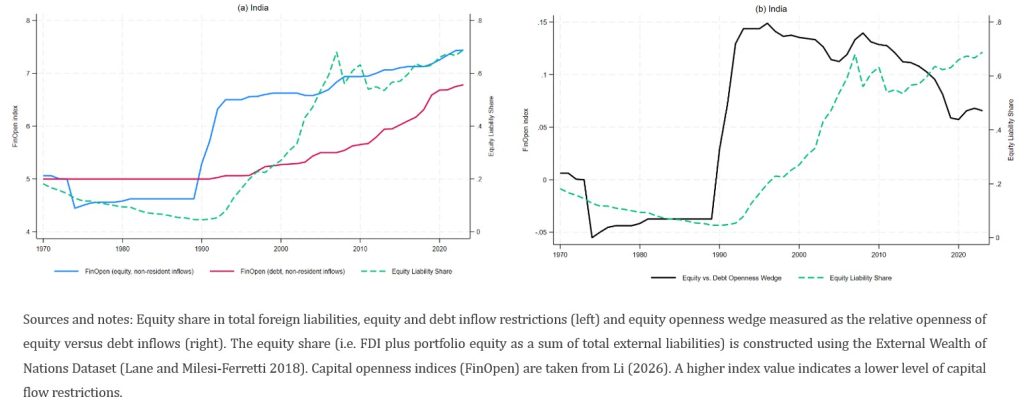
India provides an illustrative example of why this added nuance matters (Figure 1). Following its early-1990s reforms, India adopted a gradual and selective approach to capital account liberalization, easing restrictions on equity inflows while maintaining tighter controls on debt inflows and capital outflows. This more favourable treatment of equity was followed by a marked increase in the equity share of India’s external liabilities. While only illustrative, this pattern suggests that differentiated liberalization may play an important role in shaping the composition of countries’ external balance sheets.
Figure 1. Capital inflow openness and equity share in foreign liabilities
Using data for 118 countries over 1995–2022, we examine whether countries that are more open to equity inflows than debt inflows exhibit a higher share of equity in their total foreign liabilities. Our key measure is the equity openness wedge: the degree to which a country is more open to foreign equity inflows than to debt inflows.
We find that countries with a larger equity openness wedge tend to have a significantly higher share of equity in their external liabilities. Quantitatively, countries with relatively tighter restrictions on debt than on equity tend to have, on average, a 7-percentage-point higher equity share in foreign liabilities – a sizable effect relative to a sample median equity share of around 39 percent. Importantly, this relationship holds after controlling for the standard determinants of external capital structure identified in the literature, including institutional quality, financial development, trade openness, and economic size (Faria and Mauro 2009).
We also find that the effect of asymmetric liberalization is stronger in countries with better institutional quality. Even if a country opens more to equity inflows, foreign investors may remain reluctant to commit long-term capital unless institutions provide sufficient legal protection, policy predictability, and contract enforcement. Capital account liberalization therefore might not substitute for broader institutional reforms – but it can complement them.
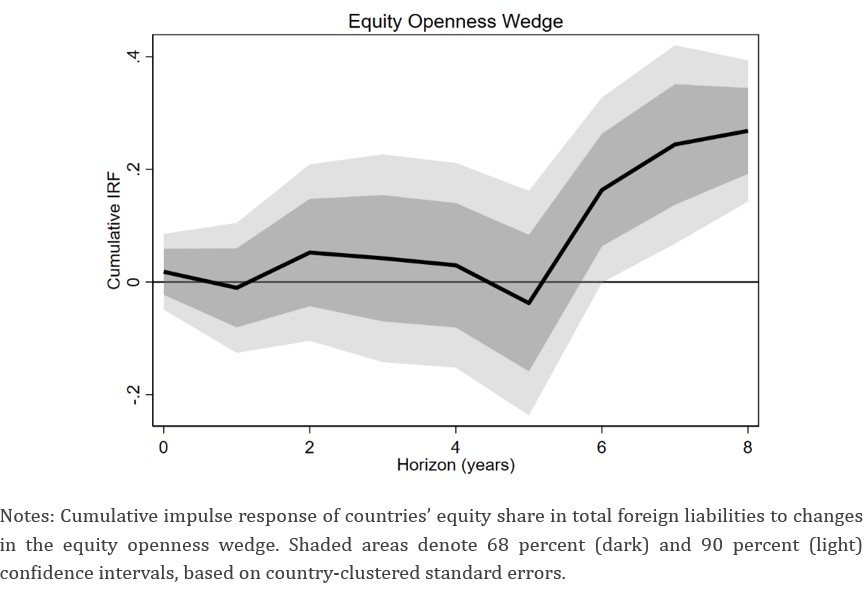
Because external liabilities are stock variables, changes in capital account policies affect them only gradually as new financing accumulates over time. Using local projection methods, we show that the impact of a more equity-friendly capital account regime builds slowly and becomes clearly visible only after around five to six years (Figure 2). This suggests that the benefits of targeted liberalization strategies may take time to materialize. Policymakers should therefore view capital account sequencing as a medium- to long-term strategy rather than only as a short-run stabilization tool.
Figure 2. Cumulative Effect of Asymmetric Capital Openness on Equity Share
To better understand the transmission mechanism, we complement our macro analysis with firm-level data covering more than 12 million firm-year observations across emerging markets. We find that when countries tilt capital account policies in favour of equity inflows, firms become more likely to issue equity. This suggests that the observed shifts in countries’ external liability structures reflect real financing decisions at the firm level.
Our findings suggest that for countries seeking to integrate into global financial markets while limiting external vulnerability, how they liberalize may matter as much as whether they liberalize. A sequencing strategy that liberalizes equity inflows before debt inflows can help tilt external financing toward more stable forms of funding and away from debt-heavy external balance sheets. This is consistent with the IMF’s Institutional View, which emphasizes that capital account liberalization should proceed gradually and in line with countries’ institutional and macro-financial readiness (IMF 2022).
At the same time, our results should not be interpreted as implying that differentiated capital controls are always optimal or costless. We focus on the composition of external liabilities rather than broader welfare implications, efficiency costs, or other trade-offs associated with capital account policies. Nor can capital account policies substitute for sound institutions and broader structural reforms. Rather, our findings suggest that targeted capital account liberalization can complement such reforms by helping countries shape not just how much foreign capital they receive, but the type of financing they rely on.
Catão, L A V and G M Milesi-Ferretti (2014), “External Liabilities and Crises,” Journal of International Economics 94(1): 18–32.
Erten, B, A Korinek and J A Ocampo (2021), “Capital Controls: Theory and Evidence,” Journal of Economic Literature 59 (1): 45–89.
Faria, A and P Mauro (2009), “Institutions and the external capital structure of countries”, Journal of International Money & Finance 28, 367–391.
IMF (2022), “Review of the Institutional View on the Liberalization and Management of Capital Flows”, Washington D.C.
Krahnke, T and W Li (2026), “Tilting the Balance Towards Equity: Capital Controls and the Structure of External Liabilities”, IMF WP 26/37, Washington D.C.
Lane, P and G Milesi-Ferretti (2018), “The external wealth of nations revisited: International financial integration in the aftermath of the global financial crisis”, IMF Economic Review 66 (1), 189–222.
Li, W (2026), “Beyond Binary: A Policy-Intensity Measure of Capital Flow Management”, IMF WP 26/21, Washington D.C.