

This policy brief is based on Banco de España Working Papers. 2615. The views expressed are those of the authors and not necessarily those of the institutions the authors are affiliated with.
Abstract
We study the implications of the sharp increase in euro area policy rates in 2022 for bank risk-taking. Using granular Spanish data, we find that banks more exposed to concentrated deposit markets experienced weaker deposit growth during the tightening cycle, the so-called deposit channel. These banks reduced lending more, especially to riskier firms. For new loans, they charged higher rates and achieved higher returns without a subsequent deterioration in loan performance. The deposit channel therefore affects not only the quantity of credit, but also its quality. These results point to a mechanism whereby higher deposit franchise value induces more prudent behaviour, but at the cost of tighter credit conditions for weaker borrowers.
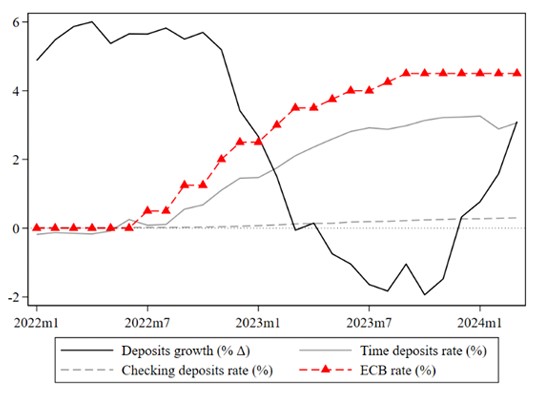
The euro area tightening cycle that began in July 2022 was the fastest and most intense in the history of the monetary union. After almost a decade of very low or negative interest rates, the ECB raised policy rates rapidly to contain inflation. One striking feature of this episode was that retail deposit rates increased only slowly, and much less than policy rates.
This gap between policy and deposit rates is central to the deposit channel of monetary policy (Drechsler et al. 2017). When banks have market power in deposit markets, they do not need to raise deposit rates one-for-one with policy rates. This protects their margins, as asset returns rise while funding costs remain sticky. However, this can trigger outflows as depositors move funds towards better-paying alternatives (e.g. time deposits, money markets, government securities), so greater market power may weaken deposit growth (Figure 1).
Figure 1. Monetary policy, deposit rates, and deposit growth
We examine the implications of the deposit channel for bank lending and risk-taking. We find that banks raising deposits in more concentrated markets reduced lending more sharply, especially to riskier firms. At the same time, they charge higher rates on new loans without a deterioration in subsequent loan performance.
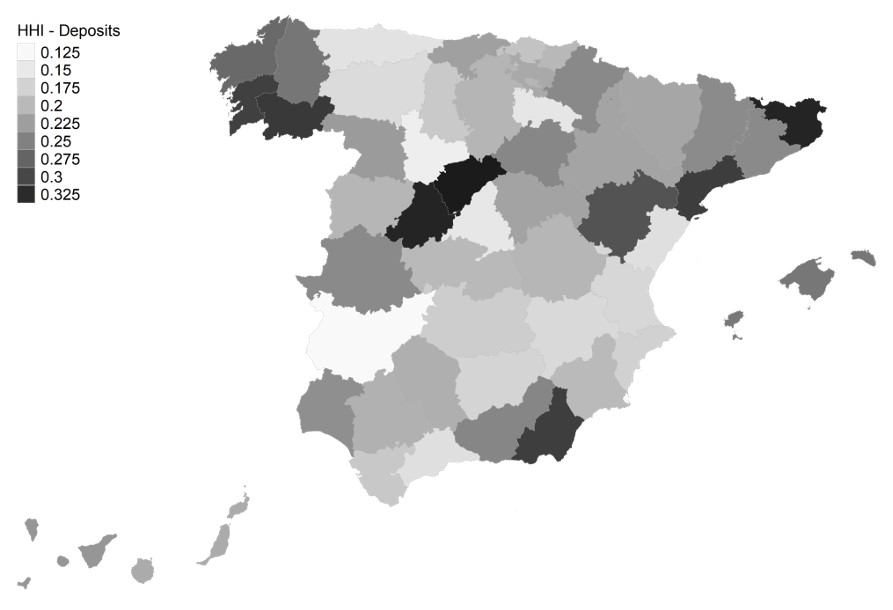
Spain provides a useful setting for this analysis because banks rely heavily on deposits as a source of funding and deposit-market concentration varies substantially across provinces. Some regional markets are highly concentrated, while others are more competitive. Because banks operate across multiple markets, this regional variation allows us to compare branches of the same bank facing different degrees of deposit-market power and to trace how this shapes the deposit channel during a monetary tightening (Figure 2).
Figure 2. Regional heterogeneity in deposit market concentration
The empirical analysis combines three main sources of confidential data. First, supervisory data on deposits at the bank-province level. Second, the Spanish Central Credit Register, which provides loan-level information covering virtually the universe of bank credit to firms. Third, bank balance-sheet data, which permits us to control for capital, liquidity and other relevant bank characteristics.
The period is also well suited to identification. The policy shock was large, rapid and largely unexpected. At the same time, banks entered the tightening cycle with relatively strong capital positions and ample liquidity, helping distinguish the deposit channel from more traditional bank-lending-channel explanations based on scarce liquidity or weak capital.
Our first results show that the deposit channel of monetary policy operated during the tightening cycle in a major Euro Area economy: within the same banking group, branches in more concentrated provinces experienced weaker deposit growth than branches in more competitive provinces (Figure 3).
Figure 3. The deposit channel of monetary policy during a tightening cycle
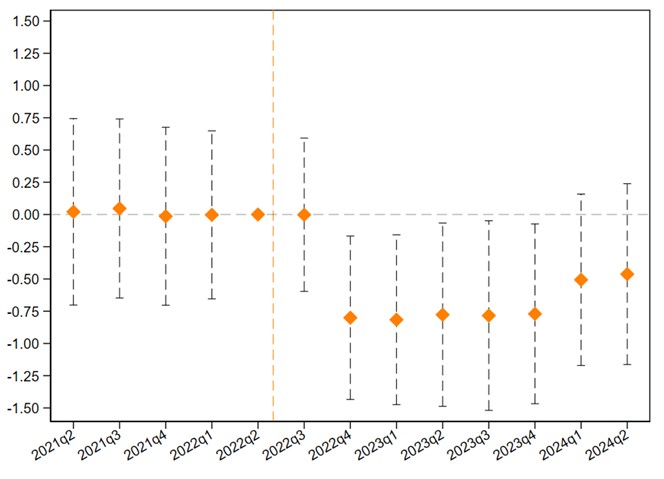
The effect is especially visible for time deposits. A one-standard-deviation increase in local deposit-market concentration reduced time-deposit holdings by around 3.8% relative to branches of the same bank in average-concentration areas. This pattern emerges only after the start of monetary tightening, with no evidence of a differential pre-trend beforehand. Therefore, the deposit channel had heterogeneous impact across banks depending on the local markets in which they raised deposits.
Our second result is that the deposit-side shock translated into lower lending. Banks raising deposits in more concentrated markets reduced lending significantly more than other banks, with a one-standard-deviation increase in exposure — measured as the deposit-weighted average HHI across markets in which they raise deposits — associated with a 10.5% larger contraction in credit supply.
The effect was stronger for riskier firms. Banks more exposed to the deposit channel cut lending to borrowers with higher ex-ante default risk by an additional 4.6% relative to average-risk firms. The deposit channel therefore affected not only the volume of credit, but also its composition, shifting lending away from riskier borrowers and pointing to more prudent bank behavior during tightening.
Our third result provides evidence on new term loans. Banks more exposed to concentrated deposit markets originated about 5% fewer new credit and charged roughly 20 basis points higher interest rates for loans with similar risk.
Comparing otherwise similar borrowers facing different interest rates, we find no statistically significant deterioration in performance one year ahead. Instead, higher rates translate into about 21 basis points higher realized returns.
This finding points to a broader effect of the deposit channel: banks become more selective. They reduced the quantity of credit, especially to riskier borrowers, raised margins on the loans they continued to grant, and improved the risk-return trade-off of new lending.
The results are consistent with the franchise-value channel. When policy rates rise but deposit rates remain sticky, banks in concentrated deposit markets earn higher intermediation margins. These rents increase the value of their deposit franchise. Once the franchise becomes more valuable, banks have more to lose.
This changes incentives. Banks can protect their franchise by tilting credit supply towards safer borrowers. This is the opposite of the “search for yield” mechanism often associated with long periods of very low interest rates. In the low-rate environment, compressed margins may encourage banks to take on more risk. In the tightening environment studied here, higher margins from sticky deposits make some banks more cautious.
In addition, the franchise value motive induces banks to be more selective, not only prioritizing safer borrowers but also reallocating lending toward those offering higher returns, as expanding deposit funding to support additional lending would otherwise erode deposit margins.
All in all, our findings suggest that the deposit channel interacts with the risk-taking channel of monetary policy. It is associated with a sharper contraction in credit to riskier firms during tightening episodes.
The deposit channel of monetary policy is not only a funding-cost mechanism. It also shapes banks’ risk-taking incentives. During the 2022–2024 euro area tightening cycle, Spanish banks raising deposits in more concentrated markets experienced weaker deposit growth, cut lending more sharply, and pulled back most from riskier firms. At the same time, they charged more on new loans without worsening loan performance, thereby raising realised returns.
The core message is simple: when policy rates rise but deposit rates remain sticky, banks do not just lend less, they lend differently. A more valuable deposit franchise makes banks more selective and more prudent, strengthening financial stability but at the cost of riskier borrowers. Altogether these results reveal a nexus between the deposit and risk-taking channels of high relevance for the financial stability considerations of monetary policy design.
Drechsler, Itamar, Alexi Savov and Philipp Schnabl. (2017). “The Deposits Channel of Monetary Policy”. The Quarterly Journal of Economics, 132(4), pp. 1819–1876. https://doi.org/10.1093/qje/qjx019
Gutiérrez, José E., Enric Martorell and Mariya Melnychuk. (2026). “The Nexus between the Deposit and Risk-Taking Channels of Monetary Policy”. Working Papers 2615, Banco de España. https://doi.org/10.53479/43145