

The views expressed hereby are those of the authors and do not necessarily reflect those of the European Central Bank or De Nederlandsche Bank.
Abstract
We estimate the contribution of discretionary fiscal policy measures to euro area inflation in the post-pandemic era using an extension of Bernanke and Blanchard (2024b)’s semi-structural model. Since the pandemic, aggregate discretionary fiscal measures had a modest yet progressively increasing positive contribution to inflation that partly worked through an indirect effect on wage growth and inflation expectations. However, net indirect taxes helped to contain inflationary pressures, both during the pandemic and energy crises. Fiscal policy, therefore, can be a powerful tool to smooth the inflationary effects of adverse supply shocks, yet may also increase inflation persistence if fiscal stimulus is not withdrawn in a timely manner.
Many studies have shown that the post-pandemic inflationary surge in the euro area was driven by both supply- and demand-side factors. The former refers, for example, to supply chain disruptions during and after the pandemic and the series of energy and other commodity price shocks following Russia’s invasion of Ukraine in early 2022, while demand shocks may have arisen from the release of pent-up demand after the pandemic and from expansionary fiscal and monetary policy responses to the pandemic and energy crises. A common finding across most studies is that supply shocks accounted for the lion share of the inflation surge, particularly in its initial phase, while the contribution of demand shocks to inflation was more contained yet may have gained in importance over time as economic recovery gradually unfolded.
Several papers investigate the role of fiscal policy in driving inflation in the euro area, during the most recent episodes or over a longer period. For instance, Bankowski et al. (2023) and Angelini et al. (2025) use structural model-based simulations to show that the recent energy and inflation compensation measures extended by euro area governments smoothed inflation dynamics in 2022 but also increased its persistency. At the same time, these papers estimate that the total discretionary fiscal policy measures since the pandemic would have an upward impact on euro area inflation over the period 2023 to 2027. Ascari et al. (2024) use a Bayesian VAR model and find a substantial and progressively increasing contribution of fiscal shocks to euro area inflation since the pandemic. From a longer perspective, Checherita-Westphal et al. (2024) conclude that the impact of the total discretionary fiscal policy impulse or fiscal stance on inflation works through the indirect channel of the output gap, while Checherita-Westphal and Pesso (2024) find a non-linear effect of fiscal stimulus on inflation that depends, inter alia, on the level of government debt.
Our paper (Bonam, Cerra-Pacheco and Checherita-Westphal, 2025) provides new evidence on the contribution of discretionary fiscal policy measures to inflation in the euro area, during and after the pan-demic. To this end, we use the semi-structural model from Bernanke and Blanchard (2024b), which we augment with a measure that captures discretionary fiscal policy changes as estimated by fiscal experts within the Eurosystem. While the Bernanke-Blanchard model was originally built to investigate the drivers of US inflation, it has been used to analyse inflation dynamics during the pandemic era in various other economies as well, including the euro area (see Bernanke and Blanchard, 2024a). In their suggestions for further research and development of the model, the authors mention explicitly the incorporation of fiscal policy, which is the focus of our paper.
As a starting point, we estimate the model over the same sample that was used in the replication exercise of the Bernanke-Blanchard model for the euro area by Arce et al. (2024), i.e. from 1999Q1 to 2023Q2, and using the same dataset.
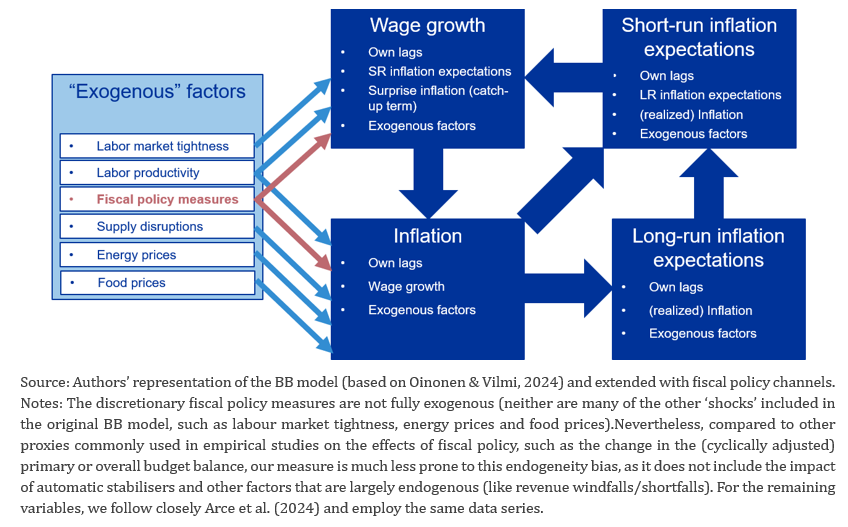
To recall, the original Bernanke-Blanchard model (henceforth referred to as the BB model) is a semi-structural model consisting of four equations that describe the dynamics of four endogenous variables: (1) wage growth, (2) inflation, (3) short-term inflation expectations, and (4) long-term inflation expectations. The equations for wage growth and inflation include product- and labour market shocks that are likely to be relevant drivers of inflation. It is in this part of the model where we introduce our proxies for discretionary fiscal policy measures. As such, we allow for the possibility that the discretionary fiscal measures taken by euro area governments have both a direct impact on inflation, e.g. through indirect taxes and subsidies, and an indirect effect through, for example, aggregate demand. See Figure 1 below for a stylised representation of the extended model.
Figure 1. Stylised representation of the Bernanke-Blanchard model extended with discretionary fiscal policy
Our main variable of interest, i.e. the discretionary fiscal policy measures, are obtained from the Eurosystem’s Working Group of Public Finance (WGPF). This annual series is constructed based on a narrative, country-specific and measure-by-measure approach on the revenue side and by benchmarking the growth rate of three relevant expenditure categories, i.e. government consumption, government investment and discretionary transfers, to nominal potential growth. These proxies for discretionary fiscal policy measures are regularly used in the ECB/Eurosystem macroeconomic forecasting and simulation models to evaluate the impact of fiscal assumptions on growth and inflation.1 The discretionary measures are calculated at the country level and, for the purpose of the present paper, aggregated at the euro area level.
As a baseline, we focus on the contribution to inflation arising from changes in total discretionary fiscal measures, i.e. the sum of all changes in various types of government spending and revenue components. Next, we distinguish between measures that have a more direct impact on inflation — such as indirect taxes and subsidies that have been heavily deployed by governments in their fight against the energy crisis — and the remaining set of discretionary measures that are likely to affect inflation indirectly through aggregate demand. This latter set of measures includes transfers and wage subsidies that played an instrumental role in the fiscal response to the pandemic crisis, as well as government consumption, government investment, and discretionary measures on direct taxation. To estimate the extended BB model using quarterly data, we convert the annual series for the discretionary measures to a quarterly frequency using an interpolation based on the quarterly time profile of the primary budget balance.
Figures 2 to 5 show the decompositions of the endogenous variables of the extended BB model into their various sources over the post-pandemic period. These decompositions take into account the full dynamic and general equilibrium effects inherent in the model. For example, changes in discretionary measures may impact inflation indirectly through their effect on wage growth. As realized inflation partly affects inflation expectations, discretionary measures may then have a further knock-on effect on wages as these are also influenced by changes in inflation expectations, and again on inflation.
Figure 2 shows that discretionary measures have been a particularly important driver of wage growth in the midst of the pandemic (green bars). This is not surprising, given the wide use of wage subsidies — and job retention schemes more generally — that supported wage growth during that time, even as labour market conditions deteriorated. As the economy recovered from the pandemic and fiscal support was gradually being rolled back, improved labour market conditions became a relatively more important driver of wage growth dynamics in the euro area (red bars). Note that, during the energy crisis, relative energy and food prices were putting substantial upward pressure on wages.
Figure 2. Sources of euro area wage growth
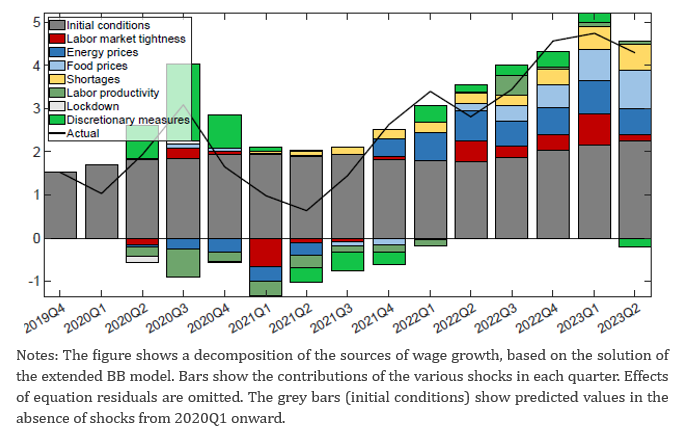
Figure 3 shows that discretionary fiscal measures played a non-trivial role in driving inflation dynamics through both direct and indirect channels. During the peak of the pandemic in 2020, these measures contributed to lowering inflation through a multitude of indirect tax cuts and subsidies. This occurred while other discretionary fiscal measures contributed positively to wage growth. In the years following the pandemic, the unwinding of accumulated savings and further fiscal support measures in 2021 started to put upward pressure on inflation. Hence, the contribution of discretionary measures became progressively more positive, with an average contribution to inflation of around 0.4 p.p. in 2021 and almost 1 p.p. in 2022. Thereafter, the fiscal contribution to inflation declined to an average of 0.3 p.p. in 2023. This time profile is consistent with the hump-shaped response of economic aggregates to fiscal shocks and closely resembles the dynamic contribution of fiscal shocks to euro area inflation in recent years shown by Ascari et al. (2024).
Figure 3. Sources of euro area inflation
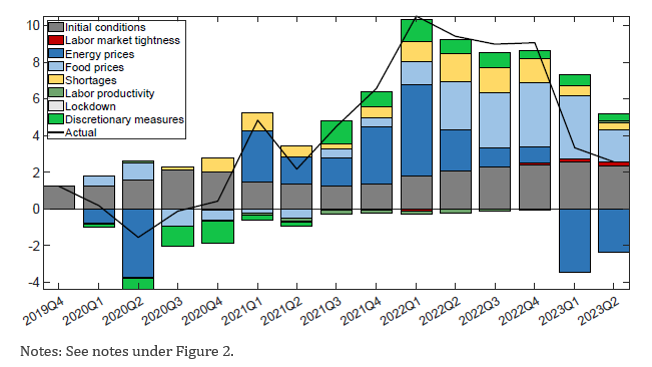
Figure 4. Sources of euro area short-term inflation expectations
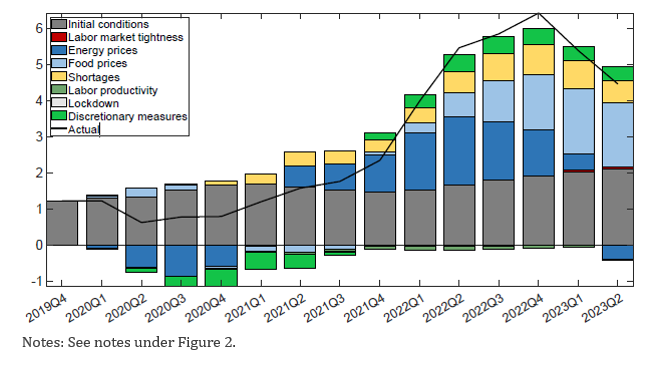
The impact of fiscal policy on inflation is likely to have been amplified by the wage channel, which works through the interaction between wage growth, realized inflation and inflation expectations. Indeed, Figure 4 shows a notable positive effect of discretionary fiscal measures on short-term inflation expectations in the years following the pandemic. However, as shown by Figure 5, long-term inflation expectations have remained remarkably stable, even as realized inflation reached historically high levels. The limited role of both discretionary measures and the other shocks in driving long-term inflation expectations confirms the strong anchoring of inflation expectations in the euro area on the back of a credible monetary policy.
Figure 5. Sources of euro area long-term inflation expectations
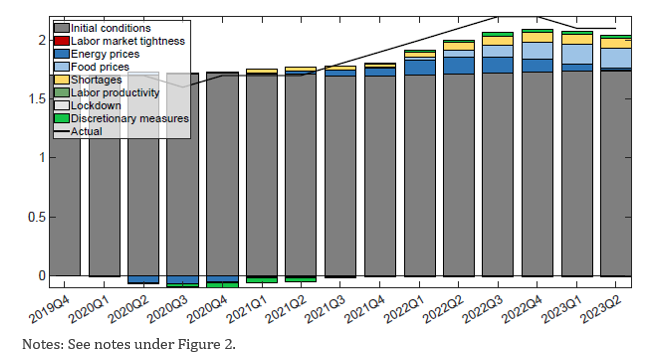
Our results show that, overall, discretionary fiscal policy measures have been an important driver of euro area inflation. However, they do not overturn the conclusions from the results of the original BB model that commodity prices have been the dominant source of the recent inflation surge and that demand-side factors played a smaller, yet increasingly more important, role.
In the paper, we conduct several robustness exercises. The most straightforward exercise is to extend the dataset up to 2024Q3, the latest quarter for which all data was available at time of writing.
Figure 6. Sources of euro area inflation using expanded sample until 2024Q3
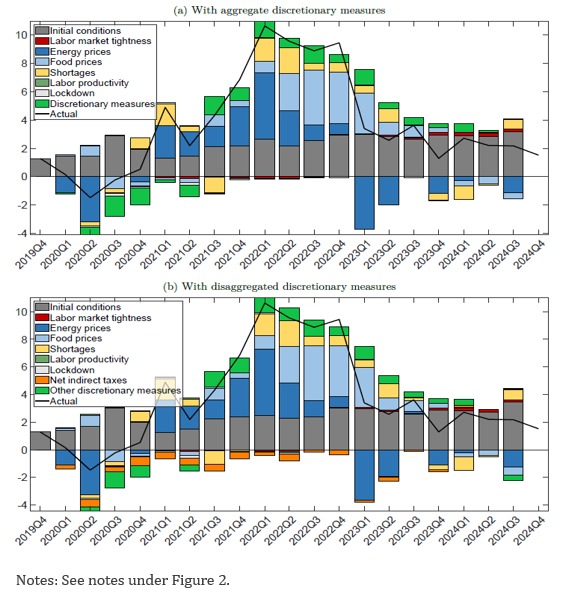
The results using this extended dataset are both qualitatively and quantitively very similar to our main results shown in Figure 3, with the contribution of overall discretionary measures on inflation becoming progressively more positive following the pandemic crisis and gradually declining towards the end of the sample (Figure 6, panel a). When distinguishing between net indirect taxes and other discretionary measures as explained above (Figure 6, panel b), we find that the former had a consistent negative contribution to euro area inflation up to 2023Q4 and thereby helped smooth inflation dynamics during the post-pandemic period and the energy crisis.
Other robustness checks for which the main results hold include: (i) the estimation of the model using pre-COVID data and (ii) the use of consumer, energy and food prices at constant taxes to better distinguish the impact of fiscal policy measures on inflation. The latter may be particularly relevant for the years 2022 and beyond, given governments’ widespread use of tax measures in response to the energy and cost of living crisis.
Our analysis contributes to the literature on the impact of discretionary fiscal policy measures on euro area inflation in the post-pandemic era by extending Bernanke and Blanchard (2024b)’s semi-structural model to account for fiscal policy.
We find that, since the pandemic crisis, the contribution of discretionary fiscal measures to euro area inflation has been modest yet became progressively more positive over time. Our estimates further show that wages were an important conduit for the impact of fiscal policy on inflation. Model-based historical decompositions show a rather notable contribution from discretionary fiscal measures to short-term inflation expectations, but a very limited impact on long-term inflation expectations. The latter remained broadly unaffected by shocks, confirming their strong anchoring in the euro area.
Further, the contribution of aggregate fiscal policy on inflation masks offsetting effects arising from different types of discretionary measures. When we distinguish between indirect taxes (net of subsidies) and other discretionary measures, we find that the contribution of the former to inflation has been negative after the pandemic crisis. This result is in line with other ECB model-based studies showing that ‘unconventional’ fiscal stimulus through cuts in net indirect taxes helped to temporarily lower inflation in the euro area. In contrast, the impact on inflation of discretionary fiscal measures other than net indirect taxes has been mostly positive since 2020, reaching a peak contribution to inflation of almost 1 percentage point in 2022.
Finally, our results support earlier findings from the literature that commodity price shocks and supply shortages together explain the bulk of the recent inflation surge in the euro area, while demand-side factors played a more limited, though increasing role. In this respect, our findings are consistent with those from Arce et al. (2024) for the euro area. Our main contribution, therefore, is to show that, in addition to the relevance of supply-side factors, fiscal policy played a non-negligible role in shaping inflation dynamics in the euro area. From that perspective, our results suggest that a well-calibrated set of fiscal policy instruments can smooth the inflationary effects of adverse supply shocks and could therefore complement monetary policy in ensuring price stability. However, fiscal policy may also increase inflation persistence, especially if the stimulus is not timely withdrawn.
Bonam Dennis, Mariana Montserrat Cerra Pacheco and Cristina Checherita-Westphal (2025), The fiscal sources of euro area inflation through the lens of the Bernanke-Blanchard model, ECB Working Paper No. 3153.
Angelini, E., Bankowski, K., Muggenthaler-Gerathewohl, P., Checherita-Westphal, C., and Zimic, S. (2025). The macroeconomic impact of euro area discretionary fiscal policy measures since the start of the pandemic. ECB Economic Bulletin Box, Issue 3.
Arce, Ó., Ciccarelli, M., Kornprobst, A., and Montes-Galdón, C. (2024). What caused the euro area post-pandemic inflation? An application of Bernanke and Blanchard (2023), ECB Occasional Paper No. 343.
Ascari, G., Bonam, D., Mori, L., and Smadu, A. (2024a). Fiscal policy and inflation in the euro area. De Nederlandsche Bank.
Bańkowski, K., Bouabdallah, O., Checherita-Westphal, C., Freier, M., Jacquinot, P., and Muggenthaler, P. (2023). Fiscal policy and high inflation. ECB Economic Bulletin Article, Issue 2.
Bernanke, B. and Blanchard, O. (2024a). An analysis of pandemic-era inflation in 11 economies. Peterson Institute for International Economics Working Paper, pages 24–11.
Bernanke, B. and Blanchard, O. (2024b). What caused the US pandemic-era inflation? American Economic Journal: Macroeconomics, 17(3): 1—35.
Checherita-Westphal, C., N. Nadine Leiner-Killinger and T. Schildmann (2024), Euro area inflation differentials: the role of fiscal policies revisited, Empirical Economics, Vol. 68, pages 803–854
Checherita-Westphal, C. and Pesso, T. (2024). Fiscal policy and inflation: accounting for non-linearities in government debt. ECB Working Paper No. 2996.
Oinonen, S. and Vilmi, L. (2024). What factors have influenced the dynamics of euro area prices and wages? Bank of Finland Bulletin, May 2024.
For more details on the size of the discretionary measures and their composition across five broad instruments (i.e., government consumption, government investment, fiscal transfers, indirect taxes, and direct taxes and social security contributions) at the euro area aggregate level over recent years, see Angelini et al. (2025).