This policy brief is based on IMF Working Paper 26/117. The views expressed are those of the authors and not necessarily those of the institutions the authors are affiliated with.
Abstract
Budgets may look like tables of numbers, but they are also stories about priorities, constraints, and who pays. This brief examines more than 500 fiscal communications from G7 finance ministries from 2000 and 2024, using text analysis, and finds that governments send fiscal signals through three channels: a technical budget document for experts, a political speech for the public, and a press release for the media. Some differentiation is expected because each format serves a different audience. The more important finding is that this division of labor is systematic. The same fiscal package becomes an accounting record in the budget document, a political narrative in the speech, and a headline signal in the press release. This structure is useful, but it can also pull the fiscal story away from the fiscal arithmetic. Governments highlight spending commitments more readily than financing choices and discuss debt risks in language that reassures more often than it warns. Fiscal credibility depends not on making the budget sound painless, but on keeping the promise, the price tag, and the payment path in the same story. Fiscal communication is political, multi-audience, and often optimistically framed, which makes coherence across channels not a cosmetic issue, but a condition for credibility.
Fiscal policy is the part of macroeconomic policy that citizens encounter most directly (see Auerbach, 2009). It taxes, spends, transfers, borrows, builds, cuts, and compensates. It determines who receives support, who pays, what is postponed, and what is passed to the next generation. Yet the way governments communicate these choices has received far less attention than the way central banks communicate interest-rate decisions. This is the fiscal communication paradox. Fiscal policy is highly visible in its effects but comparatively underdeveloped in its communication architecture.
Central banks learned long ago that policy is not made only with instruments, it works with expectations (see Haldane and McMahon, 2018). A rate decision matters; so does explanation of whether it is temporary, conditional, reluctant, or the beginning of a cycle. Over time, speeches, inflation reports, forecasts, press conferences, and forward guidance became part of the monetary transmission mechanism itself (Blinder et al. 2008; Woodford 2005). Communication was no longer commentary on policy; it became one channel through which policy operated.
Finance ministries have always communicated. They present budgets, issue fiscal plans, defend measures in parliament, and release statements to the press. But fiscal communication developed in a different tradition. It remained tied to legal disclosure, political bargaining, and the annual budget cycle. The budget has been treated as the main signal; communication around it served to explain, defend, or summarize the package.
There were good reasons for this. During the inflation-targeting era, short-run macroeconomic stabilization was increasingly assigned to central banks. Fiscal policy became associated less with demand management than with consolidation, fiscal rules, and medium-term debt control (see Alesina and Perotti, 1995). The institutional setting was also more complex. Budgets pass through cabinets, parliaments, coalition agreements, legal constraints, and distributional conflicts. Central banks can organize communication around a single operating target. Inflation can be reduced to a number. Fairness, sustainability, growth, taxation, and public spending cannot. Fiscal policy now carries a wider set of responsibilities, from stabilization, redistribution, investment, security, to debt management, and each speaks to a different audience. The issue is not simply whether finance ministries disclose enough fiscal information. It is how that information is translated across audiences, and whether the translation preserves the underlying trade-off.
The issue, then, was not silence. It was complexity. A finance ministry must speak at once to voters, parliamentarians, markets, public agencies, interest groups, and the media. Finance ministries operate under a broader mandate, address a more heterogeneous audience and are subject to electoral cycles and coalition dynamics. A statement that reassures bond investors may alarm households; language that mobilizes voters may raise doubts among analysts; a compromise that satisfies coalition partners may obscure the underlying fiscal trade-off.
That problem matters more now. Since the global financial crisis, fiscal policy has again become a central tool of macroeconomic stabilization. Governments have used budgets to support demand, protect households, respond to shocks, finance security, support green investment, and manage debt under tighter constraints. Fiscal policy has moved back to the center of macroeconomic management. But fiscal communication has not moved as far.
The UK’s 2022 mini-budget illustrates the point in a broad, institutional sense. The episode was not simply about wording. Policy choices, market conditions, and pension-fund dynamics all mattered (Bank of England, 2023). But it also showed that a fiscal announcement is judged as an information package: the measures themselves, the financing story, the risk assessment, and the institutional process through which the numbers have been tested. The growth narrative was clear; the financing narrative and independent assessment were less visible. When the story, the arithmetic, and the scrutiny do not line up, communication does not reduce uncertainty. It amplifies it.
This is the central constraint of fiscal communication. It must persuade without pretending, simplify without concealing, and reassure without suggesting that trade-offs have disappeared. Monetary policy communication is difficult because expectations are fragile. Fiscal communication is difficult because the distributional stakes are visible from the start. Monetary policy may move a yield curve. Fiscal policy tells people whether taxes rise, benefits fall, services improve, or debt is passed forward. Fiscal politics begins where promises meet payment. Voters may welcome a bridge, a hospital, a tax cut, or a pension increase. But each commitment has to be financed or absorbed into debt. The constraint does not disappear because the language becomes smoother.
The paradox is not simply that fiscal communication has received less attention than monetary communication. It is that budget communication must do several things at once. It must disclose a fiscal plan, defend a political settlement, and help different audiences understand the constraint.
This happens through three channels. The first is informational. Budget statements reveal priorities, financing choices, macroeconomic assumptions, and tolerance for debt risk. The second is narrative (see Shiller, 2018). The same measure can be framed as fairness, efficiency, investment, or responsibility. The words do not change the arithmetic, but they affect how visibly the arithmetic enters the debate. The third is audience design. Budget documents speak mainly to experts, speeches to the public, and press releases to the media. The risk is not that these formats differ. They must. The risk is that they separate the promise from the financing.
Communication should therefore be judged not only by what is published, but by what each audience can actually understand. Experts look for assumptions and debt dynamics; citizens for taxes, benefits, and services; markets for the credibility of the financing path; journalists for the headline. A coherent fiscal message does not give every audience the same level of detail. It gives them the same underlying story.
This is why LLM-assisted text methods matter. Fiscal communication is long, technical, multi-format, and written for several audiences at once. Until recently, it was difficult to analyze this material systematically across countries and over time. These methods make visible not only what governments say, but how clearly they say it, which themes they emphasize, and how they frame spending, revenue, and debt. They allow us to study the communication architecture through which fiscal numbers become fiscal meaning. That is the question we take to the G7 evidence.
We take these channels to the data in Evdokimova and Imam (2026), using a corpus of more than 500 fiscal communications from G7 countries (Canada, France, Germany, Italy, Japan, the United Kingdom, and the United States) over 2000–2024. The corpus covers three recurring forms of communication: budget documents, ministerial speeches, and press releases. We use LLM-assisted text methods, together with standard readability and text-statistical measures, to examine clarity, thematic emphasis, rhetorical tone, and the framing of spending, revenue, and debt.
The design follows the argument. These are not interchangeable documents. They are the recurring public formats through which the same fiscal package is recorded, justified, and transmitted. Budget documents show the arithmetic; speeches explain the political settlement; press releases shape the first public signal.
The main finding is simple. Governments do not speak about budgets in one voice. They speak in three (see Figure 1).
Budget documents are the technocratic voice. They contain assumptions, projections, debt paths, fiscal rules, revenue measures, expenditure plans, and legal details. They speak to parliaments, analysts, markets, rating agencies, international institutions, and specialists. They are where fiscal intent meets fiscal arithmetic.
Ministerial speeches are the political voice. They turn the budget into a story about growth, fairness, responsibility, resilience, or renewal. They do not simply summarize fiscal choices, they give those choices meaning.
Press releases are the headline voice. They compress the fiscal package into media-ready signals: tax relief, cost-of-living support, investment, prudence, or help for families and firms. They shape the first interpretation of the budget before most readers have opened the document itself.
Figure 1. Finance ministries speak in different voices: Eloquence Among G7 Countries by Type of Document
(ratio of unique words relative to total words)
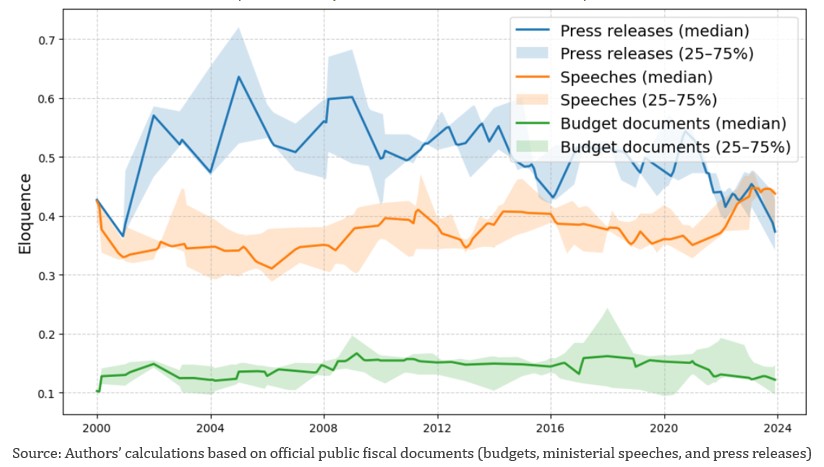
Some differentiation is inevitable. This is audience design. Messages are adapted to what different readers need and have time to absorb. A single technical document for everyone would speak clearly to almost no one. But the important finding is that this division of labor is systematic. The same fiscal package becomes three different objects: an accounting record in the budget document, a political narrative in the speech, and a headline signal in the press release.
This architecture is useful. It allows finance ministries to speak to experts, citizens, and the media in forms each can process. But it also creates risks. The budget speech may be more hopeful than the document. The press release may emphasize benefits while leaving costs in the background. The technical annex may contain trade-offs that never quite enter the public story. The problem is not necessarily deception. More often it is fragmentation, with different parts of the same budget communicating different parts of the truth.
The first distinguishing feature across communication channels concerns clarity. We measure it using a readability score, where lower values indicate easier prose. A score of 8 is broadly accessible to younger readers, while a score of 14 implies college-level difficulty (see Figure 2). Across the G7, ministerial speeches are consistently easier to understand than written fiscal documents. Budget documents remain dense and technical, as one would expect. More surprisingly, press releases are often short without being simple. They compress technical information into brief, sometimes jargon-heavy statements aimed as much at journalists and analysts as at ordinary citizens.
Figure 2. Finance ministers speak more clearly than finance ministries write
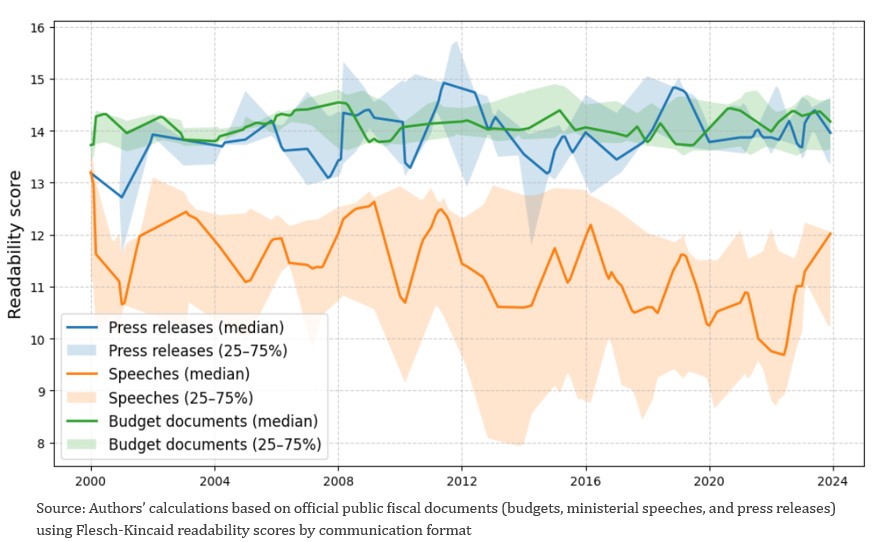
This creates a clarity gap. Citizens who hear only the speech may get the purpose without constraints. Experts who read only the document may see the arithmetic but miss the political framing that shapes public expectations. The issue is not that speeches should resemble annexes, or that budget documents should be read like campaign leaflets. The issue is consistency: different audiences can receive different levels of detail but the underlying fiscal narrative should remain coherent.
A second pattern concerns framing. Fiscal policy is not communicated in neutral language. A tax rise can be framed as burden-sharing, a spending cut as efficiency, borrowing as investment, and consolidation as responsibility. These frames help audience decide whether a policy is fair, necessary, temporary, or avoidable.
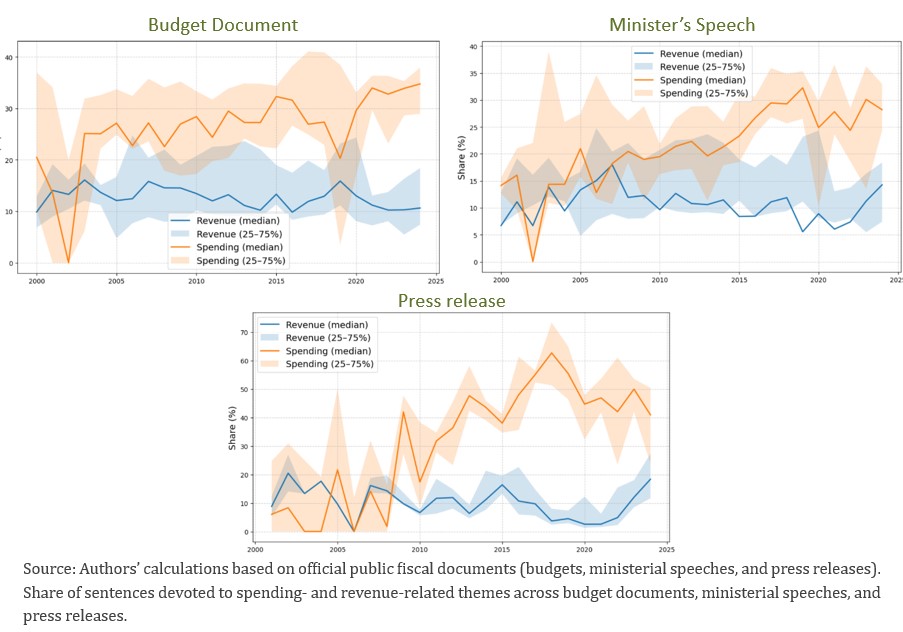
Across the G7, fiscal communication reflects a persistent rhetorical bias toward expansionary, popular measures and away from contractionary, unpopular ones. Finance ministries devote substantial attention to spending initiatives: infrastructure, families, health, climate, security, innovation, and social protection. Revenue receives less prominent treatment, especially in speeches and press releases (see Figure 3). Tax cuts are usually presented clearly and positively. Tax increases are more often described as closing loopholes, improving fairness, strengthening compliance, or financing essential services. Spending cuts appear under gentler labels, such as efficiency, re-prioritization or reform.
This asymmetry is understandable. Budgets are political documents as well as accounting documents. But it matters. Fiscal sustainability depends on the link between promises and financing. A budget debate that speaks fluently about what government will provide but is less explicit about how it will be paid for, gives the public only part of the fiscal picture. The asymmetry is not merely rhetorical. It affects whether citizens can see the link between today’s promises, tomorrow’s taxes, and future debt.
Figure 3. Fiscal communication talks more readily about spending than revenue
Debt communication raises the same issue in a sharper form. Governments must avoid unnecessary alarm. A finance minister who speaks too bluntly about fiscal risk may unsettle markets. Yet excessive reassurance also has a cost. Our evidence suggests that G7 finance ministries often present debt and fiscal sustainability in reassuring terms, even when debt pressures are rising. Cautionary language appears during crises, but it is frequently paired with confidence that adjustment will come later.
This is the fiscal communicator’s dilemma. Too much pessimism can destabilize expectations. Too much optimism can weaken credibility if adjustment is repeatedly promised and repeatedly deferred. The useful middle ground is measured candor: risks, assumptions, contingencies, and trade-offs explained without pretending that every fiscal path is painless. The arithmetic is stubborn. Language can frame it; it cannot repeal it.
These findings should be read for what they are. We do not identify the market or electoral effect of a specific phrase, nor do we treat every cross-country difference as political strategy. Legal traditions, budget procedures, coalition politics, and administrative habits all matter. The contribution is to show that fiscal communication has a structure, and that this structure reveals how governments present the trade-offs between spending, revenue, and debt.
The policy implications follow directly from the evidence. The aim is not to make budgets less technical. Some fiscal information must remain precise, legal, and detailed. The aim is to make the public signal more coherent. Citizens should not have to choose between a speech they can understand and a budget document they cannot. The public version of the budget should contain the same trade-offs as the technical version, only expressed more clearly.
First, governments should publish a short, plain-language fiscal statement alongside the budget. It should explain the main measures, their financing, the distributional choices, and the risks around the baseline. It should not be a promotional brochure. It should be a bridge between the speech and the fiscal tables.
Second, finance ministries should align the three voices of the budget. A claim made in the speech should be traceable to the fiscal tables. A headline in the press release should not obscure the financing assumption reported in the annex. Different formats can have different tones; they should not imply different fiscal realities.
Third, governments should make trade-offs more visible. New spending should be linked to financing choices. Tax reductions should be linked to implications for debt, future spending, or other revenues. Consolidation should explain not only the savings, but also who bears the burden and why the adjustment is necessary.
Fourth, fiscal communication should become more conditional. Rather than presenting a single reassuring path, ministries should explain what happens if growth disappoints, interest rates rise, or spending pressures persist. Acknowledging uncertainty is not a sign of weakness if it is attached to a credible framework. It is often what makes reassurance credible.
Finally, independent fiscal institutions could help assess not only forecasts and compliance with rules, but also the coherence of fiscal narratives. Their role would not be to police language or strip budgets of politics. Budgets are political by nature. The role would be to ensure that public communication does not drift too far from fiscal reality. This would extend fiscal scrutiny from the realism of the baseline to the coherence of the public explanation around it.
The deeper point is simple. Fiscal policy is made of numbers, but it is understood through words. Credible communication does not mean saying less or saying everything in one voice. It means ensuring that what is said to citizens, markets, and the media remains anchored in the same fiscal arithmetic. Budgets do not speak for themselves. Governments speak for them. They should do so clearly enough for citizens, carefully enough for markets, and candidly enough to sustain trust.
Alesina, A and R Perotti (1995), “Fiscal expansions and adjustments in OECD countries”, Economic Policy 10(21): 205–248.
Auerbach, A J (2009), “Implementing the new fiscal policy activism”, American Economic Review: Papers and Proceedings 99(2): 543–549.
Bank of England (2023), “An anatomy of the 2022 gilt market crisis”, Staff Working Paper No. 1019.
Blinder, A S, M Ehrmann, M Fratzscher, J De Haan and D-J Jansen (2008), “Central bank communication and monetary policy: A survey of theory and evidence”, Journal of Economic Literature 46(4): 910–945.
Evdokimova, T and P A Imam (2026), “Decoding Fiscal Messaging: How G7 Finance Ministries Communicate”, IMF Working Paper, March.
Haldane, A G and M McMahon (2018), “Central Bank Communications and the General Public”, AEA Papers and Proceedings 108: 578–583.
Shiller, R J (2017), “Narrative economics”, American Economic Review 107(4): 967–1004.
Woodford, M (2005), “Central bank communication and policy effectiveness”, NBER Working Paper No. 11898.