

This SUERF Policy Brief summarizes Alter, Bersch, Touna Mama, and Quaye (2026), IMF Working Paper WP/26/58. The views expressed are those of the authors and do not necessarily represent those of the International Monetary Fund, its Executive Board, or IMF management.
Abstract
What is the relationship between central bank independence (CBI) and local-currency sovereign borrowing costs? This paper examines this question using a panel of up to 137 emerging market and developing economies over 2000–2024. In the 40 countries with local-currency yield data, We find robust evidence that a 0.1-point increase in de jure CBI is associated with a 0.6–0.7 percentage-point decline in five-year yields in normal times (2010–2020). The credibility premium compresses both the near-term risk premium and the long-horizon term premium. It is amplified under inflation-targeting frameworks, and is largest in Sub-Saharan Africa. The premium vanishes in global crises, when common shocks dominate institutional differences. Domestic fundamentals explain more cross-country yield variation than global factors, particularly in Sub-Saharan Africa. The results imply that credible CBI reform is not only a monetary policy imperative but also a strategy for reducing borrowing costs and deepening domestic bond markets.
The institutional case for central bank independence (CBI) rests on a simple logic. Without a credible commitment to price stability, governments have persistent incentives to generate short-lived output gains through surprise inflation — a strategy rational investors anticipate, delivering higher inflation without lasting growth benefits (Kydland and Prescott, 1977; Barro and Gordon, 1983). An independent central bank resolves this time-inconsistency problem, and the empirical literature since Cukierman, Webb, and Neyapti (1992) and Alesina and Summers (1993) has documented a robust link between de jure CBI and lower, less volatile inflation across advanced and emerging market economies.
Price stability, however, is only one dimension of credibility. A government financing itself in local currency depends on investors’ confidence that monetary policy will remain disciplined even under fiscal pressure. Legal provisions that insulate the central bank — limits on direct government lending, secure governor tenure, clear price-stability mandate — act as a fiscal firewall. If markets price this credibility, stronger CBI should reduce sovereign borrowing costs directly, by compressing the inflation-risk and default-risk compensation embedded in local-currency bond yields. Whether this “credibility premium” is measurable and economically meaningful in the local-currency debt markets of emerging market and developing economies (EMDEs) is the question we address — and one of particular relevance for Sub-Saharan Africa (SSA), where building deep domestic bond markets is a precondition for durable fiscal resilience.
Our analysis draws on a panel of up to 40 EMDEs over 2000–2024, combining five-year local-currency sovereign yields with de jure CBI indices from Garriga (2025) and Romelli (2024). We give preference to the Garriga index for its theoretically motivated weighting: half of the score reflects statutory constraints on central-bank lending to government—the mechanism most directly relevant to fiscal dominance. Country and year fixed effects control for unobserved heterogeneity throughout. We decompose sovereign yields into three components following term-structure theory (Campbell and Shiller, 1991): the expected path of future policy rates, a near-term sovereign risk premium, and a long-horizon term premium. Panel Granger-causality tests address the direction of the CBI–yield relationship, and a dominance decomposition partition explained yield variance between domestic fundamentals and global factors.
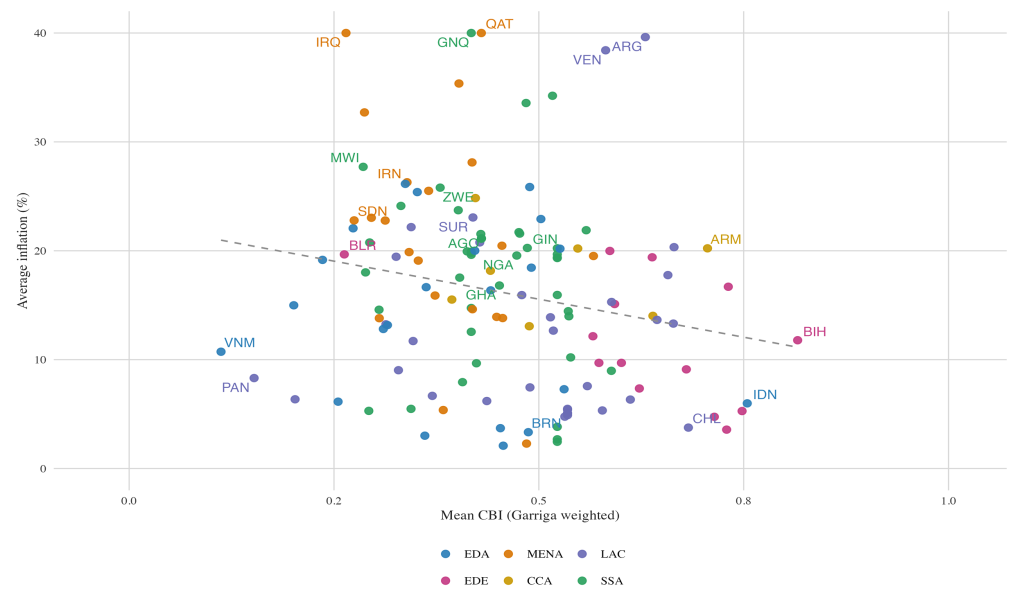
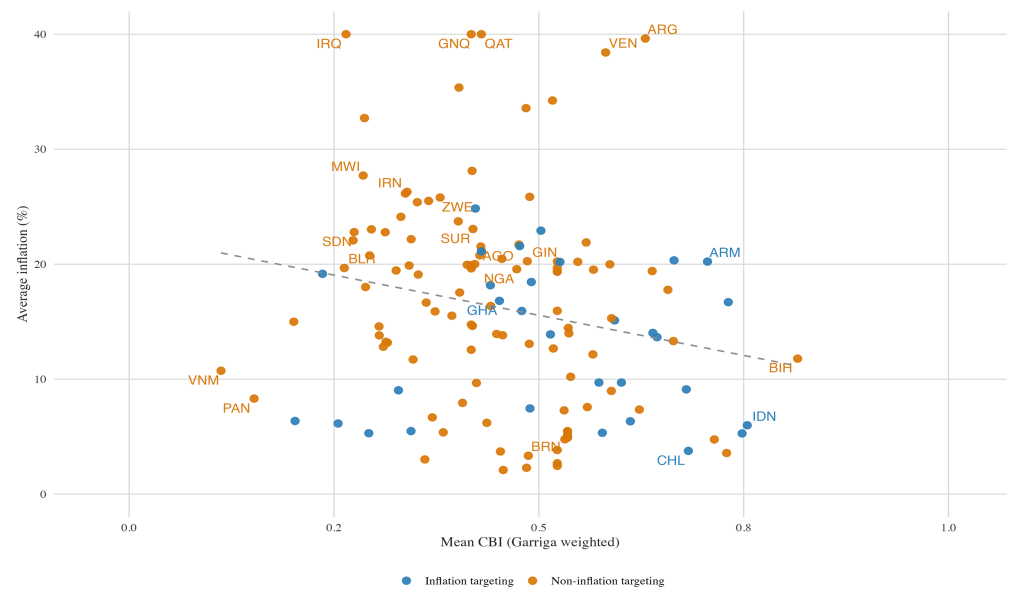
A first look at the cross-section confirms the foundational CBI–inflation relationship across EMDEs. Countries with stronger de jure CBI exhibit systematically lower average inflation, and this pattern holds after partitioning the sample by region and by monetary-policy framework. Figure 1(a) shows the relationship by region, while Figure 1(b) distinguishes inflation-targeting (IT) from non-IT economies. Two features stand out. First, the negative slope is visible in every region, but it is steepest and most concentrated in Sub-Saharan Africa and the Middle East and North Africa—regions where high-inflation legacies make the value of institutional credibility particularly salient. Second, inflation-targeting countries cluster in the low-inflation, higher-CBI quadrant, consistent with the idea that rule-based frameworks reinforce, rather than substitute for, the credibility embedded in independence statutes.
Figure 1. Central Bank Independence and Inflation in EMDEs, 2000–2024
(a) By region
(b) By monetary-policy framework
Note: Each dot is a country-level average over 2000–2024 of annual CPI inflation (capped at 40 percent for visibility) against the Garriga (2025) weighted CBI index. EDA = Emerging and Developing Asia; EDE = Emerging and Developing Europe; LAC = Latin America and Caribbean; MENA = Middle East and North Africa; CCA = Caucasus and Central Asia; SSA = Sub-Saharan Africa. Dashed line: linear fit. Source: Authors’ calculations based on Garriga (2025) and IMF WEO.
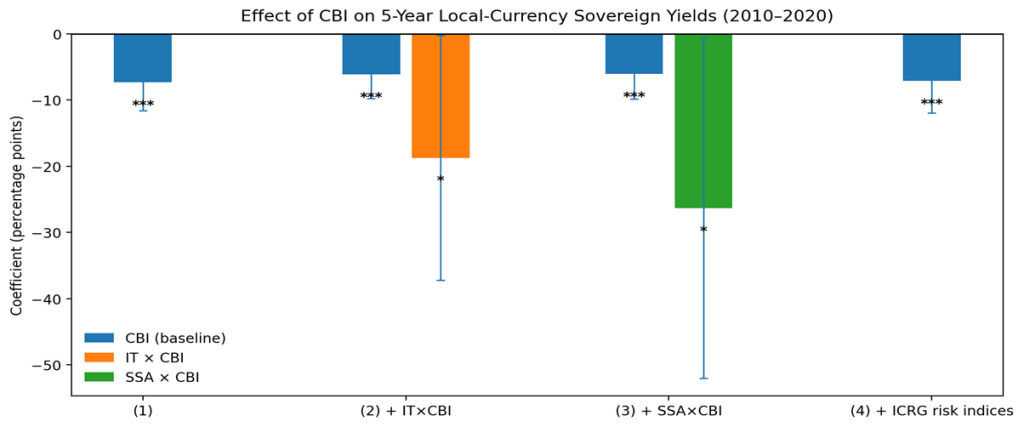
Moving from inflation to yields, we find that the same institutional feature that anchors prices also lowers borrowing costs. In normal times (2010–2020), a 0.1-point increase in de jure CBI is associated with a 0.6–0.7 percentage-point reduction in five-year local-currency sovereign yields (Figure 2, panel a). This result is robust across alternative independence indices and to the inclusion of country risk controls.
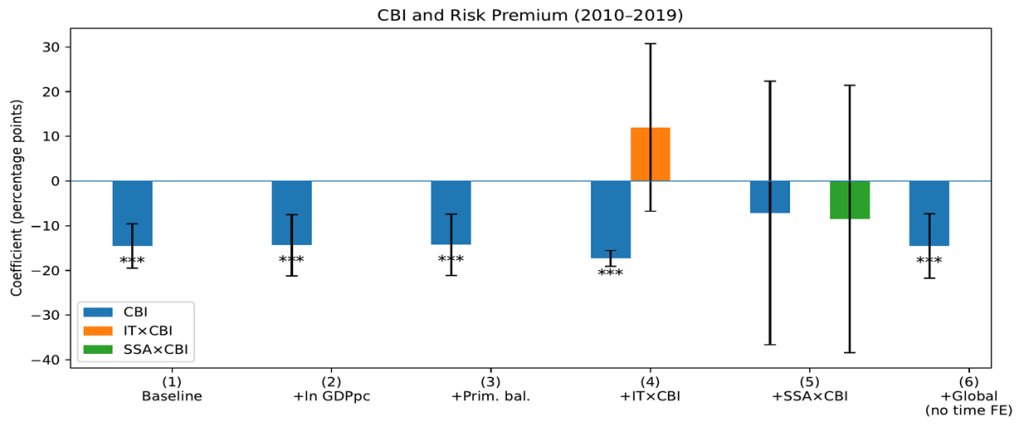
Yield decomposition reveals that the effect runs through two important channels. Figure 2, panel (b), shows that a 0.1-point increase in CBI lowers the near-term sovereign risk premium by about 1.4–1.7 percentage points: investors demand less compensation for the risk that fiscal stress will translate into monetization or default. Figure 2, panel (c), shows a separate but reinforcing effect on the long-horizon term premium of about 0.6–0.7 percentage points per 0.1-point increase, reflecting lower long-run inflation uncertainty. Importantly, the credibility premium is heterogeneous: it is substantially amplified under inflation-targeting regimes and in Sub-Saharan Africa, where the incremental effect on yields reaches 2.6 percentage points per 0.1-point increase in CBI—reflecting the disproportionate value of credibility signals where institutional track records are thinner.
Two further findings shape the policy implications. First, the credibility premium is state-contingent. When the sample is extended to include the Global Financial Crisis and the COVID-19 shock, the estimated coefficient attenuates substantially and loses statistical significance. When global risk repricing dominates, cross-country differences in domestic institutional quality are overwhelmed by synchronized external forces. While credibility pays in normal times, it does not insulate small open economies from systemic global shocks.
Second, a dominance decomposition of explained yield variance finds that domestic variables — CBI, fiscal rules, debt-to-GDP, current-account and primary balances — account for a larger share of cross-country yield variation than global factors (VIX, US rates, commodity prices). This primacy of domestic drivers is most pronounced in Sub-Saharan Africa, reinforcing the conclusion that institutional reform at home remains the principal lever for lowering domestic borrowing costs — even in a financially integrated world.
The findings carry important implications for monetary-framework design and local-currency debt-market development. First, CBI has measurable fiscal value. Statutory reforms that credibly limit fiscal dominance — through lending restrictions, secure governor tenure, and a clear price-stability mandate — lower sovereign borrowing costs in local currency. Strengthening the legal architecture of independence is therefore both a monetary and a fiscal strategy.
Second, an inflation-targeting framework amplifies the dividend. Markets price CBI most sharply within a rule-based framework: combining strong de jure independence with an established IT regime delivers a credibility premium substantially larger than either element alone. Emerging markets that are considering a move to IT should view formal adoption not as an alternative to strengthening the independence statute, but as a complement to it.
Third, Sub-Saharan Africa stands to gain most. Precisely where institutional credibility has been thinnest, markets reward improvements most generously. Credible CBI reform could reduce domestic financing costs, lengthen the maturity of local-currency issuance, and help close the currency-mismatch vulnerability that drives sudden-stop risk (see also Athanasopoulos et al., 2025).
Finally, CBI is not a crisis shield. The attenuation of the premium during global stress underscores that institutional reform cannot substitute for complementary resilience: FX reserves, credible fiscal frameworks, deeper and more liquid domestic bond markets, and improved risk-sharing capacity remain essential complements to independence.
Figure 2. Decomposing the Credibility Premium: Yields, Risk Premium, and Term Premium
(a) Five-year local-currency sovereign yields
(b) Near-term sovereign risk premium
(c) Long-horizon term premium
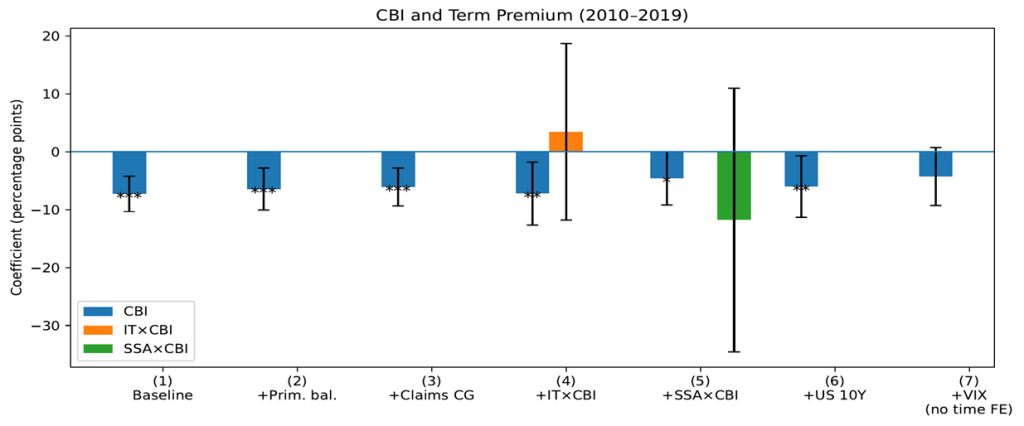
Note: Bars report estimated coefficients on the Garriga (2025) weighted CBI index (scaled 0–1) in panel fixed-effects regressions of five-year local-currency sovereign yields and their decomposed components, 2010–2020 (panel a) and 2010–2019 (panels b and c). All specifications include country and year fixed effects. Specification (4) adds an IT×CBI interaction; specification (5) adds an SSA×CBI interaction. Whiskers show 95% confidence intervals with standard errors clustered at the country level. Significance: *** p<0.01, ** p<0.05, * p<0.1. Source: Alter, Bersch, Touna Mama, and Quaye (2026).
Debt markets price institutional credibility. In normal times, a more independent central bank — one whose legal framework credibly limits government influence over monetary policy — commands lower sovereign borrowing costs in local currency. This paper provides systematic evidence for that proposition across a broad EMDE panel, identifies the specific pricing channels (risk premium and term premium compression), and shows that the credibility dividend is largest precisely where it is most needed: in Sub-Saharan Africa and under inflation-targeting regimes. For policymakers, the message is clear: safeguarding central bank independence is simultaneously a monetary-policy imperative and a pillar of a durable domestic financing strategy.
Alesina, A. and L.H. Summers (1993). “Central Bank Independence and Macroeconomic Performance: Some Comparative Evidence.” Journal of Money, Credit and Banking, 25(2), 151–162.
Alter, A., J. Bersch, A. Touna Mama, and B. Quaye (2026). “The Credibility Premium: Central Bank Independence and Local-Currency Sovereign Yields.” IMF Working Paper WP/26/58.
Athanasopoulos, A., N. Fraccaroli, A. Kern, and D. Romelli (2025). “Central Bank Independence and Sovereign Borrowing.” World Bank Policy Research Working Paper.
Barro, R.J. and D.B. Gordon (1983). “Rules, Discretion and Reputation in a Model of Monetary Policy.” Journal of Monetary Economics, 12(1), 101–121.
Bolhuis, M.A., R.C. Mano, and H. Thorell (2026). “Consequences of Undermining Central Bank Independence: Evidence from Governor Transitions.” IMF Working Paper 2026/040.
Campbell, J.Y. and R.J. Shiller (1991). “Yield Spreads and Interest Rate Movements: A Bird’s Eye View.” Review of Economic Studies, 58(3), 495–514.
Cukierman, A., S.B. Webb, and B. Neyapti (1992). “Measuring the Independence of Central Banks and Its Effect on Policy Outcomes.” World Bank Economic Review, 6(3), 353–398.
Garriga, A.C. (2025). “Revisiting Central Bank Independence in the World: An Extended Dataset.” International Studies Quarterly, 69, sqaf024.
Garriga, A.C. and C.M. Rodriguez (2023). “Central Bank Independence and Inflation Volatility in Developing Countries.” Economic Analysis and Policy, 78, 1320–1341.
Kydland, F.E. and E.C. Prescott (1977). “Rules Rather than Discretion: The Inconsistency of Optimal Plans.” Journal of Political Economy, 85(3), 473–491.
Rogoff, K. (1985). “The Optimal Degree of Commitment to an Intermediate Monetary Target.” Quarterly Journal of Economics, 100(4), 1169–1189.
Romelli, D. (2024). “Trends in Central Bank Independence: A De-Jure Perspective.” BAFFI CAREFIN Centre Research Paper.