

This policy brief is based on The Editorial – The consumer confidence conundrum first published on 21 June 2026. The views expressed are those of the author and not necessarily those of the institutions the author are affiliated with.
Abstract
Consumer confidence has historically occupied a central place in macro analysis. Across both the United States and Europe, sentiment surveys have been widely used as leading indicators of household demand, cyclical turning points and recession risks. Yet, since the COVID-19 pandemic, the relationship between consumer confidence and actual economic activity has become significantly less stable. This raises a fundamental question for macro investors: how much of a signifier is consumer confidence, and how should sentiment indicators be interpreted in today’s macro regime? In particular, we argue in this piece that consumer confidence indicators remain useful, but their informational content has changed materially.
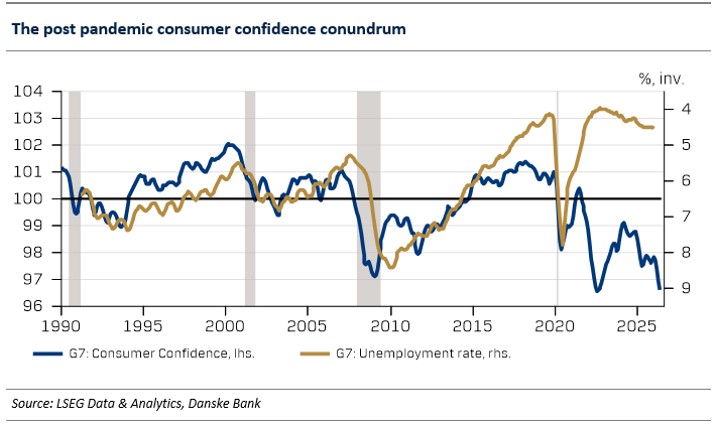
By several measures, key regions right now are recording levels of consumer confidence that historically have been associated with recession, or at best business cycle trough levels, and yet general economic indicators and financial market pricing widely agree on being close to the business cycle peak! This has opened up a reality gap between how consumers and households ‘feel’ and how they ‘behave’. As this gap has been lingering for some time, we feel it is time to examine the consumer confidence conundrum.
Figure 1.
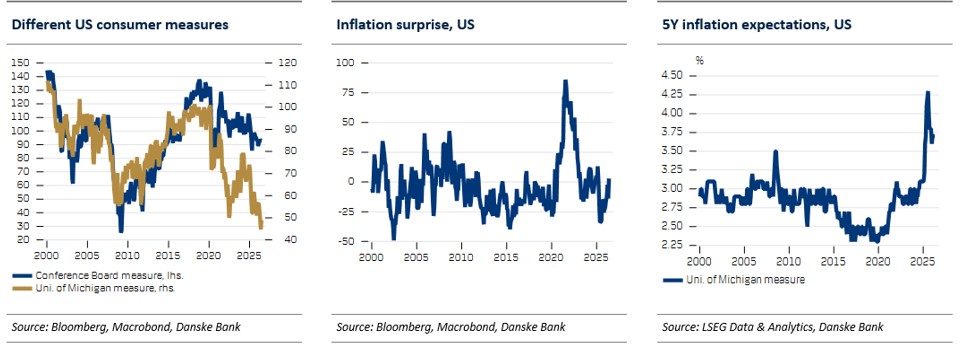
Gauging what consumer confidence is, and how to measure it, is no trivial matter. To some degree you can compare it to the discussion about inflation, in the sense that there are many ways to measure it and none is outright wrong. Different indicators provide different and interesting insights, yet the common denominator to all is that this is about how people ‘feel’, and thus points to their intentions, and not how they ‘act’ and ‘react’. The most straightforward comparison is between the US Conference Board and the University of Michigan survey. The former puts more emphasis on the labour market, while the latter emphasises inflation. At critical points in time, they thus send different signals. Take the example of inflation. It’s clear that once we see significant negative inflation news, it impacts Michigan more than the Conference Board.
Simplistically, the key determinants for consumer confidence have historically been households’ perception of their real purchasing power (thereby inflation), job security, and the broader economic outlook. Theoretically, that means consumer confidence should rise when wage growth is solid, inflation is low or falling, and when labour markets are strong, and vice versa. However, most recently, academic studies show that inflation, as well as (social) media, has moved to become the key determinant. Housing wealth, equity market performance and interest rates can also matter, as they shape how secure households feel about their balance sheets and future spending capacity, but they drive the consumer confidence less than before.
Figure 2.
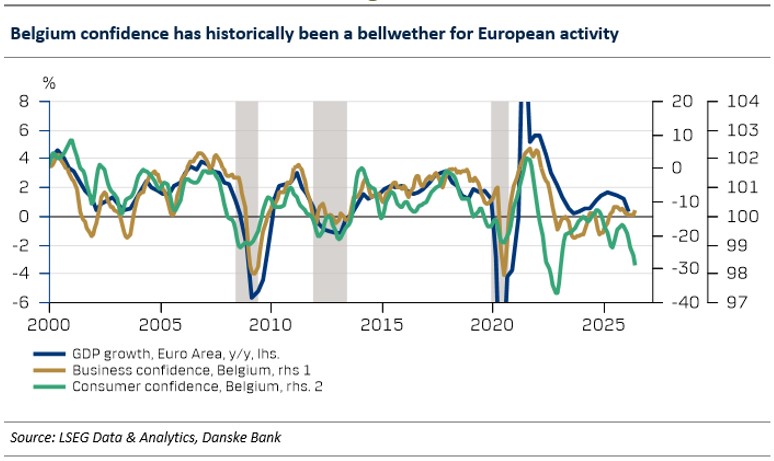
Before digging deeper into the details, we need to highlight an important difference between the US and the European consumer and its links to activity. Historically, pre-pandemic, US consumer confidence had been a much better indicator of US activity than, for comparison, European consumer confidence vs. European activity, simply because the US economy is significantly more consumption-driven than Europe. Private consumption accounts for roughly 70% of US GDP, compared with about 53% across the euro area. Unsurprisingly, this creates a tighter link between US household sentiment and aggregate US growth. That said, the euro area is heterogeneous, with Ireland and Greece at each end of the private consumption spectrum (Ireland at 27% and Greece at 75% of GDP). The big four countries are all between 50 and 60% though.
Interestingly, when looking for the ‘average’ euro area country, Belgium has historically been a useful proxy. Both Belgian business confidence and Belgian consumer confidence have shown a strong and relatively tight relationship with euro area GDP growth, making Belgium a practical bellwether for broader European activity.
Figure 3.
The most important development regarding consumer confidence in recent years has been the weakening relationship between sentiment and spending following the pandemic. After the collapse in consumer confidence in 2020, and again during the inflation surge in 2022, we should not only have seen a collapse in activity but also an eventual rebound in confidence, as hard data has held up very well, but neither of that happened. The divergence between ‘feel’ and ‘action’ has been especially notable in the US. In fact, a simple regression model between US consumer confidence (neither Conference Board nor Michigan) since the pandemic is not statistically significant to predict or explain current retail sales; though, slightly surprising when taking into account the structural difference, it is still relevant for the euro area, albeit the link has weakened markedly towards retail sales.
Figure 4.
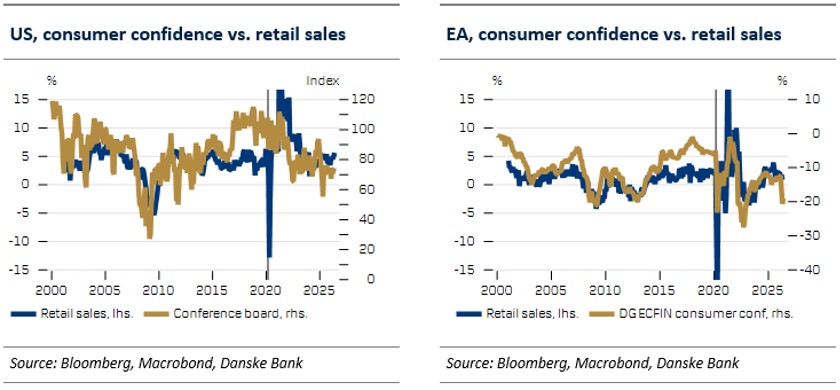
For the US, this means that despite consistently reported weak consumer confidence amid high inflation, elevated interest rates, and concerns about economic prospects, consumption remained surprisingly strong relative to what the confidence indicators suggested. Certainly, part of the story of the US consumer acting pro cyclically and aggressively is that they drew down excess savings, but the aggressive nature of the US consumer is still clear.
The same phenomenon emerged in Europe, albeit slightly later following the energy and subsequent inflation surge in 2022 after Russia’s full-scale invasion of Ukraine. Consumer confidence fell to exceptionally depressed levels, reflecting concerns over inflation, real income erosion and energy security. However, the economy proved significantly more resilient than most had expected, with actual consumption staying far more robust than the survey data implied. This suggests that euro area sentiment surveys are increasingly capturing household anxiety rather than actual spending intentions.
And while we are indirectly circling around inflation as a cause for low consumer confidence, we highlight that academic research is rather unanimous in its conclusion: services/goods that see frequent price updates impact the inflation perception more than services/goods with less frequent price updates, which in turn drives consumer confidence.
As part of our model framework, consumer confidence remains an important input. At the same time, we are fully aware that consumer confidence dynamics have changed and hence the modality relationship should be treated carefully and adjusted accordingly.
Thus, when examining consumer confidence, which remains deeply depressed by historical standards, the first order derivative has turned positive and this is where things become very interesting. Our data framework shows that the strongest forward returns in risk assets have historically occurred not when consumer confidence is high, but when confidence is extremely weak and starts to improve at the margin. That is where we are now.
Figure 5.
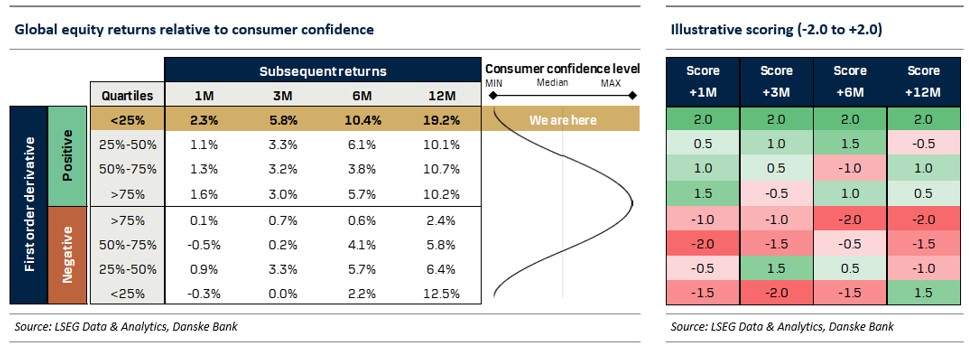
As a consequence of the lower consumer confidence and the still solid-to-strong activity (subject to region), the reality gap has widened markedly between perceived and realised consumer conditions. Had we used the regression models, with their fit and estimates until 2019, retail sales in Europe should print around -1.5% y/y while the US should be around 0.8% y/y. In fact, the most recent data shows that retail sales in the euro area were 0.9% (April data), while it was 5.6% in the US (May data).
This means that while we still use soft data as an integral part of our framework, it is the outcome of the hard data that ultimately matters for economic activity and thus financial market returns. At the current juncture, we put more emphasis on e.g. retail sales than consumer confidence, for the reasons mentioned above, when doing our recommended asset allocation.
This divergence also raises a broader question of what exactly consumer confidence measures today.
Increasingly, confidence surveys are no longer just the traditional economic variables discussed above, but also reflect social/traditional media-driven anxiety and elevated uncertainty as much as actual economic stress. As such, it’s not a new phenomenon. As early as 2014, ECB researchers found that ‘Changes in the sentiment of Dutch public social media messages were compared with changes in monthly consumer confidence over a period of three-and-a-half years, revealing that both were highly correlated (up to r = 0.9) and that both series cointegrated’.
When discussing consumer confidence, we have to highlight that sentiment has become highly sensitive to headlines – political noise with social media amplification. To give a practical example, when the Iran war started in February, the world was flooded with alarmist narratives in the media around surging oil prices, fertiliser costs and inflation shocks, and whether global growth could ‘survive’ without the Strait of Hormuz. The message was clear: the consumer was under pressure. Now, four months later, that narrative has been undone, with oil essentially at pre-war levels and fertiliser prices below pre-Iran war levels; yet, the consumer may still feel the pressure of weak consumer confidence, despite the economic implications appearing manageable. The positive stories are rarely visible in the media.
We are naturally fully aware that you get more attention when you write something is ‘wrong’, or ‘collapsing’, than you would if heralding ‘steady progress’, or ‘it will be ok’, but as the former is driving consumer confidence more, the asymmetry makes it less reliable as a gauge for economic activity.
The shift in consumer confidence has left us with a conundrum. It is not that we argue it has become irrelevant, but rather it can no longer be read in isolation, and it reflects a different aspect than traditionally. The post-COVID period has changed the informational content of confidence surveys: they still tell us something important about household anxiety, inflation perceptions and the political economy of the cycle, but they have become a weaker guide to actual spending behaviour and near-term market direction. In both the US and the euro area, the reality gap has widened: consumers feel recessionary, while hard data continues to look far more resilient.
This is also visible in financial markets. Pre-pandemic, the stock-to-bond ratio and consumer confidence moved with a strong degree of consistency, with stronger confidence coinciding with stronger equity performances. That relationship has broken down since COVID-19, alongside consumer confidence’s reliability as a predictor. As readers are well aware, equities have repeatedly outperformed bonds in recent years, despite depressed consumer confidence.
Figure 6.
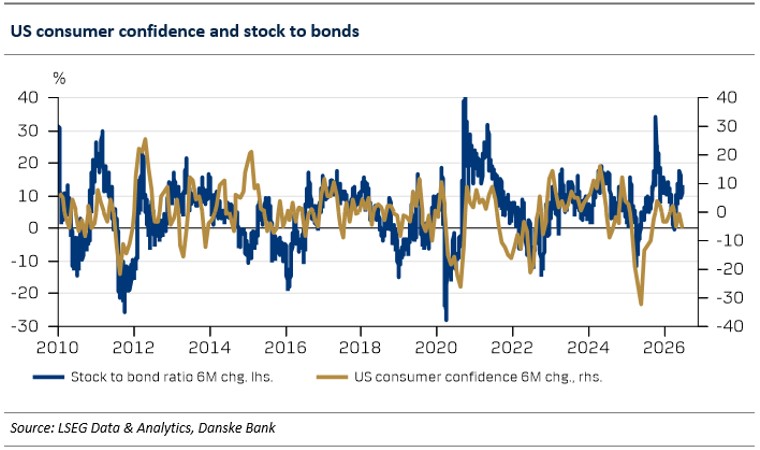
For investors, the key implication is that low confidence should not automatically be treated as a recession signal or a reason to underweight risk, but rather that it may serve as an amplifier of shocks. For now, the level of confidence remains weak, but the direction is improving, and historically that has mattered more for forward returns than the absolute level. However, as argued above, we need to treat this with caution given the limited explanatory power today.
The risk case is that confidence remains depressed because labour markets may weaken or real incomes roll over. But our base case is more constructive: the post-pandemic reality gap narrows from below, confidence improves gradually, and risk assets can continue to be supported as long as hard data validates the recovery narrative. Once inflation risk and expectations fades, with still tight labour markets, the reality gap should close from below.