

This policy brief is based on BIS Working Papers No 1288. The views expressed are those of the author and not necessarily those of the institutions the author is affiliated with.
Abstract
Can a central bank tighten monetary policy, and real interest rates fall? Introducing endogenous capital into the New Keynesian model allows real interest rates to move in any direction on the impact of a positive persistent monetary policy shock. This raises concerns that the real interest rate channel is only observational — not structural — in these models. I find that the puzzle goes beyond capital. It emerges when the elasticity of an endogenous state variable to a persistent shock is high enough to sink inflation expectations, inducing the endogenous component of the monetary policy rule to sufficiently offset its exogenous one. The channel is structural, but short-run definitions of the natural interest rate (r-star) and real interest rate gap can be misleading, particularly following events that significantly disrupt investment, such as pandemics, financial crises or trade wars. I propose a more robust alternative that also improves inflation forecasting.
In recent decades, central banks have relied on the real interest rate gap (RIRG) as a key indicator of monetary policy stance and effectiveness. This gap compares the actual real interest rate to an estimated “natural” rate — one that would prevail in an economy free of nominal rigidities. The difference is interpreted as the degree of policy tightness or looseness. The interpretation comes from the widely used New Keynesian framework in which monetary policy is thought to operate primarily through the real interest rate channel, that is, when the central bank raises the nominal policy rate, and prices are sticky, real interest rates rise, dampening consumption and investment, and ultimately lowering inflation. This mechanism is central to contemporary monetary policy analysis, communication, and forecasting.
However, Rupert and Šustek (2019) have highlighted an inconsistency that challenges this conventional wisdom. When persistent monetary tightening occurs in an environment where investment is highly sensitive, the real interest rate may actually fall on the impact, even as the central bank adopts a contractionary stance. This phenomenon — which I call the “capital puzzle” — is mostly likely to be observed during periods of economic disruption, such as recessions, financial crises, or pandemics, when investment collapses and the transmission mechanism of monetary policy becomes blurred.
The puzzle raises critical questions for policymakers, financial-sector practitioners, and academics alike:
This note synthesises the findings of my recent research, Amaral (2025, 2024),1 on why the puzzle exists and proposes practical solutions for it.
In traditional New Keynesian models (e.g., Galí (2015), Woodford (2003)), monetary policy affects the economy primarily via the real interest rate channel. When the central bank increases the policy rate (a positive shock ∈
m
t
to it), real interest rates (rt) rise, making borrowing more expensive. Households reduce spending (ct), output (yt) falls, and inflation (πt) declines. This sequence underpins much of modern monetary policy analysis and is widely accepted across central banks and financial markets.

Nonetheless, this transmission mechanism becomes foggy when models are extended to include endogenous capital — where investment and capital accumulation are allowed to respond dynamically to shocks. In such models, a persistent monetary policy shock (an unexpected sequence of policy rate hikes), whose persistence is governed by, say, a parameter ρm, can cause investment, and aggregate demand, to collapse. In turn, this collapse can lower real interest rates, even as the central bank is tightening the monetary policy stance (Figure 1). Since the policy rate does not affect real variables in a counterfactual without nominal rigidities, in this exercise the impulse response function for r̂t is the same as the one for the real interest rate gap,r̂
Gap
t
, where hat-variables are deviations from the non-stochastic steady state. Thus, we observe a negative gap while the central bank tightens policy — how is this possible?
Figure 1. Impulse response function to a positive monetary policy shock in a canonical
New Keynesian model augmented with endogenous capital
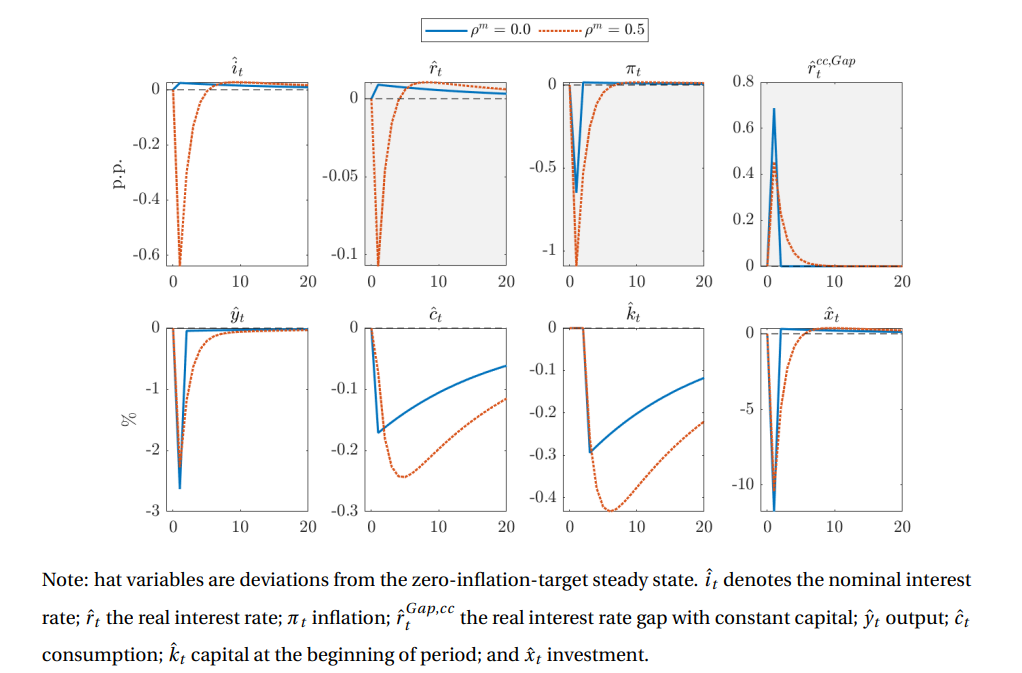
From a mechanical perspective, given a monetary policy rule composed of an endogenous and an exogenous component, for an exogenous positive monetary policy shock to reduce the real interest rate on the impact, it must induce a contemporaneous negative endogenous response in the policy rule that is numerically larger than the sum of the shock and the expected disinflation.

In the canonical model, which has no endogenous state variables, this is never the case because the sign of the coefficient which disciplines the reaction of r̂t is the same as the one for the real interest rate gap,r̂
Gap
t
to the shock is not restricted by the trajectory of any endogenous state variable. In this case, the cross-equation restrictions of the 3-equation New Keynesian model are enough to guarantee the observational equivalence with the real interest rate channel. This changes once we add an endogenous state variable, say capital, to the model. In this case, the trajectory of the state variable can reverse the sign of the coefficient. Thus, the explanation for the puzzle resides on two elements: (1) the policy rule specification and (2) the amplification/reversal effect of endogenous state variables.
Considering that all happens is general equilibrium, but any model needs a story to tell, I propose then the following explanation for the New Keynesian capital puzzle: a monetary tightening in the form of a shock to the Taylor rule increases the short-term nominal interest rate (policy rule), causing an increase in the real interest rate when nominal prices move sluggishly (Fisher equation). This rise in the real interest rate causes households to cut back on their spending (IS). Given the lower expected demand, if investment sinks too much, households cut consumption even further (IS with capital). The large decline in output puts significant downward pressure on inflation (Phillips Curve), amplifying the negative endogenous response of the policy rule. This results in the nominal interest rate reversing its sign and dropping when the negative endogenous response of the policy rule is numerically larger than the original exogenous positive monetary policy shock, ultimately causing a drop in the real interest rate because, after all, prices are sticky. Then, onward, this flow continues with shrinking and oscillating amplitude until convergence to the in-period equilibrium, as induced by monetary dominance.

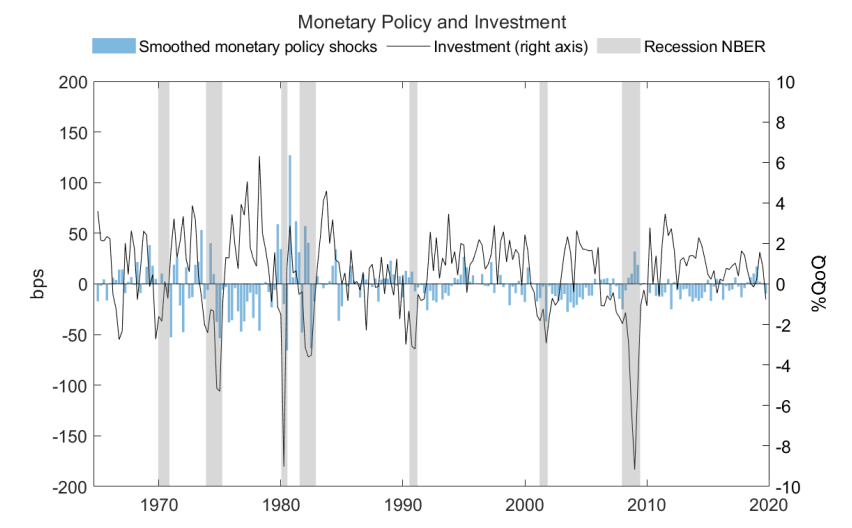
So, how relevant is the capital puzzle? Historical data for the United States illustrate that investment slumps are not uncommon during recessions and crises (Figure 2). In major episodes such as the early 1980s recession, the Global Financial Crisis of 2008, and the Covid-19 pandemic, investment dropped sharply, sometimes by more than 8% QoQ SAAR in a single quarter. Notably, some of these periods coincided with contractionary monetary policy shocks as recovered from medium-scale models of the like used by central banks — e.g., Smets and Wouters (2003, 2007, 2024) — further complicating the interpretation of the policy stance. These shocks are not necessarily intended by the monetary authority. They may represent a misinterpretation of the conjuncture and its expected developments by the board, resulting in a delay in cutting rates at the pace expected by the agents. But it also may represent more fundamental real-world restrictions that are not present in the model, like the effective lower bound of the policy rate, which limit the capacity of a central bank of easing or tightening monetary policy.
Figure 2. Estimated monetary policy shocks from Smets and Wouters (2024) and observed investment in the United States from 1965Q1 to 2019Q4
The capital puzzle has, therefore, important consequences:
To address the shortcomings of the traditional RIRG, Amaral (2025) proposes a new measure: the “state-invariant” real interest rate gap. This approach involves building a satellite model identical to the original, except that state variables are kept fixed. The state-invariant gap is calculated by subjecting the satellite economy to the same sequence of shocks as the original one. Then, the state-invariant RIRG is calculated by comparing the real interest rate in the satellite economy to a counterfactual of that same economy but free of nominal rigidities. This definition aligns short-run estimates of the neutral rate (e.g., from DSGE models) more closely with medium-run estimates (e.g., Laubach and Williams (2003)) as it allows a clear separation between what is the pure effect of the shock (state-invariant effect) and what is caused by the internal dynamics of the state variables (state-variant effect).
Amaral (2025) shows that the state-invariant effect will always have the sign consistent with the New Keynesian theory, that is, a contractionary monetary policy shock always raises r̂
Gap
t
. How does the state-invariant RIRG work?
• Isolates policy effects: By controlling for the impact of shocks on capital and, possibly, other endogenous state variables, the state-invariant RIRG provides a clearer signal of the monetary policy stance.
• Sign consistency: The measure always reflects the intended direction of a monetary policy shock — tightening contributes for a positive gap, loosening for a negative gap — even in the face of large investment changes.
• Empirical validation: Analysis of US data from 1965 to 2023 shows that the state-invariant RIRG is often a better predictor of future inflation and a more reliable guide to policy stance than conventional measures.
By simulating Smets and Wouters (2024)’s model with US data from 1965Q1 to 2019Q4 and forecasting 1-year-ahead annual inflation using the different definitions of RIRGs, the state-invariant gap generates lower root mean square errors than the traditional state-variant one and also the state-consistent RIRG,r̂
Gap,cons
t
.2 Moreover, when additional RIRGs are added to the regression specification, only the state-invariant is significant, and the state-variant’s coefficient turns positive (the opposite sign to the one predicted by theory). Using different measures of RIRGs and also r̂t on the regression improves the forecast most of the times.3
As we have seen, fixing endogenous state variables solves the identification problem related to the capital puzzle. Alternatively, if the intention is just to mitigate it, it is necessary to downplay the state-variant effect in the RIRG.
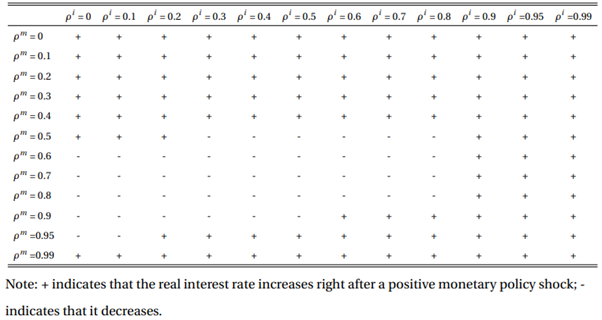
One way of doing this is by smoothing the policy reaction function so as to also smooth the dynamic effects of monetary policy shocks. This is standard practice in central banking. Central banks rarely adjust policy rates in large, abrupt steps. Instead, they typically “smooth” interest rate changes, responding gradually to new information and economic conditions. This practice is motivated by a desire to guarantee some predictability to the agents, avoid financial instability, and exercising caution regarding uncertainty about future events as well as the transmission effectiveness of monetary policy (Amaral et al., 2025). Table 2 shows how increasing the smoothing parameter of the policy rule (ρi )tends to reduce the likelihood of the capital puzzle in the Smets and Wouters (2007)’s model when investment adjustment costs (κi )
are quite low (capital more volatile).4 The positive on-impact relationship between monetary tightening and real interest rates holds across a wide range of realistic parameter values,5 providing reassurance to policymakers and modelers.
Table 1. Smets and Wouters (2007)’s parameters sweep with = 0.005
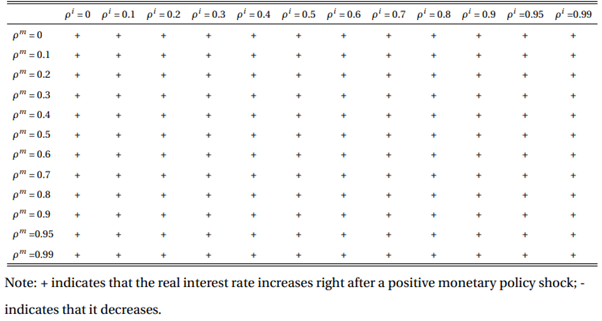
Another way of mitigating the capital puzzle is by having sizable adjustment costs attached to the endogenous state variables of the model. Table 2 shows the effect of doubling investment adjustment costs starting from the set-up of Table 1, but still at much lower levels than those estimated with historical data (e.g., 5.4882 in Smets and Wouters (2007)). Notice that the capital puzzle disappears, exemplifying why the impulse response functions of estimated medium-scale DSGE models do not exhibit the puzzle. However, these models usually have fixed parameters and are estimated in relatively long samples, what leads them to average out temporary parameter instabilities. It should be expected that estimating investment adjustment costs in samples marked by economic crises would lead to lower values than estimating them in a period of macroeconomic stability.
Table 2. Smets and Wouters (2007)’s parameters sweep with = 0.01
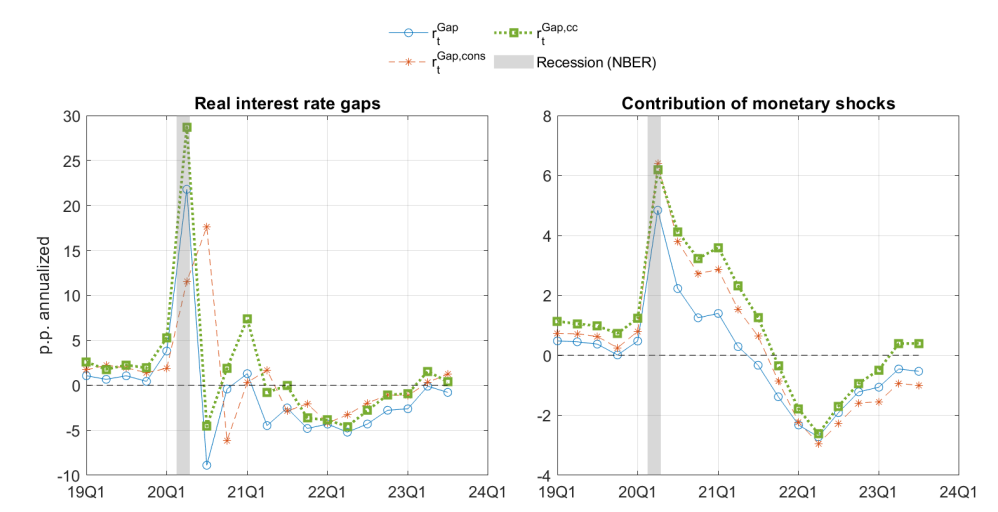
It is possible to discern the rough trends of recent U.S. monetary policy history by tracking the evolution of estimated RIRGs derived from medium-scale DSGE models. Although fitting a long span of data into a single model presents challenges — likely missing key features relevant to specific sub-periods — retrieving RIRGs from Smets and Wouters (2024) provides a narrative similar to the one constructed in greater detail using a broader range of sources (Figures 3 and 4). All RIRG definitions exhibit similar trends, but the state-invariant gap appears to provide stronger signals, particularly during turning points in the economy.
Figure 3. Historical real interest rate gap in the United States from 1965Q1 to 2019Q4
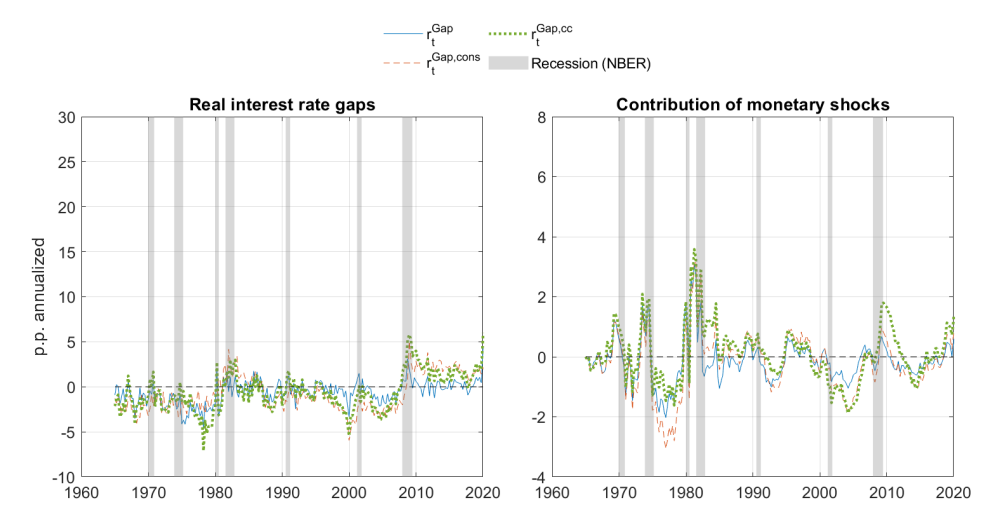
Great Inflation (1960s – 1970s): The RIRGs reveals a consistently loose monetary policy stance, especially in the second half of the 1970s, contributing to high and volatile inflation.
Volcker Disinflation (1979 – ~1985): The abrupt tightening under Chairman Paul Volcker is reflected in the sudden reverse of the RIRGs, marking a decisive shift in monetary policy.
Great Moderation (~1985 – 2007): The RIRGs show a prolonged period of moderate looseness, coinciding with stable inflation and growth rates, and a clearer loosing contribution from monetary policy in the 2000s.
Post-Global Financial Crisis (2008–2019): The RIRGs capture the involuntary tightening caused by the effective lower bound on policy rates and the preponderance of negative natural interest rates, highlighting the challenges faced by the Federal Reserve.
COVID-19 Pandemic (2020–2023): The RIRGs document the intense and involuntary contraction of monetary policy stance following the pandemic shock, as investment collapsed and the effective lower bound of the policy rate was binding.
Figure 4. Historical real interest rate gap in the United States from 2019Q1 to 2023Q3
The capital puzzle highlights the need to reconsider how the stance of monetary policy is measured and communicated, particularly during periods of significant economic disruption. This need arises because the puzzle challenges a fundamental tenet of monetary policy analysis: the assumption that the real interest rate gap reliably reflects, at least partially, the monetary policy stance. Consequently, reconciling short- and long-run estimates of natural interest rates becomes crucial in such contexts. To address this, central banks should move beyond conventional indicators and incorporate more robust measures, such as the state-invariant real interest rate gap (RIRG), to complement existing tools. This approach becomes particularly important during and after major shocks, as traditional measures may provide misleading signals due to heightened sensitivity in investment and other endogenous state variables.
Amaral, E (2024): “Smoothing the New-Keynesian Capital Puzzle”, BCB Working Paper Series, no 606.
Amaral, E (2025): “The Capital Puzzle”, BIS Working Papers, no 1288, available at https://www.bis.org/publ/work1288.pdf.
Amaral, E, Ehlers, T, Shim, I and Tombini, A (2025): “Monetary policy decision-making and communication under high uncertainty: insights from central banks in the Americas and other economies”, manuscript.
Rupert, P and Šustek, R (2019): “On the mechanics of New-Keynesian models”, Journal of Monetary Economics, vol 102, pp 53–69.
Smets, F and Wouters, R (2007): “Shocks and frictions in US business cycles: A Bayesian DSGE approach”, American Economic Review, vol 97, no 3, pp 586–606.
Smets, F and Wouters, R (2024): “Fiscal Backing, Inflation and US Business Cycles”, CEPR Press, no 19,791, Paris and London.
Laubach, T and Williams, J (2003): “Measuring the natural rate of interest”, Review of Economics and Statistics, vol 85, no 4, pp 1,063–1,070.
Woodford, M (2003): Interest and Prices: Foundations of a Theory of Monetary Policy, Princeton University Press.
Galí, J (2015): Monetary policy, inflation, and the business cycle, Princeton University Press
For the most recent version of the paper, please visit the author’s website.
The state-consistent RIRG is identical to the state-variant RIRG, except that all state variables in the natural counterfactual are replaced with their values from the actual economy.
See Amaral (2025) for several robustness checks.
All remaining parameters are calibrated at the original estimated posterior mode of the model.
DSGE models estimated with historical data usually present high policy-rate smoothing and low monetary policy shock persistence. For a discussion on that topic, see Amaral (2025).