

This policy brief is based on Bank of Albania Working Paper 09 (105) 2026. The views expressed herein are of the author and do not necessarily represent the views of the Bank of Albania.
Abstract
The exchange rate has a significant influence on headline inflation. Our study aims to analyze the asymmetric effects of the exchange rate on different levels of inflation. We explore the asymmetric effects on inflation by using a Quantile Nonlinear Autoregressive Distributed Lag (Q-NARDL) model. This framework allows for the identification of asymmetric effects in both the short and long run, while accommodating nonlinear cointegration relationships between exchange rate movements and inflation across quantiles. We find that the exchange rate influences headline inflation positively. The effects are not significant for currency appreciation. By contrast, depreciations tend to have a more pronounced inflationary effect, particularly at higher quantiles of inflation.
Within an inflation-targeting monetary policy framework, exchange rate movements and inflation expectations play a central role in shaping price dynamics. This is particularly relevant in Albanian economy which has a high import content in the consumer basket (Skufi et al., 2024). Exchange rate pass-through (ERPT) to inflation may be asymmetric, meaning that the effects of exchange rate appreciations on domestic prices can differ from those of depreciations (Delatte & López-Villavicencio, 2012; Cheikh & Zaied, 2020; Colavecchio & Rubene, 2020). Moreover, the magnitude of pass-through may depend on the prevailing inflation environment (López-Villavicencio & Mignon, 2017; Chroufa & Chtourou, 2023). While a substantial body of literature has examined the determinants of inflation in Albania (Hledik et al., 2021; Skufi & Kika, 2019; Istrefi & Semi, 2009; Tanku et al., 2007), limited attention has been paid to the asymmetric nature of ERPT. We fill this gap by analyzing the asymmetric effects of exchange rate movements on headline inflation in Albania.
The analysis is based on monthly data covering the period from 2002 to 2024. Published data are obtained from the Albanian National Institute of Statistics and the Bank of Albania. Guided by the existing literature, inflation is modeled as a function of the monetary policy rate, foreign inflation, the exchange rate, oil prices, economic activity, and money supply. Given the focus on nonlinear dynamics, exchange rate series is decomposed to positive and negative changes, as illustrated in Figure 1.
Figure 1. Model variables
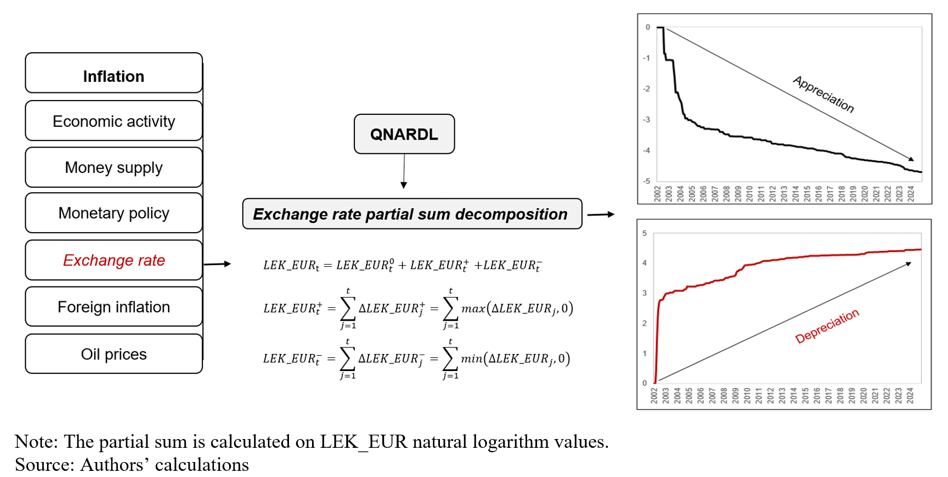
The empirical analysis employs the Quantile Nonlinear Autoregressive Distributed Lag (QNARDL) model to capture heterogeneous inflation responses across different points of its conditional distribution, following Cho et al. (2015). The QNARDL framework allows for the identification of asymmetric effects in both the short and long run, while accommodating nonlinear cointegration relationships between exchange rate movements and inflation across quantiles. To investigate potential directional nonlinearities, exchange rate depreciations and appreciations are modeled separately. This way we assess whether the ERPT effect varies depending on the prevailing level of inflation, as well as the direction of exchange rate movement (depreciation vs. appreciation).
The results reveal a clear asymmetric and nonlinear ERPT across the inflation distribution as shown in Figure 2. At lower quantiles, the inflationary effect of exchange rate depreciation is modest and appreciations have negligible effects on domestic prices. By contrast, at higher quantiles, the impact of depreciation rises markedly, while the effect of appreciation remains weak. This suggests that exchange rate pass-through intensifies in periods of high inflation, with depreciations of the lek exerting a substantially stronger inflationary impact than the disinflationary effect of appreciations, consistent with earlier studies (Delatte & López-Villavicencio, 2012; Caselli & Roitman, 2016; Kayamo, 2021; Pham et al., 2023).
Figure 2. QNARDL results: Asymmetric and non-linear effects of exchange-rate depreciations versus appreciations
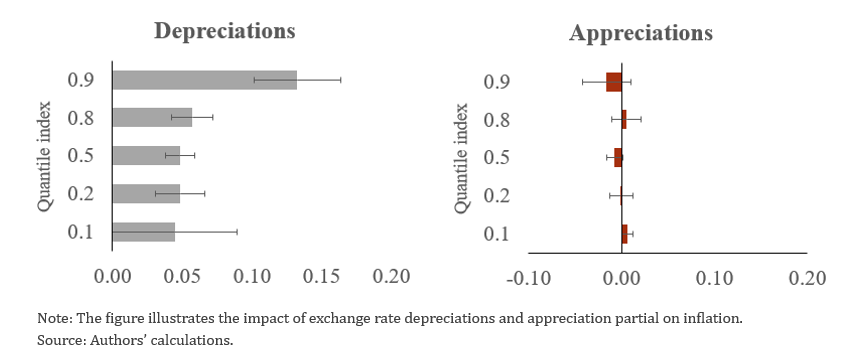
Adjustment dynamics are also more pronounced at the tails of the inflation distribution, indicating faster convergence to equilibrium during episodes of very low or very high inflation. Overall, the QNARDL estimates show that both the strength and transmission of inflation drivers in Albania vary across inflation level, in line with Cheikh & Zaied (2020) and Chroufa & Chtourou (2023). Exchange rate shocks and external inflation pressures are more influential at higher inflation levels, while domestic monetary policy remains effective across quantiles.
This study examines ERPT in Albania using an asymmetric cointegrating framework that decomposes nominal exchange rate movements into appreciations and depreciations across the inflation distribution. Our estimates show that exchange rate movements significantly affect inflation, but the magnitude of pass-through is highly uneven. Depreciations exert a pronounced inflationary effect, especially at higher inflation quantiles, while appreciations have a negligible impact. These findings highlight the relevance of accounting for asymmetric and state-dependent exchange rate dynamics when assessing inflationary pressures under an inflation-targeting regime.
Caselli, F. G. & Roitman, A., 2016. Non-Linear Exchange Rate Pass-Through in Emerging Markets. IMF Working Papers, 16(1).
Cheikh, N. B. & Zaied, Y. B., 2020. Revisiting the pass-through of exchange rate in the transition economies: New evidence from new EU member states. Journal of International Money and Finance, Volume 100.
Cho, J. S., Kima, T.-h. & Shin, Y., 2015. Quantile cointegration in the autoregressive distributed-lag modeling framework. Journal of Econometrics, Volume 188, pp. 281-300.
Chroufa, M. A. & Chtourou, N., 2023. Asymmetric relationship between exchange rate and inflation in Tunisia: fresh evidence from multiple threshold NARDL model and Granger quantile causality. SN Bus Econ, Volume 3.
Colavecchio, R. & Rubene, L., 2020. Non-linear exchange rate pass-through to euro area inflation: a local projection approach. ECB Working Paper Series, Volume 2362.
Delatte, A.-L. & López-Villavicencio, A., 2012. Asymmetric exchange rate pass-through: Evidence from major countries. Journal of Macroeconomics, Volume 34, p. 833–844.
Hledik, T., Kika, E., Mitre, O. & a, 2021. The Albanian Medium Term Projection Model. Bank of Albania WP, 45(84).
Istrefi, K. & Semi, V., 2009. Përçimi i kursit të këmbimit në Shqipëri: Evidencë nga vektorët autoregresivë. Bank of Albania WP.
Kayamo, S. E., 2021. Asymmetric impact of real exchange rate on inflation in Ethiopia: a non-linear ARDL approach. Cogent Economics & Finance, 9(1).
López-Villavicencio, A. & Mignon, V., 2017. Exchange rate pass-through in emerging countries: Do the inflation environment, monetary policy regime and central bank behavior matter?. Journal of International Money and Finance, Volume 79, pp. 20-38.
Pham, T. A. T., Nguyen, T. T., Nasira, M. A. & Huynh, T. L. D., 2023. Exchange rate pass-through: A comparative analysis of inflationtargeting & non-targeting ASEAN-5 countries. The Quarterly Review of Economics and Finance, Volume 87, p. 158–167.
Skufi, L. & Kika, E., 2019. The Price Formation Process in the Albanian Economy: A Macro Modelling Approach. Bank of Albania WP, 44(83).
Skufi, L., Kika, E. & Çela, E., 2024. Macro Econometric Albanian Model (Meam): An Update Of The Main Equations And Model Elasticities. Bank of Albania WP, 7(94).
Tanku, A., Vika, I. & Gjermeni, M., 2007. Roli i kursit të këmbimit në shënjestrimin e inflacionit, Si veprohet?. Bank of Albania WP, Volume 11.