

This policy brief is based on ECB Working Paper No 3210. The views expressed in this Policy Brief are those of the authors and do not necessarily reflect those of the ECB or the Eurosystem.
Abstract
Synthetic risk transfers (SRTs) allow banks to offload the credit risk of their loan portfolios to non-bank investors while retaining the loans on their balance sheets. Using transaction-level data from the ECB’s credit registry, we analyse this rapidly growing, multi-billion-euro market. We identify three channels through which SRTs can pose risks to financial stability. First, banks strategically select capital-expensive loans for the SRT, then redeploy the freed capital, leaving themselves effectively less capitalised after the SRT compared to before. Second, after transferring a loan’s credit risk, banks significantly reduce their monitoring of the borrowing firm. Third, while leverage of non-bank SRT investors remains modest, they are nevertheless interconnected with banks through the loan market.
Synthetic risk transfer (SRT) is a financial instrument through which banks pool loans and sell tranches of the credit risk to non-bank investors while retaining the loans themselves on their balance sheets. SRTs are therefore a hybrid instrument of credit default swaps (CDS) and traditional securitization. Like CDS, SRTs shift credit risk to an investor that is compensated with regular fee payments without transferring ownership of the underlying assets. Like traditional securitisation, they consist of different risk tranches: the junior tranche absorbs the first loan losses and is sold to non-banks, while the senior tranche absorbs subsequent loan losses and is typically retained by the bank. By transferring credit risk, SRTs free regulatory capital. Despite their rapid growth and increasing prominence in regulatory debates, SRTs are entirely unexplored in academic research.
This Policy Brief summarises the main findings of Osberghaus and Schepens (2026), the first academic study of the SRT market. We use transaction-level data from the ECB’s credit registry AnaCredit to highlight the main channels through which SRTs can pose risks to financial stability.
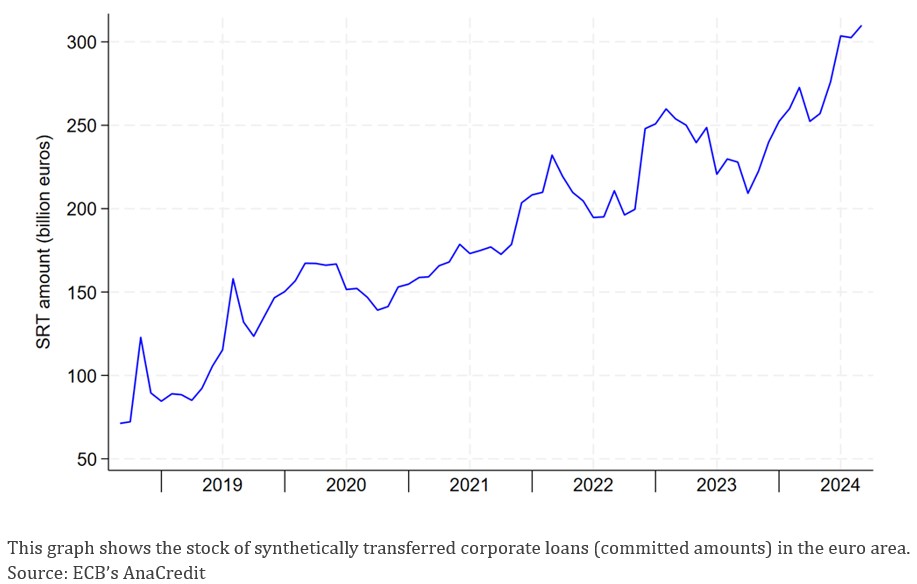
The IMF estimates that banks globally have synthetically transferred more than €1 trillion in assets between 2016 and 2024. The largest market is in Europe, where, according to AnaCredit, the outstanding stock of synthetically transferred corporate loans quintupled from around €60 billion at the end of 2018 to more than €300 billion by mid-2024 (Figure 1), surpassing traditional securitisation for corporate loans. SRTs are also large in relative terms: 35 banks, many of which are among the largest in the euro area, had more than 10% of their corporate loan portfolio synthetically transferred. The US market is smaller but growing fast, with estimated growth rates of around 400% in 2024.
Figure 1. Outstanding SRT volume in Europe quintupled between 2018 and 2024
SRT banks tend to be large. The median SRT bank has a balance sheet of €373 billion, compared to €24 billion for selected non-SRT banks. They also tend to be less capitalised: the median Tier 1 capital ratio of SRT banks (i.e., Tier 1 capital over risk-weighted assets) is 14.9% and thereby significantly lower than the 18.2% of non-SRT banks. These differences in the capital ratios are not explained by bank size and become more pronounced after a regulatory change in April 2021 that increased the capital relief for SRTs. At the same time, based on their regulatory leverage ratios (i.e., Tier 1 capital over unweighted assets), SRT banks have ample space to expand their balance sheets.
In a typical SRT transaction, a bank pools a set of corporate loans and sells the junior tranche to a non-bank investor, such as an investment fund, pension fund, or government entity, while retaining the senior tranche. The actual loans are not sold but retained on the bank’s balance sheet. By selling the junior tranche, the bank transfers the credit risk and receives regulatory capital relief: the risk weights on the retained senior tranche are substantially reduced, often to 10% or 15%. Around 80% of European SRTs are executed through financial guarantees and 20% through credit-linked notes. Most transactions are bilateral and private. The median SRT has a junior tranche thickness of 15% and a maturity of nine years. Coupon payments to investors, where observable, range between 7% and 13%.
SRT loans differ from the average loan on a bank’s balance sheet. The median SRT loan amount is €150,000, compared to €20,000 for the median non-SRT loan. SRT loans carry lower interest rates and longer maturities, and their borrowers have slightly lower average probabilities of default (PDs). Importantly, SRT loans span all sectors of the economy and include credit lines, which are difficult to traditionally securitize.
The first potential risk concerns how banks select the loans they include in an SRT. The amount of capital banks must hold is determined by the risk weights assigned to their loans. Ideally, these risk weights accurately reflect the true economic riskiness of the loan. In reality, some loans have low risk weights but are risky, and vice versa. Since capital is privately costly, banks prefer loans with lower risk weights relative to their economic riskiness. This is reflected in the loan selection for the SRT: we show that banks synthetically transfer loans that are capital-expensive relative to their economic riskiness. As a result, banks are left with the capital-cheap loans, which are riskier per unit of capital. Banks’ capital ratios themselves do not increase after the SRT, since they redeploy the freed capital.
We establish this strategic loan selection causally by exploiting the “SME supporting factor,” a regulatory provision that creates a jump in risk weights of around 15 percentage points as firms’ annual revenues pass a threshold of €50 million, while plausibly leaving the economic riskiness of loans unaffected. We show that the likelihood of a loan being synthetically transferred increases by up to 70% at this threshold. On the redeployment side, higher SRT issuance is associated with significant increases in new lending and decreases in regulatory leverage ratios, but no change in Tier 1 capital ratios. Under stylised assumptions, the strategic loan choice based on the SME supporting factor alone saved the median SRT bank an additional 3% of capital compared to a scenario in which the SME supporting factor did not exist, which can be seen as a lower bound for the true effect.
The second potential risk is moral hazard: once a bank has transferred the credit risk of a loan, it has less incentives to monitor the borrowing firm. Monitoring is particularly important in the SRT market, since SRT loans are often non-standardized and the borrowers are usually private firms, lacking the external discipline that public equity markets can impose. We measure monitoring intensity by the frequency with which banks update their internal PD estimates for individual firms. This measure captures information production: banks that actively monitor their borrowers incorporate new information by revising their PD estimates more frequently. We validate this proxy by showing that banks that update their PD estimates more often are better at predicting actual firm default, both at the individual loan level and at the portfolio level.
After a loan is synthetically transferred, the lending bank reduces its PD update frequency by 12 to 28% on average, compared to other banks’ lending to the same firm and compared to other firms to which the same bank lends. The reduction is more severe when the bank transfers a larger share of its total exposure to the firm: if it transfers the entire exposure, the probability and magnitude of updating its PD estimate fall by 35 to 70%.
The reduction in the frequency of PD updates is asymmetric. After an SRT, banks become significantly less likely to register deteriorations in a borrowing firm’s credit quality compared to other banks lending to the same firm but show no change in their propensity to register improvements. This pattern is consistent with our monitoring interpretation, since bank-internal downgrades contain more private information than upgrades (Weitzner, Beyhaghi, and Howes, 2025).
A third potential source of risk stems from the interconnectedness between banks and the non-bank investors who buy SRTs. We find that banks are 57 to 66% more likely to sell an SRT to a non-bank investor with which they also have a credit relationship. Moreover, our results suggest a slight increase in the outstanding bank loan liabilities of SRT investors in the months before the SRT investment, consistent with partial debt financing. While this channel is less precisely estimated than the first two due to the smaller number of observations, it highlights capital as a major friction in the SRT market: the loans that are made to SRT investors cost far less in bank capital than the capital these loans implicitly free up through the SRT transaction. The investors’ leverage, however, remains modest.
Osberghaus, A., & Schepens, G. (2026). Synthetic, but how much risk transfer? Available at SSRN 6482739.
Weitzner, G., Beyhaghi, M., & Howes, C. (2025). The information advantage of banks: Evidence from their private credit assessments. Available at SSRN 4265161.