

This policy brief is based on OeNB Working Paper 277 as part of the ECB ChaMP Research Network working paper series. The views expressed are those of the authors and not necessarily those of the institutions the authors are affiliated with.
Abstract
This paper examines how monetary policy affects bank lending in the euro area, focusing on cross-country heterogeneity in monetary policy transmission. Using instrumental variables based on high-frequency monetary policy surprises and local projections, we estimate the dynamic response of lending to non-financial corporations, accounting for asymmetry between easing and tightening shocks. Our findings suggest that the responses of bank lending are generally synchronous across countries, peaking after 12 to 18 months, but the magnitudes differ substantially. Responses to tightening shocks are typically smaller, consistent with downward rigidity in the bank lending channel. These findings underscore the heterogeneity of monetary transmission in the euro area.
The speed and strength of monetary policy transmission to macroeconomic variables such as economic activity and inflation is subject to considerable uncertainty. Consequently, the European Central Bank’s 2025 monetary policy strategy statement reconfirms and emphasizes a medium-term orientation of policy actions in view of time lags in monetary policy transmission. Nevertheless, policy makers require timely estimates of the dynamic responses of the economy to monetary policy shocks. Moreover, heterogeneity in the transmission of monetary policy across euro area countries has been documented extensively in the empirical literature (see e.g., Ciccarelli et al., 2013; Hafemann and Tillmann, 2020; Corsetti et al., 2022; Mandler et al., 2022; Mandler and Scharnagl, 2023). A common finding in the empirical literature is that the transmission of euro area monetary policy to prices and output differs across countries in terms of the strength of dynamic effects on macro-economic variables. However, the speed of monetary policy transmission to output and prices appears broadly synchronous across euro area countries, with peak effects typically materializing between one year and two years after the initial shock. We investigate monetary policy transmission via the bank lending channel in euro area countries, examining the presence of cross-country heterogeneity, asymmetric responses and potential structural breaks.
Following Gertler and Karadi (2015), we consider a medium-scale VAR that features an interest rate with 12-month maturity as the monetary policy indicator, thereby capturing the stance of monetary policy during periods of forward guidance. Furthermore, the country VARs include variables for industrial production, the price level as measured by the headline inflation index according to the Harmonized Index of Consumer Prices, an external finance premium that reflects variation in private sector borrowing cost in bond markets and a set of contemporaneous exogenous control variables capturing labor market and global resource price developments. We employ high frequency identified monetary policy surprises as instrumental variables to infer impulse response functions of the underlying VARs and estimate local projections for each country. This approach is advantageous as it avoids imposing overly restrictive identifying assumptions regarding the structural relationships between macroeconomic variables. Furthermore, local projections provide a flexible framework for incorporating asymmetry and offer robustness against misspecification in the VARs.
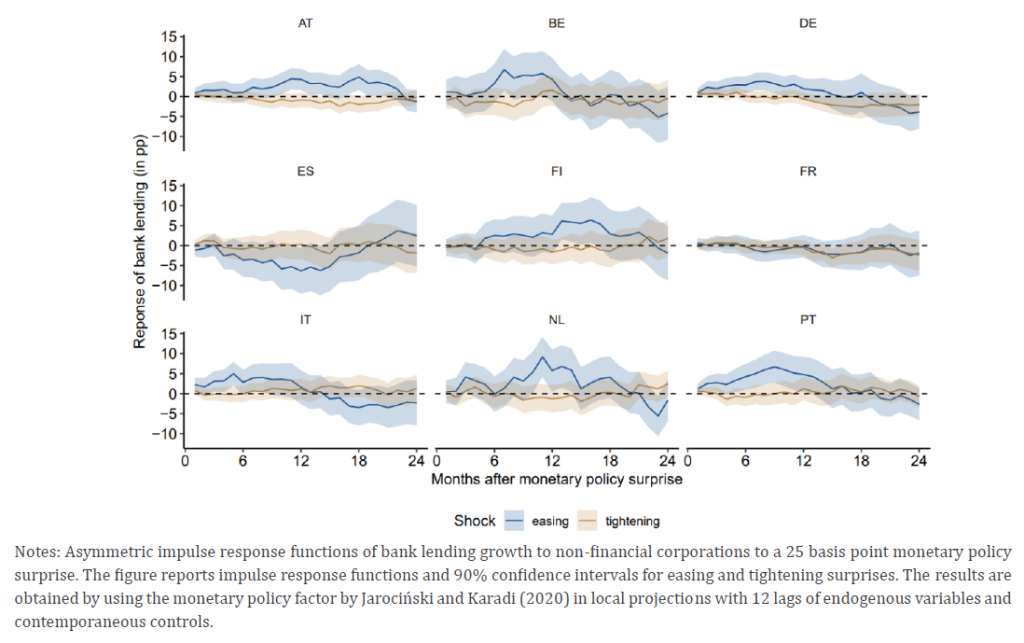
The empirical evidence points to heterogeneity in both the magnitude and timing of the dynamic effects of monetary policy actions. While the peak response typically materializes within 8 to 12 months, the intensity of the reaction varies substantially across countries. In Germany, for instance, the results are consistent with economic theory, showing a pronounced increase in loan growth following monetary easing. In contrast, the results for Spain reveal a striking divergence: while tightening shocks produce no statistically significant impact on lending growth, easing shocks result in significant and unexpectedly strong contractions at the 12-month horizon. This aligns with previous findings by Hafemann and Tillmann (2020) and suggests that in certain economies, the bank lending channel may be less relevant during phases of contractionary monetary policy. France, meanwhile, stands as an outlier, exhibiting small and statistically insignificant effects of both monetary policy easing and tightening.
Figure 1. Asymmetric impulse response functions of bank lending growth
(to non-financial corporations to a 25 bps monetary policy surprise)
Quantitatively, the asymmetry is most evident when comparing the cumulative peak impacts of a 25basis point shock. A tightening shock of 25 basis points results in an average peak reduction in loan growth of approximately two percentage points. However, an equivalent easing shock produces a far wider and more volatile range of responses, with peak increases falling between one and nine percentage points. This stark contrast suggests that expansionary policy yields stronger effects on bank credit growth, whereas the effects of contractionary policy are more limited.
Figure 2. Strength of transmission from IRFs of bank lending growth to non-financial corporations
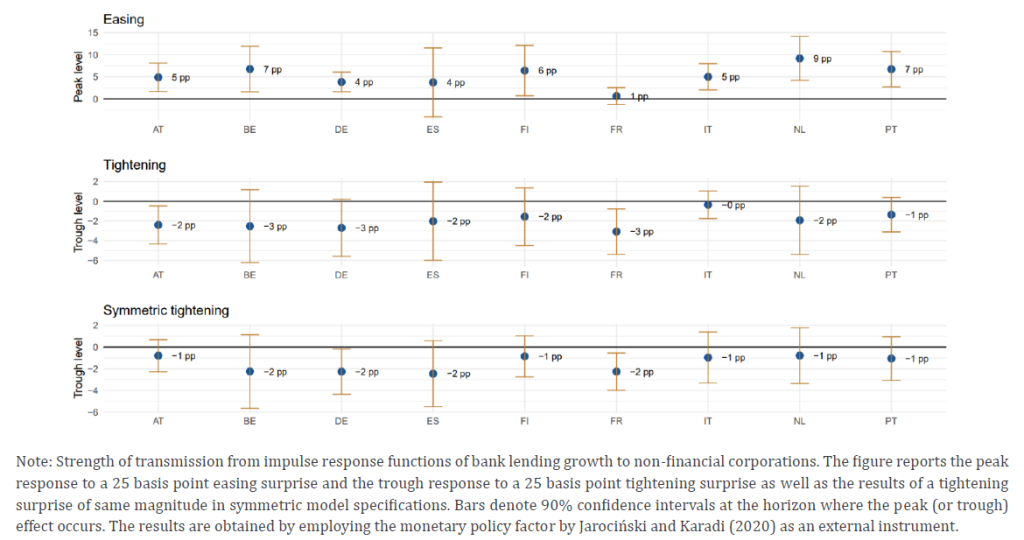
Our main findings are threefold: First, transmission is broadly synchronous across the common currency area, with the impact on bank lending to non-financial corporations peaking between six months and two years after an initial monetary policy shock, consistent with the medium-term orientation of monetary policy. Second, despite broadly similar timing, magnitudes differ markedly across countries; the peak effect in the most affected country exceeds that of the least affected one by a wide margin, implying substantial cross-country heterogeneity in the sensitivity of bank lending to monetary policy. Third, our results indicate pronounced asymmetry in transmission. At the country level, expansionary monetary policy shocks tend to propagate faster and more forcefully than contractionary shocks. Taken together, these results indicate that ECB monetary policy affects bank lending in a strong but possibly asymmetric manner.
Bijsterbosch, M., Falagiarda, M., 2014. Credit supply dynamics and economic activity in euro area countries: a time-varying parameter var analysis.
Ciccarelli, M., Maddaloni, A., Peydró, J.L., 2013. Heterogeneous transmission mechanism: monetary policy and financial fragility in the eurozone. Economic Policy 28, 459–512.
Corsetti, G., Duarte, J.B., Mann, S., 2022. One Money, Many Markets – Fixed Rate Versus Adjustable Rate Mortgages: Evidence from Euro Area Banks. Journal of the European Economic Association 20, 513–548.
Gertler, M., Karadi, P., 2015. Monetary policy surprises, credit costs, and economic activity. American Economic Journal: Macroeconomics 7, 44–76.
Hafemann, L., Tillmann, P., 2020. The Aggregate and Country-Specific Effectiveness of ECB Policy: Evidence from an External Instruments VAR Approach. International Journal of Central Banking, 97–136.
Mandler, M., Scharnagl, M., Volz, U., 2022. Heterogeneity in Euro Area Monetary Policy Transmission: Results from a Large Multicountry BVAR Model. Journal of Money, Credit and Banking 54, 627–649.
Mandler, M., Scharnagl, M., 2023. The effects of shocks to interest rate expectations in the euro area: Estimates at the country level. Journal of Forecasting 42, 643–656.