

This policy brief is based on Bank of Finland, BOFIT Discussion Papers, 4/2025. The views expressed are those of the authors and not necessarily those of the institutions the authors are affiliated with.
Abstract
Following Russia’s invasion of Ukraine in February 2022, the US, the EU, and other like-minded global western countries imposed a sweeping set of primary and secondary export restriction and sanctions on Russia. Our paper assesses the effectiveness of these measures and their ongoing refinement and modification over time using a calibrated three-country dynamic general equilibrium trade model with heterogeneous firm productivities. To this end, the modeling set-up comprises a rich specification of sanctions loopholes and workarounds and subsequent countermeasures. The numerical model evaluations and the numerous policy counterfactuals highlight the challenges of sanctions evasion and offer insights for effective future sanction designs. In particular, we show that targeted secondary extraterritorial sanctions are an impactful policy tool impeding Russia’s imports of critical technologies.
Following Russia’s invasion of Ukraine in February 2022, a coalition of 37 like-minded economies, including the EU, the US, Japan, South Korea and Canada, imposed extensive, coordinated export controls and sanctions to restrict Russia’s military industrial base and its access to advanced technologies. These measures targeted semiconductors, communications equipment, precision instruments, transport equipment and dual-use goods, among others. Over time, the sanctions were tightened to include extraterritorial “secondary sanctions” against entities in third countries that were found to be assisting with circumvention.
Figure 1. Alternative Export Sanctions Evasion Measures
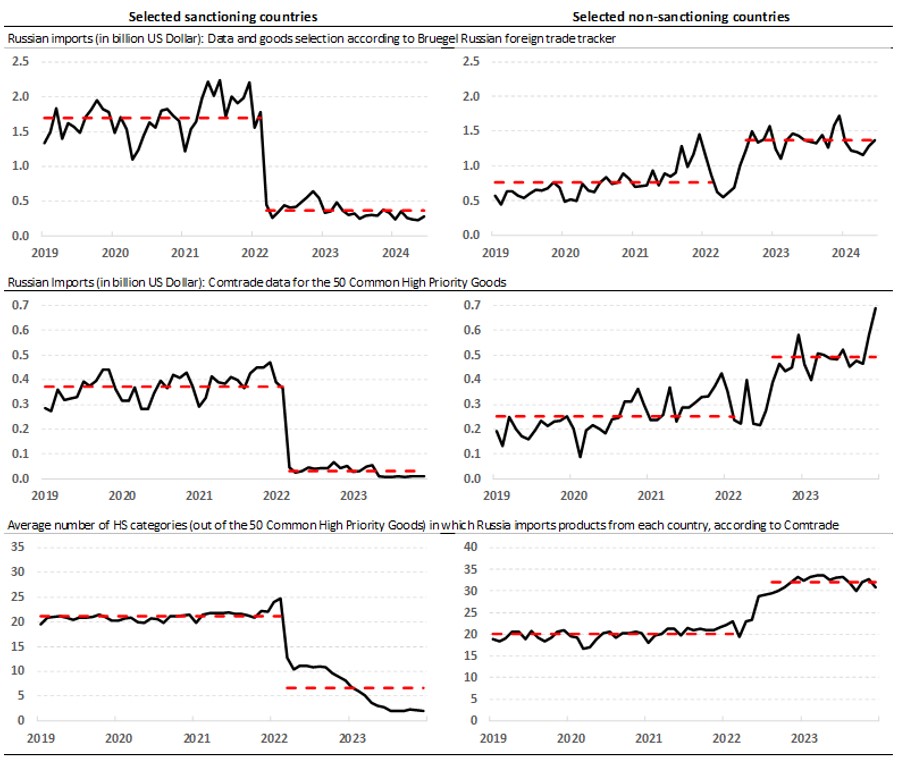
Source: For the Russian imports of sanctioned goods according to the Bruegel Russian Foreign Trade Tracker, see https://www.bruegel.org/dataset/russian-foreign-trade-tracker. The data on Common High Priority Goods is taken from the COMTRADE database (https://comtradeplus.un.org/). The data range up to June 2024 and December 2023, respectively.
Despite these efforts, Russia has maintained significant access to restricted goods via non-sanctioning countries. Figure 1 illustrates this through three complementary indicators including Bruegel data on high-tech SITC categories and the EU’s Common High Priority Goods list. Since Russia stopped releasing customs trade data at the end of February 2022, we follow the Bruegel Russian Foreign Trade Tracker and look at mirror bilateral export data from the sanctioning twenty-seven EU countries, the US, the UK, Japan, South Korea, Switzerland and Norway, and the non-sanctioning countries China, Turkey, Kazakhstan, India, and Brazil. In total these thirty-eight countries accounted for 80% of Russia’s exports and imports in 2019. The data show that, after Russia’s invasion of Ukraine, imports of selected technology-related goods from the 33 sanctioning countries collapsed and have remained low, while imports of the same goods from five non-sanctioning countries rose sharply.
This pattern holds both for broad SITC product groups and for a narrower list of 50 high-priority dual-use and advanced technology goods identified by the EU, US, UK, and Japan as critical for Russian military production. Quantitatively, the post-war rise in imports from non-sanctioning countries offsets about 45% of the decline in broad categories and nearly 70% in high-priority goods. Moreover, the range of high-priority products sourced from these countries has grown from on average around 20 to over 30 items since the war began, indicating that the non-sanctioning countries are not only exporting more of the same products to Russia, but also products that they did not export to Russia before.
Against this backdrop, in Funke and Wende (2025) we employ a calibrated multi-country general equilibrium trade model to quantify how evasion strategies erode the effectiveness of multi-layered export sanctions, and how targeted secondary measures can mitigate these effects.
Figure 2 illustrates the three-country dynamic trade model, based on Melitz (2003) and Ghironi and Melitz (2005), which we used for our analysis. This comprises the sanctioning coalition (SC), Russia (RU), and the rest of the world (RW). The SC countries impose export bans on sensitive goods to Russia, while the RW countries act as a bridge, enabling the re-routing of sanctioned products.
Figure 2. Schematic Model Architecture

Production occurs in two stages. First, heterogeneous firms produce tradable goods using labor, capital and final goods, but only the most productive firms export. In the second stage, wholesale distributors bundle intermediate goods for sale to firms as intermediate goods and households as consumption and capital goods. Households consume, save through bonds and capital accumulation, and supply a fixed amount of labor.
The model incorporates two key channels for evading sanctions. Firstly, sanctioned goods are sourced from non-sanctioning countries through trade diversion. Secondly, shell firms in RW countries re-export sanctioned goods to Russia without transformation, as shown by the dashed-dotted lines in Figure 2. While these transactions are profitable for the re-exporters, they face rising risks from secondary sanctions and contractual clauses, such as the EU’s ‘no re-export to Russia’ requirement. We model this through increased re-export costs, which in our model can be productivity-dependent. In other words, secondary sanctions can focus on significant products. Additionally, sanctioned goods can be replaced by non-sanctioned substitutes or domestic production, necessitating new investment and firm entry. To our knowledge, this is the first general equilibrium trade model to explicitly capture loopholes and workarounds used to circumvent sanctions.
Figure 3 shows the macroeconomic effects of primary export bans under two sanction coverage scenarios. According to Hausmann et al. (2024, p. 122), 19.1 % of all HS-6 items are sanctioned jointly by the EU and the US, 17.5 % only by the EU, and 7.4 % only by the US – meaning that 44 % of HS-6 items are at least partially restricted. In our simulations, we model a 19.1 % coverage as the present overlap between EU and US sanctions lists, and a 44 % coverage as a counterfactual scenario where both align to the stricter list in a coordinated upgrade. The top three rows of Figure 3 display impulse responses for GDP, consumption, and investment in the sanctioning coalition (SC), Russia (RU), and the Rest of the World (RW). The bottom two rows show total exports, exports to Russia, and the share of re-exports in Russian imports, highlighting the role of loopholes and workarounds. Solid lines include re-exports via RW countries, dashed lines exclude them.
In the benchmark case with 19.1 % coverage, 67.7 % of sanctioned varieties are re-exported via RW countries. The long-run GDP effects (including re-exports) are −0.609 % for Russia, −0.013 % for SC countries, and +0.018 % for RW countries. Under the stricter 44 % coverage, the GDP changes deepen to −1.491 % (RU), −0.032 % (SC), and +0.048 % (RW), with 76.2 % of sanctioned varieties re-exported, which partially offsets the intended impact on Russia. Seven main findings emerge:
Overall, the simulations show that without robust secondary extraterritorial measures alongside primary bans, intensified export controls risk being undermined by sophisticated workarounds, limiting their effectiveness.
Figure 3. The Sanctions Regime of the Global Western Coalition

Notes: The IRFs show the percentage deviations of the variables from their initial steady state.
The share of re-exports is shown in percentage points. Years are drawn on the horizontal axis.
The paper extends the analysis by examining how the ability to substitute goods changes over time in response to sanctions, a topic discussed by Baqaee et al. (2023) and Moll et al. (2023). Drawing on the Le Chatelier principle, the model incorporates the idea that substitution elasticities tend to rise as time passes: markets adapt, new supply emerges in response to high prices, and blocked trade encourages the creation of alternative routes. This implies that the effectiveness of sanctions will erode over time unless there is sustained enforcement. Relying only on short-run substitution elasticities risks overstating long-term effects, while using only long-run elasticities may understate the initial impact. The model therefore incorporates a time-varying adjustment process, inspired by Alessandria et al. (2021), allowing the gradual change in substitution capabilities to be tracked explicitly.
With this augmented framework, the analysis shows that sanctions initially inflict greater economic damage on Russia than in the benchmark model, consistent with the idea that substitution is more limited in the short run. Over time, however, markets adapt, and the relative impact declines. The degree of temporary “overshooting” in the initial sanction effect depends on the calibration of the adjustment speed, reinforcing the policy conclusion that export bans need to be maintained and reinforced over time to remain effective.
Our paper then investigates different designs of extraterritorial secondary sanctions, implemented alongside primary export bans. Two policy variants are examined: one that increases re-export costs uniformly across all goods, and one that raises costs disproportionately for high-productivity, technology-intensive goods. Both approaches are calibrated to generate the same average cost increase for re-exporters, allowing for a clean comparison. The uniform cost increase reduces re-exports by driving the least productive intermediaries out of the market but leaves the average price of re-exported goods largely unchanged. In contrast, targeting high-technology products leads to a fall in the effective productivity of remaining re-exporters, raises the average price of these goods, and reduces Russian imports along the intensive margin.
These mechanisms also affect incentives. Uniform cost increases leave average re-exporter profits broadly unchanged because market exit by low-productivity firms offsets the losses of those remaining. Targeted measures against high-tech goods, however, reduce average profits more directly by raising costs where demand is most sensitive and where Russia’s military-industrial base is most reliant. This targeted approach therefore more effectively limits Russia’s access to sophisticated technologies critical for advanced weapons systems, while also diminishing the profitability of sanction evasion in these product categories.
Alessandria, G., Choi, H. and K.J. Ruhl (2021). “Trade Adjustment Dynamics and the Welfare Gains from Trade”, Journal of International Economics 131, 103458.
Baqaee, D., Hinz, J., Moll, B., Schularick, M., Teti, F.A., Wanner, J. and S. Yang (2023). “What if? The Effects of a Hard Decoupling from China on the German Economy”, Kiel Institute for the World Economy, Kiel.
Baqaee, David, and Hannes Malmberg (2025). “Long-Run Consequences of Sanctions on Russia.” AEA Papers and Proceedings 115: 583–87.
Funke, M. and A. Wende (2025). „ The limited effectiveness of sanctions on Russia: Modeling loopholes and workarounds,” Bank of Finland, BOFIT Discussion Paper No. 04/2025, https://urn.fi/URN:NBN:fi-fe2025051947380.
Ghironi, F., and M.J. Melitz (2005). “International Trade and Macroeconomic Dynamics with Heterogeneous Firms,” Quarterly Journal of Economics, 120, 865–915.
Hausmann, R., Schetter, U. and M.A. Yildirim (2024). “On the Design of Effective Sanctions: The Case of Bans on Exports to Russia”, Economic Policy 39, 109-153.
Melitz, M.J. (2003). “The Impact of Trade on Intra‐Industry Reallocations and Aggregate Industry Productivity,” Econometrica, 71, 1695-1725.
Moll, B., Schularick, M. and G. Zachmann (2023). “The Power of Substitution: The Great German Gas Debate in Retrospect”, Brookings Papers on Economic Activity, Fall 2023, 395-455. “SUERF_References” – e.g. text —-Alvarez, F., M. Beraja, M. Gonzalez-Rozada, P. A. Neumeyer (2018). From Hyperinflation to Stable Prices.

