

This Note is a summary of Ulrich Bindseil, Svetla Daskalova and Richard Senner (2026), “Gold and the External Wealth of Nations” SAFE Working Paper No. 486. The views expressed in this publication are those of the authors and do not necessarily reflect the views of past or present employers, in particular do not necessarily represent the views of the European Central Bank or the Financial Stability Board.
Abstract
While gold prices fell significantly during the first half of 2026, they had reached unprecedented levels in Q4 2025. We analyse the portfolio-reallocation incentives faced by countries with positive net international investment positions (NIIP) and perceived cross-border seizure risk. Central bank purchases (and physical import) of gold reduces NIIP and seizure risk but can also drive steep increases in gold prices. We review the history of gold as an international settlement asset, the evolution of financial sanctions, and the global distribution of NIIP and gold holdings. We calibrate a simple model to recent gold mining cost curves and show that (assuming a current account balance of zero) closing one trillion dollars of NIIP per year through newly mined gold could push prices above USD 8,500 per ounce, while a ten-trillion-dollar target could be consistent with USD 67,000 per ounce. NIIP-surplus countries face a trade-off between rapid NIIP reduction with risk of subsequent valuation losses, versus gradual adjustment which tempers price impacts but lengthens the period of high seizure risks. We argue that in today’s world of deteriorating international trust, gold prices will be supported for the years to come by seizure risk.
In the five years following the outbreak of the global financial crisis in 2007, and again as of 2018, gold prices have trended upward, with a steep acceleration in 2025. From February 2022 to February 2026, gold prices increased by 180 percent while the S&P 500, for example, increased by only 50 percent. Adjusted for inflation, real gold prices already in 2024 surpassed their previous peak seen during the 1979 oil crisis (ECB, 2025b). Economic researchers have attributed gold’s general upwards price trend to changes in real interest rates, inflation expectations, exchange rate developments, and risk aversion (Baur and McDermott 2010; Batten, Ciner, and Lucey 2014). The prolonged period of low or negative real interest rates in advanced economies following the crisis would have reduced the opportunity cost of holding non-yielding assets, thereby supporting gold demand. However, this explanation would not seem to match the accelerated increase of gold prices that occurred in parallel with the normalization of interest rates since 2021.
A notable structural development since around 2010 has been the shift of the official sector from net seller to sustained net buyer. Central banks, particularly in emerging market economies and the Global South, began to accumulate gold reserves on a significant scale. According to World Gold Council data, official sector purchases have constituted an important component of annual global demand in recent years (World Gold Council 2025). Studies of central bank reserve behaviour suggest that gold purchases are associated with diversification motives, precautionary considerations, and, in some cases, a desire to reduce exposure to specific reserve currencies (Beckmann and Czudaj 2017).
Three recent phases can be distinguished in terms of central banks’ appetite for gold. First, from the early 1990s to the outbreak of the financial crisis in 2007, central banks were net sellers of gold. Between 2011 and 2021, central banks – mainly from emerging economies – purchased gold at an annual rate of 270–650 tonnes per year. The third phase saw a steep level shift occurring in 2022: since that year, annual net purchases surpassed every year 1,000 tonnes, or roughly 32 million ounces, meaning at USD 3,000 per ounce a value of USD 100 billion.
Survey evidence is consistent with this interpretation. According to the World Gold Council’s 2024 Central Banks Gold Reserves survey of nearly 60 central banks, the most frequently cited motivations include gold’s role as a long-term store of value and inflation hedge, its performance during crises, and its usefulness as a portfolio diversifier. Respondents also referred to protection against default risk, geopolitical uncertainty, and political instability. A non-negligible share of central banks, particularly in emerging and developing economies, explicitly mentioned concerns about sanctions and potential shifts in the international monetary system. Roughly one quarter cited sanctions risk or anticipated changes in the global monetary order as factors influencing their gold holdings (World Gold Council 2024).
OMFIF (2024) argues that gold has regained prominence as a safe asset in an environment of heightened geopolitical tension and uncertainty about the long-term role of the US dollar: “most insidious, dollar ‘weaponisation’ resulting from US-led sanctions, has added pressure on central banks to diversify away from dollar assets… Gold is deemed a more secure asset because it is no one’s liability. It is therefore seen as providing greater protection from the possibility of sanctions” (p. 8). Empirical evidence supports this interpretation. Arslanap et al. (2023) note that the freezing of the Russian central bank’s foreign exchange reserves highlighted the vulnerability of externally held assets and may encourage shifts toward gold, which can be relocated and stored domestically. Their econometric analysis finds that both the volume and value of gold reserves increase following the imposition of financial sanctions by major reserve-currency issuers.
Growing concerns about the security of externally held reserves are also reflected in changing gold storage preferences. While 64% of respondents still favour the Bank of England as their primary vaulting location, there has been significant growth in domestic gold storage, rising from 35% in 2023 to 41% in 2024, and reaching 59% in 2025 (World Gold Council 2025).
Our paper therefore starts from the idea that the unprecedented recent gold price dynamics are due to a renewed appreciation of gold to settle the net international investment position (NIIP) of nations in a world of deteriorating international relations and a general decline in the rule of international law. Purchases with physical imports not only reduce the NIIP and thereby vulnerability against sanction-related freezes of foreign assets, but also lead, in conjunction with speculative dynamics they trigger, to an unprecedented upward dynamic of gold prices.
At the time of writing, gold is undergoing a significant cyclical correction. After reaching a record USD 5,589 per ounce on 28 January 2026, prices have fallen by about 25% toward USD 4,000, as a global tech-led equity selloff has prompted investors to raise cash by selling gold, while expectations that the Federal Reserve will keep interest rates higher for longer have strengthened the US dollar and Treasury yields, weighing on the non-yielding metal. This paper, however, is concerned with structural rather than cyclical forces. Geopolitical fragmentation, declining confidence in cross-border property rights, and the incentive for NIIP-surplus economies to reduce external financial exposure are trends that are likely to unfold over years and decades.
Classical discussions of the gold standard often rely on the idea that physical gold flows from trade-deficit to trade-surplus countries would prevent the cumulation of a net international investment position (NIIP). David Hume’s famous price-specie-flow mechanism outlined a related macroeconomic adjustment: an external surplus brings an inflow of specie, which expands the domestic money stock, raises prices, and erodes competitiveness; a deficit does the reverse. Yet the historical operation of the gold standard, especially in its classical era (roughly 1870s-1914), was far less mechanical than the textbook story implies.
Gold flows were often small relative to the scale of current account imbalances, and balance-of-payments pressures were already at that time mediated through commercial bills, correspondent banking, central-bank policies, and international capital markets. Even when gold ‘settled’ a balance in an accounting sense, ownership could be transferred without physically moving bars-costly physical transport was only considered where trust in property rights was weak. In the words of economic historian Brown (1940): “the most important factors of adjustment in this highly integrated pre-war system of international finance were movements of credit, both long and short term. We have assigned a minor role to gold as an equilibrating factor in international trade.” The elasticity of gold settlement was not only a technical feature of payments systems, but also an institutional outcome rooted in trust and enforcement. Overall, the century from 1815 to 1914 was one in which no advanced economy disrespected the rule of law when it came to foreign claims on gold.
World War I marked a break as belligerent states legislated unprecedented administrative regimes to freeze, administer, and often liquidate enemy-owned assets. “Trading with the Enemy Acts” were passed in Britain (1914) and the United States (1917), enabling the large-scale expropriation of private and public parties in enemy countries. These laws became foundational instruments of large-scale expropriation between 1914 and 1949, embedding economic coercion in modern statecraft (Mulder 2020).
Ferrari et al. (2025) build a new database of 117 cases of freezes and seizures of central bank assets since 1914. Cipriani et al. (2023) note that counts of sanctions have increased over time, from 52 sanctions episodes in the 1950s to 257 in the 2010s, with the share of financial sanctions rising. Most sanctions are imposed by North American and European countries targeting Asian and African countries.
Regarding the G7 freeze of Russian assets in 2022 after Russia’s attack on Ukraine, Ferrari et al. (2025, p. 4) note that “the current freeze of Russian central bank assets is rarely seen in history. Russia’s sanctioned foreign reserves are over three times larger than those of the median country sanctioned since 1914 relative to global reserves. They are comparable in magnitude to the total sum of all sanctions imposed on central bank assets during World War II. Moreover, our data show that never in history have non-belligerent countries seized the assets of a belligerent country’s central bank in an ongoing war to finance reconstruction of a third country.”
For decades after the collapse of Bretton Woods, many advanced economies stored large shares of their gold in a small number of foreign vaults – above all at the Federal Reserve Bank of New York and the Bank of England. Over the last decade, however, a significant number of states have chosen to physically relocate part of their gold. This movement seems to result from a re-assessment of the trade-off between financial claims in foreign jurisdictions and physical control under domestic law.
Germany provides the most substantial case of modern relocation. In 2013, the Deutsche Bundesbank announced a storage plan under which it would transfer bullion from New York and Paris to Frankfurt. By 2017 it had completed transfers of 674 tonnes, achieving the target that half of Germany’s gold would be held domestically and ending storage in Paris entirely (Deutsche Bundesbank 2017). The Netherlands relocated 122.5 tonnes from New York to Amsterdam in 2014, out of a sense that it was better to have gold “near at hand” (Associated Press 2014). Hungary, Austria, Poland, and Turkey all undertook similar relocation exercises – the last explicitly framing the move as part of a broader strategy to diversify reserve assets and reduce reliance on the US financial system amid heightened political tensions with Washington.
Political discussion regarding a further relocation of gold re-emerged in 2025 in the context of perceived American hostility against Europe, including the idea of a possible military seizure of Greenland, and the experience in the context of the Russian invasion of Ukraine and that sovereign assets can be immobilised at scale (Reuters 2025; Financial Times 2025). Physical gold relocation thus emerges as a response to the insight that financial cross-border claims, however secure in good times, are contingent on the legal and political authority of the jurisdiction in which they reside, whereas domestically held gold is not subject to foreign power provided territorial sovereignty is ensured.
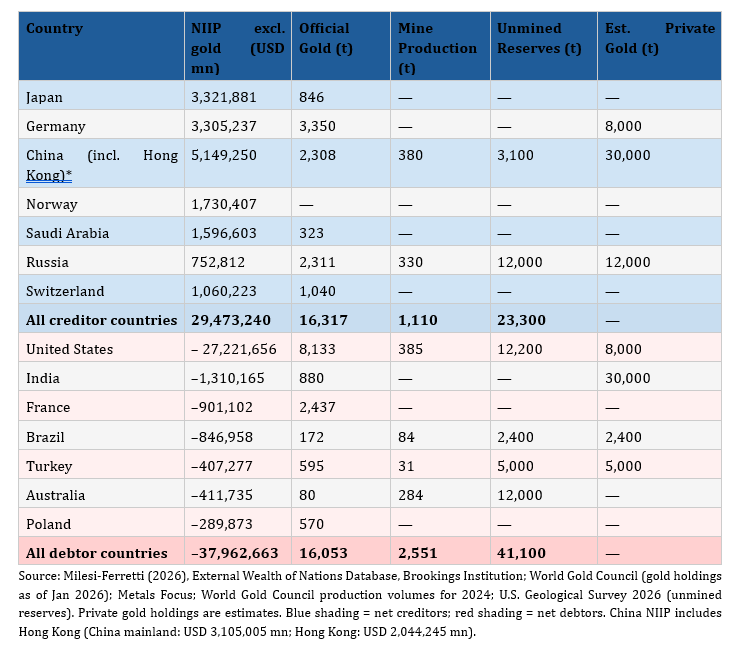
To understand the feasibility and implications of a gold-based NIIP adjustment mechanism, Table 1 maps the global distribution of NIIPs, official gold reserves, private gold holdings, and production capacity. Among creditors, Japan, Germany, and China each hold surpluses exceeding USD 3 trillion; all creditor countries combined reach approximately USD 29.5 trillion. On the debtor side, the United States alone accounts for over USD 27 trillion – more than 70% of the total debtor aggregate of approximately USD 38 trillion.
Overall, there is a weak relationship between external financial position and official gold holdings: creditor nations hold approximately 16,300 tonnes and debtor nations a comparable 16,100 tonnes. Some of the largest gold holders – the United States and France – are net debtors, while Japan, the world’s largest creditor, holds relatively modest reserves. Germany and China are the notable exceptions, combining large NIIP surpluses with significant official gold holdings.
From the perspective of a gold-based NIIP adjustment mechanism, official and private gold holdings differ fundamentally in their supply dynamics: official reserves are policy controlled, strategically managed, and relatively inelastic, whereas private holdings are more responsive to price changes but dispersed, less predictable, and subject to significant mobilisation constraints.
Another key supply factor is countries’ gold production capacity. It is believed that globally, most gold, about 75%, has already been mined, while around 25% remains underground. Annual production is relatively small (about 1.7% of above-ground stocks), and new supply can only adjust slowly over time. In a gold-based adjustment mechanism, production and under-soil reserves therefore matter as a longer-term source of supply, but they are less flexible than existing above-ground stocks.
Table 1. NIIP and gold statistics by country
(one tonne of gold ≈ USD 152 mn at USD 4,742/oz, the price as of 22 April 2026)
The literature on predicting gold prices and anchoring them in a supply-and-demand logic has not dramatically progressed since Hotelling (1931). For long-term forecasting, the key variables are not short-term demand conditions but rather the current and expected future costs of marginal producers, along with the ability to anticipate technological developments that may reshape production economics (Tilton and Guzman 2017).
For gold specifically, several authors have been sceptical of long-run supply elasticity and have argued that exhaustion of easily minable gold will drive production costs up over time in any case. Fellows (2010) notes that as gold prices rose roughly five-fold since 1999, average gold mine ore grades fell by nearly 30%, and all-in production costs more than doubled. Mamcarz (2015) concludes that “exploring gold deposits is becoming less profitable and newly discovered deposits are increasingly less accessible. Only the discovery of new mines and application of new exploitation technologies could lead to an increased gold supply in the world market and a drop in its price. Stagnation or a production decline with the increasing demand will cause gold to be one of few natural resources whose shortages will be permanent.”
As JP Morgan (2025) notes from the demand side: “Most gold trades are financial, so prices respond less to mined supply-demand balances than other commodity metals. A change in the price is a revaluation of the entire inventory of stored metal in every currency, not an expression of near-term supply-demand economics for mined output.” JP Morgan predicts a continuous upward trend in prices, with averages of USD 5,055/oz by Q4 2026, rising toward USD 5,400/oz by end-2027, driven by central bank purchases and investor demand. They highlight a strong relationship between investor and central bank demand and gold price movements, with demand explaining about 70% of quarterly price changes. In contrast, Standard & Poors (2025) foresees a mean reversion, anchoring gold prices to the increased production capacity and a marginal cost curve that would allow for significant supply boosts at prices above USD 2,500/oz.
When analysing the possibility to close the NIIP through gold purchases, we must also consider the ongoing and projected current account imbalances. Table 2 zooms into some large economies of the world and their 2024 current account imbalances and puts them into relation to the 2024 net gold imports as reported by the World Gold Council. The current account balance can be assumed to already consider the net gold exports. For the US, net gold exports in 2024 were estimated to amount to 210 tonnes, compared to an annual production of 170 tonnes, implying that in net terms US private gold holders sold 40 tonnes despite local production. Net gold imports of China in 2024 were estimated to be around 500 tonnes.
Table 2. NIIP, current accounts and estimated gold net exports in 2024
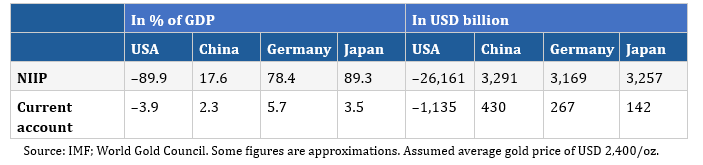
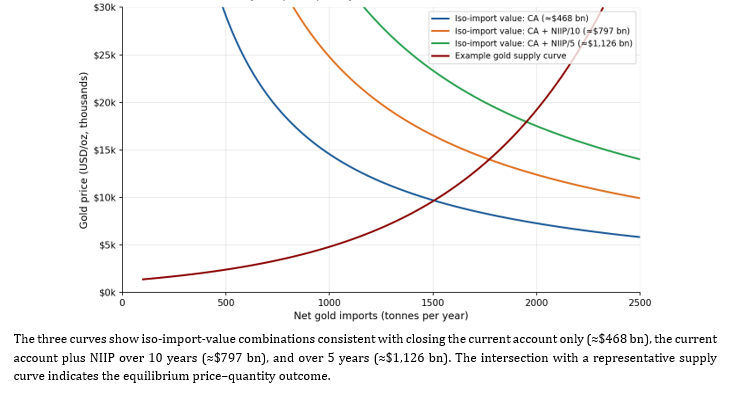
The size of the current account imbalances in 2024 were in any case large compared to net cross-border gold flows. Taking the example of China, to counterbalance in 2024 the current account surplus at 2024 gold prices, the value of gold imports would have had to be multiplied by a factor of around 12.5 (the current account surplus before gold exports would have been USD 468 billion). For example, we could speculate that by multiplying gold imports from 500 tonnes to 1,500 tonnes and with an implied increase of gold prices to, say, USD 9,000 per ounce, this could have been achieved.
Taking again the perspective of China, and if we add to the closing of the annual current account surpluses a gradual reduction of the NIIP, annual gold import values would need to increase further. If the NIIP is to be closed within 10 years, gold imports need to be worth approximately USD 797 billion per year (468 + 3,291/10); if the gap is to be closed in 5 years, this number would need to amount to approximately USD 1,126 billion. Figure 1 draws the combination of gold prices and gold quantities imported that would match these three numbers – the iso-net import-value curves – together with an example supply curve. With that example, if China would like to close its NIIP gap including projected current account surpluses over the next 5 years, it would end up buying around 1,100 tonnes of gold per year at a price of USD 22,000/oz. The shape of this supply curve faced by China depends on many factors, such as the elasticity of supply of gold mining in the rest of the World (i.e. excluding China), the elasticity of supply by the rest of the world gold owners, and the behaviour of other countries with negative NIIP and/or current account surpluses.
Figure 1. NIIP, current accounts, and estimated gold net imports: stylised price-quantity combinations (China illustration)
We propose a simple model to quantify the price impact of closing a given positive NIIP amount (and the ongoing annual current account balance) via newly mined gold in the rest of the world. This model assumes that the above-ground stock supply is inelastic (e.g. due to speculative demand), so the country that wants to close its NIIP cannot do it by purchasing existing gold from other countries but must source gold from new extraction. The central bank of the potentially sanctioned NIIP-surplus country (the ‘NIIP+ country’) buys freshly mined gold from the rest of the world (RoW) to close its NIIP.
We parameterise a marginal cost curve for gold mining calibrated to pre-2022 market observations: a base cost of USD 1,000/oz, a production capacity limit of 6,000 tonnes per year (against recent global production of around 3,500 tonnes per year), and a shape that implies a gold price near USD 2,000/oz for production near 3,000 tonnes. The supply curve is highly convex near the capacity limit, reflecting the sharp upward shape seen in LBMA cost data. Table 3 summarises the equilibria for different NIIP-closure targets. For ease of comparison, it also reports results from the extended model incorporating elastic supply from existing private gold holdings, which is developed in section 5.3.
Table 3. Gold market equilibria for NIIP closure
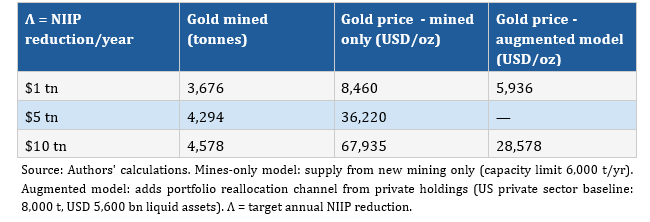
Even under the modest scenario of USD 1 trillion per year in NIIP reduction, the clearing price in the mines-only model reaches approximately USD 8,460 per ounce – with gold production rising to 3,676 tonnes. For a USD 10 trillion annual target, the price exceeds USD 67,000 per ounce, as the supply curve approaches its capacity constraint. The non-linearity reflects the strong convexity of the marginal cost curve near the production limit.
The NIIP+ country also faces an important intertemporal trade-off. Aggressive buying in period 1 drives up prices, which will subsequently fall once mining production has had more time to expand. There is thus a trade-off: buy aggressively at high prices (which will drop afterwards) and fully close the NIIP, or do not close it fully, avoid pushing prices so high, have less revaluation losses afterwards but remain exposed to expropriation risk and potential losses on the remaining NIIP. The optimal quantity of gold to be purchased is decreasing in the probability of sanctions (a lower probability of sanctions reduces the urgency of NIIP closure) and increasing in the expected long-term gold price (higher expected future prices mitigate concerns about valuation losses).
In an extension, we relax the mines-only baseline and allow elastic supply from privately held gold in the RoW through a simple portfolio-reallocation channel, building on Bezemer and Senner (2025). Countries have relatively stable portfolio compositions across asset classes. As gold prices rise, the existing stock of private gold may exceed the desired portfolio share, generating a positive supply flow from existing holders toward NIIP-surplus buyers.
In a conservative calibration, using US private sector gold holdings of approximately 8,000 tonnes and liquid assets of USD 5,600 billion, the augmented model clears at 3,528 tonnes and USD 5,936/oz for a USD 1 trillion closure, compared with 3,676 tonnes and USD 8,460/oz in the mines-only baseline. For a USD 10 trillion closure, the augmented price falls to USD 28,578/oz. Importantly, above approximately USD 2 trillion in annual adjustment, most of the imported gold comes from existing above-ground stocks rather than from below-ground mining. These results highlight that the trajectory of gold prices depends critically on whether private holders in deficit countries choose to monetise their holdings at elevated prices or hold on in expectation of further appreciation.
A large-scale reallocation of international reserves by NIIP-surplus countries away from foreign financial assets and toward physical gold would have pronounced macroeconomic consequences, especially for the United States, given its central role as issuer of the dominant global reserve currency and safe asset.
The most immediate transmission channel would be domestic interest rates. The US has long benefited from persistent foreign demand for dollar-denominated assets, especially Treasury securities, which has helped suppress yields and finance both fiscal deficits and current account imbalances at relatively low cost. A sustained liquidation of these holdings would exert upward pressure on Treasury yields, primarily through an increase in term premia, as foreign central banks and sovereign wealth funds have historically played a stabilising role in long-duration bond markets. A greater share of government debt would need to be absorbed domestically, potentially crowding out private investment, or necessitating policy responses from the Federal Reserve.
Exchange rate dynamics would also be affected. The sale of dollar-denominated assets and subsequent purchases of gold would imply a net increase in the supply of dollars in foreign exchange markets, placing downward pressure on the value of the dollar. A reduced role for the dollar in official reserve portfolios would structurally weaken USD valuation.
The reallocation toward gold would also have important implications for global asset prices and financial intermediation. Unlike sovereign bonds, gold does not serve as a highly flexible form of collateral in modern financial systems, and its increased prominence in reserve portfolios could therefore contribute to a tightening of global liquidity conditions. In this sense, the shift would represent not only a portfolio adjustment but a partial movement away from a credit-based reserve system toward one anchored more heavily in real assets.
Beyond the unwinding phase, one can speculate about the macroeconomic and financial stability properties of a future world in which nations continue to steer NIIPs close to zero by using gold purchases and physical settlement. Gold prices would be volatile in such a world, as demand and supply would continuously reflect the evolving geography of balance-of-payments imbalances and gold availability. Historically, market efficiency relied on abstract transfers of gold positions – loco London or New York. A more fragmented international system with physical settlement would entail substantially higher transaction costs and greater volatility. This adds an additional reason for global policymakers to renew efforts to support a world order based on the rule of international law and co-operation.
If foreign-held financial assets are exposed to sanctions and potential expropriation, countries with positive NIIPs have an incentive to replace them with assets not subject to foreign jurisdiction. Gold satisfies this condition because it can be physically imported and held domestically. The freezing of Russian reserves in 2022 and the general increase in geopolitical tensions over the last 25 years have brought this to the forefront.
The decline of gold as a settlement asset in the late 20th century was not due to a loss of its fundamental properties, but to the general decoupling of currencies from gold and the rise of cross-border financial claims under conditions of high trust in property rights enforcement. Once this trust weakens, the relative advantage of financial claims diminishes, and gold re-emerges as a settlement instrument. The current environment represents a partial reversal of the conditions that allowed large and persistent NIIP positions to accumulate.
Given the limited size of official gold reserves, the uncertain availability of private holdings, and the low elasticity of mine supply, attempts to reduce NIIP positions through gold purchases imply large price increases. In extreme scenarios, where sizeable shares of global NIIP are shifted into gold over short horizons, the implied price adjustments are very large. Even under more gradual adjustment paths, the effect remains significant since nominal demand of this scale cannot be accommodated without substantial repricing. The mines-only baseline implies roughly USD 8,500/oz for USD 1 trillion in annual NIIP reduction, rising to above USD 67,000/oz for USD 10 trillion. Introducing a portfolio reallocation channel materially lowers the required price.
The model makes explicit the trade-off faced by NIIP-surplus countries: faster adjustment reduces sanctions exposure but raises acquisition costs and risks subsequent valuation losses; slower adjustment prolongs geopolitical risk.
A transition toward a world in which NIIPs are gradually reduced through gold purchases and transfers would, in effect, revive Hume’s price-specie-flow mechanism (albeit without reinstating the gold standard) – costly, inefficient, and volatile. Nevertheless, if the geopolitical trends of the past two decades continue, such practices could well become the prevailing norm. This adds a powerful reason for policymakers to renew efforts to uphold the rule of international law and co-operation in which first and foremost territorial integrity and international treaties are respected.
Arslanap, S., Eichengreen, B. and Simpson-Bell, C. (2023). ‘Gold as international reserves: A barbarous relic no more?’ Journal of International Economics, November 2023.
Beckmann, J. and Czudaj, R. (2017). ‘Drivers of Central Bank Gold Purchases.’ Journal of International Financial Markets, Institutions and Money 51: 1–15.
Bezemer, D. and Senner, R. (2025). ‘Asset pricing and the Covid-19 deposit glut.’ SNB Working Paper 2025-05.
Brown, W.A. (1940). The International Gold Standard Reinterpreted, 1914–1934. National Bureau of Economic Research.
Cipriani, M., Goldberg, L.S. and La Spada, G. (2023). ‘Financial Sanctions, SWIFT, and the Architecture of the International Payment System.’ Journal of Economic Perspectives 37(1): 31–52.
Deutsche Bundesbank (2017). ‘Bundesbank Completes Gold Transfer Ahead of Schedule.’ February 2017.
ECB (2025). ‘What does the record price of gold tell us about risk perceptions in financial markets?’ Financial Stability Review, May 2025.
ECB (2025b). ‘Gold demand: the role of the official sector and geopolitics.’ International Role of the Euro, June 2025.
Fellows, M. (2010). ‘Gauging the Long-Term Cost of Gold Mine Production.’ The Alchemist 60: 4–7.
Ferrari Minesso, M., Krahnke, T., Mehl, A. and Vansteenkiste, I. (2025). ‘Seizing central bank assets?’ Journal of International Economics.
Hotelling, H. (1931). ‘The Economics of Exhaustible Resources.’ Journal of Political Economy 39(2): 137–175.
Hume, D. (1752). ‘Of the Balance of Trade.’ In Political Discourses. Edinburgh.
JP Morgan (2025). ‘Will gold prices continue to hit all-time highs in 2026?’
Mamcarz, K. (2015). ‘Long term determinants of the price of gold.’ Studia Ekonomiczne 252: 80–94.
Milesi-Ferretti, G.M. (2026). ‘The External Wealth of Nations Database.’ Brookings Institution.
Mulder, N. (2020). ‘The Trading with the Enemy Acts in the Age of Expropriation, 1914–1949.’ Journal of Global History 15(2): 227–250.
OMFIF (2024). ‘Gold and the New World Disorder.’ December 2024.
Sachdeva, M. and Hsueh, M. (2026). ‘The return of history: gold, the dollar, and the monetary future.’ Deutsche Bank Research Institute, April 2026.
Associated Press (2014). ‘Dutch Move 122 Tonnes of Gold out of US.’ November 21, 2014.
Financial Times (2025). ‘Germany and Italy Pressed to Bring $245bn of Gold Home from US.’ 2025.
Reuters (2025). ‘Trump Spurs Questions about Safety of Germany’s Gold in New York.’ May 30, 2025.
Standard & Poors (2025). ‘Metal Price Assumptions: Gold Powers Higher, Copper Jumps.’ October 2025.
Tilton, J.E. and Guzman, J.I. (2017). Mineral Economics and Policy. RFF Press.
World Gold Council (2024). Central Bank Gold Reserves Survey.
World Gold Council (2025). Gold Demand Trends: Full Year 2024. London: World Gold Council.
World Gold Council (2025a). Central Bank Gold Reserves Survey. June 2025.