

This policy note is based on the speech by Huw Pill, Chief Economist and Executive Director for Monetary Analysis and Research at the Bank of England, at the 2026 National Bank of the Republic of North Macedonia and SUERF conference, Skopje. The views expressed are those of the author and do not necessarily reflect those of the Bank of England or its Monetary Policy Committee.
Abstract
Scenario analysis can help develop a more robust approach to monetary policy in an environment of profound uncertainty. A robust monetary policy will deliver inflation close to target on a lasting basis across a broad and diverse set of possible environments. In current circumstances, this requires that monetary policy makers stand ready to act against inflationary pressures stemming from developments in the Middle East to deliver price stability over the medium term. Economic uncertainty is always present (perhaps especially so at present), but the task of monetary policy is to provide clarity on pursuit of price stability in an uncertain world, thereby not letting uncertainty in itself becoming a reason for inaction.
This note explores well-trodden ground: the conduct of monetary policy under uncertainty.
To set expectations at the right level at the outset, I recognise that – precisely because this ground is so well-trodden – it is difficult to say something new. So don’t expect too much in terms of novelty.
But equally, this ground is well-trodden precisely because it is so important. Dealing with uncertainty is central to taking monetary policy decisions – perhaps now more than ever.
The recent outbreak of hostilities in the Gulf has created new risks for central bankers that we are grappling with in real time (I will return to the conjuncture at the end of my comments). As my tenure on the Bank of England’s Monetary Policy Committee (MPC) extends into its fifth year, I look back across a period of what seems like unprecedented uncertainty, spanning pandemic, invasions, energy price spikes and market turmoil.
But monetary policy makers are often prone to characterise their tenure as one of “unusually high uncertainty”. Mea culpa.1 It is noteworthy then that, for all the talk of a Great Moderation in the early years of this century,2 you didn’t hear central bankers at that time saying that they were facing a period of “unusually high certainty”.3
But there is a sense in which this misses the point.
It is the irreducible nature of the uncertainty surrounding the inflation outlook and the propagation of inflationary shocks that renders the monetary policy problem ‘interesting’ – or (perhaps better when viewed from my seat on the MPC) ‘difficult’. After all, as former Fed Chairman Alan Greenspan famously remarked: “Uncertainty is not just an important feature of the monetary policy landscape; it is the defining characteristic of that landscape”.4
And the nature of that uncertainty matters.
Back to the work of Theil in the 1950s and ‘60s,5 macroeconomists have characterised the challenges facing monetary policy makers as an optimal control problem. Under certain conditions,6 this leads to a certainty equivalence result.
In that setting, while introducing greater uncertainty into the system unavoidably adds to the volatility of inflation, it does not alter how monetary policy should respond to developments in the data. The optimal monetary policy rule is invariant to the magnitude of risk captured by the distribution of shocks hitting the economy.
This approach became the workhorse framework for thinking about monetary policy. And much progress was made in developing ‘the science of monetary policy’ on that basis.7 For example, the approach established the importance of the Taylor principle: having nominal interest rates rise more than proportionately to inflation’s deviation from its target imparted a necessary stabilising property to the conduct of monetary policy.8
In that context, a mapping was identified between ‘optimal targeting rules’ for monetary policy and ‘optimal instrument rules’ for monetary policy.9 Cutting through the jargon, this implied that once the monetary policy problem has been defined correctly within the standard framework, deriving how monetary policy should respond to developments in the state of the economy was simply a matter of mathematics.
The optimal sensitivity of policy interest rates to the evolution of macroeconomic indicators (such as inflation or the output gap) was implicit in the definition of the inflation target, the central bank’s model of the economy, and the distribution of shocks hitting that economy – all of which were assumed to be known with certainty.
This was the basis of the textbook presentation of the ‘inflation forecast targeting’ regime that served the Bank of England (and other central banks) well for a long period around the turn of the century. And it marked the apogee of viewing ‘monetary policy as engineering’.10
But if the answer to your question is simply a mechanical transformation of the question itself, then you need to be confident that you have defined the question in the right way.
From the outset it was recognised that the standard optimal control characterisation of monetary policy missed important forms of uncertainty: where expectation formation was not always rational; where key players in the economy needed to learn over time about its structure and the behaviour of other actors; where key model parameters were not known with certainty and/or were subject to shocks; where the underlying paradigm driving the inflation process – whether New Keynesian, monetarist, classical or Austrian – was unclear.
The economic literature explored how policy makers should address these concerns.11 And in doing so, the literature brought into question the certainty equivalence result that insulated monetary policy makers from the quantum of uncertainty they faced.12
Experience over recent years has further challenged the belief that the economy and the transmission of monetary policy were simple enough and/or understood well enough to be characterised by a naïve linear modelling framework. From my perspective, the character and magnitude of the uncertainties the MPC have faced over recent years extends well beyond what that standard framework could capture.
More profoundly, former BoE Governor Lord King has argued that monetary policy makers face ‘radical uncertainty’ – uncertainties that are not susceptible to being represented by probabilities or as risks.13 Such radical uncertainty captures: the Knightian uncertainty familiar from economics texts; the Keynesian uncertainty that arises from the strategic interaction among economic actors (through which the economy coordinates on one of several aggregate outcomes); and, more simply, the “unknown unknowns” that plague the policy making environment in practice.
Rather than confining themselves to the question nested within the conventional analytical framework, a successful monetary policy maker needs to start by asking a more relevant – but also substantially more challenging – question: How should monetary policy be conducted in an environment of more profound uncertainty, where the character of inflationary shocks and structure of the transmission mechanism are not well understood?
Recognising the necessarily real time dimension of policy making14 – the need to take decisions as events happen, rather than enjoying the luxury of waiting to see how events transpire before analysing the outcomes and then setting policy – only sharpens these challenges.
Acknowledging these considerations, in 2023 the Court of the Bank of England commissioned Ben Bernanke (former Chair of the Federal Reserve Board and Nobel Prize winner in economics) to conduct “a review into the Bank’s forecasting and related processes during times of significant uncertainty” (emphasis added).
That is a big question. It deservedly received a big answer. Professor Bernanke’s review ran to more than 30,000 words and offered twelve recommendations for reform of the Bank of England’s preparation of its monetary policy decisions.15 These recommendations are currently being addressed by BoE staff, with the results becoming apparent in the evolution of the MPC’s published analysis and communication over time.16
But in the eyes of many stakeholders, Professor Bernanke’s guidance can be boiled down to one word: scenarios. More specifically, Professor Bernanke recommended that ‘to improve the MPC’s policy discussion, the central forecast should be regularly augmented by alternative scenarios’ (recommendation 7). This has been the focus of much of the subsequent commentary about how the Bank of England is responding to Professor Bernanke’s suggestions.
Constructing scenarios is not a novel approach to addressing the implications of uncertainty for monetary policy, neither across central banks nor through time at the Bank of England. And scenario analysis has been used in many other settings. But using scenarios as a tool to address the implications of radical uncertainty for monetary policy is an important innovation (even if not, of itself, a complete answer to all the issues raised by Professor Bernanke in his review), particularly so if the results of this approach are also used as a key tool for central bank communication with the public.
At the heart of such an approach is the pursuit of robustness in policy choices. By evaluating policy settings across a range of different scenarios, monetary policy makers can develop confidence that their decisions will deliver ‘good’ outcomes (evaluated against their price stability objective) even in the face of radical uncertainty.
Rather than narrowly optimal in one setting (and potentially fragile in the face of small deviations from that setting), a robust monetary policy delivers inflation close to target across a broad and diverse set of environments defined by the range of scenarios considered.17
Using scenario analysis in this way immediately begs two inter-related questions: (1) How do you select the scenarios of relevance? and (2) How do you distil the implications of various scenarios into a necessarily single decision about the level (and future path) of policy interest rates?
As regards the former question, choosing the breadth and diversity of scenarios inevitably requires the exercise of judgment. That judgement will have to manage the trade-off between, on the one hand, ensuring the range of scenarios considered is broad enough to offer meaningful diversity (and thus really test robustness of decisions in different environments) and, on the other hand, avoiding that decisions are distracted or distorted by arcane or obscure scenarios. Exercising judgement in this context is one aspect of what might be labelled ‘the art of monetary policy’.
This allusion to art is not as trivial as it may initially sound. I understand that the CIA and the US Department of Homeland Security have both employed science fiction writers to develop scenarios for their counter-terrorism work, on the basis that institutional biases and ‘groupthink’ among experts stifle their ability to think ‘outside-the-box’ and consider possibilities that would otherwise be ignored.18 While (to my knowledge) the Bank of England has not followed this route as yet, an important aspect of the post-Bernanke reforms at the Bank of England is to promote diversity of thought among the staff and encourage those willing to take contrarian views to ‘think-the-unthinkable’.19
Turning to the latter question, monetary policy makers benefit from adopting a systematic approach to setting the stance of policy, since this allows them to influence private expectations of those policy settings and the implications they have for a wider set of economic variables. It is this insight that has led to a focus on ‘monetary policy rules’, which in most practical applications provide a mapping from the available data to the policy interest rate.
When pursuing a robust approach to monetary policy in the face of radical uncertainty, policy makers need to choose a policy rule that performs well in a variety of disparate settings.
To explore this in the abstract (and for simplicity), we can imagine two characterisations of the inflation process and ask how monetary policy should be set to deliver price stability reliably when we cannot be sure which of the two characterisations is actually driving inflation outcomes.
We can start by considering the universe of policy rules that could be employed in these settings. Suppose each policy rule were to deliver a pair of performance outturns, one in each of the two settings that we consider. By looking across all the possible rules, we can define a locus of efficient pairings – each pair associated with a specific policy rule – that represent the outturns that cannot be improved upon in a Pareto sense (i.e., along this efficient locus, you cannot find a rule that improves performance in one of the settings without worsening it in the other).
This leaves the question of how to select a rule from among those defining this efficient frontier.20
One way of doing so would be to adopt a Bayesian approach. This entails assigning subjective probabilities to each of the two characterisations of inflation dynamics, even though there may not be an objective analytical basis for those probabilities at certain times. Such an approach assesses the desirability of policy rules on the basis of a weighted average of how they perform across the two settings, with the weights determined by the chosen subjective probabilities.
An alternative approach involves a form of ‘risk management’, where policy makers choose a policy rule on the basis that it will avoid the worst possible outcomes. One way to capture this is to assume that policy makers seek to minimise the impact of the worst outcome they could achieve across the two inflation environments – a so-called ‘min-max’ strategy.
In this context, the preferred rule under the Bayesian approach will be identified by a tangency to this efficient locus, where the slope of the tangent is related to the probability assigned to each if the two settings.21 By contrast, the preferred rule under the min-max approach will be identified by the point where the efficient locus crosses the 45° line – if all scope to lower the two losses simultaneously has been exhausted, the minimisation of the maximum loss entails the two losses being equal.
Having set up this simple machinery, we can explore three cases.22
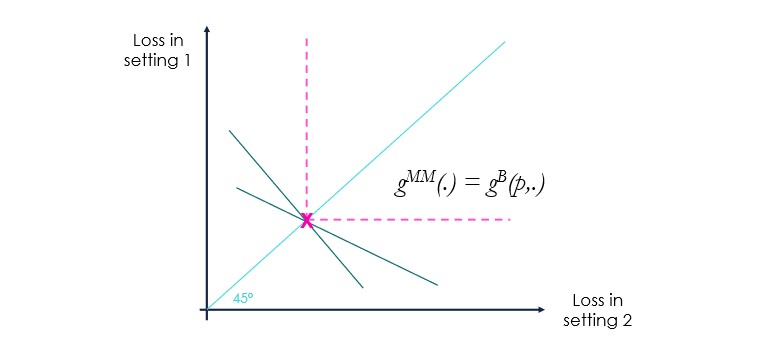
The first case is one with the standard setting, where the underlying drivers of the inflation process are unique and known. In that context, there is a unique optimal rule.
It may be that we have several narratives to describe monetary policy – say a monetarist narrative and a New Keynesian narrative – but in this setting the differences between them are cosmetic not substantial. In this context, the preferred choice of rule in the Bayesian approach is independent of the subjective probability and identical to the preferred choice in the min-max approach (Chart 1). In other words, in the standard setting robustness collapses into optimality and the issues raised earlier in my presentation are irrelevant.
Chart 1. Standard framework – different narratives of the same underlying inflation process
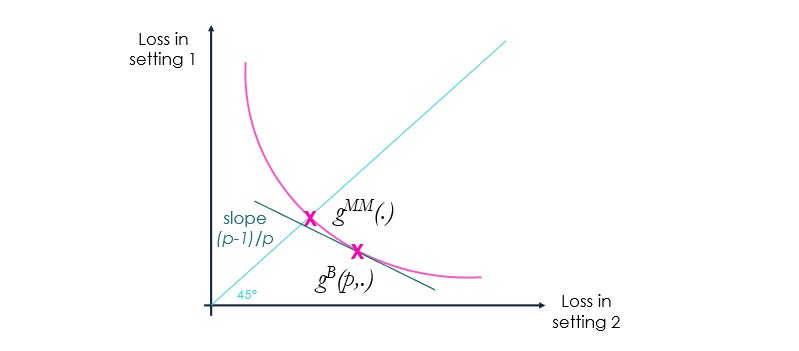
A more interesting case arises when the efficient locus is convex to the origin (as in Chart 2), so that identifying a preferred rule faces meaningful trade-offs. In general, the Bayesian and min-max approaches will be associated with different preferred rules. As a starting point for a policy discussion at the MPC, these two different rules identify distinct scenarios that are worth exploring in coming to a final ‘rule-based but not rule-bound’ decision on the setting for policy interest rates.
Chart 2. Convex efficient locus
Two features of this case are worth highlighting.
First, there is always a subjective probability in the Bayesian approach that will mimic the preferred rule in the min-max approach. In that sense, the Bayesian approach encompasses the min-max approach.
Second, within the Bayesian approach small changes in the subjective probability involve small movements along the efficient locus. And in all likelihood, this implies relatively small changes in the definition of the preferred policy rule. As such, in this setting updating subjective Bayesian probabilities of the two characterisations of the inflation process – say shifting a parameter capturing the slope of the Phillips curve or the persistence of inflationary shocks – is not likely to lead to big changes in the preferred policy rule (and therefore in the preferred path for policy rates).
It may require a shift to a different approach (say min-max) to create scope for a meaningfully different scenario and meaningfully different implications for monetary policy.
Chart 3a. Non-convex efficient locus
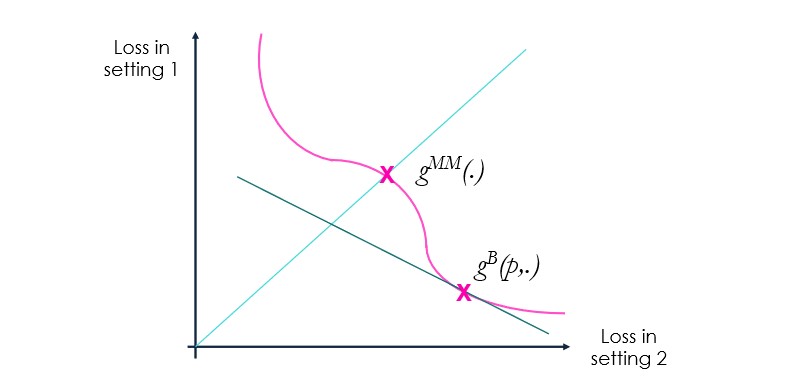
There is finally a yet more interesting setting. In this case, the efficient locus – while necessarily always downward sloping – no longer shows convexity to the origin (as in Chart 3a). (The features of the underlying economic processes that would lead to this form of locus are worth exploring further, but in the interests of time I will not do so here.)
Again, a number of points can be highlighted.
First, it is possible that the preferred rule from the min-max approach is no longer supportable by a specific subjective probability in the Bayesian approach. In other words, the min-max approach no longer nests within the Bayesian approach. As a result, the scenarios associated with the two approaches are demonstrably more distinct.
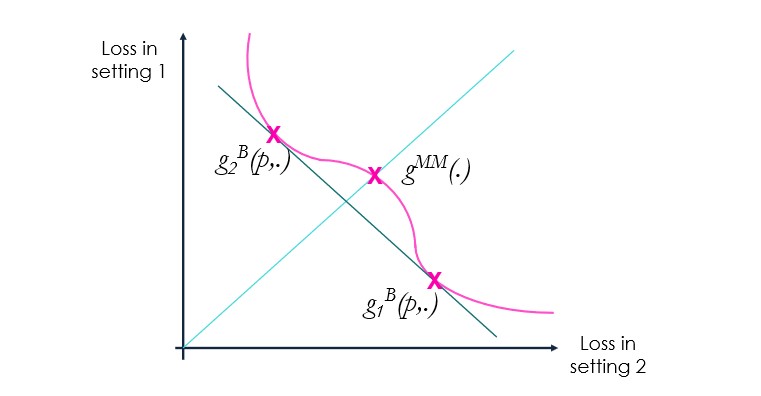
Second, while updating of subjective Bayesian probabilities leads to the same marginal moves along the efficient locus (and thus small changes in the preferred policy rule) over most ranges, there are also situations where such updating leads to significant jumps along the efficient locus (as in Chart 3b) – and thus potentially much bigger changes in the preferred policy rule. These discontinuities emphasise the importance of looking at a more diverse set of scenarios, since such scenarios may require much more significant shifts in the appropriate path of monetary policy than the more marginal recalibration of policy implied by a simple sensitivity analysis.
Third, in this situation, it is natural to consider at least three distinct scenarios, which do not straightforwardly line up along a simple hawk / dove spectrum. Having a richer dimensionality to the definition of scenarios may serve a richer discussion among policy makers in coming to an eventual policy decision.
This simple exercise demonstrates how the pursuit of robustness in monetary policy making can be supported by scenario analysis, which both entertains a variety of different characterisations of the inflation process (“different models”) and defines different systematic characterisations of monetary policy that span those different characterisations (“different policy rules”). In other words, the questions of how to select scenarios and how to bring the analysis of them together to support a necessarily single policy choice are co-determined.
Chart 3b. Non-convex efficient locus: Jumps along the efficient locus
Of course, the practical question of how to operationalise this abstract framework to address immediate policy questions remains open.
In my view, the MPC operates in a rule-based rather than rule-bound manner: it needs to retain flexibility (and thus room for discretion) in setting monetary policy when there is so much uncertainty and volatility, as at present. Irrespective of the scenarios presented by Bank staff and the policy rules we might consider in the context of those scenarios, the MPC will always retain agency over its policy decisions. The rationale for MPC decisions to deviate from those policy rules or scenarios often contains as much information as the choice of the rules or scenarios themselves.
In this context, scenario analysis can be seen as a mechanism to test whether a rule remains appropriate under materially different states of the world. It does not encourage discretion. Rather it reinforces focus and discipline in decision making in a radically uncertain world.
That said, some helpful parallels between the current challenges facing the MPC and the simple framework I have discussed today can be drawn.
From a UK monetary policy perspective, for all the geo-political and geo-economic speculation of late following the outbreak of hostilities in the Gulf, the evolution of global commodity prices (particularly energy prices) is of greatest importance. It is via energy prices that events in the Gulf will shape the outlook for UK inflation and thus monetary policy.
Three channels of transmission to prices23 are relevant: (1) direct effects on UK inflation via the impact of oil and gas price rises on fuel and energy price components of the CPI; (2) indirect effects owing to the pass-through of higher energy costs to other components of the CPI, such as food and services prices; and (3) potential second-round effects, stemming both from (a) relative price changes (whereby CPI inflation is propagated by the efforts of individuals and firms to resist the real income deterioration owing to relative price shocks) and (b) from a possible de-anchoring of longer-term private inflation expectations.24
Given the way utility bills and fuel prices are determined in the UK, direct effects operate relatively mechanically. While less mechanical, through analysis of input / output tables and estimation of time series models, we have a reasonably reliable guide to how indirect effects influence the evolution of CPI inflation. Nonetheless, given the lags in monetary policy transmission and the immediacy with which direct and indirect effects influence CPI inflation, there are limits to what the MPC can do to dampen volatility arising through these channels at shorter horizons.
As a result, the MPC’s focus is second-round effects – in particular, those associated with ‘catch-up’ dynamics in the aftermath of large relative price changes.25 The distinguishing feature of second-round effects is their potential to have a lasting impact on price dynamics. The resulting lower frequency and more persistent inflationary pressures can – and must – be contained by monetary policy in pursuit of the 2% inflation target.
At the heart of these second-round effects lies the complex interactions among price setting, wage dynamics and inflation expectations. But, while there is much evidence and agreement that our understanding of the price / wage / cost nexus is at present inadequate,26 there is no consensus over how it should be improved. In the spirit of the earlier discussion, one might say that our collective understanding of these interactions is characterised by ‘radical uncertainty’.
Mapping to the framework discussed above, two broad views of the likely character of second-round effects can be identified.
One interpretation makes cyclical tightness central to why the propagation of the energy shocks in 2022 proved more persistent than originally expected. Now that the labour market is softer and an output gap has emerged, this interpretation implies a more benign view of inflation persistence in the aftermath of Gulf hostilities relative to what we saw at the time Ukraine was invaded.
An alternative interpretation places more weight on structural change in price and wage setting as the explanation of greater-than-expected inflation persistence after the 2022 energy shock. Other things equal, this interpretation would suggest that persistence in the current episode may again be greater than implied by our standard models estimated during the ‘halcyon days of inflation targeting’ in the early 2000s.
On this latter view, the energy shocks of 2022 and 2026 (so far at least in the latter case) both represent significant adverse terms-of-trade shocks that weigh on domestic real income and exacerbate cost-of-living of households (particularly more vulnerable, lower incomes households). These are real phenomena that need to play out via real adjustments over time. Monetary policy cannot prevent or implement those real adjustments: it can simply provide the nominal environment in which they can occur in a less costly manner.
These two interpretations are neither mutually exclusive nor exhaustive. But nonetheless it is useful here to distinguish them in this simplistic way in order to offer some mapping into the framework developed above.
In the policy discussion, my own view has been (and remains) that the burden of proof lies on the side of those seeking to deny a role for structural change (owing to the cumulative effect of past shocks – the financial crisis, Brexit, Covid, invasion and government policies – and perhaps the prospective effect of new shocks, such as the impact of AI adoption) in price and wage setting.
Using the language of the Bayesian approach, I attach sufficient weight to the ‘structural change’ interpretation to conclude that propagation of both previous inflationary shocks and the new energy shock emanating from the Gulf is persistent enough to justify “caution” in the conduct of monetary policy.27
At the same time, I cannot be certain that this interpretation of the inflation risks is correct. The power of statistical tests to identify the slow-moving structural changes in price and wage setting behaviour on which my view rests in real time is unavoidably low. So, my policy assessment also entertains the possibility that the alternative view of the risk of second-round effects could be true. And in evaluating how to weight this alternative view, I consider not just the likelihood of it holding, but also the implications in terms of policy outcomes if it were to do so.28
The pursuit of a robust monetary policy response inherent in these considerations led me to support the unanimous MPC decision to hold Bank Rate at 3¾% at our meeting last week. That said, I see the upside risks to price stability mounting as a result of events in the Gulf.
As a result, I stand ready to act – if necessary – to contain the lasting components of any new inflationary pressures so as to deliver on the MPC’s price stability mandate over the medium term. The fog of uncertainty in which we always operate cannot be an excuse for inaction. Uncertainty is always present (perhaps especially so of late), but the task of monetary policy makers is to provide clarity on their pursuit of the price stability objective in that uncertain world.
Bank of England (2024). Forecast Evaluation Report, 23 January 2026.
Bernanke, B.S. (2004). “The Great Moderation,” remarks at the meetings of the Eastern Economic Association, Washington DC, 20 February 2004.
Bernanke, B.S. (2024). “Forecasting for monetary policy making and communication at the Bank of England: A review,” Bank of England.
Breeden, S. (2023). “Monetary policy as engineering?” speech at the Institute of International Finance, 19 December 2023.
Clarida, R., J. Gali and M. Gertler (1999). “The science of monetary policy: A New Keynesian perspective,” Journal of Economic Literature 37(4), pp. 1661–1707.
Gerdesmeier, D., R. Motto and H. Pill (2002). “Monetary policy rules under paradigm uncertainty,” Computing in Economics and Finance 154.
Giannone, D., L. Reichlin and L. Sala (2005). “Monetary policy in real time,” NBER Macroeconomics Annual 19, pp. 161-217.
Greenspan, A. (2003). “Monetary policy under uncertainty,” remarks at the Federal Reserve Bank of Kansas City Jackson Hole symposium, 29 August 2003.
Haberis, A., R. Harrison, K. Reinold and M. Waldron (2025). “Monetary policymaking under uncertainty,” Bank of England macro technical paper no. 5.
Kanngiesser, D. and T. Willems (2024). “Forecast accuracy and efficiency at the Bank of England – and how errors can be leveraged to do better,” Bank of England staff working paper no. 1078.
Kay, J. and M.A. King (2020). Radical uncertainty: Decision-making for an unknowable future, Bridge Street Press.
McCallum, B.T. and E. Nelson (2005). “Targeting vs. instrument rules for monetary policy”, Federal Reserve Bank of St. Louis Review 87(5), pp. 597-611.
Nakamura, E., V. Riblier and J Steinsson (2025). “Beyond the Taylor rule,” NBER working paper no. 34200.
Pill, H. (2025a). “Evolving UK monetary policy in an evolving world,” speech at the Institute of Chartered Accountants of England and Wales annual conference Thriving in Transformation, 17 October 2025.
Pill, H. (2025b). “The courage not to act,” remarks on the monetary policy outlook at a briefing hosted by Barclays, 20 May 2025.
Rudebusch, G. and L.E.O. Svensson (1999). “Policy rules for Inflation Targeting,” chapter 5 in (ed. J.B. Taylor) Monetary policy rules, Chicago University Press, pp. 203-262.
Sargent, T.J. (1987). Macroeconomic theory, 2nd ed., Academic Press.
Speyerl, E. (2025). “Science fiction as a military asset,” Foreign Affairs Review, 14 November 2025.
Stock, J. and M. Watson (2002). “Has the business cycle changed and why?” NBER Macroeconomics Annual 17, pp. 159-218.
Svensson, L.E.O. (2005). “Targeting versus instrument rules for monetary policy: What is wrong with McCallum and Nelson?” Federal Reserve Bank of St. Louis Review 87(5), pp. 613-626.
Theil, H. (1964). Optimal decision rules for government and industry, Amsterdam: North-Holland.
Williams, J.C. (2025). “Uncertainty and robust monetary policy,” remarks at the Reykjavík Economic Conference, 9 May 2025.
Woodford, M. (2001). “The Taylor rule and optimal monetary policy,” American Economic Review 91(2), pp. 232-237.
For example, the minutes of the 4 August 2022 MPC meeting (in which I participated) state: “The risks around the MPC’s projections from both external and domestic factors are exceptionally large at present” (emphasis added).
Stock and Watson (2002), Bernanke (2004).
And, once you switch from a real time policy making perspective to a retrospective analytical perspective, it is easy to forget that the Great Moderation was itself punctuated by risky events: the regime change marked by the introduction of the euro; Y2K; 9/11; the second Gulf War, etc.
Greenspan (2003) (emphasis added).
Theil (1964).
Specifically, if the problem is characterised in linear quadratic (LQ) terms, where the structure of the economy is linear and the objective of the policy maker is quadratic (Sargent, 1987). Such a setting emerges naturally when a macro model is linearised around a steady-state which is consistent with the achievement of an inflation target and shocks to the system are additive and Gaussian.
Clarida et al. (1999).
Woodford (2001).
Rudebusch and Svensson (1999).
Breeden (2023).
Haberis et al (2025). (This is one of a series of new macro technical papers published by Bank of England staff describing how responses to the Bernanke review are being incorporated into the preparation of MPC meetings and decisions.)
The benefit of adopting simple rules that were easier to communicate was also touted For an insightful discussion of these issues, see the interactions recorded in McCallum and Nelson (2005) and Svensson (2005).
Kay and King (2020).
Giannone et al (2005).
Bernanke (2024).
Pill (2025a).
Williams (2025).
Speyerl (2025).
Looking to Hollywood for inspiration for monetary policy scenarios might appear farfetched. But the insights in AI Artificial Intelligence (dir. Steven Spielberg, 2001) and Contagion (dir. Steven Soderbergh, 2011) would have been very relevant for recent and contemporary monetary policy challenges.
Gerdesmeier et al (2002).
This follows from the usual graphical approach to optimisation familiar to any undergraduate student of economics.
To explain the nomenclature shown in the charts: gMM(.) is the preferred policy rule deriving from the min-max approach; gB(p,.) is the preferred policy rules deriving from the Bayesian approach with subjective probability p.
I recognise that via terms of trade and confidence effects, the fallout from events in the Gulf is also likely to weigh on UK demand and therefore influence price developments through its impact on resource pressure via the Phillips curve.
Although I do not focus on the differences here, it is important to distinguish between second-round effects owing to ‘catch up’ dynamics as firms and households respond to relative price changes with distributional impact ((a) in the text) and those owing to scepticism about the credibility of monetary policy ((b) in the text. The former are those likely to derive from structural changes in price and wage setting behaviour.
As Nakamura et al (2025) noted in their Jackson Hole paper last year, while the academic literature has tended to focus on the uniqueness of outcomes consistent with price stability in their evaluation of structural monetary models (which in turn reflects understandable concerns about dis-anchoring longer-term private inflation expectations from target), monetary policy makers have tended to focus on ‘catch-up dynamics’ in price- and wage-setting behaviour (which tends to reflect concerns about the aggregate inflationary implications of adjustments to relative price shocks).
This is one of the main conclusions of the recently published Forecast Evaluation Report (Bank of England, 2026), which draws on the work of Kanngiesser and Willems (2024).
This assessment is reinforced by the latest (pre-Gulf hostilities) information from the Agents’ pay survey. With a fuller sample, expected pay settlements in 2026 now lie at 3.6% – barely below the equivalent survey expectation reported a year ago for 2025 (3.7%). Of course, this is a single indicator (albeit one on which the MPC have rested much in the past), but it signals – even before the new inflationary shock from the Gulf became apparent – a potential stalling of the underlying disinflation process that we are relying on to achieve the inflation target on a lasting basis. See also the discussion in Pill (2025b).
Given these concerns, I internalise in my policy deliberations the possibility that small perturbations of the baseline scenario (e.g. slightly increasing the slope of the wage Phillips curve in a workhorse New Keynesian model estimated on data largely from the ‘Great Moderation’ period) would leave me vulnerable to missing more appropriate policy prescriptions that would derive from a fundamental rethink of the relevant macroeconomic dynamics (e.g. models of price- and wage-setting behaviour harking back to the 1970s and ‘80s, where real income resistance plays a greater role).