

This policy brief is based on Banca d‘Italia working paper “Overconfident forecasters and the impact of inflation information: evidence from a randomized survey experiment”. The views expressed are those of the authors and do not necessarily reflect the views of the Bank of Italy or the European System of Central Banks.
Abstract
How do firms process inflation information, and can central bank communication improve the quality of inflation expectations? Using a randomized information experiment embedded in the Bank of Italy’s Survey of Inflation and Growth Expectations (SIGE), this policy brief shows that timely inflation information significantly improves firms’ expectation formation. Firms that do not receive information about recent inflation display two well-known anomalies: average expectations react too slowly to macroeconomic news, while individual forecasts react too strongly to idiosyncratic information. Firms receiving the information treatment move substantially closer to the full-information rational expectations benchmark. A model-selection exercise indicates that a framework combining noisy information with overconfidence in private signals best explains the evidence. The findings suggest that central bank communication can improve not only the level of expectations, but also the efficiency with which firms incorporate macroeconomic information.
Inflation expectations play a central role in firms’ pricing, wage-setting, investment and hiring decisions. For central banks, anchoring inflation expectations is therefore essential for preserving price stability and ensuring effective monetary transmission.
Yet a growing literature shows that firms, households and professional forecasters do not process macroeconomic information perfectly. Average expectations often adjust too slowly to new information, while individual forecasts can react excessively to noisy or idiosyncratic signals.
The analysis exploits a unique feature of the Bank of Italy’s Survey of Inflation and Growth Expectations (SIGE), a quarterly survey of Italian firms. Prior to 2012, all respondents were reminded of the latest official inflation rate in a preamble preceding the questions on inflation expectations. Since 2012, however, firms have been randomly assigned to either a treatment group, which continues to receive the inflation reminder, or a control group, which does not. Approximately one-third of firms are assigned to the control group, generating exogenous variation in firms’ exposure to information about current inflation.
This design creates a natural experiment. Treated firms observe the latest inflation figure immediately before submitting expectations, while non-treated firms do not. Because treatment assignments are randomized and persistent over time, the setting allows researchers to identify how access to public information changes the way firms update beliefs.
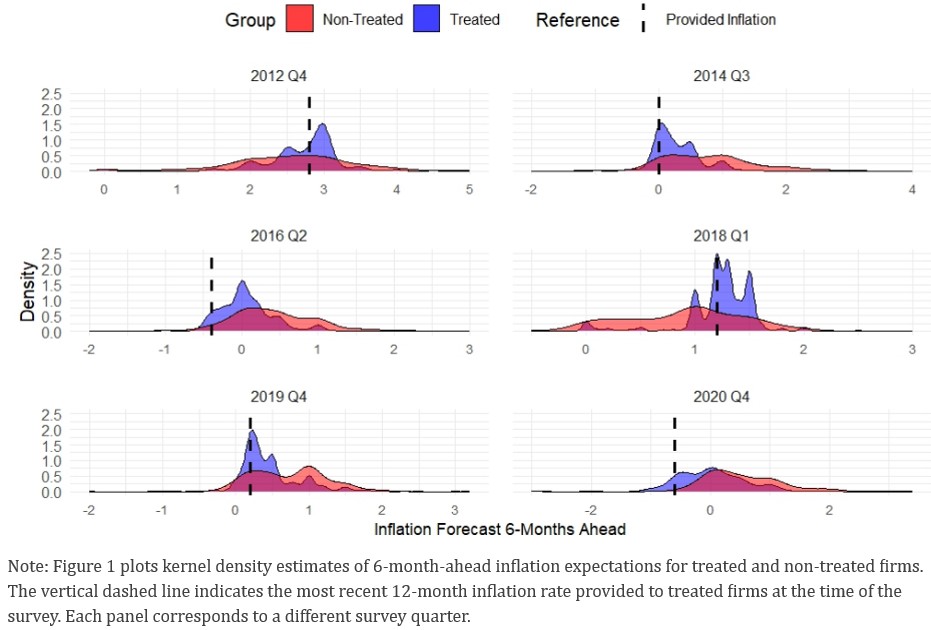
The treatment has visible effects on expectations. Forecast distributions for treated firms become more concentrated around the latest inflation release and display lower disagreement relative to untreated firms. This suggests that salient inflation information helps firms coordinate expectations around a common signal.
The paper studies deviations from rational expectations using “error-on-revision” regressions. Under the full-information rational expectations benchmark, forecast revisions should already incorporate all available information, implying that forecast errors should not be predictable from forecast revisions.
The evidence reveals two important patterns among firms that do not receive inflation information.
First, there is consensus underreaction: average forecasts respond too slowly to macroeconomic news.
Second, there is individual overreaction: managers revise forecasts too aggressively in response to idiosyncratic information.
Both patterns mirror previous evidence from surveys of professional forecasters. However, the randomized treatment allows the paper to examine whether better information can reduce these distortions.
The answer is yes. Firms receiving recent inflation information display significantly less underreaction at the consensus level and less overreaction at the individual level. Forecast errors also become substantially less predictable among treated firms, indicating that expectations move closer to the rational benchmark.
To understand the mechanisms behind the results, the paper compares several competing models of expectation formation within a common noisy-information framework.
The evidence strongly favors the overconfidence mechanism. Managers appear to place excessive confidence in their own private information relative to public signals. As a result, individual forecasts react too strongly to idiosyncratic news.
Providing a salient public inflation signal changes this behavior. Once firms observe a clear public signal, they rely less heavily on private information and place greater weight on the common signal. Aggregate expectations therefore update faster, while individual overreaction declines.
Alternative explanations — including noisy-memory models, diagnostic expectations and over-extrapolation — struggle to jointly match the empirical evidence.
Overall, the findings suggest that firms’ inflation expectations are shaped not only by imperfect information, but also by behavioral distortions linked to excessive confidence in private signals.
Figure 1. Distribution of 6-month-ahead inflation forecasts for treated and non-treated firms
The findings carry several implications for monetary policy and central bank communication.
First, communication policy can improve the efficiency of expectation formation itself. Central bank communication does not only influence the level of inflation expectations; it also affects how firms process information and update beliefs.
Second, salient public signals reduce disagreement across firms. By anchoring expectations more closely to common macroeconomic information, communication may improve the transmission of monetary policy to firms’ pricing decisions.
Third, communication may help offset distortions generated by excessive reliance on private information. Clear public communication can partially counteract expectations becoming excessively influenced by idiosyncratic signals.
The results were especially relevant during the low-inflation period, covered by much of the sample, when firms tended to pay less attention to aggregate inflation developments. The findings suggest that timely communication can contribute to maintaining well-anchored inflation expectations. More broadly, effective communication should not merely provide information, but also make macroeconomic signals more salient, credible and easier for firms to process.