

This policy brief is based on “Does Populism Erode Central Bank Independence?”, Open Economies Review, https://doi.org/10.1007/s11079-026-09863-7. The views expressed are those of the authors and not necessarily those of the institutions the authors are affiliated with.
Abstract
Central bank independence protects monetary policy from short-term political influence. Yet it may become fragile when political actors portray independent institutions as obstacles to the will of the people. Research suggests that populist governments are more likely to put political pressure on central banks. Using annual data for around 60 countries from 1996 to 2018, we find that stronger populist rhetoric within a country is also associated with lower legal central bank independence. By contrast, populist regimes are not more likely to replace central bank governors before the end of their legal term.
Central banks have returned to the centre of political debate. After the recent inflation surge, policy rates rose sharply and monetary policy again had visible distributional consequences. Higher interest rates affect mortgage holders, firms, governments and financial markets. They also create political incentives to criticise central banks, especially when elected governments prefer cheaper credit, lower debt-service costs or a weaker exchange rate. The basic question is therefore not new, but it has become more salient: can central banks remain independent of political influence?
This question is particularly relevant in an era in which populist parties and leaders have gained support in many countries. Populism is not simply dissatisfaction with existing policy. It typically contrasts a supposedly unified ‘people’ with allegedly self-serving elites and expert institutions. Independent central banks are obvious targets in such a narrative. They are unelected, technocratic and powerful; they take decisions that can be unpopular in the short run; and they often justify these decisions with reference to medium-term price stability rather than immediate political demands.
The concern is not merely rhetorical. Central bank independence is a commitment device. By delegating monetary policy to an institution with a clear mandate and protection from day-to-day political interference, societies reduce the temptation to use monetary policy for short-term expansion at the cost of higher inflation later. If this institutional settlement weakens, price stability and financial stability may become harder to maintain.
Our paper asks whether populism erodes central bank independence, and through which channel. There are two obvious possibilities. First, populist governments may change central bank laws and thereby reduce legal independence. This is a formal, institutional change. Second, they may try to replace central bank governors before the end of their legal term, especially when governors resist political demands.
The distinction matters. If threats to independence mainly take the form of early dismissals, then monitoring governor turnover may be sufficient. If, however, the main channel is legal erosion or persistent political pressure, the risk is more subtle. A central bank can remain formally staffed by the same governor while its room for manoeuvre narrows, its legal mandate is adjusted, or the political cost of resisting pressure rises. There is ample evidence that governments, not only populist ones, exert political pressure on central banks (Binder, 2021; Gavin and Manger, 2023).
We use annual data for around 60 countries between 1996 and 2018. Central bank independence is measured with two recent legal indexes, one by Romelli (2024) and one by Garriga (2025). These indexes capture features such as appointment procedures, policy autonomy, objectives and limits on central bank financing of government. We also use data on central bank governor turnover, distinguishing regular turnover from irregular turnover before the end of the legal term.
Populism is measured using party-level indicators of populist rhetoric based on the V-Party data employed by Gavin and Manger (2023). In robustness checks for the turnover analysis, we also use the Hawkins et al. (2019) measure of populist leadership. The empirical framework separates changes within a country over time from differences across countries. This is important because our question is not simply whether countries with more populist politics have less independent central banks. It is whether a rise in populism within a given country is associated with a subsequent weakening of central bank independence.
The analysis controls for other factors that may affect central bank independence or governor turnover, including government debt, the political system, checks and balances, exchange-rate movements and financial development. The aim is not to claim that populism is the only relevant political factor, but to test whether it has an independent association with central bank independence after accounting for other institutional and macroeconomic conditions.
The central result is clear. Higher populism within a country is associated with lower legal central bank independence. This finding appears with both legal CBI indexes. Using the Romelli measure, the estimated association is a reduction of about 4.6 percentage points; using the Garriga measure, it is about 11.7 percentage points. The effect is identified from changes within countries over time.
By contrast, cross-country differences in average populism do not explain differences in legal central bank independence. This nuance is important for policy interpretation. The result should not be read as saying that all countries with strong populist parties necessarily have weak central banks. Rather, it suggests that when populism rises within a country, legal central bank independence becomes more vulnerable.
This evidence is consistent with the broader concern that populism challenges institutions designed to constrain short-term political discretion. Central banks are part of that institutional architecture. They are protected precisely because monetary policy decisions often require a horizon longer than the electoral cycle. If populist politics treats such constraints as illegitimate elite interference, legal independence becomes politically exposed.
Figure 1. Populism is associated with weaker legal central bank independence, but not with higher governor turnover
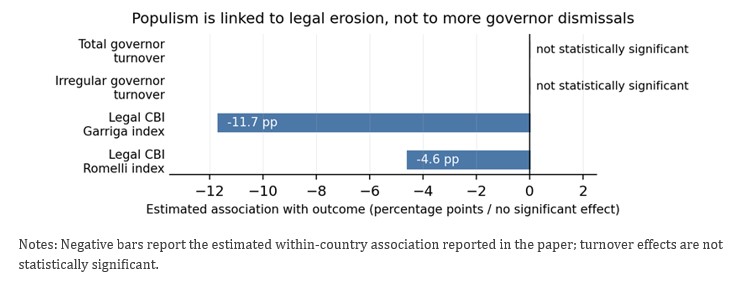
The second result is perhaps more surprising. Populist regimes are not more likely to replace central bank governors before the end of their legal term. This remains true when an alternative measure of populist leadership is used in robustness checks, although the sample is smaller.
This does not mean that populist pressure on central banks is harmless. It suggests that governor dismissal is not the dominant observable channel. Dismissal is costly and visible. It can alarm investors, trigger legal or political resistance and signal institutional conflict. Governments may therefore prefer other routes: public criticism, threats, changes in the legal framework, appointment pressure, mandate reinterpretation or sustained attacks on the central bank’s legitimacy.
This interpretation is consistent with the literature on political pressure on central banks. Political pressure is more prevalent under populist leadership, and previous research suggests that central banks often accommodate such pressure. If pressure is sufficient to influence policy, replacing the governor may be unnecessary.
For central bankers, the implication is that independence should not be assessed only by asking whether the governor remains in office. Legal design, political norms and public legitimacy all matter. A central bank may retain its leadership and still face a weaker institutional environment. Conversely, strong legal provisions may not be enough if political actors repeatedly challenge the central bank’s mandate and portray resistance as undemocratic.
For financial markets, the key issue is credibility. Market participants not only care about today’s policy rate, but also about the expected reaction function of the central bank. If investors believe monetary policy is becoming more politically constrained, expectations about inflation, exchange rates and future policy may adjust. Recent evidence for the Federal Reserve suggests that perceived pressure affects financial markets (see Eijffinger and de Haan, 2026 for a review of recent research). This is one reason why central bank independence is relevant not only for constitutional lawyers and monetary economists, but also for practitioners concerned with risk, asset allocation and financial stability.
For policy makers, the lesson is that central bank independence is a living institution. It depends on statutes, but also on appointment procedures, transparency, communication, checks and balances, and a shared understanding of the mandate. Legal safeguards should therefore be designed to make erosion visible and politically costly, not only to prevent outright dismissal of governors.
First, analysts monitoring central banks should look beyond turnover. Early replacement of governors is an important warning signal, but it is too narrow. Changes in central bank law, mandate language, appointment rules, reporting requirements and limits on financing government deserve systematic attention.
Second, central banks need robust public communication. Independence is easier to maintain when the public understands what it is for: not immunity from democratic accountability, but insulation of monetary policy instruments from short-term political pressure in pursuit of a democratically assigned mandate. Explaining the costs of inflation and the reasons for difficult decisions is part of institutional resilience.
Third, legal independence and democratic accountability should be seen as complements rather than opposites. Central banks need clear objectives, transparency and accountability mechanisms. But accountability should not become day-to-day political control over policy instruments. The challenge is to preserve legitimacy while preventing the politicisation of monetary decisions.
Fourth, governments and legislatures should recognise that even small legal changes can have broader credibility effects. Financial markets may interpret institutional weakening as a signal about future inflation tolerance or fiscal dominance. Once credibility is damaged, restoring it can be costly.
Populism can threaten central bank independence without producing a spectacular institutional crisis. Our evidence shows that increases in populism within countries are associated with lower legal central bank independence. The risk of populism is therefore the gradual weakening of legal protections against political influence and the normalisation of political pressure. Our results also suggest that populist regimes are not more likely to replace a central bank governor before the end of their term in office. This surprising finding may indicate that political pressure, which is more prevalent under populist leadership, is sufficient to alter monetary policy as desired. In other words, replacing the governor is unnecessary.
Binder, C (2021) Political pressure on central banks. Journal of Money, Credit and Banking 53: 715–744. https://doi.org/10.1111/jmcb.12772.
Eijffinger, S. and de Haan, J. (2026), ‘Central bank independence and accountability’, Journal of International Money and Finance, 166, 103595. https://doi.org/10.1016/j.jimonfin.2026.103595
Gavin, M, Manger, M (2023) Populism and de facto central bank independence. Comparative Political Studies 56: 1189–1223. https://doi.org/10.1177/00104140221139513
Garriga, AC (2025) Revisiting central bank independence in the world: An extended dataset. International Studies Quarterly 69, sqaf024. https://doi.org/10.1093/isq/sqaf024
Hawkins, KA, Aguilar, R, Jenne, E, Kocijan, B, Rovira Kaltwasser, C, Castanho Silva, B (2019) Global Populism Database. [Dataset], https://doi.org/10.7910/DVN/LFTQEZ
Romelli, D (2024) Trends in central bank independence: a de-jure perspective. Research Paper No. 217, BAFFI CAREFIN Centre. https://doi.org/10.2139/ssrn.4716704