

The views expressed here are those of the authors and do not necessarily represent the views of De Nederlandsche Bank or the Eurosystem. We thank Remco van der Molen and Anne-Clarine Prosman for feedback on a draft version of this policy brief. Any errors remain our own.
Abstract
Operational resilience is a growing financial stability concern amid geopolitical tensions and cyber threats. We discuss a stress testing approach in which operational shocks to critical infrastructure generate systemic risk through four channels: common exposures, interconnectedness, loss of trust and macroeconomic feedback loops. Applying this approach across scenarios can help policymakers anticipate transmission, strengthen safeguards and promote system wide resilience.
Operational resilience has moved steadily up the financial stability agenda. Geopolitical tensions have heightened concerns about cyberattacks and sabotage (IMF, 2024). Episodes such as the 2025 Iberian power blackout show how operational disruptions to non-financial critical infrastructure can also affect the financial system (Cremades et al., 2025). Emerging AI technologies may further accelerate the exploitation of operational vulnerabilities (ESRB, 2026; Crisanto et al., 2026). In short, both the likelihood of operational shocks and their potential to spread across financial institutions and markets are increasing.
Considering these rising challenges, policymakers need to understand how operational disruptions can threaten financial stability in a timely manner. A better level of understanding will then guide efforts to build resilience. All this requires tools that connect the initial operational shock to its propagation across the financial system (Bank of England, 2024; ESRB, 2026). Existing stress tests often assess whether individual institutions can withstand disruption. The macroprudential challenge is to identify when operational disruptions across institutions interact and become systemic. This brief describes such an approach linking disruptions in financial and non-financial critical infrastructure to systemic risk.
Our framework traces the transmission from an operational shock to systemic risk in five steps (Figure 1). Conventional financial stress tests typically begin with macro-financial shocks, such as higher interest rates or falling house prices. In the present context, the stress test begins with an operational shock. This shock may take different forms, including infrastructure sabotage, a cyber incident or an extreme weather event.
Second, the operational shock affects critical infrastructure. This may involve core financial infrastructure, such as payment or securities settlement systems, or non-financial infrastructure, such as energy, rail or communications networks.
Third, the shock directly affects financial institutions through familiar operational risk channels: people, processes and systems. Customer services may become unavailable, trading may be interrupted or employees may lose access to IT systems. These disruptions can severely affect individual financial institutions without becoming systemic.
The fourth step is where the initial operational disruption can potentially amplify within the financial system and start having systemic implications. We see four possible amplification channels:
Figure 1. From operational disruption to systemic stress
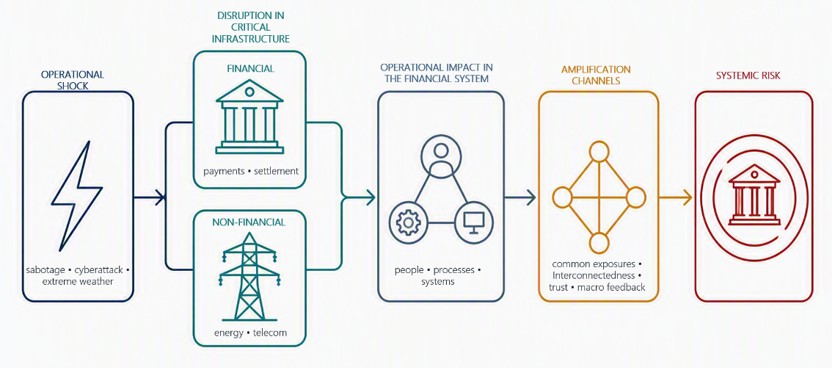
In the end, policymakers need to assess whether the financial system can absorb the shock without systemic consequences. For this fifth and last step in our approach, quantification is essential. However, such quantification is not always straightforward, for instance due to data challenges.
To further our understanding, policymakers could consider developing system wide models, collect data on operational dependencies and embed operational scenarios in stress tests. The framework could, for example, assess vulnerabilities arising from shared ICT third-party dependencies using information available under the Digital Operational Resilience Act (DORA). It could also examine operational disruptions following extreme weather events, such as the transmission of flood risk to lenders’ credit risk (Caloia et al., 2026). Applying the framework across these and other scenarios would help policymakers identify vulnerabilities and strengthen resilience early on.
Bank of England (2024), Operational resilience in a macroprudential framework.
Caloia, Francesco G., Kees C.H. van Ginkel and David-Jan Jansen (2026), Floods and financial stability: Scenario-based evidence from below sea level. Journal of Financial Stability, 84, 101545.
Cremades, Lourdes, Álvaro Esandi and Miguel Pérez (2025), The impact of the 28 April 2025 blackout on Spain’s payment systems. Financial Stability Review – Banco de España, 49, Autumn.
Crisanto, Juan Carlos, Adrien Currat, and Jeffery Young (2026), When machines attack: frontier AI cyber threats and policy responses in the financial sector. FSI Occasional Paper No. 28.
Eisenbach, Thomas M., Anna Kovner and Michael Junho Lee (2022), Cyber risk and the U.S. financial system: a pre-mortem analysis. Journal of Financial Intermediation, 100971.
European Systemic Risk Board (ESRB) (2026), Addressing frontier AI models with cyber capabilities from a financial stability perspective.
International Monetary Fund (IMF) (2024), Cyber risk: a growing concern for macrofinancial stability. IMF Global Financial Stability Report, April.
Jamilov, Rustam, Helene Rey, and Ahmed Tahoun (2026), The anatomy of cyber risk. Journal of Finance, forthcoming.